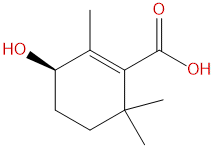


Storage conditions:Short-term storage at 2~8℃, long-term storage at -20 ~ -80℃
Rehmapicrogenin (CAS number: 135447-39-1) is a natural product isolated from the root of the traditional Chinese medicine Rehmannia glutinosa, belonging to the class of steroidal saponins. Rehmannia glutinosa, as a traditional Chinese medicine, has a long history of application in tonifying blood, nourishing yin and regulating endocrine. The research on its active ingredients has gradually deepened in recent years. Because of its significant biological activity, especially its anti-inflammatory and anti diabetes effects, rehmannia aglycones have become a research hotspot in the fields of pharmacology and natural product chemistry. This article aims to systematically review the chemical structure and physicochemical properties, plant sources and extraction methods, pharmacological activity and mechanism of action, pharmacological evaluation and pharmacokinetic characteristics of Rehmannia glutinosa glycoside, and explore its clinical application prospects and future development directions, providing theoretical basis and research references for subsequent drug development and clinical translation.
The chemical formula of Dihuang bitter glycoside is C10H16O4, with a molecular weight of 184.2350, belonging to the steroid bitter glycoside group. Its structural features include a typical steroid skeleton with certain polar groups, endowing it with unique physicochemical properties. The LogP value is 1.5349, indicating that it has moderate lipid solubility, which is conducive to membrane penetration but not excessively hydrophobic, balancing bioavailability and in vivo distribution. The topological polar surface area (TPSA) is 57.53 Å ², indicating that its polarity is moderate and conducive to binding with biomolecules such as enzymes and receptors. The water solubility is 10.6417, indicating that its solubility in the aqueous phase is moderate, making it easy to absorb and distribute in vivo. The low permeability of the blood-brain barrier means that its role in the central nervous system may be limited, reducing the risk of central toxicity. The negative result of hERG channel inhibition experiment indicates a low risk of cardiac toxicity. The Ames mutagenicity test result is 0.0, indicating that its genotoxicity risk is extremely low and meets drug safety requirements.
Dihuang bitter glycoside mainly comes from the roots of Rehmannia glutinosa, a plant in the Scrophulariaceae family widely distributed in eastern and central China. The root of Rehmannia glutinosa contains various active ingredients such as steroidal saponins, phenols, and polysaccharides. As an important component of steroidal bitter glycosides, Rehmannia glutinosa has high content and biological activity.
Traditional extraction methods usually use solvent extraction combined with column chromatography separation technology. The specific steps include:
In recent years, the application of ultrasound assisted extraction and microwave-assisted extraction technologies has improved the extraction efficiency and purity of dihydroquercetin, and the process is more environmentally friendly, suitable for large-scale production.
Dihuang bitter glycoside has shown significant anti-inflammatory activity in multiple in vitro and in vivo experiments. The mechanism mainly involves inhibiting the expression of inflammatory mediators, including inducible nitric oxide synthase (iNOS), cyclooxygenase-2 (COX-2), and pro-inflammatory cytokine interleukin-6 (IL-6). These factors play a key role in the inflammatory response, and Dihuang bitter glycoside can effectively alleviate the symptoms of inflammation related diseases by downregulating its expression, reducing the inflammatory response.
The potential of Dihuangpicrin in the treatment of diabetes has been gradually emphasized. Its target involves multiple glucose metabolism and insulin signaling pathways, including:
By adjusting the above targets, rehmannia aglycone can improve insulin resistance, promote glucose metabolism, reduce blood sugar levels, and show good anti diabetes potential.
In addition to the anti-inflammatory and anti diabetes effects, preliminary studies also found that rehmannia aglycone may have the potential of antioxidation, immune regulation and protection of cardiovascular function, but the related mechanisms need to be further explored.
The pharmacological effects of Dihuang bitter glycoside mainly rely on its regulation of various molecular targets, involving multiple levels such as signal transduction, gene expression, and metabolic regulation.
Dihuang bitter glycoside reduces the expression of inflammatory mediators iNOS, COX-2, and IL-6 by inhibiting the nuclear factor kappa B (NF - κ B) signaling pathway. NF - κ B, as a key transcription factor in inflammatory response, is activated to upregulate the transcription of various inflammatory genes. Dihuang bitter glycoside blocks this pathway, reduces the production of pro-inflammatory factors, and thus exerts anti-inflammatory effects.
The synergistic effect of these mechanisms makes rehmannia aglycone show significant effects in regulating blood sugar and improving the pathological state of diabetes.
The molecular weight of Dihuang bitter glycoside is 184.2350, which meets the requirement of Lipinski rule that the molecular weight should be less than 500. LogP is 1.5349, indicating moderate lipid solubility, which is beneficial for oral absorption. The TPSA is 57.53 Å ², indicating that its polarity is moderate and facilitates cell membrane permeation. Moderate water solubility, convenient for drug formulation design. Low blood-brain barrier permeability reduces the risk of central nervous system side effects. HERG inhibition was negative and Ames test showed no mutagenicity, demonstrating good safety and toxicological characteristics.
At present, there is limited systematic pharmacokinetic research on the glycosides of Rehmannia glutinosa. Preliminary in vivo experiments have shown that it has good oral absorption and high bioavailability. The metabolic pathways mainly involve phase I and phase II metabolism in the liver, and the metabolites have not been fully identified. Excretion is mainly through the renal and biliary pathways. In the future, more systematic research on ADME (absorption, distribution, metabolism, excretion) is needed to clarify its in vivo kinetic characteristics and provide a basis for clinical dose design.
Dihuangpicrin has broad clinical application potential due to its significant anti-inflammatory and anti diabetes activities. At present, the treatment of diabetes and its complications still faces many challenges, especially drug side effects and drug resistance. Dihuang bitter glycoside provides a new therapeutic strategy by regulating blood glucose and inflammatory response through multiple targets and pathways.
The key to future clinical applications lies in:
In addition, the potential applications of Dihuang bitter glycoside in anti-inflammatory, immune regulation, and cardiovascular protection fields are also worth exploring, which may expand its indications.
As an important active component in Rehmannia glutinosa, rehmannia aglycone shows good anti-inflammatory and anti diabetes potential with its unique chemical structure and multi-target pharmacological effects. It has excellent pharmacological parameters, high safety, and good clinical development prospects. In the future, systematic research on its pharmacokinetics, mechanism of action and clinical efficacy should be strengthened to promote its transformation into a new natural drug and provide new options for the treatment of diabetes and related inflammatory diseases. With the continuous advancement of natural product pharmacology and modern drug development technology, Dihuang Ku Yuan is expected to become an important member in the development of natural product drugs, promoting the modernization and internationalization of traditional Chinese medicine.
