Introduction/Overview
Natural products, as an important source of drug discovery, play an irreplaceable role in the history of human disease treatment. Among them, phenanthrene compounds have always been a hot topic in medicinal chemistry and pharmacology research due to their unique chemical structures and extensive biological activities. Blestrialene A, CAS number 126721-53-7, is a natural product of the Blestrialene family isolated from the tubers of the orchid plant Gymnadenia conopsea. Early research reported that it has significant anti allergic activity, which has attracted preliminary attention from researchers. However, as research deepens, its more remarkable anti-tumor potential is gradually revealed, making it a highly promising candidate molecule in the field of tumor pharmacology. This article aims to systematically review the chemical properties, plant sources, pharmacological activities, multi-target mechanisms of anti-tumor effects, drug evaluation, and future clinical application prospects of Baiji Lianfei A, in order to provide comprehensive scientific references for the in-depth development of this compound.
Chemical structure and physicochemical properties
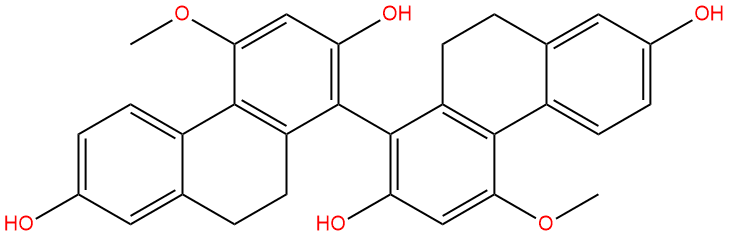
The chemical name of Baiji Lianfei A is (-) - Baiji Lianfei A, indicating its specific stereochemistry. Its molecular formula is C28H26O8 and its molecular weight is 482.5320. Structurally, it belongs to the dimeric phenanthrene class compounds, whose skeleton is composed of two phenanthrene ring units connected by specific chemical bonds, forming a rigid, highly conjugated planar or twisted structure. This unique structure is the basis for its interactions with various biomolecules such as DNA and enzyme proteins.
Its physicochemical properties have a decisive impact on its biological activity and pharmacokinetic behavior. The calculated lipid water partition coefficient (LogP) is 5.2782, indicating that the compound has high lipophilicity, which is beneficial for its penetration of cell membranes, but may also lead to poor water solubility. Its topological polar surface area (TPSA) is 99.3800 Å ², reflecting the presence of a certain number of polar atoms (such as oxygen atoms) in the molecule. The measured or predicted water solubility values are relatively low (about 0.0041 mg/mL), indicating that in the formulation development process, it may be necessary to improve its solubility through salt formation, inclusion complex formation, or the use of special delivery systems such as nanoparticles and liposomes. These physicochemical parameters collectively determine that Baiji Lianfei A belongs to Class II or IV compounds in the Biopharmaceutical Classification System (BCS), namely low solubility, high permeability, or low solubility, low permeability. This is one of the key challenges that need to be overcome in its subsequent development.
Plant sources and extraction methods
The main source of Baiji Lianfei A comes from the dried tubers of Gymnadenia conopsea, a plant in the Orchidaceae family. Iron wire lotus is often used in traditional medicine, especially in East Asia, to nourish and strengthen the body, relieve cough and asthma. The medicinal parts of the tubers contain various active ingredients, including phenanthrene, dihydrophenanthrene, glycosides, etc.
The extraction and separation of Baiji Lianfei A from plant materials usually follow the standard process of natural product chemistry. Firstly, the dried tubers are crushed and subjected to extraction or reflux extraction using organic solvents such as methanol, ethanol, or acetone to obtain the crude extract. Subsequently, the crude extract was preliminarily separated using solvent partitioning method (such as partitioning between different polar solvent systems, such as petroleum ether, ethyl acetate, n-butanol, and water) to enrich the site of phenanthrene compounds (usually the ethyl acetate site). Further purification depends on various chromatographic techniques, including silica gel column chromatography, reverse phase silica gel column chromatography (ODS), Sephadex gel column chromatography (LH-20) and high performance liquid chromatography (HPLC). Through techniques such as nuclear magnetic resonance (NMR), mass spectrometry (MS), and X-ray single crystal diffraction, the chemical structure of the compound was ultimately determined to be Bai Ji Lian Fei A. In order to meet the needs of in-depth pharmacological and pharmacokinetic research, sufficient amounts of the compound are currently being explored through plant cell culture or total/semi synthetic pathways, but the relevant processes are still being optimized.
Pharmacological activity research
The pharmacological activity research of Baiji Lianfei A has expanded from its initial anti allergic activity to a wider range of fields, among which its anti-tumor activity is the most concerned core.
-
Antiallergic activity Early studies have found that Baiji Lianfei A can inhibit systemic allergic reactions induced by compound 48/80 or anti immunoglobulin E (IgE) antibodies in mice, significantly reducing plasma histamine levels. In vitro experiments have shown that it can inhibit the release of histamine from rat peritoneal mast cells, suggesting that its mechanism of action may be related to stabilizing mast cell membranes and inhibiting degranulation.
-
Antitumor activity This is the focus of research on Baiji Lianfei A. A large number of in vitro studies have shown that it has broad-spectrum and significant cytotoxicity or proliferation inhibition on a variety of human tumor cell lines, including but not limited to lung cancer, breast cancer, liver cancer, colon cancer, leukemia, etc. Its anti-tumor activity is not simply a cytotoxic effect, but involves inducing cell cycle arrest, apoptosis, autophagy, and inhibiting invasion and metastasis at multiple levels.
- cell cycle arrest Baiji Lianfei A can block tumor cells at specific phases of the cell cycle, such as G0/G1 phase or G2/M phase, thereby inhibiting their proliferation.
- Inducing cell apoptosis This compound can significantly induce apoptosis in tumor cells, characterized by typical features such as phosphatidylserine eversion, decreased mitochondrial membrane potential, activation of Caspase family proteases, and DNA fragmentation.
- Inhibit invasion and metastasis Baiji Lianfei A can downregulate the expression of proteins closely related to tumor metastasis, thereby inhibiting the migration and invasion ability of tumor cells.
-
Other activities Some studies also suggest that Baiji Lianfei A may have antioxidant, anti-inflammatory and other activities, but research in these areas is relatively scarce and needs further confirmation.
Mechanism of action and molecular targets
The anti-tumor effect of Baiji Lianfei A exhibits multi-target and multi pathway characteristics, which is consistent with its complex chemical structure and also its advantage in overcoming tumor drug resistance potential. The potential molecular targets reported involve multiple key biological processes such as apoptosis regulation, signal transduction, transcriptional regulation, extracellular matrix degradation, and DNA metabolism
-
Apoptosis regulatory targets:
- BCL2 family Baiji Lianfei A has been shown to downregulate the expression of anti apoptotic proteins B cell lymphoma 2 (BCL2) and myeloid leukemia 1 (MCL1), while possibly upregulating the expression of pro apoptotic proteins such as BAX, disrupting mitochondrial outer membrane permeability, leading to the release of cytochrome C and initiating endogenous apoptotic pathways.
- Signal Transduction and Transcription Activation Factor 3 (STAT3)STAT3 is an important oncogenic transcription factor. Baiji Lianfei A can inhibit the phosphorylation (activation) of STAT3, block its nuclear translocation and the transcription of downstream target genes (such as Cyclin D1, BCL2, Survivor), thereby inhibiting cell proliferation and promoting apoptosis.
-
signal transduction pathway:
- Mitogen activated protein kinase 1 (MAPK1/ERK2)Baiji Lianfei A may interfere with cell proliferation and survival signals by affecting the MAPK/ERK signaling pathway.
- Hypoxia inducible factor-1 alpha (HIF1A)In the hypoxic microenvironment of tumors, Baiji Lianfei A may inhibit the stability and activity of HIF1A, thereby interfering with tumor angiogenesis and metabolic adaptation.
-
Degradation and Transfer of Extracellular Matrix:
- Matrix metalloproteinase-2 (MMP2)Baiji Lianfei A can inhibit the expression and activity of MMP2, which is a key enzyme in degrading extracellular matrix and promoting tumor invasion and metastasis. Its inhibition helps to prevent metastasis.
-
DNA Metabolism and Damage:
- DNA Topoisomerase I and II α (TOP1, TOP2A)As a common target of phenanthrene compounds, Baiji phenanthrene A may interfere with DNA replication and transcription by inserting DNA or forming stable complexes with topoisomerases, leading to DNA damage and exerting cytotoxic effects.
-
Hormone related targets:
- Estrogen receptor alpha (ESR1) and aromatase (CYP19A1)These targets suggest that Bletilla bifidum A may have a specific effect on hormone dependent tumors (such as some breast cancer). It may act as a regulator of estrogen receptors or an aromatase inhibitor, interfering with the signaling pathway or synthesis of estrogen.
In summary, Baiji Lianfei A synergistically acts on multiple targets mentioned above, forming a complex anti-tumor network that ultimately leads to tumor cell growth inhibition and death.
Evaluation of drug properties and pharmacokinetics
It is crucial to conduct a preliminary pharmacological evaluation of Baiji Lianfei A based on its physicochemical properties and preliminary biological data.
-
Absorption, distribution, metabolism, excretion (ADME) prediction High LogP value and low water solubility suggest that oral absorption may be limited by dissolution rate, but once dissolved, it may have good intestinal permeability. Its TPSA value is at a moderate level and has a certain impact on membrane permeability. Predicting low blood-brain barrier permeability is a disadvantageous factor for treating central nervous system tumors, but may reduce central nervous system side effects. At present, there is insufficient public data on its metabolic pathways (such as whether it is metabolized by cytochrome P450 enzyme system) and main excretion pathways (bile or kidney), and experimental research is urgently needed.
-
Preliminary Safety Assessment:
- HERG inhibition Predictions or preliminary experiments suggest that Baiji Lianfei A does not inhibit hERG potassium channels, which is a positive signal indicating a lower risk of causing QT interval prolongation and tip twisting ventricular tachycardia in the heart.
- Genotoxicity (Ames test)The reported Ames test result is 0.6 (usually calculated based on the number of revertant colonies, which needs to be determined in conjunction with the specific experimental protocol), and this value should be interpreted with caution. It is usually necessary to combine more genetic toxicity tests (such as micronucleus test, chromosome aberration test) to comprehensively evaluate its genetic toxicity risk. The current data only suggests the need for further in-depth research.
- In vitro cytotoxicity The selectivity of its toxicity to normal cells is the key to drug development. Existing research needs to supplement its toxicity data on normal cell lines (such as human liver cells, kidney cells, and myocardial cells) and calculate the therapeutic index (TI).
-
Pharmacokinetic Challenge The main challenge faced by Baiji Lianfei A lies in its poor water solubility, which may lead to low oral bioavailability, poor in vivo distribution, and difficulties in developing injection dosage forms. In addition, its multi-target nature is both an advantage and a potential risk of off target effects and complex toxic side effects.
Clinical application prospects and prospects
As a natural lead compound with multi-target anti-tumor activity, Baiji Lianfei A has broad clinical application prospects, but the road is long and requires interdisciplinary collaboration.
-
As a lead compound for novel anti-tumor drugs Its multi-target mechanism of action helps overcome the resistance problem of single target drugs, especially suitable for the treatment of complex and heterogeneous malignant tumors. Future research can focus on:
- structural optimization By using medicinal chemical methods to modify its structure, it can improve its water solubility, metabolic stability, and targeting selectivity while retaining or enhancing its activity. For example, introducing hydrophilic groups or preparing prodrugs.
- combination therapy Exploring the combination therapy of Baiji Lianfei A with existing chemotherapy drugs, targeted drugs, or immune checkpoint inhibitors may produce synergistic effects and reduce toxic side effects.
-
Innovation in formulation technology To address its solubility and delivery issues, the new drug delivery system will play a crucial role. For example, preparing it into nanocrystals, polymer micelles, liposomes, or albumin nanoparticles can improve its solubility, prolong circulation time, enhance passive targeting of tumor sites (EPR effect), and even achieve active targeting.
-
In depth study on the mechanism of action Although multiple potential targets have been identified, the primary secondary relationships, synergistic networks, and specificity of each target in different tumor types still need to be further elucidated at the genetic and proteomic levels. Verify key targets using CRISPR-Cas9 gene editing, proteomics, and other technologies.
-
Comprehensive preclinical evaluation Urgent need to carry out systematic in vivo pharmacodynamics (validated on more human tumor xenograft models), pharmacokinetics (absolute bioavailability, tissue distribution, metabolite identification), and toxicology (acute toxicity, chronic toxicity, reproductive toxicity, etc.) research to provide solid data support for its application for clinical trials.
-
Expand new indications Based on its preliminary anti allergic and anti-inflammatory activities, its potential applications in allergic diseases, autoimmune diseases, and other fields can be explored.
Conclusion
Baiji Lianfei A is a naturally occurring compound with a unique chemical structure and diverse biological activities, discovered from the traditional medicinal plant Tie Lian. From its initial anti allergic activity to the highly anticipated multi-target anti-tumor effect, its research value is increasingly prominent. It regulates the proliferation, apoptosis, invasion, and metastasis of tumor cells by acting on multiple key targets such as MCL1, BCL2, STAT3, MMP2, TOP1/2, demonstrating great potential as a new generation of anti-tumor drugs. However, its inherent pharmaceutical defects, such as poor water solubility and unclear metabolic behavior in vivo, are challenges that must be overcome in future translational research. Through multidimensional in-depth research and technological innovation in modern medicinal chemistry, pharmacy, pharmacology, and toxicology, Baiji Lianfei A is expected to evolve from an excellent natural lead compound to a clinically effective anti-tumor drug, providing a new option for cancer treatment. This process once again confirms that continuously excavating and optimizing active molecules from natural treasure trove is still a promising path for innovative drug development.