

Storage conditions:Short-term storage at 2~8℃, long-term storage at -20 ~ -80℃
Cognitive impairment is a common and serious neurological disease that affects quality of life, including Alzheimer's disease (AD), vascular dementia, and other neurodegenerative diseases. With the aggravation of global population aging, the incidence rate of cognitive impairment continues to rise, and it is urgent to develop safe and effective therapeutic drugs. Epigalantamine, as a naturally derived alkaloid compound, has received widespread attention in the field of cognitive dysfunction treatment in recent years due to its unique pharmacological activity and good drug properties.
Epigalantamine is an alkaloid with acetylcholinesterase inhibitory activity, which can effectively increase acetylcholine levels in the brain and improve nerve conduction function. In addition, its targets include various molecules related to cognitive function, including NFE2L2, CHRNA7, HTR2A, HMOX1, CREB1, BDNF, NGF, CHAT, and GRIN2B, demonstrating a comprehensive regulatory ability with multiple targets and mechanisms. This article provides a systematic review of the chemical structure, plant origin, pharmacological activity, mechanism of action, and pharmacological evaluation of galantamine, exploring its potential and future development direction in the treatment of cognitive impairment.
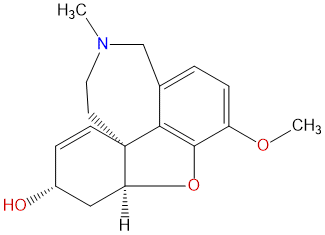
Epigalantamine, CAS number 1668-85-5, is a natural alkaloid with a molecular weight of 287.3590. Its chemical structure is based on the Galantamine skeleton and has a characteristic tetrahydroisoquinoline ring structure. The molecule contains multiple chiral centers, giving it a high degree of stereoselectivity. The LogP value of galantamine is 1.9401, indicating that it has moderate lipid solubility and is beneficial for penetrating lipid bilayer membranes. The topological polar surface area (TPSA) is 41.93 Å ², indicating that its polarity is moderate and contributes to the penetration of the blood-brain barrier.
The water solubility index is 3.1966, indicating that it has a certain solubility in water, which is beneficial for the development of oral formulations. Importantly, epigallocatamine has excellent blood-brain barrier penetration ability, which is particularly crucial for central nervous system drugs. The hERG channel inhibition test result is negative, indicating a low risk of cardiac toxicity. The Ames mutagenicity test result is 0.0, indicating a low risk of genetic toxicity, further supporting its safety.
Galantamine mainly comes from plants in the Alliaceae family, such as Galanthus spp., Leucojum spp., and Narcissus spp. Especially Galanthus nivalis, which has a high content of galanthamine, is the main natural source. The traditional extraction method usually uses organic solvent extraction combined with acid-base extraction, followed by column chromatography separation and purification.
Modern extraction techniques include ultrasound assisted extraction, microwave-assisted extraction, and high-performance liquid chromatography (HPLC) separation, which improve extraction efficiency and purity. In recent years, research on biosynthetic pathways has also provided a theoretical basis for the biosynthesis of galantamine. In the future, it is expected to achieve large-scale production, reduce costs, and ensure supply through genetic engineering microbial fermentation.
The pharmacological activity of galantamine mainly manifests in improving cognitive function and neuroprotective effects. As an acetylcholinesterase (ACHE) inhibitor, it can effectively block the breakdown of acetylcholine, increase the concentration of acetylcholine in synaptic cleft, enhance cholinergic neurotransmission, and improve memory and learning abilities.
In addition, galantamine has a regulatory effect on the alpha 7 nicotinic acetylcholine receptor (CHRNA7), promoting neuronal excitability and synaptic plasticity. Its regulation of the 5-hydroxytryptamine 2A receptor (HTR2A) helps improve emotional and cognitive disorders. Galantamine also exerts antioxidant and anti-inflammatory effects by activating nuclear factor erythroid 2-related factor 2 (NFE2L2) and inducing heme oxygenase 1 (HMOX1) expression, slowing down the process of neurodegeneration.
Neurotrophic factors such as brain-derived neurotrophic factor (BDNF) and nerve growth factor (NGF) are upregulated under the action of epigallocatamine, promoting neuronal survival and synapse formation. It activates cAMP response element binding protein 1 (CREB1), further regulates gene expression, and enhances neural plasticity. Epigalantamine also affects the glutamate receptor subunit GRIN2B, regulates excitatory nerve conduction, and prevents excitotoxicity.
The mechanism of action of galantamine is complex and multidimensional, covering multiple levels such as neurotransmitter regulation, antioxidant stress, neurotrophic and inflammatory response regulation.
Acetylcholinesterase inhibition (ACHE)
Galantamine competitively inhibits acetylcholinesterase activity, prolongs the action time of acetylcholine in synaptic cleft, enhances cholinergic neurotransmission, and improves cognitive function.
Nicotine acetylcholine receptor (CHRNA7) activation
As a positive regulator of the α 7 receptor, epigallocatamine promotes calcium influx, activates downstream signaling pathways, enhances neuronal excitability and synaptic plasticity, and promotes cognitive memory.
Regulation of 5-hydroxytryptamine 2A receptor (HTR2A)
By regulating 5-HT2A receptors, galantamine participates in regulating emotional and cognitive states, reducing anxiety and depression symptoms, and improving neurological and mental states.
Antioxidant and anti-inflammatory mechanisms
Galantamine activates the NFE2L2 signaling pathway, promotes HMOX1 expression, enhances cellular antioxidant capacity, reduces nerve damage caused by oxidative stress, and inhibits neuroinflammatory responses.
Neurotrophic factor regulation
By upregulating BDNF and NGF, galantamine promotes neuronal survival, differentiation, and synaptic formation, enhancing the functional remodeling of neural networks.
Activation of transcription factor CREB1
The activation of CREB1 promotes the expression of various neurotrophic genes, enhances neural plasticity and memory consolidation.
Glutamate receptor GRIN2B regulation
Galantamine regulates the NMDA receptor subunit GRIN2B, balances excitatory nerve conduction, prevents excitotoxicity, and protects neurons.
In summary, galantamine exhibits excellent neuroprotective and cognitive improvement potential through multi-target synergistic effects and comprehensive regulation of nervous system function.
The pharmacological evaluation of galantamine shows that it has good potential for drug development. Its molecular weight is 287.3590, with moderate LogP value and TPSA, in compliance with Lipinski's rules, and it has good oral bioavailability. Moderate water solubility, conducive to formulation development and in vivo absorption.
Importantly, galantamine can effectively penetrate the blood-brain barrier, ensuring its efficacy in the central nervous system. The hERG channel inhibition test was negative, reducing the risk of cardiac toxicity. The Ames mutagenicity test results showed no genetic toxicity and high safety.
Pharmacokinetic studies have shown that oral administration of Epigalantamine results in rapid absorption, moderate plasma half-life, and good in vivo distribution and metabolic stability. Its main metabolic pathway includes liver CYP450 enzyme mediated oxidative metabolism, and the metabolites have no significant toxicity. The main excretion pathway is urine, and the renal clearance efficiency is good.
Overall, epigallocatechin sulfate has shown excellent pharmacokinetic and safety performance, laying the foundation for further clinical development.
Galantamine, as a candidate drug for the treatment of cognitive impairment, has significant clinical application potential. Its multi-target and multi mechanism mode of action can comprehensively improve the neurological function of patients with cognitive impairment and slow down disease progression. Compared with existing acetylcholinesterase inhibitors, epigallocatechin sulfate shows better safety and neuroprotection, especially in terms of antioxidant and neurotrophic factor regulation, which may bring more lasting therapeutic effects.
Future research should focus on the clinical efficacy evaluation, dose optimization, and long-term safety monitoring of metformin. Meanwhile, combining modern drug delivery technologies such as nanocarriers and brain targeted drug delivery systems is expected to further enhance its efficacy and patient compliance. In addition, the potential applications of metformin in other neurodegenerative diseases such as Parkinson's disease and multiple sclerosis are also worth exploring in depth.
The development of combination therapy strategies based on the multi-target mechanism of action of galantamine also has broad prospects. By combining with anti-inflammatory drugs, neurotrophic factors, or other cognitive improvement drugs, it is possible to achieve synergistic effects and enhance therapeutic efficacy.
Epigalantamine, as a natural derivative with multi-target regulatory ability, has shown broad application prospects in the treatment of cognitive dysfunction. Its unique chemical structure and physicochemical properties endow it with excellent pharmacokinetic characteristics and safety. By regulating acetylcholinesterase activity, nicotinic receptors, 5-hydroxytryptamine receptors, and antioxidant pathways, galantamine achieves multi-level protection and functional improvement of the nervous system.
In the future, with the deepening of clinical research and the development of new formulation technologies, galantamine is expected to become an important drug in the field of cognitive impairment treatment, bringing good news to patients. Continuous basic research and clinical exploration will drive it from the laboratory to clinical applications, promoting innovative development in the treatment of neurodegenerative diseases.
