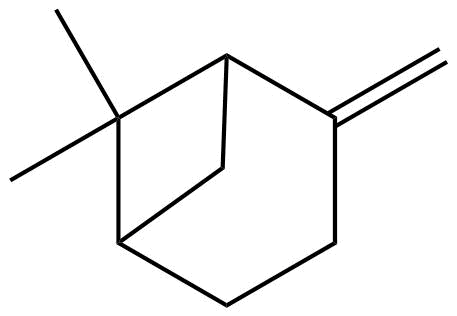


Product name: β-Pinene
Synonym name: Nopinen;Nopinene;β-Pinene
Catalogue No.: BP4269
Cas No.: 127-91-3
Formula: C10H16
Mol Weight: 136.238
Botanical Source:
Type of Compound:
Purity: 95%~99%
Analysis Method: HPLC-DAD or/and HPLC-ELSD
Identification Method: Mass, NMR
Packing: Brown vial or HDPE plastic bottle
Storage: Store in a well closed container, protected from air and light. Put into refrigerate or freeze for long term storage.
Whenever possible, you should prepare and use solutions on the same day. However, if you need to make up stock solutions in advance, we recommend that you store the solution as aliquots in tightly sealed vials at -20℃. Generally, these will be useable for up to two weeks.
The product could be supplied from milligrams to grams
Inquire for bulk scale.
For Reference Standard and R&D, Not for Human Use Directly.
Storage conditions:Short-term storage at 2~8℃, long-term storage at -20 ~ -80℃
.0000
4.2853
4.2851
.0046
11.2133
14.0307
High
78.1221
4.3851
No
Yes
No
No
No
No
0.0
No
No
No
No
β - Pinene (CAS number 127-91-3), as an important natural monoterpene, is widely present in various plant essential oils, especially in pine and lip shaped plants. Its unique exocyclic double bond structure endows it with diverse biological activities, making it widely studied in the field of natural product pharmacology. In recent years, with the continuous deepening of research on the potential of natural products in the prevention and treatment of respiratory diseases, β - pinene has become a research hotspot due to its significant pharmacological activity and good safety performance. This article provides a systematic review of the chemical structure and physicochemical properties, plant sources and extraction methods, pharmacological activity and mechanism of action, pharmacological evaluation and pharmacokinetic characteristics of β - pinene, and looks forward to its potential in clinical applications.
β - Pinene is an isomer of pinene containing an extra cyclic double bond, with a molecular formula of C10H16 and a molecular weight of 136.2380. Its structural feature is a monocyclic terpene skeleton with an external double bond, endowing it with high reactivity. The LogP value of β - pinene is 4.2853, indicating its strong hydrophobicity, and its topological polar surface area (TPSA) is 0, indicating extremely low molecular polarity and difficulty in forming hydrogen bonds, which is consistent with its extremely low water solubility (0.0046 mg/mL). Its physicochemical properties make β - pinene easy to penetrate biological membranes, especially the blood-brain barrier (BBB), and have high accessibility to the central nervous system. In addition, β - pinene did not exhibit hERG channel inhibitory activity, and the Ames mutagenicity test result was negative, indicating its high safety.
β - Pinene is widely present in the volatile oils of various plants, especially in the pine genus (such as Pinus spp.) and certain lip shaped plants (such as Rosmarinus officinalis) as the main sources. There are significant differences in its content among different plant species and growth stages. The traditional extraction method mainly uses steam distillation to extract essential oils from plant leaves, resins, or wood, and β - pinene is separated as one of the main components of the essential oil. In recent years, supercritical CO2 extraction technology has been applied to the extraction of β - pinene due to its mild operation, good selectivity, and environmental friendliness, which can effectively improve yield and purity. In addition, molecular distillation and chromatographic techniques are commonly used for the purification and quantitative analysis of β - pinene.
The pharmacological activity research of β - pinene covers multiple aspects such as anti-inflammatory, antioxidant, antibacterial, analgesic, and respiratory protection. Its potential application in respiratory system diseases is particularly prominent.
anti-inflammatory effect
β - Pinene can significantly inhibit the release of inflammatory mediators such as tumor necrosis factor - α (TNF - α), interleukin-6 (IL-6), and nitric oxide (NO), reducing tissue inflammatory response. Both in vitro and in vivo experiments have shown that it has a good inhibitory effect on acute and chronic inflammation models.
Antioxidant effect
β - Pinene has the ability to scavenge free radicals, increase the activity of antioxidant enzymes (such as superoxide dismutase (SOD) and glutathione peroxidase (GSH Px)) in the body, and alleviate oxidative stress damage.
Antibacterial activity
β - Pinene exhibits inhibitory effects on various Gram positive and Gram negative bacteria, especially on respiratory pathogens such as Staphylococcus aureus and Streptococcus pneumoniae.
Analgesia and neuroprotection
β - Pinene exerts analgesic effects by regulating neurotransmitter release and ion channel activity, while also having a certain protective effect on nerve cells.
Respiratory protection function
β - Pinene has shown potential therapeutic value for respiratory diseases such as asthma and chronic obstructive pulmonary disease (COPD) by regulating respiratory mucus secretion, alleviating airway inflammation, and relaxing bronchial smooth muscle.
The mechanism of action of β - pinene in respiratory diseases involves multiple molecular targets, mainly including:
TRPV1 (Transient receptor potential vanillic acid receptor 1)
TRPV1 is a non selective cation channel involved in airway inflammation and pain transmission. β - Pinene can alleviate airway inflammation and neuropathic pain by regulating TRPV1 activity.
TRPA1 (Transient receptor potential vanillic acid receptor A1)
TRPA1 plays an important role in airway inflammation and allergic reactions. The regulation of TRPA1 by β - pinene helps alleviate airway allergic reactions and inflammation.
CHRM3 (M3 type cholinergic receptor)
CHRM3 mediates bronchial smooth muscle contraction and mucus secretion. β - Pinene helps alleviate airway obstruction by inhibiting CHRM3 activity, promoting bronchial dilation, and reducing mucus secretion.
ADRB2 (β 2 adrenergic receptor)
ADRB2 is an important target for bronchial smooth muscle relaxation. β - Pinene may promote bronchiectasis and improve respiratory function by activating ADRB2.
MUC5AC (Mucin 5AC)
MUC5AC is the main component of respiratory mucus, and excessive secretion leads to airway obstruction. β - Pinene can regulate the expression of MUC5AC and prevent excessive accumulation of mucus.
In summary, β - pinene exerts a comprehensive respiratory protective effect by modulating airway inflammation, smooth muscle tone, and mucus secretion through multi-target synergistic action.
The pharmacological evaluation of β - pinene shows that it has good potential for drug development. Its LogP value is relatively high, indicating good lipid solubility, which is conducive to cell membrane penetration and tissue distribution, especially the high permeability of the blood-brain barrier, providing possibilities for its application in central nervous system diseases. The low water solubility limits its oral bioavailability, but it can be improved through modern pharmaceutical technologies such as nanocarriers and liposomes.
β - Pinene did not exhibit hERG channel inhibition, reducing the risk of cardiac toxicity, and the Ames test was negative, indicating a low risk of genotoxicity. Pharmacokinetic studies in vivo have shown that β - pinene is rapidly absorbed, widely distributed, and metabolized mainly through the liver enzyme system for oxidation and hydroxylation, ultimately excreted through urine and breath. Its half-life is moderate and suitable for daily administration.
Based on the multi-target effect and good safety of β - pinene in respiratory diseases, it has broad prospects in the adjuvant treatment of asthma, chronic obstructive pulmonary disease, bronchitis and other diseases in the future. In addition, the anti-inflammatory, antioxidant and neuroprotective effects of β - pinene also provide a theoretical basis for its application in nervous system diseases, skin diseases and infectious diseases.
However, clinical research on β - pinene is still relatively limited and lacks systematic clinical trial data. Future research should focus on pharmacokinetic optimization, dosage form innovation, and safety evaluation, while conducting large-scale randomized controlled clinical trials to verify its efficacy and safety. In addition, the combined application of β - pinene with other natural products or Western medicine is also worth exploring in depth to achieve synergistic effects.
β - Pinene, as a unique and biologically active natural monoterpene, exhibits significant anti-inflammatory, antioxidant, and respiratory protective effects. Its multi-target regulatory mechanism provides new ideas for the treatment of respiratory diseases. Combining good safety and medicinal properties, β - pinene has the potential to become a new natural medicine. In the future, through in-depth pharmacological mechanism research and clinical validation, β - pinene is expected to play an important role in the field of natural product pharmacology and clinical treatment.
