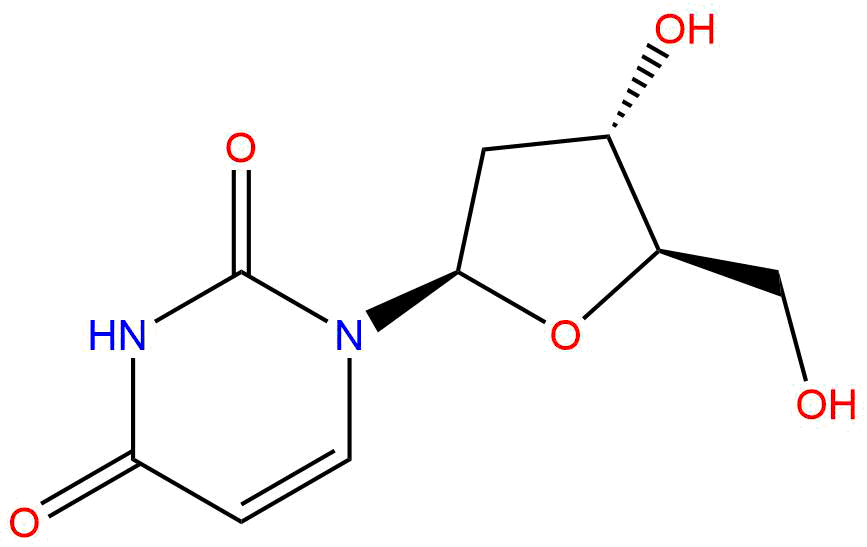


Product name: 2'-Desoxyuridine
Synonym name: Deoxyribose uracil; Deoxyuridine;Uracil deoxyriboside
Catalogue No.: BP4234
Cas No.: 951-78-0
Formula: C9H12N2O5
Mol Weight: 228.204
Botanical Source:
Type of Compound:
Purity: 95%~99%
Analysis Method: HPLC-DAD or/and HPLC-ELSD
Identification Method: Mass, NMR
Packing: Brown vial or HDPE plastic bottle
Storage: Store in a well closed container, protected from air and light. Put into refrigerate or freeze for long term storage.
Whenever possible, you should prepare and use solutions on the same day. However, if you need to make up stock solutions in advance, we recommend that you store the solution as aliquots in tightly sealed vials at -20℃. Generally, these will be useable for up to two weeks.
The product could be supplied from milligrams to grams
Inquire for bulk scale.
For Reference Standard and R&D, Not for Human Use Directly.
Storage conditions:Short-term storage at 2~8℃, long-term storage at -20 ~ -80℃
104.5500
-1.5163
-1.5173
38.2897
.7911
1.9852
High
14.1836
3.4576
Yes
Yes
No
No
Yes
No
1.8
Yes
Yes
Yes
No
2 '- Deoxyuridine (dUrd) is a pyrimidine based 2' - deoxyribonucleoside, structurally composed of a uracil base connected to 2 '- deoxyribose via a β - N1 glycosidic bond. As an important intermediate in nucleic acid metabolism, 2 '- deoxyuridine plays a crucial role in DNA synthesis and repair processes. It has metabolic activity in various organisms, including mice, brewing yeast, Escherichia coli, and humans, demonstrating broad biological significance. In recent years, with the continuous deepening of the application of nucleoside compounds in anti-tumor, antiviral, and gene therapy, the research value of 2 '- deoxyuridine as the basic nucleoside structural unit has become increasingly prominent. This article aims to provide a systematic review of the chemical structure and physicochemical properties, sources and extraction methods, pharmacological activity, mechanism of action, drug evaluation, and clinical application prospects of 2 '- deoxyuridine, with the hope of providing reference and inspiration for research in related fields.
The chemical formula of 2 '- deoxyuridine is C9H12N2O5, with a molecular weight of 228.2040. Its structure consists of uracil bases and 2 '- deoxyribose. Unlike uridine, its ribose ring lacks a hydroxyl group (- OH) at the 2' position, which gives it higher chemical stability and different biological functions. The CAS number of this compound is 951-78-0.
In terms of physical and chemical properties, 2 '- deoxyuridine exhibits high water solubility (approximately 38.29 mg/mL), with a LogP value of -1.5163, indicating strong hydrophilicity and easy solubility in water but difficult solubility in fat soluble solvents. The polar surface area (TPSA) is 104.55 Å ², reflecting its high molecular polarity, which has a significant impact on its binding with biomolecules. The high penetrability of the blood-brain barrier suggests its potential biological activity in the central nervous system. In addition, the hERG channel inhibition experiment results were negative, indicating a low risk of cardiac toxicity. The Ames test value is 1.8, indicating a low risk of genotoxicity and good safety.
2 '- deoxyuridine mainly exists as a nucleic acid metabolite in various organisms, and is not directly present as a secondary metabolite in plants in the natural world. Its main source is the degradation products of DNA in biological cells, or it is generated through the biosynthetic pathway by the catalysis of deoxygenases from uridine.
Although 2 '- deoxyuridine itself is not directly extracted from plants, it can be obtained through hydrolysis and purification steps in some plant tissues rich in nucleic acids. Common extraction methods include:
In addition, modern biotechnology methods such as microbial fermentation and enzyme catalyzed synthesis are widely used in the industrial production of 2 '- deoxyuridine, especially in the fields of drug synthesis and nucleic acid research.
2 '- deoxyuridine, as a precursor and metabolic intermediate for DNA synthesis, has various pharmacological activities, mainly reflected in the following aspects:
Antitumor activity
2 '- deoxyuridine itself is not a direct anti-tumor drug, but its metabolites and analogues play an important role in the development of anti-tumor drugs. For example, 5-fluoro-2 '- deoxyuridine (5-FdUrd) is a widely used anti metabolic anti-cancer drug that inhibits tumor cell proliferation by incorporating DNA. The study of the metabolic pathway of 2 '- deoxyuridine provides a theoretical basis for the design of such drugs.
Antiviral effect
Nucleoside compounds are widely used in antiviral therapy. The structure of 2 '- deoxyuridine provides a template for developing nucleoside analogues for designing inhibitors targeting viral DNA polymerase, indirectly exerting antiviral effects.
DNA repair and gene stability
2 '- deoxyuridine participates in base substitution and synthesis during DNA repair, maintaining genomic stability. Abnormal metabolism may lead to the accumulation of DNA damage, which in turn can cause genetic diseases or cancer.
Neuroprotective effect
Due to its excellent blood-brain barrier penetration, some studies have focused on the potential applications of 2 '- deoxyuridine and its derivatives in neurological diseases, such as the treatment and neuroprotection of neurodegenerative diseases.
The biological function of 2 '- deoxyuridine mainly depends on its role in nucleic acid metabolism, and the specific mechanisms include:
Role in nucleotide metabolism pathway
2 '- deoxyuridine is phosphorylated by nucleoside kinase to produce 2' - deoxyuridine monophosphate (dUMP), which is then converted to thymidine acid (dTMP) by thymidine synthase, providing essential nucleotides for DNA synthesis. This process is crucial for cell proliferation and DNA repair.
Interaction with DNA polymerase
As a precursor of DNA synthesis, the metabolite of 2 '- deoxyuridine can be recognized by DNA polymerase and incorporated into DNA strands, affecting the accuracy of DNA replication and repair.
Regulating the activity of thymidylate synthase (TS)
The metabolite dUMP of 2 '- deoxyuridine is a substrate of TS, which catalyzes the conversion of dUMP to dTMP and is the only pathway for thymidine synthesis in cells. TS is a target of various anti-tumor drugs, and the metabolic status of 2 '- deoxyuridine affects TS activity and drug sensitivity.
Participate in DNA damage response
In the process of DNA damage repair, the metabolic regulation of 2 '- deoxyuridine maintains base balance, prevents mutation accumulation, and ensures genome stability.
2 '- deoxyuridine has good pharmacological parameters:
In terms of pharmacokinetics, 2 '- deoxyuridine is mainly metabolized in vivo through nucleoside kinases and nucleotide metabolizing enzymes, with a fast half-life and good bioavailability. Its water solubility and polarity make it widely distributed in the blood, but its fast metabolic rate limits its application as a drug alone. Through structural modification and drug carrier technology, its stability and targeting can be improved.
Although 2 '- deoxyuridine itself has not been widely used as an independent drug, it has important clinical potential as a central molecule in nucleoside metabolism in multiple fields:
The foundation of anti-tumor drug development
The metabolic pathway of 2 '- deoxyuridine provides a theoretical basis for the design of anti metabolic drugs, especially in the design of thymidine synthase inhibitors and DNA incorporated drugs.
Gene therapy and nucleic acid drug carriers
As a nucleoside structural unit, 2 '- deoxyuridine has important value in the synthesis and modification of nucleic acid drugs, and is expected to be used in emerging therapeutic technologies such as gene editing and RNA interference.
Treatment of neurological disorders
Its excellent blood-brain barrier penetration ability makes it and its derivatives have potential application prospects in neuroprotection and treatment of neurodegenerative diseases.
Biomarkers and Metabolic Monitoring
The concentration changes of 2 '- deoxyuridine and its metabolites in vivo can serve as biomarkers for DNA metabolism abnormalities, and are used for the diagnosis and efficacy monitoring of cancer, genetic diseases, and metabolic disorders.
Future research should focus on the structural optimization, pharmacokinetic improvement, and targeted delivery technology development of 2 '- deoxyuridine to enhance its clinical application value. Meanwhile, in-depth analysis of its mechanism of action in the cellular metabolic network will promote the innovative development of nucleoside drugs.
2 '- deoxyuridine, as a pyrimidine 2' - deoxyribonucleoside, plays an irreplaceable role in nucleic acid metabolism and cell biology. Its excellent physicochemical properties and biological activity make it an important foundation for the development of nucleoside drugs. Although it has not yet been widely used as an independent drug, in-depth research on its metabolic pathways and mechanisms of action provides valuable theoretical and practical foundations for fields such as anti-tumor, antiviral, and neuroprotection. In the future, with the development of biotechnology and medicinal chemistry, 2 '- deoxyuridine and its derivatives are expected to play a greater role in clinical treatment and become an important component of the new generation of nucleoside drugs.
