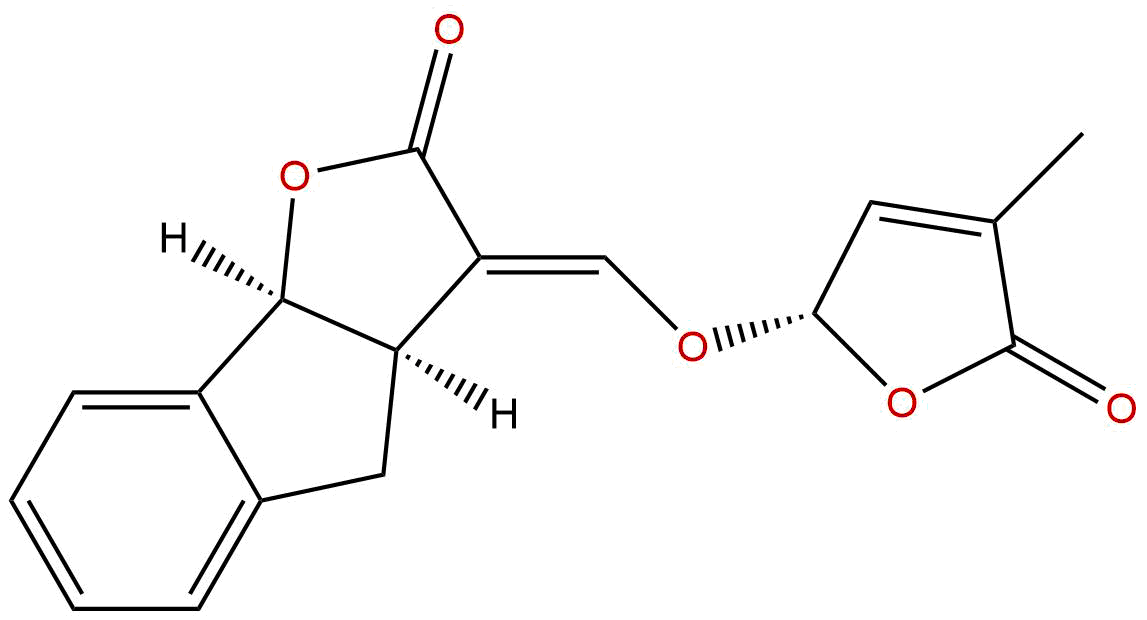


Product name: Strigolactone
Synonym name: GR24;rac-GR24;rac-strigolactone;Strigolactone GR24
Catalogue No.: BP5236
Cas No.: 76974-79-3
Formula: C17H14O5
Mol Weight: 298.294
Botanical Source:
Type of Compound:
Purity: 95%~99%
Analysis Method: HPLC-DAD or/and HPLC-ELSD
Identification Method: Mass, NMR
Packing: Brown vial or HDPE plastic bottle
Storage: Store in a well closed container, protected from air and light. Put into refrigerate or freeze for long term storage.
Whenever possible, you should prepare and use solutions on the same day. However, if you need to make up stock solutions in advance, we recommend that you store the solution as aliquots in tightly sealed vials at -20℃. Generally, these will be useable for up to two weeks.
The product could be supplied from milligrams to grams
Inquire for bulk scale.
For Reference Standard and R&D, Not for Human Use Directly.
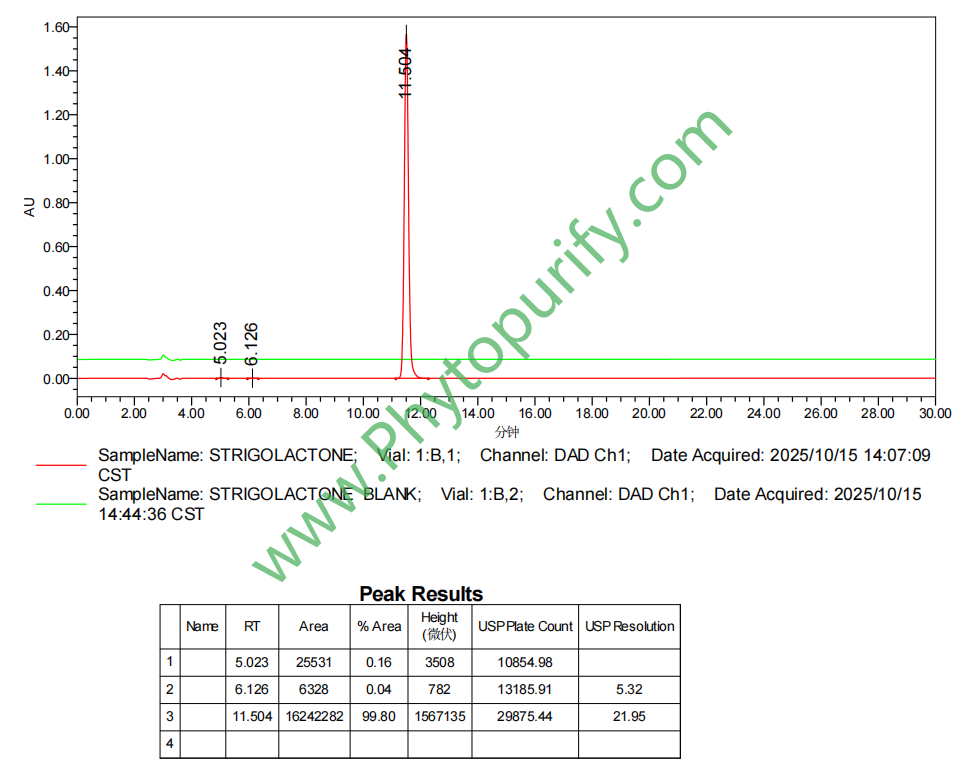
HPLC of Strigolactone
Storage conditions:Short-term storage at 2~8℃, long-term storage at -20 ~ -80℃
61.8300
2.5624
2.5624
.0703
4.2657
21.8170
High
80.8679
4.0777
Yes
Yes
Yes
No
No
No
0.3
No
Yes
Yes
Yes
Natural products, as valuable sources for drug discovery and chemical biology research, have long provided key lead compounds for human health and agricultural development. Among numerous structurally novel and functionally unique natural products, Strigolactones (SLs) have attracted much attention due to their dual roles in plant biology - as plant hormones regulating growth and development, and as rhizosphere signaling molecules mediating interactions with symbiotic microorganisms and parasitic plants. Since the first isolation and identification of Strigol from cotton root exudates in 1966, research on this class of sesquiterpenes has expanded from the initial field of plant parasitic regulation to multiple core biological processes such as plant branching, root architecture, mycorrhizal symbiosis, and stress response. In recent years, with the in-depth analysis of its biosynthesis, perception, and signal transduction mechanisms, unicyclic lactone and its synthetic analogues, especially GR24 (including its racemic and optically pure enantiomers), have become important tool molecules for studying plant developmental biology, chemical ecology, and developing new plant growth regulators and anti parasitic weed strategies.
This article focuses on the synthesis of a representative compound, (+) - GR24 (CAS number: 76974-79-3), which is a single legged gold lactone. As a stable and efficient synthetic analogue of natural one legged lactones, (+) - GR24 is not only the "gold standard" compound for studying the biological functions of SLs, but its unique chemical structure and clear stereochemical configuration also provide an ideal model for understanding the molecular recognition mechanism between SLs and their receptor proteins (such as D14, KAI2). This article provides a systematic review of the chemical structure and physicochemical properties, plant sources and synthesis strategies, broad pharmacological activities (especially plant hormone activity), precise mechanisms of action and molecular targets, drug efficacy evaluation and pharmacokinetic characteristics of (+) - GR24, and looks forward to its application prospects in agriculture, chemical biology, and potential medical fields, aiming to provide a comprehensive and in-depth professional reference for researchers in related fields.
The chemical name of (+) - GR24 is (3E) -3- {[(4-methyl-5-oxo-2,5-dihydrofuran-2-yl) oxy] methylene} -3,3a, 4,8b tetrahydro-2H-indeno [1,2-b] furan-2-one, with a molecular formula of C ₁₇ H ₁₄ O ₅ and a molecular weight of 298.2940. Structurally, (+) - GR24 belongs to a typical one legged gold lactone compound, with its core skeleton consisting of two key parts: a tricyclic lactone (ABC ring) and a butenolide (D ring) connected by an enol ether bond. Specifically, the ABC ring is an indeno [1,2-b] furan-2-one system, where the A ring is a benzene ring, the B ring is a dihydrofuran ring, and the C ring is a cyclopentane ring. The three rings are fused together to form a rigid planar structure with multiple chiral centers. The D ring is a 4-methyl-5-oxo-2,5-dihydrofuran-2-yl group, which is connected to the C-3 position of the ABC ring through a methylene group (=CH -), forming a critical enol ether bridge. The unique connection mode of the ABC-D ring is a structural feature shared by all active gold lactones and is crucial for their biological activity.
The stereochemical configuration of (+) - GR24 is one of the determining factors for its biological activity. The compound has a (3E, 3aR, 8bS) configuration in the indenofuranone moiety, where the hydrogen atoms at positions C-3a and C-8b are in the cis configuration, and the double bond at position C-3 is in the E configuration. Meanwhile, the chiral center on the D ring (the carbon atom connected to the oxygen atom) is in the R configuration. It is worth noting that (+) - GR24 is the enantiomer of (-) - GR24. Although the two are mirror images of each other, they exhibit significant differences in biological activity. Research has shown that (+) - GR24 is a potent agonist of the D14 receptor, while (-) - GR24 is more inclined to activate the KAI2 receptor. This difference in enantioselectivity provides a precise chemical probe for studying the functional differentiation of different SLs signaling pathways.
In terms of physicochemical properties, (+) - GR24 exhibits moderate lipophilicity. The calculated LogP value is 2.5624, indicating that it has a good distribution balance between the aqueous and organic phases, which is beneficial for its transmembrane transport and long-distance transport in plants. Its topological polar surface area (TPSA) is 61.8300 Å ², which is consistent with the typical characteristics of small molecule hormone compounds, indicating that it has a certain polarity and can form hydrogen bonds and other interactions with polar amino acid residues of receptor proteins. However, the water solubility of (+) - GR24 is relatively low, only 0.0703 mg/mL, which is related to its non-polar ABC ring skeleton. In practical applications, it is usually necessary to dissolve it in organic solvents such as dimethyl sulfoxide (DMSO) or acetone to prepare a mother liquor, and then dilute it to the working concentration. In addition, its blood-brain barrier (BBB) penetration is predicted to be "high", suggesting that the compound may have the potential to enter the central nervous system, although its research in animal bodies is not yet in-depth. The hERG inhibition prediction is' no ', and the Ames test prediction result is 0.3 (usually considered negative if it is less than 0.5), indicating a low risk of cardiac toxicity and genetic toxicity, providing preliminary safety evidence for its potential medical applications.
Unicorn lactone was initially discovered from plant root exudates. In 1966, Cook et al. first studied cotton(Gossypium hirsutum)Solitary foot gold alcohol was isolated from root exudates and it was found to strongly stimulate parasitic plant Solitary foot gold(Striga The germination of spp. seeds. Subsequently, a series of structurally similar natural monolactones were identified from various plants, including Orobancol, Sorgolactone, 5-Deoxystrigol, and others. These natural SLs have extremely low content in plant bodies (usually at picomolar to nanomolar levels), and their chemical properties are unstable, making them highly susceptible to hydrolysis, which poses significant challenges for their large-scale extraction, purification, and application. Therefore, chemical synthesis has become the main way to obtain sufficient, stable, and high-purity SLs compounds.
(+) - GR24 is a representative analog designed and synthesized to address the limitations of natural SLs. Its synthesis strategy is usually based on the classic "ABC+D" ring coupling route. Firstly, an ABC tricyclic lactone skeleton with specific stereochemistry was constructed through multi-step organic synthesis. This step usually involves reactions such as cyclization, reduction, oxidation, etc., and requires strict control of the configuration of the chiral center. Subsequently, the pre synthesized D-ring precursor (such as 4-methyl-5-oxo-2,5-dihydrofuran-2-yl derivative) is connected to the C-3 aldehyde or ketone group of the ABC ring through enol etherification reaction to form a critical enol ether bridge. Finally, the reaction product was purified using chromatographic separation techniques such as silica gel column chromatography and high-performance liquid chromatography (HPLC) to obtain optically pure (+) - GR24 enantiomers. Due to the possibility of producing diastereomers during the synthesis process, chiral separation or asymmetric synthesis techniques are key to obtaining high optical purity (+) - GR24.
Although (+) - GR24 is a synthetic product, its structural design is inspired by natural SLs and retains its core active groups. Compared with natural SLs, (+) - GR24 has significant advantages: it has higher chemical stability and is not easily degraded rapidly in the environment; The synthetic route is relatively mature and can achieve gram level or even larger scale production; Through stereoselective synthesis, a single enantiomer configuration can be obtained, avoiding the problem of activity mixing caused by racemates. Therefore, (+) - GR24 has become a "standard" and "tool drug" for studying the biological functions of SLs worldwide. In laboratory research, (+) - GR24 is usually stored in solid form, dissolved in DMSO or acetone before use, prepared into a mother liquor (such as 10 mM or 100 mM), and stored in the dark at -20 ° C or -80 ° C to maintain its activity.
The pharmacological activity research of (+) - GR24 mainly focuses on its function as a plant hormone and signaling molecule, and its core activities are reflected in the following aspects:
Shoot Branching Inhibition This is one of the most classic functions of lactone as a plant hormone. Research has shown that exogenous application of (+) - GR24 can significantly inhibit lateral branch (tiller) growth in various plants such as Arabidopsis, rice, and peas. In Arabidopsis, (+) - GR24 at a concentration of 100 nM to 1 μ M can effectively inhibit the germination and elongation of axillary buds. This activity depends on its receptor D14 and downstream signaling components MAX2, D3, etc. For mutants with defects in the synthesis or signaling pathway of one legged gold lactone (such as max3, max4, d14, max2)The inhibitory branching effect of (+) - GR24 was significantly weakened or disappeared, confirming its specificity of action.
Promote seed germination stimulation(+) - GR24 has a strong induction activity on the germination of parasitic plant seeds (such as monocotyledonous metals and Aristolochia). The seeds of these parasitic weeds can remain dormant in the soil for decades and only germinate upon sensing the SLs secreted by the host plant roots. (+) - GR24, as a mimic of SLs, can effectively induce their germination at extremely low concentrations (nanomolar to picomolar). This characteristic makes it a key tool for studying the germination mechanism of parasitic plant seeds, and has given rise to the "suicidal germination" strategy - that is, inducing parasitic seed germination by applying SLs analogs when there is no host crop, causing it to die due to inability to parasitize, thereby controlling weed damage.
Root Architecture Modulation(+) - GR24 has a pleiotropic effect on plant root development. It can promote the elongation of the main root while inhibiting the formation of lateral and adventitious roots. In addition, (+) - GR24 can promote the elongation and density increase of root hairs. These effects help plants optimize their root structure and improve their absorption efficiency of water and mineral elements under conditions of nutrient deficiency, especially phosphorus deficiency. Research has shown that the regulation of root architecture by (+) - GR24 also depends on the D14-MAX2 signaling pathway.
Promote symbiosis of arbuscular mycorrhizal fungi (AMF)In natural ecosystems, SLs are "distress signals" secreted by plant roots, which can attract AMF hyphae to grow towards the rhizosphere and promote their symbiotic relationship with plant roots. (+) - GR24 can simulate the function of natural SLs and significantly promote AMF in vitro experiments (such as...)Glomus The branching and growth of hyphae. This activity is of great significance for understanding the chemical language of plant microbe interactions and developing biostimulants that promote mycorrhizal symbiosis in crops.
Participate in Stress Response Recent studies have revealed that (+) - GR24 is also involved in plant responses to various abiotic stresses, such as drought, high salt, high temperature, and heavy metal stress. For example, exogenous application of (+) - GR24 can improve drought and salt tolerance in Arabidopsis and rice, and its mechanism may be related to promoting stomatal closure, enhancing antioxidant enzyme activity, and regulating the accumulation of osmoregulatory substances. These findings expand the functional scope of SLs, suggesting their potential application as novel stress regulators in agriculture.
It is worth noting that the activity of (+) - GR24 exhibits significant concentration dependence and enantioselectivity. Typically, its activity increases with increasing concentration within the range of 1 nM to 10 μ M, but excessively high concentrations (>50 μ M) may result in toxic or non-specific effects. In activity comparison, (+) - GR24 is usually stronger than its racemic form (rac-GR24) or (-) - GR24 in inhibiting branching and promoting AMF symbiosis, consistent with its high affinity for D14 receptors.
The biological function of (+) - GR24 is achieved through a highly conserved and refined signal transduction network. The core components of this network include receptor proteins, F-box proteins, transcription inhibitors, and downstream transcription factors. At present, the recognized SLs signaling pathway models are as follows:
Receptor perception The initial perception of (+) - GR24 depends on a member of the α/β hydrolase superfamily, the D14 (DWARF14) protein. D14 is a receptor with hydrolytic enzyme activity, and its active center contains a classical Ser His Asp catalytic triad. After entering the hydrophobic binding pocket of D14, the critical D ring of (+) - GR24 is subjected to nucleophilic attack by the serine residue (Ser) in the catalytic triad, resulting in the hydrolysis and cleavage of the enol ether bond between the D ring and the ABC ring. This hydrolysis process releases the ABC ring portion, while the D ring is covalently attached to the Ser residue of D14, forming a stable, modified D14 intermediate (D14-D ring complex). This hydrolysis covalent modification process is the initial step of SLs signal transduction and a key feature that distinguishes SLs from other hormone signals.
Formation of signal complex The D14 protein modified by the D-ring undergoes conformational changes, exposing the F-box protein MAX2 (More AXILLARY GROWTH 2) in Arabidopsis; The interface of D3 interaction in rice. MAX2 is the core component of the SCF (SKP1-Cullin-F-box) ubiquitin ligase complex, responsible for recruiting substrate proteins for ubiquitination degradation. The D14-D ring complex binds to MAX2 and auxiliary proteins (such as D3) to form the SCF ^ (MAX2) - D14-D ring signaling complex. The formation of this complex is a crucial step in signal transmission.
Degradation of transcription inhibitory factors The main function of the SCF ^ (MAX2) - D14-D loop complex is to recognize and ubiquitinate a class of transcription inhibitory factors called SMXL (SMAX1-LIKE) (mainly SMXL6, SMXL7, SMXL8 in Arabidopsis); D53 in rice. SMXL protein is a negative regulator of the SLs signaling pathway, which inhibits the expression of downstream responsive genes by binding to transcription factors such as BRC1. When SMXL protein is ubiquitinated by the SCF ^ (MAX2) complex, it is immediately degraded by the 26S proteasome. The degradation of SMXL protein releases the inhibition of downstream transcription factors, thereby activating the expression of a series of SLs responsive genes, ultimately leading to biological effects such as inhibition of branching and promotion of AMF symbiosis.
Enantiomer selectivity and KAI2 receptor In addition to D14, there is also a paralogous receptor in plants called KAI2 (KARRIKIN INSENSITIVE 2). KAI2 was initially identified as a receptor for sensing smoke compounds (Karrikins), but subsequent studies have found that it can also bind to certain SLs analogs (especially (-) - GR24) and activate signaling pathways. The KAI2 signaling pathway is similar to the D14 pathway and also relies on MAX2 and SMXL proteins (mainly SMXL2), but its regulation of biological processes is different, mainly involving seed germination, seedling photomorphogenesis, and root development. (+) - GR24 exhibits high selectivity towards D14, while (-) - GR24 is more inclined to activate KAI2. This enantioselectivity provides valuable chemical tools for studying these two parallel but functionally differentiated signaling pathways.
In summary, (+) - GR24 utilizes a unique molecular mechanism of "hydrolysis covalent modification ubiquitination degradation" to convert extracellular chemical signals into intracellular protein degradation events, thereby achieving precise regulation of plant growth, development, and stress response. The molecular target network of its action is clear, with core components including D14, MAX2, D3, and SMXL7. Mutations in these proteins can lead to complete or partial insensitivity of plants to (+) - GR24.
Although (+) - GR24 is mainly used as a tool molecule in plant biology research, the evaluation of its drug like and pharmacokinetic (PK) properties has important reference value for exploring its potential applications in the medical field, such as anti-tumor and anti-inflammatory effects. Based on its chemical structure and computer simulation predictions, we can conduct a preliminary evaluation of its pharmacological properties.
Analysis of drug properties parameters:
- molecular weight:298.29 Da, Far below the "Lipinski Five Rules" threshold of 500 Da, it indicates good oral absorption potential.
- LogP 2.56, located in the ideal lipophilic range (1-3), is conducive to membrane permeation and distribution.
- TPSA 61.83 Å ², below 140 Å ², indicates good intestinal absorption and cell penetration ability.
- Water solubility:0.07 mg/mL, Belongs to low solubility compounds. This may be a potential limiting factor for its oral bioavailability, which requires the use of appropriate formulation techniques such as nanoemulsions and cyclodextrin inclusion to improve.
- Blood-brain barrier penetration Predicted as' high ', indicating that it may enter the central nervous system. This characteristic needs to be treated with caution, as it may have the potential to treat central nervous system diseases and may also lead to unexpected neurotoxicity.
- HERG inhibition A prediction of 'no' indicates a lower risk of causing QT interval prolongation in the heart.
- Ames test The predicted result is 0.3 (negative), indicating that it does not have significant genetic toxicity.
Pharmacokinetic characteristics (based on prediction and limited experimental data):
- absorb Based on its good lipid solubility and low molecular weight, (+) - GR24 may be rapidly absorbed after oral administration. However, its low water solubility and potential first pass metabolic effects (such as esterase hydrolysis) may result in low absolute oral bioavailability. In plant research, foliar spraying or root irrigation are commonly used for administration, which results in higher absorption efficiency.
- distribution Due to its high BBB penetration, (+) - GR24 may be widely distributed in various tissues throughout the body, including brain tissue. Its distribution volume (Vd) may be relatively large.
- Metabolism The metabolism of (+) - GR24 mainly involves two key sites: one is the butenolide ring on the D ring, which is easily hydrolyzed by esterases to open the ring and generate inactive metabolites; The second is the ether and double bonds on the ABC ring, which may be oxidized by cytochrome P450 enzymes (CYPs). Therefore, its metabolism in the body may be very rapid, and its half-life (t1/2) may be short. This characteristic has been confirmed in plant research, that is, SLs are unstable both in vitro and in vivo and are easily degraded rapidly.
- excretion Metabolites may be mainly excreted through bile and urine.
Summary of Drug Evaluation:
(+) - GR24 has some ideal pharmaceutical properties, such as low molecular weight, moderate lipophilicity, low toxicity, and no genetic toxicity. However, its low water solubility and potential for rapid metabolism (especially the hydrolytic instability of the D ring) are the main obstacles to its potential as a candidate drug. If it is developed into a drug in the future, it will need to overcome these shortcomings through prodrug design (such as protecting the D ring), structural modification (such as replacing the D ring with more stable functional groups), or new formulation technologies. At present, its more direct application prospects are still concentrated in the agricultural field, such as as as a "suicidal germination" agent, plant growth regulator, or biostimulant. In these applications, its rapid degradation characteristics may become an environmentally friendly advantage.
Although research on (+) - GR24 is currently mainly focused on the field of plant science, its unique biological activity and signaling mechanism are gradually attracting the interest of medical researchers, demonstrating potential clinical application prospects.
Antitumor potential The core components of the one legged lactone signaling pathway, such as MAX2 and SMXL proteins, are homologous proteins in humans (such as the DDB1-CUL4-ROC1 E3 ubiquitin ligase complex). Some studies have shown that SLs analogues may exhibit anti proliferative activity against some cancer cell lines (such as breast cancer, prostate cancer, colon cancer cells) by interfering with cell cycle, inducing apoptosis or inhibiting angiogenesis. Although there is limited research on the activity of (+) - GR24 in mammalian cells, it can be used as a tool compound for screening and developing novel anti-cancer lead compounds targeting the MAX2 homologous pathway.
Anti inflammatory and immune regulation The SLs signal is closely related to plant immunity. In animal cells, some natural products (such as Triptolide) also have similar alpha, beta unsaturated lactone structures and exhibit significant anti-inflammatory activity. Therefore, (+) - GR24 and its derivatives may exert anti-inflammatory effects by regulating key inflammatory pathways such as NF - κ B and NLRP3 inflammasomes. Preliminary cell experiments suggest that rac-GR24 can inhibit the release of inflammatory cytokines from macrophages induced by lipopolysaccharide (LPS).
Metabolic diseases Since SLs regulate energy allocation and nutrient response in plants, their role in animal energy metabolism is also worth exploring. Studies have found that SLs analogs can affect the differentiation of adipocytes and glucose and lipid metabolism. In the future, (+) - GR24 can be used as a probe to study whether it can interfere with metabolic diseases such as obesity and type 2 diabetes by regulating energy sensing pathways such as AMPK and mTOR.
Agricultural applications This is the most direct and mature application direction of (+) - GR24.
prospect:
In the future, research on (+) - GR24 will develop in the following directions:
- structural optimization Develop GR24 derivatives with higher metabolic stability, stronger activity, and better selectivity, especially highly selective agonists and antagonists targeting D14 or KAI2 receptors.
- Deepening the mechanism of action Using (+) - GR24 and its enantiomers, combined with structural biology (such as X-ray crystallography, cryo electron microscopy) and chemical biology methods, further elucidate the fine molecular mechanisms of D14 and KAI2 receptors sensing SLs, as well as the regulatory network of downstream SMXL protein degradation.
- Medical translational research Systematic evaluation of the pharmacological, toxicological, and PK properties of (+) - GR24 and its derivatives in mammalian cells and animal models, exploring their potential applications in anti-tumor, anti-inflammatory, metabolic regulation, and other fields.
- Agricultural application development Promote the industrialization of (+) - GR24 and its analogues, develop efficient, low-cost, and environmentally friendly formulations, and conduct large-scale field trials to verify their practical effects in parasitic weed control and crop yield increase.
(+) - GR24, as an outstanding representative of the synthesis of one legged lactones, not only perfectly simulates the core biological activity of natural SLs, but also becomes the "gold standard" tool for analyzing the biological functions of SLs with its clear stereochemical configuration and stable chemical properties. From a chemical structure perspective, its unique ABC-D ring skeleton and key enol ether bridge endow it with a dual identity as a plant hormone and rhizosphere signaling molecule. In terms of pharmacological activity, (+) - GR24 exhibits strong regulatory capabilities in inhibiting branching, promoting parasitic seed germination, regulating root architecture, promoting mycorrhizal symbiosis, and participating in stress response at multiple levels. The brilliance of its mechanism of action lies in the cascade reaction of "hydrolysis covalent modification ubiquitination degradation" mediated by D14 receptors, which converts chemical signals into protein degradation events and achieves precise control over plant development.
Although (+) - GR24 faces challenges such as low water solubility and metabolic instability in drug development, its low toxicity and unique biological activity make it have broad application prospects in the agricultural field, especially in parasitic weed control and crop growth regulation. Meanwhile, its preliminary discovery of potential activity in mammalian cells has also opened up new directions for interdisciplinary research. In the future, with the continuous deepening of understanding of SLs signal networks and advances in chemical synthesis technology, structural optimization and functional development using (+) - GR24 as a template will inevitably give rise to more new molecules with important scientific value and application potential, contributing to sustainable agricultural development and human health.
