Introduction/Overview
Natural products, as an important source of drug discovery, play an irreplaceable role in the long history of human fight against diseases. Isolating and identifying small molecule compounds with biological activity from traditional herbs, and elucidating their mechanisms of action, is an important paradigm in modern medicinal chemistry and pharmacology research. Moraceae plants, especially the genus Moraceae(Morus)Plants, such as mulberry trees(Morus alba L.), Not only does it have a long history of medicinal and edible use, but its fruit, root bark, branches and leaves are also rich in various structurally novel and highly active secondary metabolites, including flavonoids, stilbenes, Diels Alder type adducts, and aromatic benzofuran compounds. These compounds exhibit a wide range of pharmacological activities, such as antioxidant, anti-inflammatory, neuroprotective, anti-tumor, and hypoglycemic effects, which have attracted widespread attention from scholars both domestically and internationally.
Albanol B, As an aromatic benzofuran derivative isolated from mulberry plants, it has gradually become a hot topic in natural product pharmacology research in recent years due to its unique chemical structure and various biological activities, especially its potential in anti-tumor and neuroprotective fields. Early research revealed that Albanol B has anti Alzheimer's disease (AD), antibacterial, and antioxidant activities. However, further research has found that Albanol B can effectively inhibit the proliferation of various cancer cells by regulating the cell cycle and inducing apoptosis. Its mechanism of action involves the regulation of key signaling pathways such as PI3K/AKT and MAPK/ERK, as well as its impact on mitochondrial function and reactive oxygen species (ROS) homeostasis. In addition, Albanol B has been found to downregulate the expression of cyclin dependent kinase 1 (CDK1) and arrest the cell cycle in the G2/M phase, thereby exerting its anti-tumor effect.
Given the enormous potential of Albanol B in multiple disease fields, particularly in cancer treatment, a systematic review of it is particularly important. This article aims to comprehensively review the chemical structure and physicochemical properties, plant sources and extraction methods, pharmacological activity, mechanism of action, and molecular targets of Albanol B, and evaluate its pharmacological parameters to explore its clinical application prospects and challenges, in order to provide reference for the subsequent research and development of this natural product.
Chemical structure and physicochemical properties
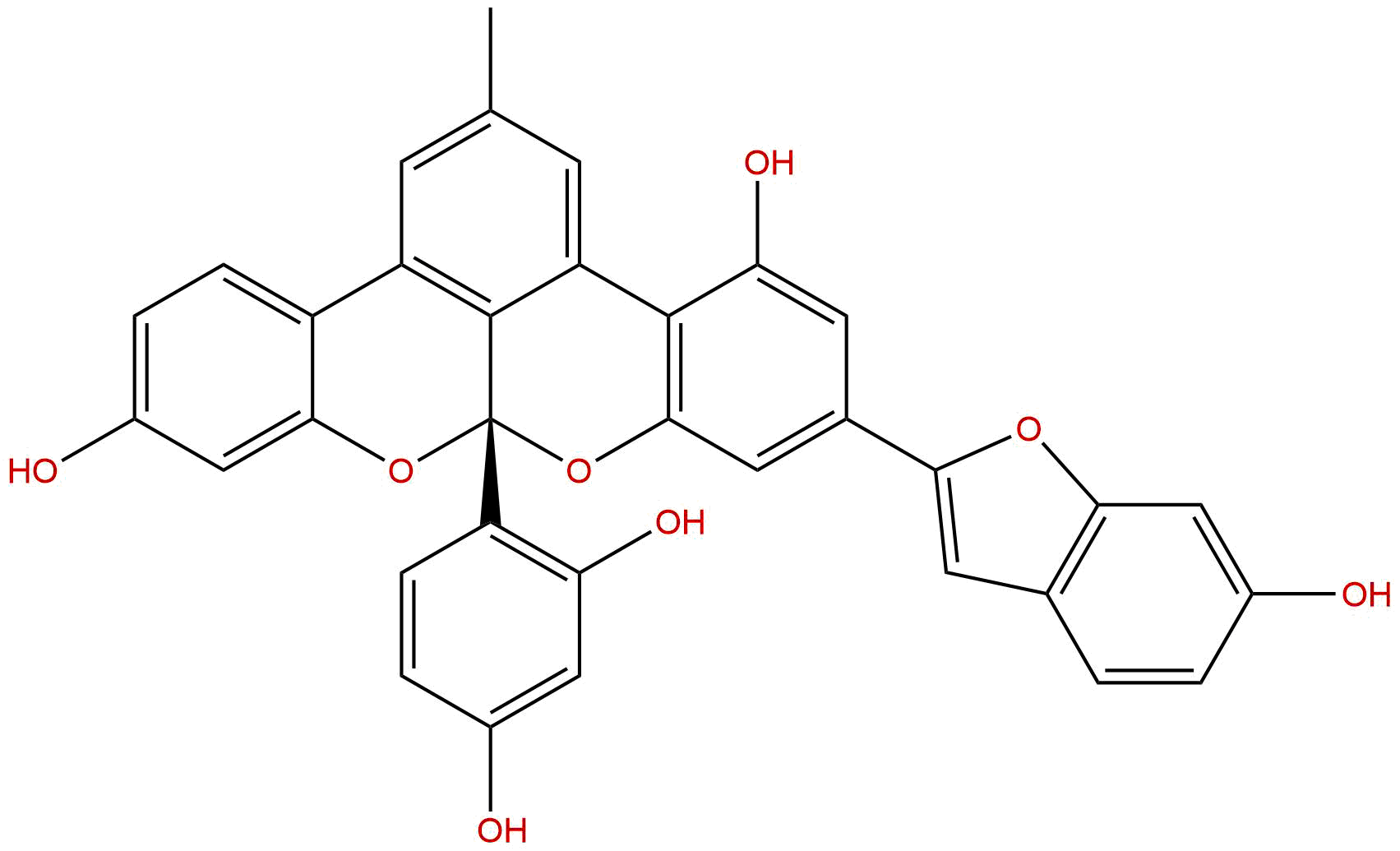
The chemical structure of Albanol B belongs to aromatic benzofuran derivatives. Structurally, its core skeleton is composed of a benzofuran ring connected to one or more aromatic rings through carbon carbon or ether bonds, forming a complex polycyclic system. This unique structure endows Albanol B with specific physicochemical properties and biological activity. Its molecular formula is C ∝₄ H ₂₂ O ₈, with an accurate molecular weight of 558.5420 Da. The molecule contains multiple phenolic hydroxyl groups, which are the structural basis for its antioxidant activity and also affect its polarity and water solubility.
In terms of physicochemical properties, Albanol B exhibits typical lipophilic characteristics. Its lipid water partition coefficient (LogP) is 6.7436, indicating that it has strong lipid solubility and is easy to penetrate biofilms, but it may also lead to poor solubility in aqueous environments. Its water solubility value is only 0.0003 mg/mL, which poses significant challenges for its absorption, distribution, and formulation development in vivo. The topological polar surface area (TPSA) is 132.7500 Å ², which is a relatively high value and usually indicates that the molecule has good oral absorption potential (TPSA<140 Å ² is generally considered good oral absorption), but it may also affect its ability to penetrate the blood-brain barrier (BBB). In fact, its blood-brain barrier permeability has been evaluated as' low ', which to some extent limits its application in the treatment of central nervous system diseases such as Alzheimer's disease, but it may not be a disadvantageous factor for the treatment of peripheral tumors. In addition, preliminary toxicity predictions indicate that Albanol B has a low risk of inhibiting hERG potassium ion channels ("no"), suggesting that its risk of causing arrhythmia side effects such as prolonged QT interval in the heart is relatively small. The Ames test result is 0.6, indicating a low potential genetic toxicity risk, but more comprehensive toxicological evaluation is still needed. These physicochemical properties and preliminary safety data provide important foundational information for further drug development of Albanol B.
Plant sources and extraction methods
Albanol B was originally derived from the mulberry tree, a member of the mulberry family(Morus alba L. Separated from it. Except for mulberry trees, other mulberry plants such as chicken mulberry(Morus australis)Meng Sang(Morus mongolica)It may also contain this compound. In mulberry trees, Albanol B mainly exists in the root bark (mulberry bark) and stem bark, with relatively low levels in fruits and leaves. As a traditional Chinese medicine, mulberry bark has the effects of purging the lungs, relieving asthma, promoting diuresis, and reducing swelling. Its chemical composition is complex, and Albanol B is one of the representative active ingredients.
The extraction of Albanol B is usually carried out using organic solvent extraction method. Due to its strong lipid solubility, commonly used extraction solvents include methanol, ethanol, ethyl acetate, or their mixed solvents. The typical extraction process is as follows: after crushing the dried mulberry root bark or stem bark, soak or reflux extract it with a certain concentration of ethanol (such as 70% -95% ethanol) at room temperature or heating conditions. After filtration and vacuum concentration of the extract, crude extract is obtained. Due to the complex composition of the crude extract, which contains a large amount of flavonoids, stilbene, and other types of compounds, further separation and purification steps are required to obtain high-purity Albanol B.
The separation and purification process usually involves multiple chromatographic techniques. Liquid liquid extraction is a commonly used method for preliminary separation, which uses different polar solvents (such as petroleum ether, ethyl acetate, n-butanol) to perform hierarchical extraction of crude extracts. Albanol B is usually enriched in the ethyl acetate extraction layer. Subsequently, silica gel column chromatography, ODS (octadecylsilane bonded silica gel) reverse phase column chromatography, Sephadex LH-20 gel column chromatography, etc. were used for systematic separation. In silica gel column chromatography, solvent systems such as chloroform methanol and dichloromethane methanol are commonly used for gradient elution. For components with similar structures and difficult separation, high-performance liquid chromatography (HPLC) or preparative thin layer chromatography (PTLC) are key methods for obtaining high-purity monomeric compounds. Through the above series of separation and purification steps, high purity Albanol B monomer can be obtained, and its structure can be confirmed by spectroscopic techniques such as nuclear magnetic resonance (NMR) and mass spectrometry (MS).
Pharmacological activity research
Albanol B exhibits various pharmacological activities, among which anti-tumor activity is its most extensively studied direction. In addition, its potential in neuroprotection and antibacterial properties is also worth paying attention to.
1. Antitumor activity
Numerous in vitro experiments have confirmed that Albanol B has a significant inhibitory effect on the proliferation of various human cancer cell lines. The types of cancer cells involved in the study include but are not limited to: breast cancer (MCF-7, MDA-MB-231), lung cancer (A549, H1299), liver cancer (HepG2), colon cancer (HCT116), prostate cancer (PC-3), cervical cancer (HeLa) and leukemia cells. The half maximal inhibitory concentration (IC ₅₀) of Albanol B on the aforementioned cancer cells is typically at the micromolar level, exhibiting strong cytotoxicity. Its anti-tumor effect is mainly achieved through the following ways:
- Inducing cell cycle arrest Albanol B can block cancer cells in the G2/M phase. This effect is closely related to its downregulation of cyclin dependent kinase 1 (CDK1) expression. The complex formed by CDK1 and Cyclin B1 is a key regulatory factor driving cells from G2 phase to M phase. Albanol B inhibits the expression of CDK1, hindering the formation and activation of this complex, thereby preventing cells from completing mitosis and stagnating at the G2/M checkpoint.
- Inducing cell apoptosis Albanol B can effectively induce apoptosis in cancer cells. The mechanism involves the endogenous (mitochondrial) apoptotic pathway. Research has found that Albanol B treatment can lead to the loss of mitochondrial membrane potential (Δ PSI m), promote the release of cytochrome c from mitochondria to the cytoplasm, activate Caspase-9 and downstream Caspase-3, and ultimately trigger an apoptotic cascade reaction. Meanwhile, Albanol B can regulate the expression of Bcl-2 family proteins, typically by downregulating the expression of anti apoptotic proteins Bcl-2 and Mcl-1, and upregulating the expression of pro apoptotic protein Bax, thereby breaking the stability of the mitochondrial outer membrane and promoting apoptosis.
- Inducing oxidative stress Albanol B can significantly increase the levels of reactive oxygen species (ROS) in cancer cells, especially the production of mitochondrial ROS. Excessive ROS can disrupt intracellular redox balance, damage mitochondrial function, and act as a second messenger to activate downstream stress signaling pathways, ultimately synergistically inducing cell apoptosis.
2. Neuroprotection and anti Alzheimer's disease activity
Early research reported that Albanol B has the potential to combat Alzheimer's disease. The mechanism may be related to the inhibition of acetylcholinesterase (AChE) activity, reduction of aggregation or toxicity of β - amyloid protein (A β), and antioxidant stress. However, given its low blood-brain barrier permeability, its practical application value in central nervous system diseases still needs further evaluation. Its neuroprotective effect may be more reflected in the peripheral nervous system or achieved by regulating the interaction between the peripheral and central nervous systems.
3. Antibacterial and antioxidant activity
Albanol B also exhibits certain inhibitory effects on certain bacteria and fungi, but its antibacterial spectrum and efficacy need to be systematically studied. In addition, the multiple phenolic hydroxyl groups in its molecular structure endow it with direct antioxidant capacity, which can scavenge free radicals such as DPPH free radicals and ABTS cationic free radicals, which may be one of the foundations for its various biological activities.
Mechanism of action and molecular targets
The pharmacological activity of Albanol B, especially its anti-tumor effect, is achieved by regulating a complex signaling network and multiple molecular targets. A deep understanding of its mechanism of action is crucial for developing it as a candidate drug.
1. Regulation of PI3K/AKT and MAPK/ERK signaling pathways
A significant characteristic of Albanol B is its impact on AKT and ERK1/2 phosphorylation levels. Research has found that Albanol B treatment of cancer cells can increase the phosphorylation levels of AKT and ERK1/2. This phenomenon seems contradictory, as the AKT and ERK pathways are typically considered signals that promote cell survival and proliferation. However, under certain stress conditions, the transient activation of AKT and ERK may be a compensatory survival response, or their activation may be associated with downstream pro apoptotic signals. For example, sustained activation of ERK can lead to cellular aging or apoptosis. The activation of AKT and ERK induced by Albanol B may be related to the production of ROS, which can act as signaling molecules to activate these kinases. The ultimate effect of this activation may depend on cell type, processing concentration and time, as well as interactions with other signaling pathways. In addition, Albanol B also affects the STAT3 signaling pathway, which is a transcription factor closely associated with inflammation and tumorigenesis.
2. Regulation of cell cycle and apoptosis related proteins
As mentioned earlier, Albanol B blocks the cell cycle in the G2/M phase by downregulating CDK1 expression. Meanwhile, it induces apoptosis by regulating the expression of Bcl-2 family proteins (Mcl-1, Bcl-2, Bax) and mitochondrial function. These effects collectively constitute the core mechanism of its inhibition of cancer cell proliferation.
3. Direct or indirect interaction with specific molecular targets
Based on literature reports and relevant target information, Albanol B may affect the following targets directly or indirectly:
- MCL1 and BCL2 As an anti apoptotic protein, downregulation of its expression is a key link in Albanol B induced apoptosis.
- STAT3 Inhibiting the phosphorylation and transcriptional activity of STAT3 may help suppress the proliferation and metastasis of tumor cells.
- MMP2 Matrix metalloproteinase-2 (MMP2) is closely related to tumor invasion and metastasis. Albanol B may exert anti metastatic effects by inhibiting the expression or activity of MMP2.
- TOP1 and TOP2A Topoisomerases are essential enzymes for DNA replication and transcription, and are also targets of many chemotherapy drugs. Albanol B may interfere with DNA function by inhibiting topoisomerase activity.
- HIF1A Hypoxia inducible factor-1 alpha (HIF1A) is a key factor in tumor adaptation to the hypoxic microenvironment. Albanol B may inhibit tumor angiogenesis and metabolic reprogramming by suppressing the expression of HIF1A.
- MAPK1 (ERK2)As a core member of the MAPK pathway, its phosphorylation level is regulated by Albanol B and participates in cell fate determination.
- ESR1 and CYP19A1 Estrogen receptor alpha (ESR1) and aromatase (CYP19A1) are important targets for the treatment of breast cancer. Albanol B may affect the growth of hormone dependent tumors by regulating these targets.
It should be pointed out that the interaction between many of the above-mentioned targets and Albanol B is still in the preliminary research or prediction stage, and their direct binding to targets and detailed binding modes still need to be confirmed through experimental methods such as surface plasmon resonance (SPR), drug affinity reaction target stability (DARTS), or cell thermal transition analysis (CETSA).
Evaluation of drug properties and pharmacokinetics
To convert Albanol B from a natural product into a clinical candidate drug, its pharmacological properties must be rigorously evaluated. Based on its physicochemical properties and preliminary pharmacokinetic (PK) predictions, Albanol B faces a series of opportunities and challenges.
1. Pharmaceutical advantages
- Clear pharmacological activity It exhibits micromolar level activity in various tumor models, and its mechanism of action is relatively clear, involving multiple signaling pathways and targets closely related to tumor occurrence and development.
- Preliminary safety is good The hERG inhibition risk is low, and the Ames test suggests a low risk of genetic toxicity, providing a favorable safety basis for its further development.
- Potential for structural modification Its complex aromatic benzofuran skeleton contains multiple modifiable sites (such as phenolic hydroxyl groups), which can be optimized through medicinal chemical methods to improve its pharmacokinetic properties and selectivity.
2. Challenges in drug development
- Extremely poor water solubility The water solubility is only 0.0003 mg/mL, which is the biggest obstacle to its medicinal properties. The extremely low water solubility will seriously affect the oral absorption, intravenous administration, and bioavailability of the drug. Formulation techniques such as nanocrystals, liposomes, cyclodextrin inclusion complexes, solid dispersions, etc. are needed to improve their solubility and dissolution rate.
- High lipophilicity LogP is 6.7436, which is beneficial for penetrating cell membranes, but may also lead to non-specific distribution and accumulation of drugs in tissues in the body, increasing the risk of toxic side effects, and may be rapidly metabolized by the CYP450 enzyme system in the liver, resulting in a short half-life and high clearance rate.
- Low blood-brain barrier permeability This poses limitations for the development of indications for the central nervous system, such as Alzheimer's disease. But for the treatment of peripheral solid tumors, this may not be the main issue and may even reduce central neurotoxicity.
- Lack of systematic pharmacokinetic data Currently, there is very limited research data on the absorption, distribution, metabolism, and excretion (ADME) of Albanol B in animal bodies. The key parameters such as oral bioavailability, plasma protein binding rate, metabolic stability, main metabolic pathways, and excretion mode are still unclear, which seriously hinders its preclinical development process.
Clinical application prospects and prospects
Although Albanol B faces challenges in drug development, its unique chemical structure and multi-target pharmacological mechanism of action make it show potential clinical application prospects in the following fields.
1. Anti tumor therapy
Albanol B exhibits broad-spectrum anti-tumor activity by inducing G2/M phase arrest and mitochondrial apoptosis, as well as regulating signaling pathways such as AKT/ERK and STAT3. Especially its inhibitory effect on key targets such as CDK1, Mcl-1, Bcl-2, makes it promising for development as a therapeutic drug targeting specific types of tumors, such as those sensitive to CDK1 or Bcl-2 family inhibitors. In the future, the combination of Albanol B with existing chemotherapy drugs (such as paclitaxel and cisplatin) or targeted drugs (such as CDK4/6 inhibitors and Bcl-2 inhibitors) can be explored to achieve synergistic effects and reduce drug resistance.
2. Adjuvant therapy for neurodegenerative diseases
Although the blood-brain barrier permeability is low, the antioxidant and anti-inflammatory activities of Albanol B may indirectly affect the central nervous system by regulating peripheral immune or metabolic pathways. In addition, developing special drug delivery systems (such as nanocarriers, brain targeted ligand modifications) to increase its concentration in the brain or explore its therapeutic potential for peripheral neuropathy is also a direction worth considering.
3. Optimize the structure as a lead compound
The complex aromatic benzofuran skeleton of Albanol B provides a good structural modification platform for medicinal chemists. Future research directions may include:
* Improve water solubility Introducing hydrophilic groups such as phosphate groups, amino acid esters, or sugar groups onto phenolic hydroxyl groups to make prodrugs, and releasing the active ingredient through enzymatic interpretation in vivo.
* Optimize pharmacokinetics Modify easily metabolized sites in molecules, such as phenolic hydroxyl groups, by methylation or introducing fluorine atoms to enhance metabolic stability.
* Improve targeting selectivity Design and synthesize derivatives with simplified structures and higher selectivity based on their binding patterns with potential targets such as CDK1 and Bcl-2.
Conclusion
Albanol B, as a natural product of aromatic benzofuran derived from mulberry plants, has shown great potential as a new lead compound for anti-tumor drugs due to its unique chemical structure and various pharmacological activities, especially by regulating CDK1, Bcl-2 family proteins, and AKT/ERK signaling pathways to exert anti-tumor effects. However, its poor water solubility and high lipophilicity, as well as the lack of pharmacokinetic research, constitute the main bottleneck for its clinical drug conversion. Future research should focus on: 1) conducting systematic in vitro and in vivo pharmacokinetic and toxicological studies to comprehensively evaluate their drug properties; 2) Using modern medicinal chemistry strategies to optimize its structure in a rational manner, in order to improve its solubility and metabolic stability; 3) Thoroughly elucidate its direct binding mode with key targets, providing a basis for structure based drug design; 4) Explore its combination application strategy with other drugs to enhance efficacy and overcome drug resistance. Despite the numerous challenges ahead, with its unique mechanism of action and clear activity, Albanol B and its derivatives are expected to make breakthroughs in the development of innovative natural product drugs, contributing to the cause of human health.