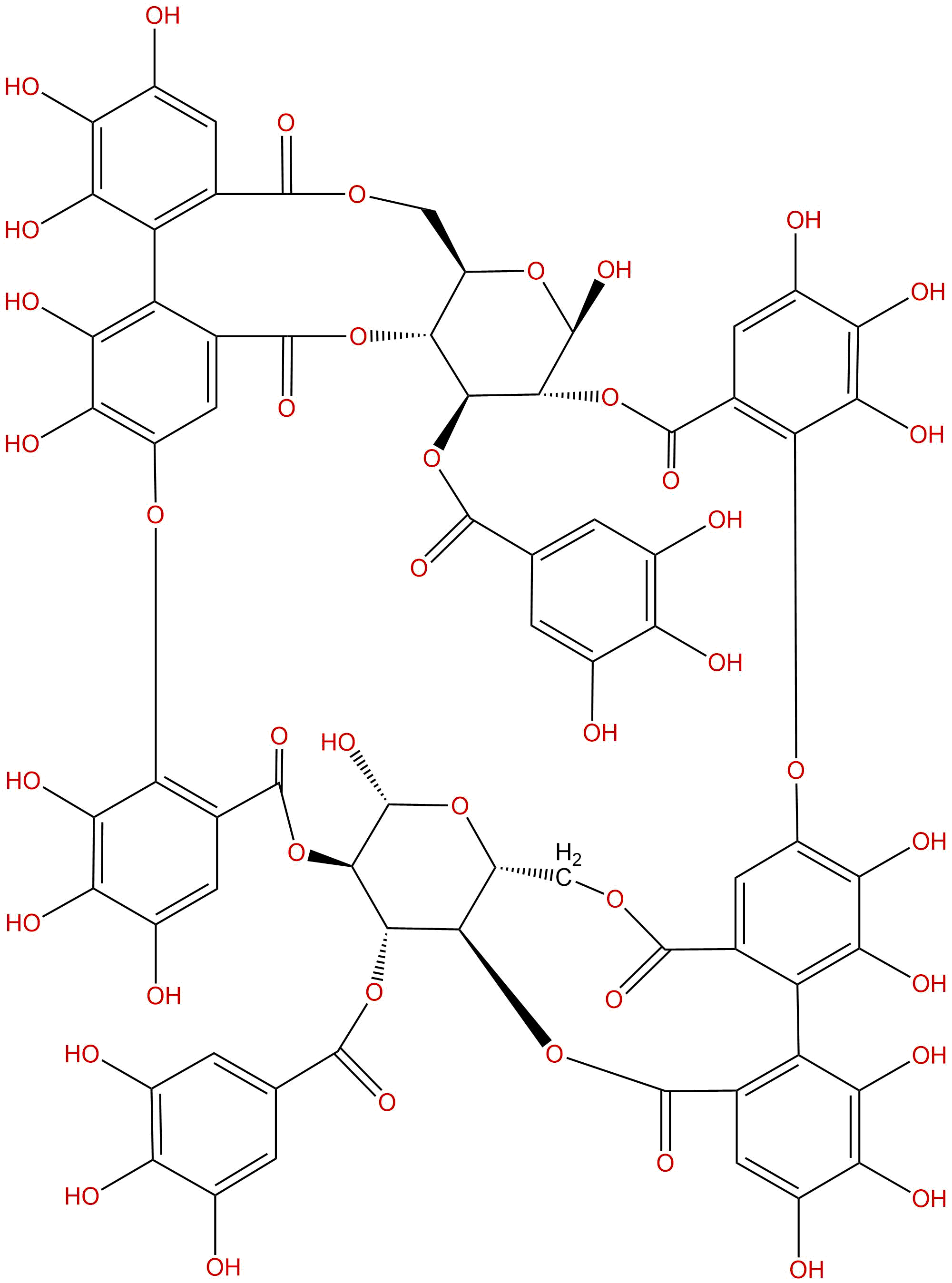


Product name: Oenothein B
Synonym name:
Catalogue No.: BP1809
Cas No.: 104987-36-2
Formula: C68H48O44
Mol Weight: 1569.09
Botanical Source: Oenothera biennis
Physical Description:
Type of Compound:
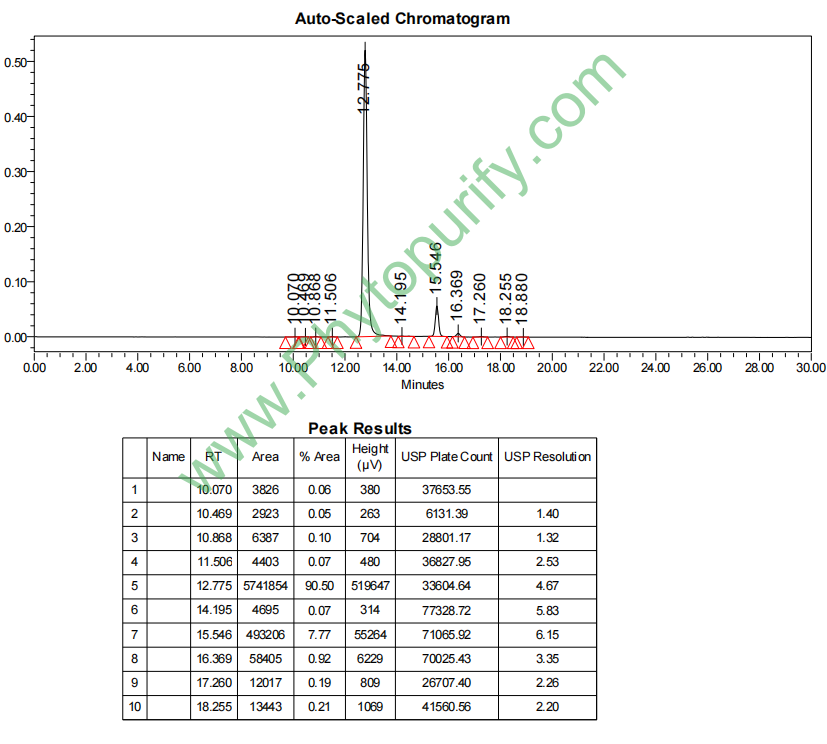
Purity: 95%~99%
Analysis Method: HPLC-DAD or/and HPLC-ELSD
Identification Method: Mass, NMR
Packing: Brown vial or HDPE plastic bottle
The product could be supplied from milligrams to grams. Inquire for bulk scale.
We provide solution to improve the water-solubility of compounds, thereby facilitating the variety of activity tests and clinic uses.
For Reference Standard and R&D, Not for Human Use Directly.
HPLC of Oenothein B
Storage conditions:Short-term storage at 2~8℃, long-term storage at -20 ~ -80℃
732.8400
1.8539
1.8541
.0006
1.1960
.3534
Low
85.6796
8.1110
Yes
Yes
Yes
No
Yes
No
0.6
Yes
No
Yes
No
Natural products have long been an important source of innovative drug discovery, and their structural diversity and wide range of biological activities provide abundant candidate molecules for modern medicine. Among numerous potential natural compounds, macrocyclic tannic acid has attracted much attention due to its complex chemical structure and significant pharmacological activity. Oenothein B, as an outstanding representative of this class of compounds, has attracted sustained research interest in pharmacology and medicinal chemistry due to its unique dimeric macrocycle structure and extensive biological effects since its discovery.
Evening primrose B is a dimeric macrocyclic tanning tannin with a molecular weight exceeding 1500 Da, and its CAS number is 104987-36-2. Early research mainly focused on its basic activities such as antioxidant and anti-inflammatory. With the deepening of research, its more specific pharmacological effects have gradually been revealed. Research has shown that evening primrose B not only has the potential to resist infections such as fungi and viruses (such as anti HCV), but also exhibits remarkable activity in the field of anti-tumor. Of particular importance, it has been identified as an effective and specific inhibitor of poly (ADP ribose) hydrolase (PARG), providing a unique target for its role in pathological processes involving DNA damage repair and cell death, such as cancer treatment and neurodegenerative diseases. In recent years, significant progress has been made in the study of its mechanism of action in immune inflammation related diseases, especially atopic dermatitis, involving the regulation of multiple key targets such as TLR4, TRPV1, TNF - α, NF - κ B (RELA), etc.
This article aims to systematically review the chemical properties, plant sources, pharmacological activities, molecular mechanisms of action, pharmacological evaluation, and clinical application prospects of evening primrose B, in order to provide comprehensive academic references for the in-depth development and transformation research of this natural product.
The chemical structure of evening primrose B is the material basis for its various biological activities. It is a dimeric macrocyclic compound composed of two tanning tannin units connected by C-O-C bonds, each unit containing a highly oxidized hexahydroxybiphenyldicarboxylic acid (HHDP) core, which is further linked to sugar groups such as glucose to form a complex and rigid three-dimensional spatial conformation. This macrocyclic structure endows the molecule with unique spatial hindrance and electron distribution, which is the key to its high affinity interaction with various proteins, especially enzymes.
From the analysis of physical and chemical properties, the molecular weight of evening primrose B is as high as 1569.0880 Da, which makes it a typical macromolecular polyphenolic compound. The calculated lipid water partition coefficient (LogP) is 1.8539, indicating that the molecule has a certain degree of lipophilicity, but not high hydrophobicity. However, its enormous topological polar surface area (TPSA) is as high as 732.8400 Å ², mainly due to the dense polar groups such as phenolic hydroxyl and ester bonds in the molecule. The extremely high TPSA and large molecular weight together determine its extremely low water solubility, with a reported value of about 0.0006 mg/mL in literature, which poses the primary challenge for its formulation development and in vivo absorption. In pharmacokinetic predictions, the ability of evening primrose B to cross the blood-brain barrier was evaluated as "low", which is consistent with the characteristics of large molecules and highly polar compounds. In the preliminary safety screening, the risk of hERG channel inhibition was "no", indicating a low potential risk of causing QT interval prolongation in the heart. The Ames test result is 0.6, indicating a low risk of mutagenicity, but further in vitro and in vivo genetic toxicity studies are needed to confirm.
Kaempferol B was originally isolated from plants in the Onagraceae family, and its name comes from the Oenothera genus. Research has found that this compound is widely present in various plants of the family, such as the aboveground parts of Oenothera stricta and Oenothera rosea, especially in leaves and flower buds where the content is relatively high. In addition, it has also been detected in some traditional medicinal plants such as Circaea spp. and some Rhododendron plants, suggesting that the distribution of this component in the plant kingdom may have a certain regularity and is often related to plant defense mechanisms.
The extraction of evening primrose B from plant materials is usually carried out using solvent extraction method. Due to its polyphenolic properties, medium polarity solvent systems such as methanol water, ethanol water, or acetone water mixed solutions are commonly used as extraction solvents. In order to obtain higher purity of evening primrose B, a series of fine separation and purification steps are required after crude extraction. The commonly used techniques include:
1. Liquid chromatography separation This is the core purification method, especially preparative high-performance liquid chromatography (Prep HPLC), which uses a reverse phase C18 column and gradient elution with acetonitrile water solution containing low concentrations of formic acid or trifluoroacetic acid as the mobile phase to effectively separate evening primrose B from other structurally similar tanning tannins.
2. Column chromatography technology: In the early enrichment stage, macroporous adsorption resin (such as Diaion HP-20) and Sephadex gel (LH-20) column chromatography are often used for preliminary separation. Sephadex LH-20 utilizes the dual principles of molecular sieve and adsorption to achieve excellent separation of polyphenolic compounds.
3. Other methods High speed counter current chromatography (HSCCC), as a liquid-liquid distribution chromatography technique without solid carriers, is also suitable for the preparation and separation of such natural products, which can avoid losses caused by irreversible adsorption.
The extraction and purification process should pay attention to controlling temperature, avoiding light, and pH value to prevent hydrolysis of ester bonds and oxidation of phenolic hydroxyl groups in evening primrose B, ensuring the stability of the compound.
Numerous in vitro and in vivo pharmacological experiments have confirmed that evening primrose B has broad and significant biological activities.
antioxidant activity As a polyphenolic compound rich in phenolic hydroxyl groups, evening primrose B is a potent antioxidant. It can directly scavenge free radicals (such as DPPH free radicals, ABTS ⁺ free radicals, superoxide anions) and has significant iron ion reduction ability. Its antioxidant mechanism is not limited to direct clearance, but also includes chelating metal ions (such as Fe ² ⁺, Cu ² ⁺) to inhibit the Fenton reaction, as well as upregulating the expression of endogenous antioxidant enzyme systems in cells (such as superoxide dismutase (SOD) and glutathione peroxidase (GPx)).
anti-inflammatory activity Yue Jian Cao Su B has shown strong anti-inflammatory effects in various acute and chronic inflammation models. In the lipopolysaccharide (LPS) - induced macrophage (such as RAW264.7) inflammation model, it can dose dependently inhibit the production of nitric oxide (NO), prostaglandin E2 (PGE2), and key inflammatory factors such as tumor necrosis factor - α (TNF - α), interleukin-6 (IL-6), and interleukin-1 β (IL-1 β). In animal models, it has inhibitory effects on carrageenan induced paw swelling in rats and acetic acid induced increased vascular permeability in mice.
Antitumor activity This is one of the most promising research directions for evening primrose B. Studies have shown that it has growth inhibitory and cytotoxic effects on a variety of human cancer cell lines, including leukemia, breast cancer, lung cancer, colon cancer, liver cancer, etc. Its anti-tumor mechanism is complex, involving inducing cell cycle arrest (often in G1 or G2/M phase), inducing tumor cell apoptosis (through mitochondrial and death receptor pathways), inhibiting tumor cell invasion and metastasis, and regulating the tumor microenvironment.
Antiviral and antimicrobial activity Evening primrose B has an inhibitory effect on the replication of hepatitis C virus (HCV). In addition, it exhibits inhibitory activity against various fungi (such as Candida albicans) and some bacteria, which may be related to its ability to bind to microbial cell wall proteins or membrane proteins, disrupting their structural integrity.
Improvement effect on atopic dermatitis Recent research hotspots have shown that evening primrose B can effectively alleviate skin inflammation, erythema, edema, and itching in animal models of atopic dermatitis (AD). It can reduce the infiltration of inflammatory cells in the skin lesions, regulate Th1/Th2 immune balance, reduce serum IgE levels, and demonstrate the potential for treating chronic inflammatory skin diseases.
The multiple pharmacological activities of evening primrose B stem from its interactions with multiple key molecular targets in the body, and its action network is complex and precise.
Specific inhibition of poly (ADP ribose) glycolytic enzyme (PARG)This is the most famous specific target of evening primrose B. PARG is the main enzyme responsible for depolymerizing ADP ribose (PAR) polymers, which are synthesized by poly (ADP ribose) polymerase (PARP) in response to DNA damage. Evening primrose B inhibits PARG, leading to abnormal accumulation of intracellular PAR levels. This accumulation can interfere with normal DNA repair processes and may trigger parthanatos (a PAR dependent cell death pathway), providing a theoretical basis for using it to selectively kill tumor cells with DNA repair defects, such as BRCA mutant cells, as a potential "synthetic death" strategy.
Regulating inflammation and immune related signaling pathways and targets In inflammatory diseases such as atopic dermatitis, evening primrose B acts in multiple stages:
Affects cell cycle and apoptosis related proteins In anti-tumor effects, evening primrose B can upregulate pro apoptotic proteins (such as Bax, caspase-3), downregulate anti apoptotic proteins (such as Bcl-2), and regulate the expression of cell cycle proteins (such as cyclin D1, cyclin B1) and cyclin dependent kinase inhibitors (such as p21).
In summary, evening primrose B acts as a "multi-target regulator", with its macrocyclic structure capable of binding to hydrophobic pockets or specific structural domains of multiple proteins through "molecular gel" or conformational regulation, thereby achieving synergistic intervention in multiple pathological pathways.
Although the pharmacological activity of evening primrose B is excellent, its medicinal properties face significant challenges, mainly due to its physical and chemical properties.
Prediction and Challenges of Absorption, Distribution, Metabolism, and Excretion (ADME):
Preliminary evaluation of safety The existing data (hERG negative, Ames test negative) provide preliminary safety signals. However, the systemic toxicity of high-dose or long-term administration, especially the potential effects on the liver and kidneys, as well as the off target effects that may arise from its potent biological activity, need to be evaluated through comprehensive preclinical toxicology studies (acute toxicity, subchronic toxicity, reproductive toxicity, etc.).
Pharmaceutical Strategy It is crucial to develop new delivery systems in order to overcome the bottleneck of drug efficacy. For example, preparing it as a phospholipid complex, encapsulating it in cyclodextrin, or designing it as a self microemulsion delivery system can significantly improve its apparent solubility and oral absorption. For skin diseases (such as atopic dermatitis), the development of topical agents (such as gel, cream, nano particle transdermal system) is a promising direction, which can avoid systemic pharmacokinetic problems and directly act on the target site.
The diversified pharmacological activities of evening primrose B have brought broad application prospects for it in multiple therapeutic fields, but at the same time, it also points out the direction that future research needs to break through.
Potential therapeutic areas:
Future research directions:
Yuejian Cao Su B, as a dimeric macrocyclic tanning tannin with unique structure and wide biological activity, is a shining pearl in the pharmacological research of natural products. From the initial antioxidant properties, to the discovery of specific PARG inhibitors, and to the revelation of multi-target intervention mechanisms such as atopic dermatitis, the research process reflects a modern drug discovery pathway from phenotype screening to deep target exploration. Although its inherent physicochemical properties, such as high molecular weight and low solubility, pose significant challenges for its direct drug development, this has precisely stimulated innovation in the fields of medicinal chemistry, pharmacy, and delivery technology among researchers. With a more detailed description of its mechanism of action and the continuous emergence of new derivatives and advanced formulation technologies based on its pharmacological skeleton, evening primrose B is expected to transform from an excellent natural active molecule into a new drug lead compound that can be used for clinical treatment, especially in the fields of tumor targeted therapy and skin local therapy. Its research not only has important scientific value, but also provides a successful example for the comprehensive development and utilization of plant resources.
