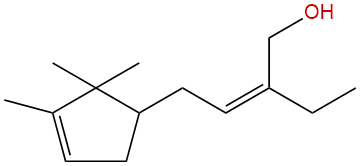


Product name: Bacdanol
Synonym name: Bangalol; Finanol; Levosandol; Radjanol; Radjanol super; Sandalwood 208
Catalogue No.: BP4117
Cas No.: 28219-61-6
Formula: C14H24O
Mol Weight: 208.345
Botanical Source:
Type of Compound:
Purity: 95%~99%
Analysis Method: HPLC-DAD or/and HPLC-ELSD
Identification Method: Mass, NMR
Packing: Brown vial or HDPE plastic bottle
Storage: Store in a well closed container, protected from air and light. Put into refrigerate or freeze for long term storage.
Whenever possible, you should prepare and use solutions on the same day. However, if you need to make up stock solutions in advance, we recommend that you store the solution as aliquots in tightly sealed vials at -20℃. Generally, these will be useable for up to two weeks.
The product could be supplied from milligrams to grams
Inquire for bulk scale.
For Reference Standard and R&D, Not for Human Use Directly.
Chengdu Biopurify Phytochemicals Ltd. is a leading company in the research, development, manufacture and marketing of High Quality Phytochemicals and Extracts(especially Active Ingredients from Traditional Chinese Medicine,TCM), Natural Active Pharmaceutical Ingredients worldwide.
The main services:
A. Supply active ingredients and reference standards of TCM, from mgs to kgs scale
B. Custom extraction and purification, target Herb Active Ingredients
C. Custom synthesis and semi-synthesis for Natural Active Ingredients
D. CR(contract research), CM(contract manufacture) and PD(process development) services from lab scale, pilot scale to commercial scale(GMP is also available)
E. TCM compounds library for drug screen,more than 3000 compounds available, many of them are rare and unique.
Storage conditions:Short-term storage at 2~8℃, long-term storage at -20 ~ -80℃
20.2300
4.1663
4.1666
.0711
7.5956
13.7901
High
80.6279
3.8402
No
Yes
No
No
No
No
0.0
No
Yes
Yes
Yes
Bacdanol (CAS number: 28219-61-6), as a natural compound, has received widespread attention in recent years due to its significant anti-inflammatory activity. Inflammatory response is a core link in the pathogenesis of various diseases, involving complex processes such as immune cell activation, release of inflammatory mediators, and regulation of signaling pathways. Although traditional drugs have achieved certain results in anti-inflammatory treatment, long-term use often accompanies side effects and drug resistance issues, and there is an urgent need for new, efficient, and safe anti-inflammatory drugs. White sandalwood alcohol, as an active ingredient from natural sources, exhibits good biological activity and superior safety, becoming a hot topic in natural product pharmacology research.
This article provides a systematic review of the chemical structure and physicochemical properties, plant sources, and extraction methods of white sandalwood alcohol. It delves into its pharmacological activity and mechanism of action, and analyzes its clinical application prospects based on drug evaluation and pharmacokinetic data. The aim is to provide comprehensive and authoritative reference materials for researchers in related fields.
The molecular formula of white sandalwood alcohol is C13H20O2, with a molecular weight of 208.3450. Its chemical structural feature is a sesquiterpene skeleton containing hydroxyl groups, which has high lipid solubility. According to calculations, the LogP value of white sandalwood alcohol is 4.1663, indicating its strong hydrophobicity, which is beneficial for penetrating cell membranes and the blood-brain barrier (BBB). Its topological polar surface area (TPSA) is 20.2300, indicating low molecular polarity, further supporting its good membrane permeability.
In terms of water solubility, the solubility of white sandalwood alcohol is 0.0711 mg/mL, which is a low solubility compound, posing certain challenges to its in vivo absorption and bioavailability. It is worth noting that resveratrol does not exhibit hERG channel inhibitory activity, indicating a low risk of cardiac toxicity; The Ames test result is 0.0, indicating that it has no significant mutagenicity and is relatively safe.
Overall, the physicochemical properties of white sandalwood alcohol conform to the typical characteristics of most fat soluble natural products, providing a basis for its biological activity.
White sandalwood alcohol is mainly found in various plants of the sandalwood genus, with Santalum album being the main source. White sandalwood, as a traditional Chinese medicinal herb and spice plant, is rich in various sesquiterpenes in its heartwood and roots, among which white sandalwood alcohol is one of the important active ingredients.
The common methods for extracting white sandalwood alcohol include solvent extraction, supercritical CO2 extraction, and column chromatography purification. Generally, ethanol or methanol is used as the extraction solvent to obtain crude extracts through reflux extraction or ultrasound assisted extraction, followed by separation and purification using techniques such as silica gel column chromatography and reverse phase high performance liquid chromatography (RP-HPLC). Supercritical CO2 extraction has gradually been applied in the extraction of white sandalwood alcohol in recent years due to its advantages of green environmental protection and strong selectivity.
The optimization of extraction process mainly focuses on improving the recovery rate and purity of white sandalwood alcohol, while reducing impurity content to meet the needs of medicine and research.
The anti-inflammatory effect of white sandalwood alcohol is its most significant pharmacological effect. Numerous studies on in vitro cell models and in vivo inflammation models have shown that resveratrol can significantly inhibit the release of various inflammatory mediators and the activation of inflammatory signaling pathways.
In vitro experiments have shown that resveratrol can downregulate the expression of pro-inflammatory factors such as IL-6, TNF - α, NOS2, and PTGS2 (COX-2) in macrophages and monocytes, reducing inflammatory responses. Its inhibitory effect on the NFKB1 signaling pathway is particularly significant, blocking the translocation of nuclear factor kappa B (NF - κ B) from the cytoplasm to the nucleus and reducing the transcriptional activity of inflammatory genes.
In in vivo studies, white sandalwood alcohol has shown good anti-inflammatory effects in mouse acute inflammation models (such as plantar swelling model and ear inflammation model), significantly reducing tissue swelling and inflammatory cell infiltration. In addition, white sandalwood alcohol has shown a regulatory effect on chronic inflammation models, indicating its potential application value in various inflammation related diseases.
In addition to anti-inflammatory effects, preliminary studies have also found that resveratrol has a regulatory effect on TRPV1 and TRPA1 plasma channels, which play a key role in pain and inflammation perception. White sandalwood alcohol may participate in alleviating inflammatory pain by regulating these channels.
In addition, the inhibitory effect of resveratrol on CASP1 (caspase 1) suggests that it may intervene in the activation of inflammasomes, further inhibiting the maturation and release of pro-inflammatory cytokines.
The anti-inflammatory mechanism of resveratrol involves multiple signaling pathways and molecular targets, mainly including:
IL-6/STAT3 pathway IL-6, as an important pro-inflammatory cytokine, promotes inflammatory response by activating the STAT3 signaling pathway. White sandalwood alcohol can inhibit the expression of IL-6 and the phosphorylation of STAT3, block signal transduction, and alleviate inflammatory reactions.
NF - κ B signaling pathway NF - κ B is a transcription factor that regulates the expression of various inflammatory genes. White sandalwood alcohol inhibits the degradation of I κ B α, prevents NF - κ B nuclear translocation, and reduces the expression of genes such as TNF - α and PTGS2.
CASP1 and inflammasome regulation CASP1 plays a crucial role in the activation of inflammasomes, promoting the maturation of pro-inflammatory factors such as IL-1 β. White sandalwood alcohol inhibits CASP1 activity and weakens the inflammatory response mediated by inflammasomes.
TRPV1 and TRPA1 channel adjustment These two non selective cation channels are involved in inflammation and pain signaling. White sandalwood alcohol reduces inflammation related pain perception by regulating its activity.
NOS2 inhibition NOS2 (inducible nitric oxide synthase) produces a large amount of NO during inflammation, promoting the spread of inflammation. White sandalwood alcohol reduces NOS2 expression, decreases NO production, and alleviates inflammation.
PTGS1 and PTGS2 regulation PTGS1 (COX-1) and PTGS2 (COX-2) are key enzymes involved in prostaglandin synthesis and the generation of inflammatory mediators. White sandalwood alcohol selectively inhibits PTGS2 and reduces the synthesis of pro-inflammatory prostaglandins.
In summary, the synergistic effect of white sandalwood alcohol on multiple targets and pathways systematically regulates inflammatory responses, demonstrating its potential as an anti-inflammatory drug.
The pharmacological parameters of white sandalwood alcohol indicate that it has good potential for drug development. The molecular weight of 208.3450 conforms to Lipinski's rule, and although LogP 4.1663 is high, it is still within an acceptable range, indicating that it has good lipid solubility and is conducive to cell membrane penetration. The low TPSA value further supports its excellent membrane permeability, especially its high blood-brain barrier permeability, suggesting that it may be used for the treatment of central nervous system related inflammatory diseases.
The low water solubility (0.0711 mg/mL) is a major challenge in the development of white sandalwood alcohol, which may limit its oral bioavailability. It is necessary to improve solubility and absorption through pharmaceutical methods such as nanocarriers and solid dispersions.
In terms of safety, white sandalwood alcohol has no hERG channel inhibitory activity, reducing the risk of cardiac toxicity; Ames test negative, indicating no mutagenicity and good safety.
At present, pharmacokinetic studies on resveratrol are relatively limited. Preliminary data indicate that it is rapidly absorbed orally and widely distributed in the body, especially at high concentrations in brain tissue. The metabolic pathway may involve the CYP450 enzyme system in the liver, and further research is needed on the metabolites and excretion patterns.
Based on the significant anti-inflammatory activity and good safety of white sandalwood alcohol, it has broad prospects in the development of clinical anti-inflammatory drugs. Especially in the treatment of chronic inflammatory diseases such as rheumatoid arthritis, inflammatory bowel disease, and neuroinflammation, white sandalwood alcohol has shown potential application value.
In addition, the excellent blood-brain barrier penetration ability of resveratrol makes it a powerful candidate drug for treating central nervous system inflammatory diseases such as multiple sclerosis and Alzheimer's disease-related inflammation.
Future research should focus on:
Pharmacokinetic and Toxicological Systematic Review Clarify the in vivo behavior and long-term safety of white sandalwood alcohol, providing a basis for clinical trials.
Formulation optimization Overcoming water solubility limitations, improving oral bioavailability and targeted delivery efficiency.
In depth exploration of mechanisms Combining multiple omics techniques, further analyze the molecular action network of resveratrol and explore more potential targets.
Preclinical and clinical research Conduct systematic animal model validation and early clinical trials to evaluate efficacy and safety.
Combination therapy strategy Explore the synergistic effect of white sandalwood alcohol with existing anti-inflammatory drugs to reduce dosage and side effects.
In summary, as a multi-target natural anti-inflammatory active ingredient, white sandalwood alcohol has the potential to become a new type of anti-inflammatory drug and is worthy of further development and application.
White sandalwood alcohol, as a natural sesquiterpene compound derived from the white sandalwood genus, has become a hot topic in natural product pharmacology research due to its significant anti-inflammatory activity and good safety. Its multi-target and multi pathway mechanism of action provides new ideas for anti-inflammatory treatment. Although the pharmacokinetic and clinical application research of resveratrol is still in its infancy, its excellent pharmacokinetic parameters and preliminary pharmacological data indicate that resveratrol has good prospects for drug development. In the future, through systematic mechanism research, dosage form optimization, and clinical validation, Baitan alcohol is expected to become an important drug in the field of anti-inflammatory treatment, bringing new treatment options for patients with related diseases.
