

Storage conditions:Short-term storage at 2~8℃, long-term storage at -20 ~ -80℃
119.3100
-.6325
-.6324
7.0545
.7919
.6533
High
28.7920
3.4842
No
Yes
No
No
Yes
No
1.2
Yes
No
Yes
No
2 '- Deoxyadenosine monohydrate (CAS number: 16373-93-6), as an important nucleoside natural product, has extensive research value in the fields of life sciences and pharmacology. As one of the fundamental building blocks of DNA, 2 '- deoxyadenosine not only plays a crucial role in the storage and transmission of genetic information, but its derivatives and metabolites also exhibit significant biological activity in various biological processes. In recent years, with the deepening development of natural product pharmacology, the pharmacological effects, molecular mechanisms, and potential clinical applications of 2 '- deoxyadenosine have gradually become a research hotspot.
This review aims to systematically summarize the chemical structure and physicochemical properties, plant sources and extraction methods, pharmacological activity and mechanism of action of 2 '- deoxyadenosine monohydrate, and explore its application prospects in the treatment of related diseases based on its pharmacological parameters and pharmacokinetic characteristics. The goal is to provide theoretical support and research ideas for subsequent basic research and clinical translation.
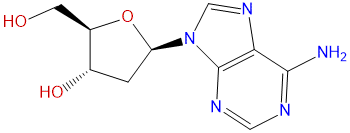
The molecular formula of 2 '- deoxyadenosine monohydrate is C10H13N5O3, with a molecular weight of 251.2460. Its structure is composed of adenine bases and 2 '- deoxyribose connected by β - N9 glycosidic bonds, forming a typical deoxyribonucleotide structure. Compared to ribose, the hydroxyl group at the 2 '- position is replaced by hydrogen, giving it higher chemical stability and specific biological functions.
In terms of physical and chemical properties, the LogP value of 2 '- deoxyadenosine monohydrate is -0.6325, indicating its strong hydrophilicity and easy solubility in water (solubility of about 7.0545 mg/mL), which is conducive to absorption and distribution in vivo. Its topological polar surface area (TPSA) is 119.3100 Å ², indicating that the molecule has a large number of polar groups, which may affect its membrane permeability. It is worth noting that this compound has a high blood-brain barrier penetration ability, indicating its potential advantages in the treatment of central nervous system diseases. In addition, 2 '- deoxyadenosine monohydrate does not exhibit hERG channel inhibitory activity, reducing the risk of cardiac toxicity; The Ames test result is 1.2, indicating low mutagenicity and good safety.
2 '- deoxyadenosine, as a nucleoside compound, is widely present in the nuclei of various plants, especially in plant tissues rich in nucleic acids such as seeds, shoots, and leaves, where its content is relatively high. Common plants rich in 2 '- deoxyadenosine include Taxus spp., Ginkgo biloba leaves, and certain medicinal herbs.
The extraction method is mainly based on the fragmentation and extraction of plant tissues, and commonly used steps include:
In recent years, the application of emerging technologies such as ultrasound assisted extraction and microwave-assisted extraction has significantly improved extraction efficiency and purity, providing technical support for large-scale preparation.
2 '- deoxyadenosine, as a nucleoside compound, mainly exhibits pharmacological activities in regulating cellular metabolism, participating in DNA repair, and regulating immune responses. Numerous in vitro and in vivo studies have revealed its potential therapeutic effects in various disease models.
anticancer activity 2 '- deoxyadenosine induces cancer cell apoptosis and inhibits tumor cell proliferation by interfering with DNA synthesis and repair processes. Some studies have shown that it can enhance the sensitivity of chemotherapy drugs and has a synergistic anti-cancer effect.
immunomodulation As an important substrate for immune cell metabolism, 2 '- deoxyadenosine affects the proliferation and differentiation of lymphocytes, regulates inflammatory responses, and exhibits certain anti-inflammatory and immune regulatory activities.
Neuroprotective effect Its excellent blood-brain barrier penetrability suggests potential neuroprotective effects in neurodegenerative diseases, possibly by regulating neuronal energy metabolism and reducing oxidative stress.
Antiviral activity Partial studies have shown that 2 '- deoxyadenosine and its derivatives can inhibit viral nucleic acid synthesis, block viral replication, and particularly exhibit inhibitory effects in certain DNA virus infections.
The biological effects of 2 '- deoxyadenosine mainly depend on its metabolic transformation within cells and its interaction with molecular targets. Its mechanism of action includes:
Regulation of nucleoside metabolism pathway 2 '- deoxyadenosine, as a precursor of deoxyribonucleotides, participates in DNA synthesis and repair, affecting the cell cycle progression. Its metabolites can regulate nucleotide pool balance, affecting cell proliferation and apoptosis.
Substrate competition between DNA polymerase and nuclease By binding to DNA polymerase, 2 '- deoxyadenosine competitively inhibits DNA synthesis, leading to DNA strand termination and inducing cell death.
Regulating cellular signaling pathways 2 '- deoxyadenosine and its metabolites can affect various signaling pathways, such as MAPK, PI3K/Akt, and regulate cell survival, proliferation, and metabolism.
Immune regulatory targets By regulating the metabolic activity of T cells and B cells, it affects the activation of immune cells and the release of inflammatory mediators.
Neuroprotective mechanism Perhaps by regulating mitochondrial function and antioxidant enzyme activity, it can alleviate oxidative damage to nerve cells and protect neuronal survival.
From the perspective of drug properties, 2 '- deoxyadenosine monohydrate exhibits excellent medicinal properties. It has a moderate molecular weight and high water solubility, which is beneficial for oral absorption and in vivo distribution. A negative LogP value indicates its hydrophilicity, which is beneficial for dissolution and transport in the blood. Although high TPSA values may limit cell membrane permeability, their high blood-brain barrier permeability suggests potential application advantages in the central nervous system.
In terms of safety, 2 '- deoxyadenosine has no hERG channel inhibitory effect, reducing the risk of cardiac toxicity. The Ames test results showed low mutagenicity and good safety, making it suitable for further clinical development.
Pharmacokinetic studies have shown that 2 '- deoxyadenosine is rapidly taken up and metabolized by cells in vivo, mainly through the phosphorylation pathway mediated by nucleoside kinases, and converted into active nucleotide form. Its half-life is moderate, and its metabolites are mainly excreted through the kidneys. The high permeability of the blood-brain barrier enables it to reach effective concentrations in brain tissue, with the potential to treat central nervous system diseases.
Based on its unique pharmacological activity and good drug properties, 2 '- deoxyadenosine monohydrate has shown broad clinical application prospects in multiple fields:
Antitumor therapy As an adjuvant chemotherapy drug, 2 '- deoxyadenosine can enhance the efficacy of traditional drugs and reduce the development of drug resistance. In the future, structural modification can be used to improve its selectivity and stability, and develop new anti-cancer drugs.
Neurodegenerative diseases Its excellent blood-brain barrier penetration and neuroprotective effects make it potentially applicable in neurodegenerative diseases such as Alzheimer's disease and Parkinson's disease.
Immune regulation and anti-inflammatory effects In autoimmune diseases and chronic inflammation, 2 '- deoxyadenosine may exert therapeutic effects by regulating immune cell function.
antiviral therapy Although research on DNA virus infection is still in its preliminary stage, its potential cannot be ignored, and in the future, it can be combined with drug design to optimize antiviral activity.
Future research should focus on in-depth analysis of its metabolic pathways, optimization of drug delivery systems, and systematic evaluation of clinical safety and efficacy. In addition, the structural modification and derivative development based on 2 '- deoxyadenosine will provide more possibilities for its clinical translation.
2 '- deoxyadenosine monohydrate, as an important natural nucleoside compound, has demonstrated potential applications in various fields such as anti-cancer, neuroprotection, immune regulation, and antiviral due to its unique chemical structure and excellent pharmacological activity. Its excellent pharmacological parameters and safety have laid a solid foundation for clinical development. In the future, through interdisciplinary research, the mechanism of action of 2 '- deoxyadenosine and its derivatives will be deeply revealed and drug performance will be optimized, which is expected to promote 2' - deoxyadenosine and its derivatives to become a new generation of highly efficient and safe therapeutic drugs, benefiting a large number of patients.
