Introduction/Overview
Natural products, as an important source of drug discovery, have written a brilliant chapter in the history of human struggle against diseases. From the classic analgesic morphine to the antimalarial drug artemisinin, plant secondary metabolites continue to provide valuable lead compounds for modern drug development due to their unique chemical diversity and biological activity. In the field of mental and neurological disorders, especially in the treatment of anxiety disorders, although existing drugs such as benzodiazepines and selective serotonin reuptake inhibitors (SSRIs) have been widely used, there are generally limitations such as dependence, tolerance, wide spectrum of side effects, or delayed onset. Therefore, searching for anti anxiety candidate molecules with new mechanisms of action, high selectivity, and low toxicity from traditional medicinal plants has become one of the hotspots in current natural product pharmacology research.
In this context, a natural phenyl glucoside compound called Methoxyeugenol 4-O-rutinoside has attracted the attention of researchers due to its potential anti anxiety activity. This compound was originally derived from the narrow leaved tiger bark fern(Daphniphyllum angustifolium)Separated from the bark of the tree. Tiger skin South genus(Daphniphyllum)Plants are widely used in traditional medicine in East Asia, and their chemical composition is complex. They are known for their diverse structure of tiger bark alkaloids, but also contain various phenylpropanoids, flavonoids, and phenolic glycosides. The discovery of methoxyeugenol 4-O-rutinoside not only enriches the chemical composition library of this genus of plants, but more importantly, it is predicted to have the potential to act on multiple targets for anti anxiety, providing a new chemical entity for the development of novel anti anxiety drugs.
This article provides a systematic review of the research progress on methoxyeugenol 4-O-rutinoside, covering its chemical structure and physicochemical properties, plant sources and extraction methods, pharmacological activity, mechanism of action, drug evaluation, and clinical application prospects. The aim is to provide comprehensive scientific basis for the in-depth research and development of this natural product.
Chemical structure and physicochemical properties
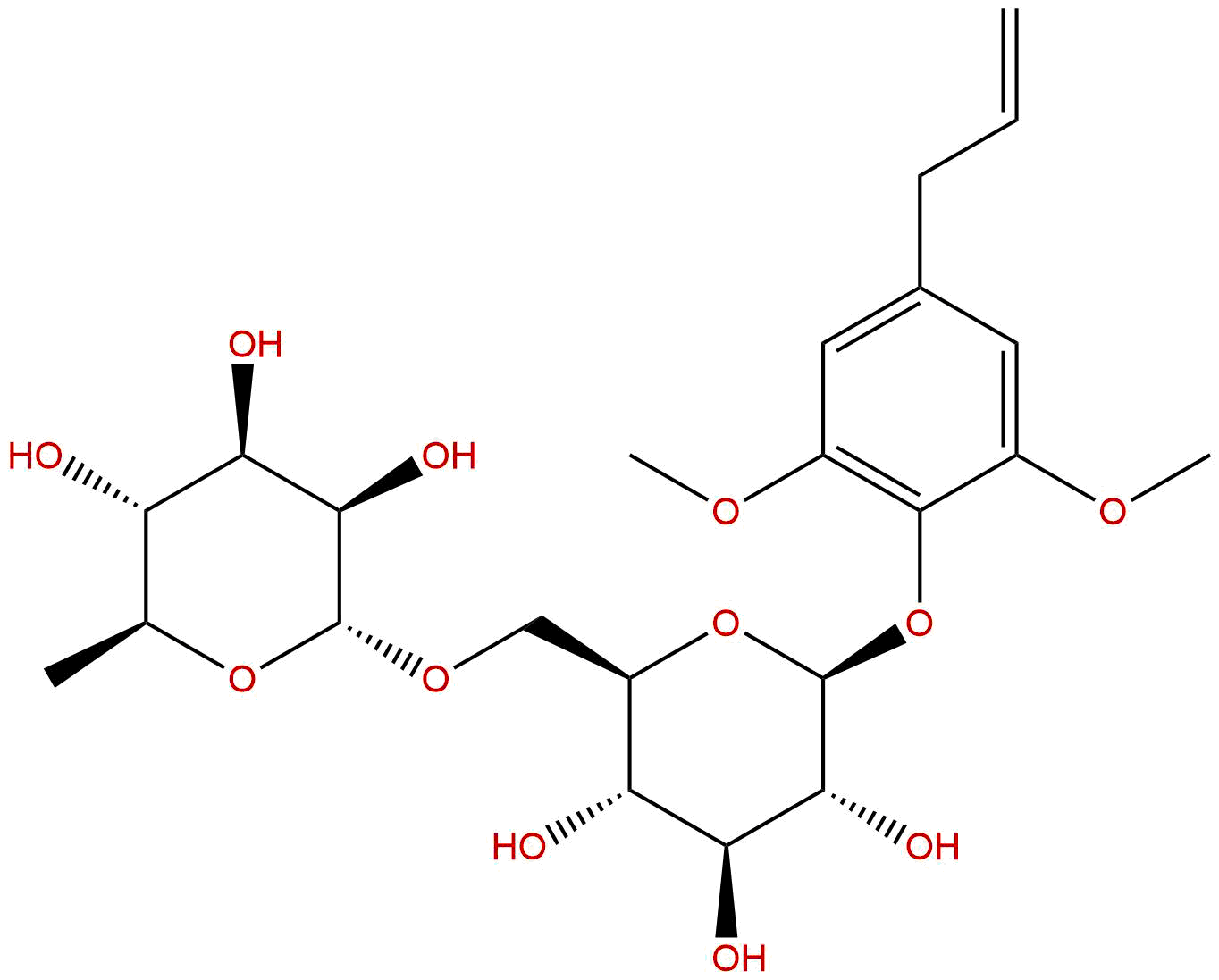
The chemical structure of methoxyeugenol 4-O-rutinoside belongs to the phenyl glucoside class. Specifically, its aglycone is methoxyeugenol, and the sugar moiety is rutinose. Rutin is a disaccharide composed of α - L-rhamnose - (1 → 6) - β - D-glucose. This compound is connected to the 4-hydroxy group of methoxyeugenol through a glycosidic bond, hence the name methoxyeugenol 4-O-rutinoside. Its IUPAC naming is relatively complex and can usually be described as: 1,2-dimethoxy-4- (2-propen-1-yl) phenyl-6-O - (6-deoxy - α - L-mannopyranosyl) - β - D-glucopyranoside. Its molecular formula is C ₂∝ H ∝₄₁₂, and its molecular weight is 502.5130 g/mol.
From the perspective of physical and chemical properties, this compound exhibits typical glycosidic characteristics. Its lipid water partition coefficient (LogP) is -0.2344, indicating strong hydrophilicity and high solubility in water (water solubility value of 25.2273). This property is closely related to the sugar moiety containing multiple hydroxyl groups in its molecule. Higher water solubility is beneficial for its absorption and transport in organisms, but it may also lead to weaker transmembrane ability, especially difficulty in crossing the blood-brain barrier (BBB). Its topological polar surface area (TPSA) is as high as 176.7600 Å ², far exceeding the recommended upper limit of 140 Å ² for oral medications, further confirming its high polarity and difficulty in penetrating biofilms. High TPSA values are often associated with poor intestinal absorption and low blood-brain barrier permeability. Therefore, the oral bioavailability of this compound in vivo may not be high, and its central nervous system (CNS) activity may require specific transport mechanisms or improvement through prodrug design.
Plant sources and extraction methods
The main known plant source of methoxy eugenol 4-O-rutinoside is the narrow leaved tiger bark fern(Daphniphyllum angustifolium). This plant belongs to the Daphniphyllaceae family and the Daphniphyllaceae genus, mainly distributed in China, Japan, and Southeast Asia. The bark of the narrow leaved tiger bark is the site where this compound was first isolated and identified. In addition, it belongs to other plants such as Jiaorang wood(D. macropodum)Wait, it may also contain similar components, but the specific content and distribution still need further research.
The extraction of this compound from plant materials typically follows the classic process of natural product chemistry. Due to the high polarity of the compound, commonly used extraction solvents are methanol, ethanol, or aqueous alcohols. The specific steps generally include:
1. Raw material pretreatment Crush the dried bark of narrow leaved tiger bark and sieve it.
2. Extract Using methods such as cold soaking, percolation, or reflux extraction, multiple extractions are carried out using 80% -95% ethanol or methanol, and the extracted solutions are combined.
3. Concentration and preliminary separation Concentrate the extract under reduced pressure to obtain the total extract. The total extract can be sequentially extracted with solvents of different polarities such as petroleum ether, ethyl acetate, n-butanol, etc. for liquid-liquid extraction to enrich the target components. Due to the high polarity of methoxyeugenol 4-O-rutinoside, it is usually enriched in the n-butanol extraction layer.
4. chromatographic separation Systematic chromatographic separation of n-butanol extract. Common methods include silica gel column chromatography (using chloroform methanol water gradient elution system), ODS (octadecyl silane bonded silica gel) reverse phase column chromatography (using methanol water or acetonitrile water system) and Sephadex LH-20 gel column chromatography (using methanol or methanol water system). By repeated column chromatography combined with thin-layer chromatography (TLC) detection, the target compound with high purity was finally obtained.
5. Structural Identification Using modern spectroscopic techniques such as nuclear magnetic resonance spectroscopy (NMR, including ¹ H-NMR, ¹ ³ C-NMR, DEPT, HSQC, HMBC, etc.) and high-resolution mass spectrometry (HR-ESI-MS), the isolated compound was structurally analyzed and ultimately confirmed to be methoxyeugenol 4-O-rutinoside.
Pharmacological activity research
At present, there is relatively limited direct pharmacological activity experimental data on methoxyeugenol 4-O-rutinoside, and its main pharmacological activity information comes from structure based virtual screening and network pharmacology prediction. The study suggests that the most prominent potential pharmacological activity of this compound is its anxiolytic effect.
Anxiety disorder is a common mental disorder with complex pathological mechanisms involving multiple neurotransmitter systems. Traditional anti anxiety drugs such as benzodiazepines mainly exert their effects by enhancing gamma aminobutyric acid (GABA) neurotransmission, while SSRIs regulate emotions by inhibiting the reuptake of serotonin (5-HT). Network pharmacology prediction shows that methoxyeugenol 4-O-rutinoside may exert synergistic effects by simultaneously acting on multiple anxiety related targets, which is in line with the concept of "multi-target therapy" in modern drug development.
The predicted targets include:
* Monoamine oxidase A (MAOA)MAOA is a key enzyme that degrades monoamine neurotransmitters such as 5-HT, norepinephrine, and dopamine. Inhibiting MAOA activity can increase the concentration of these neurotransmitters in the synaptic cleft, thereby producing antidepressant and anti anxiety effects.
* 5-hydroxytryptamine transporter (SLC6A4)SLC6A4 is responsible for reuptake of 5-HT in the synaptic cleft back into presynaptic neurons. Inhibiting this transporter is the core mechanism of action of SSRIs drugs, which can increase the level of 5-HT in synaptic cleft and improve anxiety.
* 5-hydroxytryptamine receptor 2A (HTR2A) and 1A (HTR1A)5-HT regulates emotions and behavior by acting on multiple receptor subtypes. The activation of HTR1A receptors is believed to have anti anxiety effects, while excessive activation of HTR2A receptors may be associated with anxiety and depression. Regulating the activity of these receptors is an important strategy for anti anxiety drugs.
* Dopamine receptor D2 (DRD2)The dopamine system also participates in emotion regulation. The DRD2 receptor plays a critical role in reward, motivation, and emotional processing, and its functional abnormalities are associated with anxiety and depression.
* GABA receptor subunits (GABRA1, GABRB2, GABRG2)GABA is the main inhibitory neurotransmitter in the central nervous system. GABAA receptors are chloride ion channels composed of multiple subunits (such as α 1, β 2, γ 2). Benzodiazepines enhance the inhibitory effect of GABA by binding to the site between GABRA1 and GABRG2. Regulating the expression or function of these subunits can directly produce anti anxiety effects.
* CAMP response element binding protein 1 (CREB1)CREB1 is an important transcription factor involved in neuronal survival, synaptic plasticity, and learning and memory. In antidepressant and anti anxiety treatments, phosphorylation activation of CREB1 is considered a downstream key signaling event.
* Brain derived neurotrophic factor (BDNF)BDNF is an important member of the neurotrophic factor family and is crucial for the growth, differentiation, and survival of neurons. Research has shown that a decrease in BDNF levels is closely associated with the onset of anxiety and depression, and effective antidepressant/anxiety treatments often accompany an upregulation of BDNF expression.
These predicted targets cover the monoamine energy system (5-HT, DA), amino acid energy system (GABA), as well as neurotrophic factors and intracellular signaling pathways, indicating that methoxyeugenol 4-O-rutinoside may exert its anti anxiety effect through a multi-target, multi pathway integrated regulatory mechanism. However, these predicted results urgently need to be validated through in vitro and in vivo experiments.
Mechanism of action and molecular targets
Based on the predicted targets of network pharmacology, we can preliminarily outline the possible anti anxiety mechanism network of methoxyeugenol 4-O-rutinoside. Its core may lie in the precise regulation of the balance between excitability and inhibition in the central nervous system.
Firstly, at the level of monoaminergic systems, this compound may act as both a MAOA inhibitor and a SERT (SLC6A4) inhibitor. By inhibiting MAOA, the metabolic degradation of 5-HT, NE, and DA can be reduced; By inhibiting SERT, the reuptake of 5-HT can be prevented. The synergistic effect of these two actions will significantly increase the concentration of 5-HT in the synaptic cleft, thereby activating receptors such as HTR1A in the postsynaptic membrane and producing anti anxiety effects. Meanwhile, regulation of DRD2 receptors may also be involved, improving dopaminergic neurotransmission and enhancing patients' reward perception and positive emotions.
Secondly, at the GABAergic system level, this compound may enhance GABA mediated inhibitory neurotransmission by affecting the expression or function of subunits such as GABRA1, GABRB2, and GABRG2. This is similar to the action of benzodiazepines, but may avoid typical sedative, muscle relaxant, and dependent side effects through different binding sites or regulatory mechanisms. Enhancing inhibitory neurotransmission is a direct pathway to rapidly alleviate anxiety symptoms.
Finally, at the intracellular signaling and neurotrophic levels, this compound may upregulate BDNF expression by activating CREB1. After binding to the receptor TrkB, BDNF can activate downstream signaling pathways such as PI3K/Akt and MAPK/ERK, promoting neuronal survival, synaptic plasticity, and hippocampal neurogenesis. These long-term neurotrophic and neuroprotective effects are of great significance for fundamentally improving the brain function status of anxiety patients and consolidating treatment outcomes.
Overall, the mechanism of action of methoxyeugenol 4-O-rutinoside is not a single target "lock key" mode, but a "multi-target, networked" regulatory mode. It can rapidly improve symptoms by regulating the monoamine and GABA systems, and exert long-lasting neuroprotective effects by upregulating neurotrophic factors such as BDNF. This multi-level synergistic mechanism may make it superior to existing single target drugs in terms of efficacy and side effects.
Evaluation of drug properties and pharmacokinetics
The development of methoxyeugenol 4-O-rutinoside as a clinical drug requires rigorous evaluation of its drug like and pharmacokinetic (ADME) properties. Based on the provided parameters, we can conduct a preliminary analysis.
Drugability assessment:
* Molecular weight (502.51 Da)Slightly higher than the limit of molecular weight less than 500 in the Lipinski Five Rules. However, considering that many active molecules in natural products have high molecular weights and this rule is not absolute, this value is still within an acceptable range, but it suggests that they may have poor permeability.
* LogP(-0.23)Far below the requirement of LogP less than 5 in Lipinski's rule, and even negative. This indicates that the compound has extremely strong hydrophilicity and poor lipid solubility. Low LogP usually means that it is difficult to penetrate the lipid bilayer, resulting in poor intestinal absorption and low bioavailability.
* TPSA(176.76 Ų): Far above the threshold of 140 Å ². High TPSA is the main cause of low oral absorption and low blood-brain barrier permeability. For drugs that need to enter the central nervous system to exert anti anxiety effects, this is a significant challenge.
* Water solubility (25.23 mg/mL)Good water solubility is beneficial for the development of formulations, such as being able to be made into injections. However, high water solubility often accompanies low fat solubility, which is not conducive to transmembrane transport.
* HERG inhibition (No)This is a positive signal. HERG (human Ether - à - go Related Gene) potassium channel inhibition is the main cause of drug induced cardiac toxicity (QT interval prolongation). This compound has no risk of hERG inhibition, indicating its good cardiac safety.
* Ames test (0.0)Ames test is used to detect the mutagenicity of compounds. The result is 0.0, indicating that the compound did not exhibit genetic toxicity in the in vitro bacterial recovery mutation assay, which is an important safety indicator.
Pharmacokinetic prediction:
Based on the above parameters, the pharmacokinetic behavior of methoxyeugenol 4-O-rutinoside in vivo can be predicted:
* absorb Oral absorption may be poor. Its high polarity and high TPSA make it difficult to passively diffuse through intestinal epithelial cells. It may mainly be absorbed through cellular pathways or require the use of transporters (such as glucose transporters), but the efficiency may not be high. Its oral bioavailability is expected to be very low.
* distribution Due to its strong hydrophilicity, this compound is mainly distributed in plasma and extracellular fluid, and the tissue distribution volume may be relatively small. The most crucial thing is that its ability to cross the blood-brain barrier is predicted to be 'low'. This means that even if administered by injection, the drug is difficult to reach an effective therapeutic concentration in the brain. This is one of the biggest development obstacles for a drug targeting the CNS.
* Metabolism As a glycoside, it may be hydrolyzed by gut microbiota or brush edge enzymes in the intestine, releasing aglycones (methoxyeugenol). Glycosides have higher lipid solubility and may be more easily absorbed and enter the systemic circulation. Therefore, the glycoside itself may be a prodrug, and its true active form may be the aglycone or its further metabolites. The phase I and phase II metabolic enzymes in the liver also metabolize it.
* excretion Due to its high polarity, the prototype drug and its metabolites are likely to be primarily excreted through the kidneys in the form of urine.
Summary Methoxyeugenol 4-O-rutinoside shows good safety (no hERG inhibition, no Ames toxicity), but there are significant pharmacokinetic deficiencies, especially poor oral absorption and difficulty in crossing the blood-brain barrier. This is the main bottleneck in developing it into an oral anti anxiety medication.
Clinical application prospects and prospects
Although methoxyeugenol 4-O-rutinoside faces challenges in drug development, its unique pharmacological activity and multi-target mechanism of action still provide possibilities for its clinical application prospects. Future research and development directions should focus on overcoming its pharmacokinetic barriers and thoroughly verifying its efficacy.
1. Structural modification and drug design:
Given that the prototype drug is difficult to enter the CNS, structural modification is the primary strategy. Consider:
* Prodrug design Esterification or etherification modification is carried out on the hydroxyl group of the sugar group, introducing lipophilic groups (such as acetyl, pentanoyl, etc.) to improve its lipophilicity and membrane permeability. The prodrug is interpreted by enzymes in the body to release the original drug.
* Glycosyl substitution or removal Study the pharmacological activity of its glycoside (methoxyeugenol). If the aglycone also has anti anxiety activity and better pharmacokinetic properties, it can be directly developed. Alternatively, replace the Rutin sugar with other sugar groups that are more easily absorbed, or use other linking methods.
* nano-formulation Using nano delivery systems such as liposomes, nanoparticles, and micelles to encapsulate the compound, in order to enhance its oral bioavailability and potentially achieve brain targeted delivery.
2. Exploration of administration routes:
If the oral route is difficult to overcome, other routes of administration can be considered:
* Intranasal administration There is an anatomical direct pathway between the nasal cavity and the brain (olfactory nerve and trigeminal nerve pathway), which allows drugs to bypass the blood-brain barrier and enter the brain directly. Making methoxyeugenol 4-O-rutinoside into nasal spray may be an effective CNS delivery strategy.
* Injection administration Intravenous or intramuscular injection can avoid first pass effects and absorption problems, and directly enter the systemic circulation. Although still facing BBB issues, brain distribution can be increased by increasing blood drug concentration or using BBB open technology in combination.
3. In depth validation of pharmacological activity:
Currently, all evidence regarding its anti anxiety activity comes from computer predictions. Strict experimental verification is required:
* in vitro experiment Determine its direct binding affinity and functional activity (excitatory/antagonistic/inhibitory) towards MAOA, SERT, GABAA receptors, etc. Using a neuronal cell model, investigate its effects on CREB phosphorylation and BDNF expression.
* in vivo experiments Using classic anxiety animal models (such as elevated maze, light dark box, open field experiment, social interaction experiment, etc.), the anti anxiety effect was systematically evaluated by oral administration, intraperitoneal injection, or intraventricular injection. Meanwhile, observe whether it produces side effects such as sedation, muscle relaxation, and motor coordination disorders.
4. Expansion of indications:
In addition to anti anxiety, based on its multi-target mechanism of action, this compound may also have other psychoneuropharmacological activities, such as anti depression and cognitive improvement. The targets predicted by network pharmacology also involve pathways related to depression and neurodegenerative diseases. Therefore, future research can explore its potential applications in diseases such as depression and Alzheimer's disease.
Conclusion
Methoxyeugenol 4-O-rutinoside, as a natural phenyl glucoside discovered from the narrow leaved tiger bark, provides a promising lead compound for natural product drug research due to its unique chemical structure and multi-target anti anxiety potential predicted by network pharmacology. Its mechanism of action involves the synergistic regulation of the monoaminergic, GABAergic systems, and neurotrophic factor signaling pathways, reflecting the multi-target integrated therapy concept pursued in modern drug development. However, the extremely low lipid solubility and high polarity of the compound lead to pharmacokinetic defects, especially poor oral absorption and difficulty in crossing the blood-brain barrier, which are the main obstacles on its path to clinical application.
The future research focus should be on: 1) improving its pharmacokinetic properties through medicinal chemical methods (such as prodrug design, structural optimization) or novel formulation technologies (such as nano delivery, nasal administration); 2) Through systematic in vitro and in vivo experiments, confirm its anti anxiety efficacy and elucidate its exact mechanism of action; 3) Explore its potential applications in other CNS diseases. Despite the numerous challenges, methoxyeugenol 4-O-rutinoside, as a novel natural anti anxiety candidate molecule, its in-depth research and rational development are expected to bring new ideas and drug choices for the treatment of mental illnesses such as anxiety disorders. The exploration of it is not only the study of a single compound, but also a vivid practice of how natural products can be transformed into value through modern pharmaceutical science methods.