Introduction/Overview
Natural products, as an important source of drug discovery, play an irreplaceable role in the history of human disease prevention and treatment. Anthraquinone compounds are an important family with a wide range of biological activities, widely distributed in various plants such as Polygonaceae, Leguminosae, Rubiaceae, etc. Chrysophanol-1-O - β - gentiopicroside (CAS: 54944-38-6) is an anthraquinone glycoside compound formed by the glycosidic linkage between rhein glycosides and gentiopicroside. Compared with its aglycone emodin, the water solubility and bioavailability of this compound have been significantly improved, and in recent years, research in pharmacology, especially in liver protection, has attracted much attention. As the metabolic center of the human body, the liver is susceptible to damage from various factors such as drugs, alcohol, viruses, and metabolic abnormalities. Chronic liver diseases such as liver fibrosis, cirrhosis, and even liver cancer seriously threaten human health. At present, there is a lack of highly effective and low toxicity anti liver fibrosis drugs in clinical practice. Therefore, it is of great scientific significance and clinical value to search for new liver protective lead compounds from natural products. The purpose of this article is to systematically review the chemical properties, plant sources, pharmacological activities, especially its liver protective effects and multi-target mechanisms of action of emodin 1-O - β - gentiopicroside, and to prospect its pharmacological properties and clinical application prospects.
Chemical structure and physicochemical properties
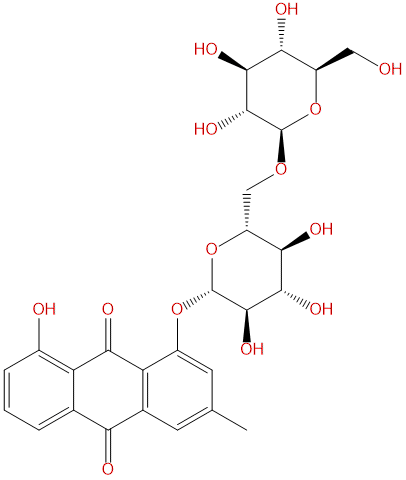
The molecular formula of emodin 1-O - β - gentiopicroside is C27H30O14, with a molecular weight of 578.5230. Its chemical structure is composed of 1,8-dihydroxy-3-methyl-9,10-anthraquinone (i.e. emodin) as the aglycone, and a molecule of gentian disaccharide is connected to the hydroxyl group at position 1 of the aglycone through a β - glycosidic bond. Gentian disaccharides are disaccharides formed by connecting two molecules of glucose through β -1,6 glycosidic bonds. This unique glycosylation modification greatly alters the physicochemical properties of the parent nucleus.
From the perspective of pharmacological parameters, the lipophilic water partition coefficient (LogP) of this compound is -0.0822, indicating its hydrophilicity, mainly due to the introduction of disaccharide structure. Its topological polar surface area (TPSA) is as high as 232.90 Å ², further confirming its strong molecular polarity. The calculated water solubility value is 4.4524, which belongs to the solubility range, providing favorable conditions for its absorption and distribution in organisms. However, higher polarity and TPSA also result in lower ability to cross the blood-brain barrier, indicating a lower risk of central nervous system related side effects. In early safety evaluations, the compound showed no inhibitory activity on hERG potassium channels (hERG inhibition: No), indicating a low potential risk of arrhythmia. The Ames test result is 1.2, indicating no significant mutagenicity, but this value is close to the critical point and further genetic toxicity research is needed to confirm.
Plant sources and extraction methods
Rhubarb phenol-1-O - β - gentiopicroside mainly comes from traditional Chinese medicine plants in the Polygonaceae family, such as Rheum palmatum L., Rheum tanguticum Maxim. ex Balf., and medicinal Rheum officinale Baill. roots and rhizomes. In addition, anthraquinone compounds have also been detected in plants such as Polygonum multiflorum Thunb. and Polygonum cuspidatum Sieb. et Zucc., which are rich in anthraquinone compounds.
Its extraction and separation usually follow the conventional process of natural product chemistry. Firstly, the dried plant material is crushed and subjected to reflux extraction or ultrasound assisted extraction using methanol, ethanol, or alcohol water solutions of different proportions. The extract is concentrated under reduced pressure to obtain a paste. Subsequently, preliminary enrichment was carried out using macroporous adsorption resin column chromatography, with commonly used water ethanol gradient elution. The compound is typically eluted in the moderately polar region (such as the 30% -50% ethanol elution portion). Further purification is often carried out using modern chromatographic techniques such as silica gel column chromatography, reverse phase silica gel column chromatography (such as ODS-C18), and high-performance liquid chromatography. The characteristic structure of gentian diglycoside can be verified by acid hydrolysis reaction, and after hydrolysis, emodin aglycone and glucose can be detected by thin layer chromatography or high performance liquid chromatography. Nuclear magnetic resonance hydrogen and carbon spectra are key means of identifying its structure, which can clarify the connection positions between glycosides and glycosides, as well as the configuration of glycosidic bonds.
Pharmacological activity research
A large number of preclinical studies have revealed that emodin 1-O - β - gentiopicroside has multiple pharmacological activities, and its core research area focuses on liver protection.
1. Liver protective activity
The hepatoprotective effect of this compound has been confirmed in various experimental liver injury models. In the acute liver injury model induced by carbon tetrachloride (CCl4) in mice, pre administration of chrysophanol-1-O - β - gentiopicroside can significantly reduce the activity of alanine aminotransferase (ALT) and aspartate aminotransferase (AST) in serum, alleviate liver tissue pathological damage such as hepatocyte necrosis and inflammatory cell infiltration. In more complex liver fibrosis models, such as CCl4 chronic injection or common bile duct ligation models, this compound exhibits significant anti fibrotic effects. It can effectively inhibit the activation and proliferation of hepatic stellate cells, reduce excessive deposition of extracellular matrix (mainly collagen I and III), thereby delaying or even reversing the process of liver fibrosis.
2. Antioxidant and anti-inflammatory activities
Oxidative stress and chronic inflammation are the core links in the occurrence and development of liver injury and fibrosis. Research has shown that this compound can effectively enhance the activity of endogenous antioxidant enzymes such as superoxide dismutase (SOD), catalase (CAT), and glutathione peroxidase (GPX) in liver tissue, while reducing the level of lipid peroxidation product malondialdehyde (MDA). In terms of inflammation, it can inhibit the expression of pro-inflammatory factors such as tumor necrosis factor - α (TNF - α), interleukin-1 β (IL-1 β), and interleukin-6 (IL-6) in liver tissue. Its anti-inflammatory mechanism is related to the regulation of inflammatory signaling pathways such as nuclear factor kappa B (NF - κ B).
3. Other potential activities
In addition to liver protection, preliminary studies also suggest that the compound may have antibacterial, anti-tumor and other activities. For example, it has a certain inhibitory effect on Staphylococcus aureus, Escherichia coli, and other bacteria. In the study of tumor cell lines, inhibitory effects on the proliferation of certain liver cancer cells have been shown, but their specific mechanisms and efficacy need to be further explored.
Mechanism of action and molecular targets
The hepatoprotective effect of emodin 1-O - β - gentiopicroside is not achieved through a single target, but involves a complex multi-target network regulation, with its core mechanism revolving around antioxidant stress, anti-inflammatory, and anti hepatic stellate cell activation.
1. Activate the NRF2/ARE antioxidant defense pathway
This is the key mechanism by which the compound exerts antioxidant effects. Under oxidative stress, emodin 1-O - β - gentiopicroside can promote the dissociation and transfer of nuclear factor E2 related factor 2 (NRF2) from cytoplasmic chaperone Keap1 to the nucleus. In the nucleus, NRF2 binds to antioxidant response elements (ARE), initiating the transcriptional expression of a series of downstream phase II detoxifying enzymes and antioxidant proteins. Research has confirmed that this compound can significantly upregulate the expression of quinone oxidoreductase 1 (NQO1), heme oxygenase-1 (HMOX1), superoxide dismutase 1 (SOD1), catalase (CAT), and glutathione peroxidase 1 (GPX1). Among them, the elevation of HMOX1 not only degrades toxic heme, but its products bilirubin and CO also have anti-inflammatory and anti apoptotic effects; The upregulation of SOD2 (mitochondrial superoxide dismutase) specifically targets reactive oxygen species from mitochondria, protecting cellular energy factories.
2. Inhibit the TGF - β 1/Smad pro fibrotic pathway
Transforming growth factor - β 1 (TGFB1) is the strongest cytokine driving liver fibrosis. This compound can downregulate the expression of TGFB1 and inhibit the phosphorylation and nuclear translocation of downstream Smad2/3, thereby blocking the transformation of hepatic stellate cells into myofibroblast like cells induced by TGF - β 1. Activated hepatic stellate cells highly express alpha smooth muscle actin (ACTA2), which is a marker protein for their activation. This compound can effectively reduce the expression of ACTA2, inhibit the contraction and migration ability of hepatic stellate cells, and reduce the synthesis of collagen.
3. Regulating the matrix metalloproteinase system
The imbalance of extracellular matrix degradation is an important cause of fibrosis formation. Matrix metalloproteinase 9 (MMP9) can degrade basement membrane components and is associated with inflammatory cell infiltration in the early stages of liver injury. Its activity is often inhibited in the later stages of fibrosis. Research has shown that this compound may affect the remodeling process of extracellular matrix by regulating the balance of MMP9 and its tissue inhibitors, but its specific regulatory mode is complex and may vary depending on the stage of the disease.
In summary, emodin 1-O - β - gentiopicroside synergistically activates the NRF2 mediated antioxidant pathway and inhibits the TGF - β 1-driven pro fibrotic pathway, forming a multi-level protective network that clears oxygen free radicals from the source, reduces inflammatory damage, and directly inhibits the activation of fibrotic core cells.
Evaluation of drug properties and pharmacokinetics
Based on its physicochemical parameters, emodin 1-O - β - gentiopicroside exhibits certain medicinal properties, but there are also challenges.
Advantages: Good water solubility (4.4524) is beneficial for the development of formulations (such as injections, oral liquids) and absorption in the gastrointestinal tract. The absence of hERG inhibitory properties reduces the risk of cardiac toxicity and provides preliminary assurance for its safety. Although the Ames test results need to be interpreted with caution, they did not show strong mutagenicity.
Challenge aspect: The molecular weight is relatively large (578.5) and contains a disaccharide structure, which may affect its oral bioavailability. Glycoside compounds are susceptible to hydrolysis by gut microbiota and brush edge enzymes (such as β - glucosidase) in intestinal epithelial cells, releasing aglycone emodin, which has high lipid solubility but may have different pharmacological and toxic profiles. Therefore, whether the compound is absorbed into the bloodstream in its prototype or glycoside form after oral administration and exerts its main effect is the focus of pharmacokinetic research. At present, the relevant research data is not sufficient. Its low blood-brain barrier permeability can be considered an advantage for the treatment of liver disease, avoiding potential central side effects. Future research needs to clarify its absolute bioavailability, plasma protein binding rate, major metabolic organs and pathways, and excretion mode in animals such as rats and dogs.
Clinical application prospects and prospects
Rhubarb phenol-1-O - β - gentian glucoside, as a natural product with clear multi-target liver protective activity, has broad prospects in the development of new anti liver injury and anti liver fibrosis drugs.
1. Direction of drug development
* Individually formulated medicine: It can be developed as an adjuvant therapy for liver fibrosis and chemical liver injury. Given its good water solubility, intravenous injection formulations can be prioritized for the treatment of acute liver injury; Alternatively, the oral bioavailability can be improved through formulation techniques such as phospholipid complexes, nanoparticles, and prodrug modifications for long-term management of chronic liver disease.
* Combination therapy: It can be used in combination with existing antiviral drugs (such as entecavir for hepatitis B), or silybin and other liver protective drugs to play a synergistic role and delay disease progress.
* Modernization of Traditional Chinese Medicine: As one of the key active ingredients in traditional hepatoprotective Chinese medicines such as rhubarb and polygonum multiflorum, in-depth research on them can help clarify the modern scientific connotation of their "hepatoprotective and jaundice reducing" effects, and promote the improvement and internationalization of Chinese medicine quality standards.
2. Future research focus
* In depth mechanism research: Further validation of the core role of key targets such as NRF2 and TGFB1 in in in vivo drug efficacy and exploration of their impact on other pathways such as PI3K/Akt and MAPK requires the use of techniques such as gene knockout animals and cell specific knockout.
* Systematic pharmacokinetic studies: It is necessary to comprehensively elucidate its ADME (absorption, distribution, metabolism, excretion) process in animals and humans, clarify its active form, and provide a basis for dosage form design and administration plan.
* Security system evaluation: A standardized GLP toxicology study needs to be completed, including repeated administration toxicity, reproductive toxicity, complete genotoxicity testing, etc., to comprehensively evaluate its safety. Attention should be paid to the possible nephrotoxicity or intestinal motility effects of its aglycone emodin at high doses.
* Structural optimization: Using it as a lead compound, structural modifications (such as glycosylation and aglycone modifications) are carried out through medicinal chemical methods in order to obtain derivatives with stronger activity, more stable metabolism, and higher bioavailability.
Conclusion
Rhubarb phenol-1-O - β - gentiopicroside is an anthraquinone glycoside derived from traditional Chinese medicine. With its unique chemical structure, it exhibits significant pharmacological activity in the field of liver protection. Its mechanism of action is different from single target drugs, but through multi-target synergy, that is, upregulating the NRF2 mediated antioxidant defense system and inhibiting the pro fibrotic signal driven by TGF - β 1, achieving multidimensional protection of the liver. Although it has shown good water solubility and preliminary cardiac safety in drug development, its large molecular weight, potential intestinal hydrolytic metabolism, and unclear systemic pharmacokinetic properties are key issues that need to be addressed in future translational research. With a more detailed analysis of its mechanism of action, clarification of its pharmacokinetic behavior, and breakthroughs in formulation technology, chrysophanol-1-O - β - gentiopicroside is expected to develop from a potential natural active ingredient into an innovative drug candidate for the treatment of liver fibrosis and related liver diseases, bringing new hope to liver disease patients.