

Storage conditions:Short-term storage at 2~8℃, long-term storage at -20 ~ -80℃
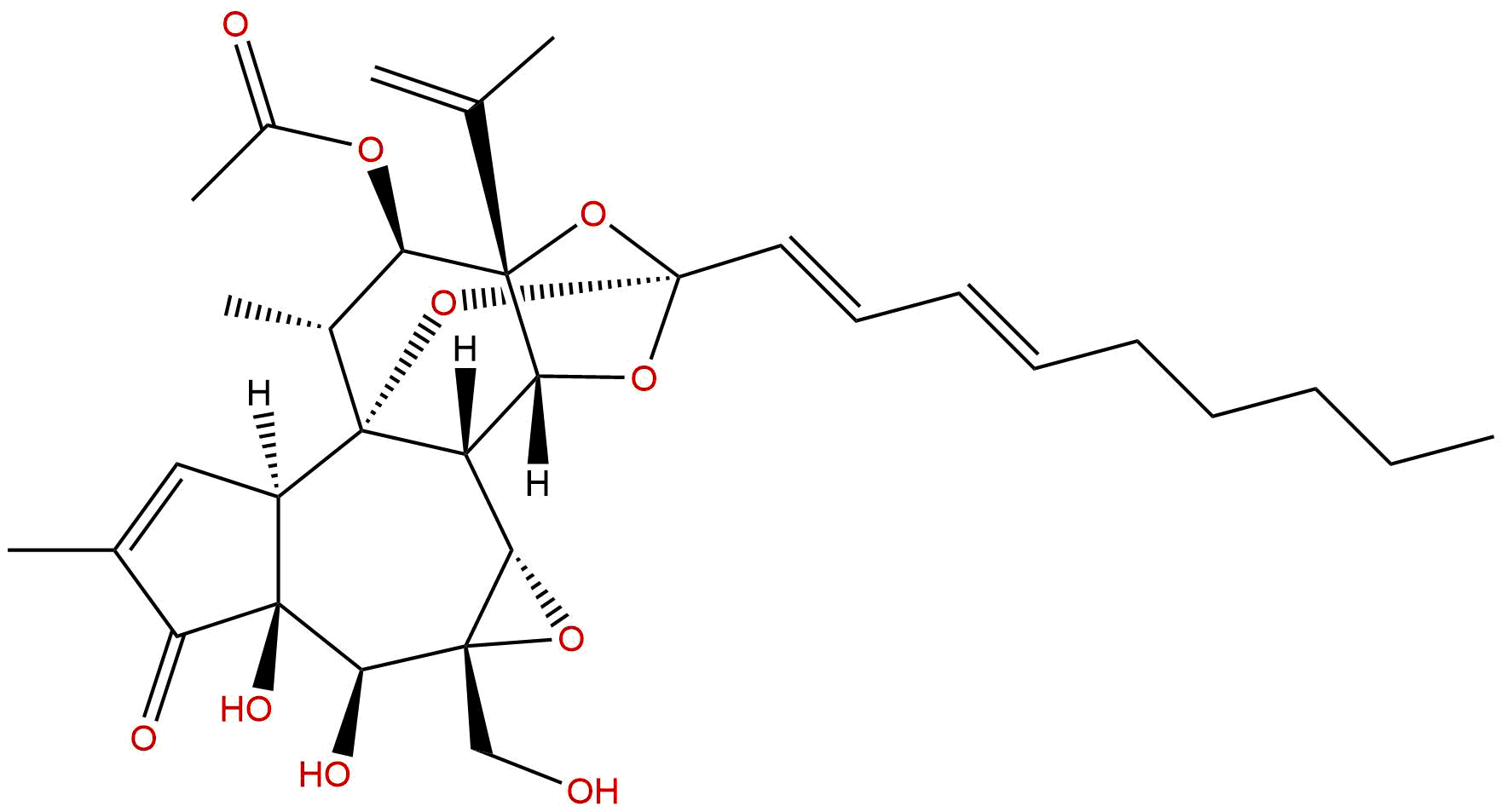
Yuanhuadine (CAS number: 76402-66-9) is a natural product isolated from the Chinese medicinal herb Daphne genkwa Sieb. et Zucc. As a traditional Chinese medicine, yuanhua has always been used to treat various diseases, especially exhibiting significant pharmacological activities in anti-tumor, anti-inflammatory, and immune regulation. Yuanhua ester B, as one of its main active ingredients, has attracted widespread attention in recent years due to its unique chemical structure and multi-target biological activity. A large number of studies have shown that genkwa ester B exhibits good potential in the field of anti-tumor, and can exert inhibitory effects on tumor cell proliferation, induce cell apoptosis, and inhibit tumor metastasis by regulating multiple signaling pathways and molecular targets. This article provides a systematic review of the chemical structure and physicochemical properties, plant sources and extraction methods, pharmacological activity and mechanism of action, pharmacological evaluation and pharmacokinetic characteristics of genkwa ester B, and explores its clinical application prospects and development directions. The aim is to provide theoretical basis and research references for the pharmacology of natural products and the development of anti-tumor drugs.
Yuanhua ester B is a natural product with a molecular weight of 586.6780 and a complex chemical structure. Its molecular structure contains multiple ester groups and aromatic rings, endowing it with unique biological activity. Its LogP value is 2.7052, indicating that the compound has moderate lipid solubility, which is beneficial for cell membrane penetration and in vivo distribution. The total polar surface area (TPSA) is 144.2800, indicating certain polarity characteristics, which have important implications for its binding to protein targets. Low water solubility (0.0208 mg/mL) suggests limited solubility in aqueous phase, which may affect its bioavailability. It is worth noting that genkwa ester B has a high blood-brain barrier penetration ability, which provides the possibility for its potential application in central nervous system related diseases. The hERG channel inhibition test result is negative, indicating a low risk of cardiac toxicity. The Ames test result is 0.6, indicating a low risk of genotoxicity and good safety.
Yuanhua ester B mainly comes from the Yuanhua plant, which belongs to the Thymelaeaceae family and the Daphne genus. It is widely distributed in southern China and Southeast Asia. The roots, stems, and flowers of Yuanhua contain abundant active ingredients, with higher levels found in the roots and flowers. Traditionally, dried roots or flowers of yuanhua are used as medicine, which has the effects of dispelling wind, dispelling cold, reducing swelling, and relieving pain.
The process of extracting ethyl ester from Yuanhua mainly includes solvent extraction and chromatographic separation. The commonly used extraction solvents are ethanol or methanol, and ultrasound assisted extraction or reflux extraction methods are used to improve extraction efficiency. After concentration, the extract was separated and purified using techniques such as silica gel column chromatography and reverse phase high performance liquid chromatography (RP-HPLC). In recent years, with the advancement of separation technology, supercritical fluid extraction and molecular imprinting techniques have also been applied to the efficient extraction and purification of genkwa ester B, significantly improving yield and purity.
The pharmacological activity research of Yuanhua ester B mainly focuses on its anti-tumor effect. In vitro cell experiments showed that Daphne genkwa ester could significantly inhibit the proliferation of many tumor cell lines, including lung cancer, breast cancer, liver cancer and colorectal cancer. Its inhibitory effect is dose-dependent, with IC50 values generally in the low micromolar range, indicating high cytotoxicity.
In in vivo experiments, genkwan ester B significantly delayed tumor growth, reduced tumor volume, and had low toxic side effects on normal tissues when administered via intraperitoneal injection or oral administration. Its anti-tumor activity is not only reflected in inhibiting tumor cell proliferation, but also includes inducing tumor cell apoptosis, blocking cell cycle progression, and inhibiting tumor angiogenesis and metastasis ability.
In addition, Yuanhua ester B also exhibits anti-inflammatory and immune regulatory effects, which can regulate the tumor microenvironment and enhance the body's immune surveillance function. These multiple pharmacological effects have laid a solid foundation for its development as an anti-tumor drug.
The anti-tumor mechanism of Yuanhua ester B involves multiple signaling pathways and key molecular targets. Research has shown that genkwa ester B can regulate the following main targets:
MCL1 and BCL2 As members of the anti apoptotic protein family, MCL1 and BCL2 are highly expressed in tumor cells, promoting cell survival. Yuanhua ester B promotes tumor cell apoptosis by downregulating its expression.
STAT3 Signal transducer and activator of transcription factor 3 (STAT3) is abnormally activated in various tumors, promoting tumor cell proliferation and immune escape. Yuanhua ester B inhibits the phosphorylation of STAT3 and blocks its signal transduction.
MMP2 Matrix metalloproteinase-2 (MMP2) is involved in the invasion and metastasis of tumor cells. Yuanhua ester B inhibits the expression and activity of MMP2, reducing the potential for tumor metastasis.
TOP1 and TOP2A Topoisomerase 1 and 2A are important enzymes for DNA replication and transcription, and ethyl genkwa ester inhibits their activity, interferes with DNA metabolism in tumor cells, and prevents cell proliferation.
HIF1A Hypoxia inducible factor 1 alpha regulates the adaptation of tumor cells to hypoxic environments and promotes angiogenesis. Yuanhua ester B inhibits the expression of HIF1A and blocks tumor angiogenesis.
MAPK1 Mitogen activated protein kinase 1 is involved in signal transduction for cell proliferation and differentiation, and its activity is regulated by naringenin B, which affects tumor cell growth.
ESR1 and CYP19A1 Estrogen receptor alpha (ESR1) and aromatase (CYP19A1) play important roles in hormone dependent tumors, and naringenin B affects hormone signaling pathways by regulating their expression.
In summary, Yuanhua ester B exhibits broad-spectrum anti-tumor potential by synergistically regulating the growth, apoptosis, invasion, and microenvironment of tumor cells through multiple targets and pathways.
The pharmacological evaluation of Yuanhua ester B shows that it has good potential for drug development. Its molecular weight is moderate, with a LogP value suitable for cell membrane penetration and high blood-brain barrier permeability, making it suitable for developing indications related to the central nervous system. In addition, the hERG channel has no significant inhibitory effect, indicating a low risk of cardiac toxicity. The Ames test results show that its genotoxicity is low and its safety is good.
However, the low water solubility of genkwan ester may limit its oral bioavailability. To address this issue, researchers have attempted to use drug delivery systems such as nanocarriers, liposome encapsulation, and solid dispersions to improve their solubility and in vivo stability.
Pharmacokinetic studies have shown that genkwa ester B is widely distributed in the body, with a moderate half-life, and can effectively reach therapeutic concentrations. Its metabolic pathway is mainly biotransformation through the liver enzyme system, and the activity and safety of metabolites still need to be further explored. Further systematic pharmacokinetic and toxicological studies are needed in the future to provide a basis for clinical translation.
Based on the multi-target effect and good safety of Yuanhua ester B in the field of anti-tumor, its clinical application prospects are broad in the future. Firstly, genkwan ester B can be used as a single drug for the treatment of various solid tumors, especially for tumor types that are resistant to traditional chemotherapy, with potential therapeutic effects. Secondly, when used in combination with existing anti-tumor drugs, yuanhuazhi ester B may produce synergistic effects, enhance therapeutic efficacy, and reduce low toxicity and side effects. In addition, due to its ability to penetrate the blood-brain barrier, genkwan ester B has unique advantages in the treatment of brain tumors and neurological tumors.
Future research should focus on optimizing its drug formulations, addressing solubility and bioavailability issues, and conducting systematic preclinical safety evaluations and efficacy validations. At the same time, in-depth analysis of its mechanism of action and exploration of more potential targets will provide support for precision therapy. Multi center, large sample clinical trials will be a key step in verifying their clinical value.
As an important active ingredient in yuanhua, yuanhua ester B exhibits significant pharmacological activity and good medicinal properties due to its unique chemical structure and multi-target anti-tumor effects. Its multiple mechanisms in regulating tumor cell proliferation, apoptosis, and metastasis provide valuable examples for the development of natural anti-tumor drugs. Although there are still some challenges in pharmacokinetics and clinical applications, with the continuous progress of extraction and purification technology, drug delivery systems, and molecular pharmacology research, genkwa ester ethyl is expected to become an important candidate for the new generation of anti-tumor drugs. Future research should strengthen its preclinical and clinical studies, promote its clinical translation, and benefit more cancer patients.
