Introduction/Overview
In the long river of natural product chemistry and pharmacology research, monoterpenes have always been an important source of drug discovery due to their structural diversity and extensive biological activity. Methylcarvacrol (CAS number: 6379-73-3), as a methylated derivative of phenylpropanoid monoterpene carvacrol, is gradually emerging from numerous natural ingredients and becoming a promising candidate molecule in the field of anti infective drug development. With the increasingly severe problem of bacterial and fungal resistance worldwide, the effectiveness of traditional antibiotics is constantly being weakened. Developing antibacterial agents with novel mechanisms of action or effective effects on multidrug-resistant bacteria has become an urgent scientific challenge. Parvacrol methyl ether not only inherits the significant antibacterial properties of its precursor Parvacrol, but also receives close attention from researchers due to its structural modifications that may improve pharmacokinetic properties and target selectivity. This article aims to systematically review the chemical properties, plant sources, extraction methods, pharmacological activities, molecular mechanisms of action, pharmacological potential, and clinical application prospects of carvacrol methyl ether, in order to provide comprehensive academic references for the in-depth research and development of this compound.
Chemical structure and physicochemical properties
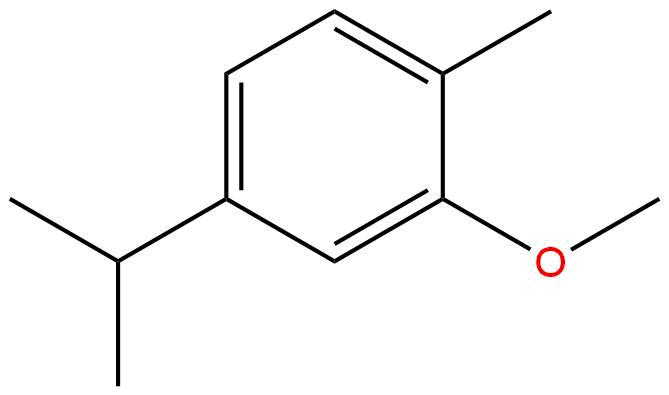
The chemical name of carvacrol methyl ether is 5-isopropyl-2-methylphenyl ether, with a molecular formula of C11H16O and a molecular weight of 164.2480. The core of its structure is a mono substituted benzene ring, with a methoxy group (- OCH3) connected to the 1st position, a methyl group connected to the 2nd position, and an isopropyl group connected to the 5th position of the benzene ring. This structure can be regarded as an ether derivative of carvacrol (whose phenolic hydroxyl group is methylated). The key chemical structural modification - methylation of phenolic hydroxyl groups, directly leads to significant changes in their physicochemical properties.
From the analysis of parameters related to drug properties, carvacrol methyl ether exhibits typical lipophilic characteristics. The calculated lipid water partition coefficient (LogP) is 4.1877, indicating that the compound has high lipid solubility, which is beneficial for its penetration of microbial lipid cell membranes, but also suggests poor water solubility (approximately 0.0360 mg/mL). Its topological polar surface area (TPSA) is only 9.2300 Å ², which is an extremely low value, further confirming its highly hydrophobic properties. These physicochemical parameters collectively determine the distribution behavior of carvacrol methyl ether in organisms: it can efficiently penetrate the blood-brain barrier (predicted as "high"), which provides potential advantages for the development of drugs for the treatment of central nervous system infections. Preliminary toxicity predictions indicate that it has no inhibitory activity on hERG potassium channels (predicted as' no '), reducing the risk of causing QT interval prolongation in the heart; The Ames test predicted a value of 0.0, indicating that it may not be mutagenic and has relatively good preliminary safety characteristics.
Plant sources and extraction methods
Celery phenol methyl ether is not widely present in the plant kingdom, but rather as a minor component or a major component of a specific chemical type, concentrated in various aromatic plants of the Lamiaceae and Myrtaceae families. Common plant sources include but are not limited to:
1. Oxalis plants Like Niuzhi(Origanum vulgare)Some chemical types may contain a certain proportion of carvacrol methyl ether in their volatile oils.
2. Thymus Plant Like thyme(Thymus vulgaris)The volatile oil components are complex, and carvacrol methyl ether is one of the important components.
3. Plants of the Elsholtzia genus This component has also been identified in some types of volatile oils.
4. Eucalyptus plants Some eucalyptus trees(Eucalyptus The essential oil of spp also contains carvacrol methyl ether.
The extraction method mainly follows the conventional extraction and separation process of plant volatile oils and lipophilic components:
1. Extract The most commonly used method is steam distillation, which uses water vapor to remove volatile components from plant materials and condenses them to obtain crude volatile oils. Supercritical CO2 extraction has also become an efficient method for obtaining high-quality essential oils and specific components (such as carvacrol methyl ether) due to its advantages of low temperature, no solvent residue, and adjustable selectivity.
2. Separation and Purification The separation and purification of carvacrol methyl ether from complex plant volatile oils usually requires the use of chromatographic techniques. Atmospheric or vacuum column chromatography (silica gel column, alumina column) is an effective means of preliminary separation. Further purification relies on high-performance liquid chromatography (HPLC) or preparative thin layer chromatography (PTLC). Gas chromatography-mass spectrometry (GC-MS) is a key analytical tool for rapid identification of carvacrol methyl ether and its relative content in volatile oils.
3. synthesis Given the limited content of natural sources, chemical synthesis is an important way to obtain sufficient amounts of carvacrol methyl ether for further research. The most direct synthetic route is to use carvacrol as the starting material and react with methylation reagents (such as iodomethane and dimethyl sulfate) under alkaline conditions for Williamson ether synthesis. Alternatively, starting from more basic chemical raw materials, the molecular skeleton can be constructed through reactions such as Friedel Crafts alkylation.
Pharmacological activity research
The pharmacological activity research of carvacrol methyl ether is currently mainly focused on the field of antimicrobial activity, and has demonstrated broad-spectrum and effective inhibitory ability.
1. Antibacterial activity:
Numerous in vitro studies have shown that carvacrol methyl ether has inhibitory effects on various Gram positive and Gram negative bacteria. It exhibits strong antibacterial activity against Gram positive bacteria such as Staphylococcus aureus (including methicillin-resistant MRSA), Staphylococcus epidermidis, Bacillus subtilis, and Listeria monocytogenes. It is also effective against Gram negative bacteria such as Escherichia coli, Salmonella, Pseudomonas aeruginosa, and Klebsiella pneumoniae, although the MIC values are usually lower for Gram positive bacteria. Its antibacterial mechanism is diverse (see next chapter for details), and it is not easy to induce resistance to a single target.
2. Antifungal activity:
Celery phenol methyl ether has inhibitory effects on various pathogenic fungi, especially on Candida species (such as Candida albicans, Candida smooth, Candida krusei) and dermatophytes. Research has shown that it can disrupt the integrity of fungal cell membranes, inhibit hyphal growth and spore germination, and also exhibit certain inhibitory potential against azole resistant fungi.
3. Other biological activities:
In addition to its outstanding antimicrobial activity, some studies have also reported other potential biological activities of carvacrol methyl ether, including antioxidant, anti-inflammatory, and deworming properties. For example, it can alleviate oxidative stress by clearing free radicals or enhancing endogenous antioxidant enzyme activity. The anti-inflammatory effect may be related to the inhibition of the production of pro-inflammatory factors such as TNF - α and IL-6. These auxiliary activities may play a synergistic role in their anti infection process, but related research is still in the preliminary stage and needs further in-depth validation.
Mechanism of action and molecular targets
The antibacterial effect of carvacrol methyl ether is not achieved through a single mechanism, but is manifested in a multi-target, destructive mode of action, which is considered an important reason why it is less likely to cause high-level drug resistance. Existing research suggests that it may act on the following key targets:
1. Destruction of cell membrane structure and function: As one of its core mechanisms of action, the high lipophilicity of carvacrol methyl ether makes it easy to insert into the phospholipid bilayer of microbial cell membranes, interfere with the arrangement of membrane lipids, and increase membrane fluidity and permeability. This can lead to leakage of intracellular ions (such as K+, H+), dissipation of proton kinetic potential, obstruction of energy metabolism, ultimately causing leakage of cellular contents and cell death. This process is similar to physical destruction and is less likely to result in drug resistance caused by specific target mutations.
2. Inhibition of key enzyme systems: Research predictions and partial experimental confirmation suggest that carvacrol methyl ether may interfere with the functions of various enzymes necessary for microbial life activities through non covalent or covalent binding.
* Energy metabolism related enzymes Like FtsZ (a key protein for bacterial cell division, similar to microtubule protein), its aggregation and function may be disrupted, thereby inhibiting bacterial division.
* Cell wall synthesis related targets PBP (penicillin binding protein) and MecA (regulatory protein mediating MRSA resistance), as well as carvacrol methyl ether, may affect their function or expression and interfere with peptidoglycan synthesis.
* Nucleic acid synthesis related enzymes DNA gyrase (GyrA/B subunit) and topoisomerase IV are classic targets of quinolone drugs, and carvacrol methyl ether may affect their function through different mechanisms.
* Folate metabolism pathway enzyme Dihydrofolate reductase (DHFR) is a target of sulfonamides and trimethoprim, and carvacrol methyl ether may have inhibitory effects.
* Fatty acid synthesis pathway enzymes Like acetyl ACP reductase (FabI), which is one of the targets of the anti tuberculosis drug isoniazid.
3. Antifungal specific targets: For fungi, besides damaging cell membranes, carvacrol methyl ether may also directly or indirectly act on key enzymes in the ergosterol synthesis pathway, such as lanosterol 14 α - demethylase (encoded by the ERG11 gene, CYP51A1 protein), which is the main target of azole antifungal drugs. In addition, it may affect the fungal efflux pump system (such as the ABC transporter encoded by the CDR1 gene), thereby reversing or overcoming fungal drug resistance.
This "multi pronged" mechanism of action makes it difficult for microorganisms to completely evade the killing effect of carvacrol methyl ether through a single gene mutation, providing a unique advantage in combating drug-resistant bacteria.
Evaluation of drug properties and pharmacokinetics
Based on its physicochemical properties and preliminary biological data, a preliminary evaluation of the pharmacological properties of carvacrol methyl ether is conducted
Advantage:
1. Clear activity Has broad-spectrum and strong in vitro antimicrobial activity, especially effective against some drug-resistant bacteria.
2. Multi target mechanism The mechanism of action is complex and may slow down the development of drug resistance.
3. Good membrane permeability High LogP and low TPSA make it easy to penetrate biological membranes, including the blood-brain barrier, expanding the potential indications.
4. Preliminary Safety Tips Predicting the absence of hERG inhibition and mutagenicity laid the foundation for subsequent development.
5. Simple structure, easy to synthesize Facilitating large-scale chemical preparation and subsequent structural modification optimization.
Challenge:
1. Very poor water solubility This is its main bottleneck in terms of pharmaceutical properties. Low water solubility can seriously affect its oral bioavailability, formulation development (such as injections), and in vivo distribution. Improvements need to be made through formulation techniques such as cyclodextrin inclusion, nanoemulsions, liposomes, solid dispersions, or prodrug strategies.
2. Potential metabolic stability issues As an ether compound, its methoxy group may undergo O-demethylation metabolism in the body (especially in the liver), regenerating carvacrol or other metabolites, affecting the exposure and duration of its original drug. It is necessary to clarify its metabolic pathway, main metabolites, and half-life through pharmacokinetic studies.
3. Lack of systematic in vivo pharmacological and toxicological data At present, the vast majority of research is still in the in vitro stage, and there is an urgent need to validate its in vivo efficacy, therapeutic window, and long-term toxicity in suitable animal models of infection, such as sepsis models, skin infection models, and fungal infection models.
Prospects of pharmacokinetics Future research should focus on the degree of oral absorption, first pass effect, plasma protein binding rate, tissue distribution characteristics (especially whether effective concentrations can be achieved at the site of infection), major metabolic enzymes (such as CYP450 isoenzymes), and excretion pathways. Its ability to penetrate the blood-brain barrier is a double-edged sword, as it may be used to treat central nervous system infections, but potential side effects on the central nervous system should also be monitored.
Clinical application prospects and prospects
The clinical application development of carvacrol methyl ether may revolve around the following directions:
As a lead compound for novel anti infective drugs: Its core value lies in its potential to combat multidrug-resistant bacteria and fungi. By studying the structure-activity relationship of the system and modifying its benzene ring, isopropyl group, and methoxy group, it is expected to obtain derivatives with stronger activity, improved water solubility, and more stable metabolism.
2. Combination therapy strategy: The combination of carvacrol methyl ether with existing antibiotics such as beta lactams, fluoroquinolones, and azole antifungal drugs may produce synergistic or sensitizing effects. Its membrane breaking effect may promote the entry of other antibiotics into the bacterial cell, while its potential inhibitory effect on resistance related proteins (such as MecA and efflux pumps) may restore the sensitivity of resistant bacteria to traditional drugs.
3. Development of topical preparations: In view of its poor water solubility but possible good transdermal absorption, the development of cream, gel, mouthwash, spray and other topical preparations for the treatment of superficial skin and mucous membrane infections is a feasible way to avoid its systemic drug delivery problems and quickly achieve clinical transformation. For example, used to treat acne (caused by Propionibacterium acnes), tinea pedis, oral candidiasis, etc.
4. Application in agriculture and food preservation: As a natural antibacterial agent, carvacrol methyl ether also has application prospects in the development of plant-based pesticides (for controlling crop bacterial/fungal diseases) and natural food preservatives, in line with the trend of green and safe development.
Challenges and future research directions:
* Thoroughly elucidate precise molecular targets and mechanisms of action It is necessary to use chemical biology methods (such as photoaffinity labeling, proteomics) to clarify the protein targets and binding modes that it directly binds to.
* Comprehensive preclinical development Complete standardized pharmacological, pharmacokinetic, and toxicological studies to determine safe and effective dosage ranges.
* Innovative formulation technology research and development Solving its water solubility and stability issues is the key to promoting its clinical application.
* Explore its anti biofilm activity Microbial biofilms are an important cause of chronic infections and drug resistance, and evaluating the inhibitory and clearance abilities of carvacrol methyl ether on biofilms is of great clinical significance.
Conclusion
Celery phenol methyl ether, a natural plant derived monoterpene ether compound, has shown remarkable potential in the field of anti infective drug development due to its broad-spectrum antimicrobial activity, unique multi-target mechanism of action, and relatively favorable preliminary drug prediction parameters. It is not only a bridge connecting the wisdom of traditional medicinal plants with modern pharmaceutical science, but also a leading molecule worth exploring in the context of the global drug resistance crisis. Although it still faces challenges in terms of solubility, metabolic stability, and in vivo data, these challenges are expected to be overcome one by one through the collaborative efforts of modern medicinal chemistry, pharmacy, and pharmacology. In the future, with a more detailed analysis of its mechanism of action, the continuous emergence of structurally optimized derivatives, and the successful development of innovative formulations, carvacrol methyl ether is expected to move from the laboratory to clinical practice, providing new weapons to address the increasingly severe challenge of drug-resistant bacterial infections and demonstrating the immortal value of natural products in innovative drug discovery.