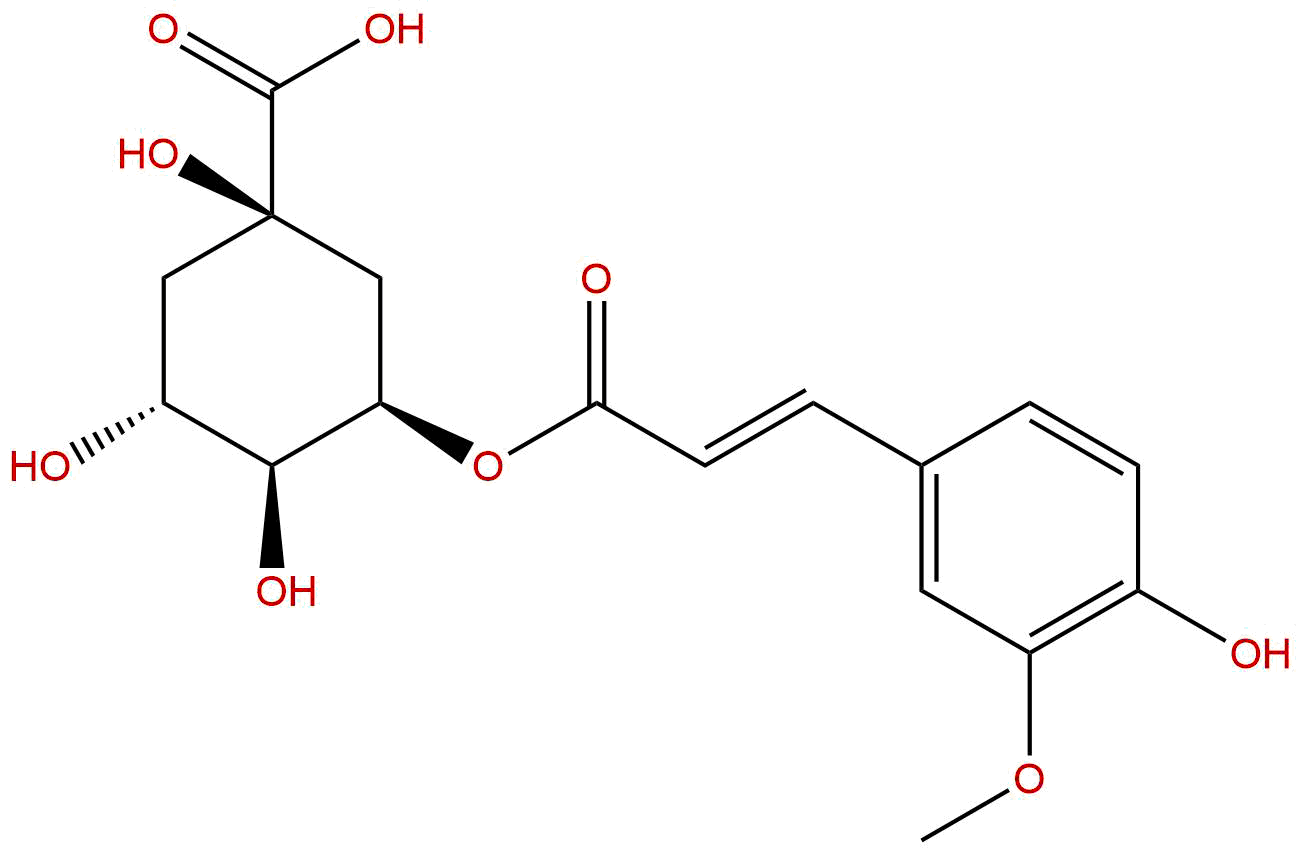


Product name: 5-O-Feruloylquinic acid
Synonym name: 5-Feruloylquinic acid
Catalogue No.: BP4507
Cas No.: 40242-06-6
Formula: C17H20O9
Mol Weight: 368.338
Botanical Source:
Type of Compound:
Purity: 95%~99%
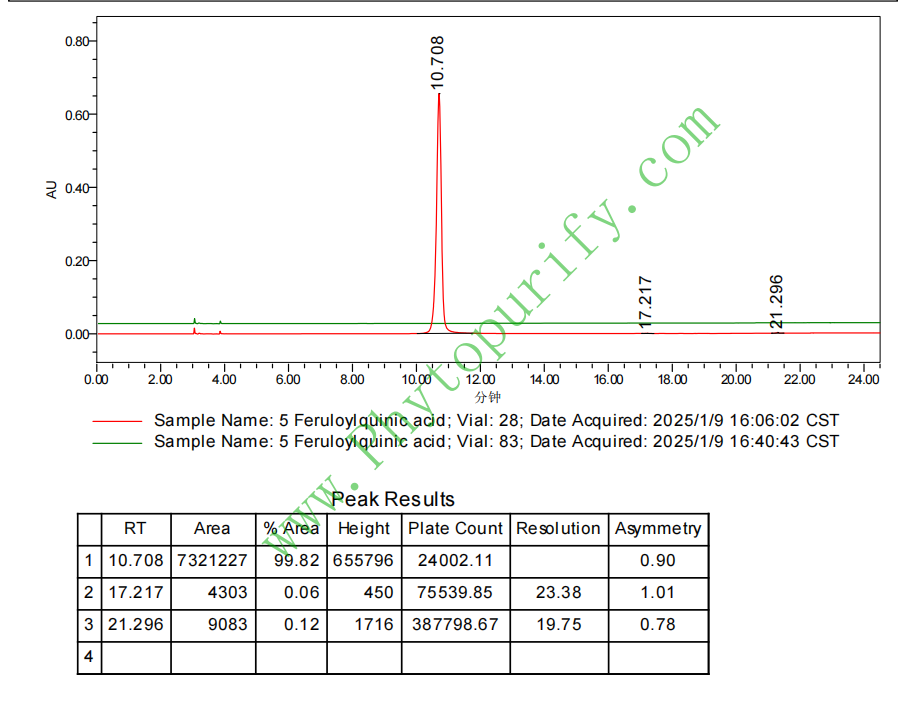
Analysis Method: HPLC-DAD or/and HPLC-ELSD
Identification Method: Mass, NMR
Packing: Brown vial or HDPE plastic bottle
Storage: Store in a well closed container, protected from air and light. Put into refrigerate or freeze for long term storage.
Whenever possible, you should prepare and use solutions on the same day. However, if you need to make up stock solutions in advance, we recommend that you store the solution as aliquots in tightly sealed vials at -20℃. Generally, these will be useable for up to two weeks.
The product could be supplied from milligrams to grams
Inquire for bulk scale.
For Reference Standard and R&D, Not for Human Use Directly.
HPLC of 5-O-Feruloylquinic acid
Storage conditions:Short-term storage at 2~8℃, long-term storage at -20 ~ -80℃
153.7500
.1024
-2.1378
5.5191
.7692
.3724
Low
74.0385
3.7737
Yes
No
No
No
Yes
No
0.0
Yes
Yes
Yes
Yes
In the field of natural product chemistry and pharmacology research, phenolic acid compounds have attracted much attention due to their extensive biological activity and low toxicity. Among them, quinic acid derivatives, as an important class of plant secondary metabolites, are widely present in various medicinal plants and daily diets, demonstrating pharmacological potential in antioxidant, anti-inflammatory, neuroprotective and other aspects. 5-O-Feruloylquinic acid (5-FQA), CAS number 40242-06-6, is a representative phenolic acid compound formed by ester bonding between quinic acid and ferulic acid. Although the research on its isomers (such as chlorogenic acid, i.e. 5-caffeoylquinic acid) has been relatively in-depth, 5-FQA, as an important derivative of ferulic acid, its unique chemical structure and pharmacological properties are gradually becoming a new focus of research. This article aims to systematically review the chemical structure, plant origin, pharmacological activity, molecular mechanism of action, pharmacological evaluation, and clinical application prospects of 5-FQA, in order to provide comprehensive scientific references for the in-depth research and development of this compound.
The molecular formula of 5-O-feruloylquinic acid (5-FQA) is C17H20O9, with a molecular weight of 368.3380. Its core structure consists of two parts: quinic acid (a cyclohexane polyol carboxylic acid) and ferulic acid (4-hydroxy-3-methoxycinnamic acid). Ferulic acid is connected to the 5th hydroxyl group of the quinic acid nucleus through ester bonds, forming a "5-O -" substitution mode, which is a key feature that distinguishes it from other isomers of ferulic acid (such as 3-O - or 4-O-ferulic acid).
From the analysis of physical and chemical properties, 5-FQA exhibits typical phenolic acid compound characteristics. The calculated lipid water partition coefficient (LogP) is approximately 0.1024, indicating that the compound has good hydrophilicity. The topologically polar surface area (TPSA) is as high as 153.7500 Å ², mainly attributed to the presence of multiple polar functional groups such as hydroxyl, carboxyl, and methoxy groups in the molecule. The theoretically calculated water solubility value is 5.5191, further confirming its good water solubility, which is beneficial for its dissolution and distribution in living organisms. These physicochemical parameters collectively determine the initial behavior of 5-FQA in biological systems, laying the foundation for its subsequent pharmacological activity.
5-FQA is widely distributed in the plant kingdom and is one of the important active ingredients in many medicinal and edible plants.
Plant-based:
1. Asteraceae plants Multiple Asteraceae plants are abundant sources of 5-FQA, such as Sorghum and Burdock, which often contain this type of component in their aboveground parts or fruits.
2. Solanaceae plants For example, goji berries have been found to contain 5-FQA and its derivatives in their fruits and leaves.
3. Umbelliferae plants Traditional Chinese medicinal herbs such as Angelica sinensis and Chuanxiong also contain ferulic acid and its ester compounds.
4. Daily dietary sources Coffee beans, cereal bran (such as wheat and oats), and some fruits and vegetables also contain small amounts of 5-FQA, which is one of the important pathways for humans to consume antioxidant phenolic acids through diet.
Extraction and Separation Methods:
The extraction of 5-FQA mainly depends on its polarity and solubility.
1. Solvent extraction method The most commonly used method is to extract using polar solvents such as methanol, ethanol, acetone, or their mixed solutions with water. In order to improve extraction efficiency, techniques such as heating reflux, Soxhlet extraction, or ultrasound assisted extraction are often used.
2. Purification and Separation After filtration and concentration, the crude extract is usually separated using column chromatography technology. Common stationary phases include macroporous adsorption resins (such as D101), silica gel, polyamide, etc. Further purification requires the use of efficient separation methods such as high-performance liquid chromatography (HPLC) or preparative thin layer chromatography (PTLC). Modern analytical techniques such as liquid chromatography-mass spectrometry (LC-MS) and nuclear magnetic resonance (NMR) are key tools for identifying the structure and purity of 5-FQA.
Numerous in vitro and in vivo studies have shown that 5-FQA has diverse and significant pharmacological activities, with antioxidant activity being the most prominent and fundamental.
1. Antioxidant activity
This is the most widely studied activity of 5-FQA. The phenolic hydroxyl and acetyl groups in its molecule are key pharmacophores that exert antioxidant effects. Research has shown that 5-FQA can effectively scavenge various free radicals, including 1,1-diphenyl-2-trinitrophenylhydrazine (DPPH) free radical, 2,2 '- diazobis (3-ethylbenzothiazoline-6-sulfonic acid) cationic free radical, superoxide anion (O ₂•⁻), and hydroxyl free radical (• OH). Its clearance ability is usually evaluated by the semi inhibitory concentration (IC ₅₀), which exhibits activity stronger than or equivalent to common antioxidants such as ascorbic acid and Trolox in many systems. This powerful free radical scavenging ability is an important foundation for its subsequent anti-inflammatory, cell protective, and other activities.
2. Anti inflammatory activity
In various cellular inflammatory models, such as the lipopolysaccharide (LPS) - induced macrophage RAW264.7 model, 5-FQA exhibits significant anti-inflammatory effects. It can dose dependently inhibit the excessive production of inflammatory mediators such as nitric oxide (NO), prostaglandin E2 (PGE2), and pro-inflammatory cytokines such as tumor necrosis factor - α (TNF - α), interleukin-6 (IL-6), and interleukin-1 β (IL-1 β). This suggests that 5-FQA has potential in the treatment of inflammatory diseases associated with oxidative stress.
3. Skin protection and anti-aging activity
Based on its antioxidant and anti-inflammatory properties, 5-FQA has attracted attention in dermatopharmacology. Research has shown that it can inhibit the activity of tyrosinase (TYR), suggesting that it may have whitening effects. More importantly, in UV induced skin photoaging or fibroblast injury models, 5-FQA can protect collagen and maintain the integrity of skin structure by reducing oxidative damage and inhibiting the overexpression of matrix metalloproteinases such as MMP-1 and MMP-3.
4. Neuroprotective potential
Preliminary research suggests that 5-FQA may have a protective effect on the nervous system. In the neuronal damage model induced by hydrogen peroxide or glutamate, 5-FQA pretreatment can improve cell survival rate, reduce lactate dehydrogenase (LDH) leakage and cell apoptosis. The mechanism may be related to clearing reactive oxygen species in nerve cells and maintaining mitochondrial function, providing clues for exploring its application in neurodegenerative diseases.
5. Other activities
In addition, there are studies reporting that 5-FQA may have mild antibacterial, antiviral, and insulin resistance improving activities, but research in these areas is still in its infancy and requires more evidence to support it.
The pharmacological effects of 5-FQA are not achieved through a single target, but rather through the synergistic effects of multiple targets and pathways, with its core mechanism revolving around anti-oxidative stress and Regulating related signaling pathways open.
1. Direct antioxidant and activation of endogenous antioxidant defense system (NRF2/ARE pathway)
* direct action The phenolic hydroxyl group in 5-FQA molecules can directly donate hydrogen atoms, neutralize free radicals, and interrupt free radical chain reactions.
* Key target pathways One of the most important molecular mechanisms of 5-FQA is the activation of the nuclear factor E2 related factor 2 (NRF2, encoded by the NFE2L2 gene) signaling pathway. In the resting state, NRF2 binds to the cytoplasmic chaperone protein Keap1 and is ubiquitinated and degraded. When stimulated by electrophilic substances such as 5-FQA or oxidative stress, NRF2 dissociates from Keap1, translocates to the nucleus, binds to antioxidant response elements (ARE), and initiates the transcriptional expression of downstream phase II detoxifying enzymes and antioxidant proteins.
* Downstream effect targets Including:
* Superoxide dismutase (SOD1, SOD2)Catalytic conversion of superoxide anions into hydrogen peroxide.
* Catalase (CAT)Decompose hydrogen peroxide into water and oxygen.
* Glutathione peroxidase 1 (GPX1)Using glutathione to reduce hydrogen peroxide and lipid peroxides.
* Heme oxygenase-1 (HMOX1)Degradation of hemoglobin produces biliverdin and carbon monoxide, which have antioxidant and anti-inflammatory effects.
Through this pathway, 5-FQA not only directly scavenges free radicals, but also "mobilizes" the cell's own antioxidant defense system, producing a strong and long-lasting protective effect.
2. Inhibit inflammation related pathways
The anti-inflammatory effect of 5-FQA is closely related to the inhibition of classical pro-inflammatory signaling pathways such as nuclear factor kappa B (NF - κ B) and mitogen activated protein kinase (MAPK) activation. It downregulates the expression of genes such as TNF - α, IL-6, IL-1 β, inducible nitric oxide synthase (iNOS), and cyclooxygenase-2 (COX-2) by reducing the degradation of I κ B α and inhibiting the nuclear translocation of NF - κ B p65 subunit.
3. Inhibit extracellular matrix degradation
In the study of skin photoaging, 5-FQA has been shown to significantly inhibit the expression of matrix metalloproteinases MMP-1 and MMP-3 induced by ultraviolet radiation. The mechanism may involve: 1) reducing the reactive oxygen species produced by UV through antioxidant action; 2) The AP-1 (c-Fos/c-Jun) and NF - κ B signaling pathways that inhibit reactive oxygen species activation are key switches for upregulating MMPs transcription.
4. Inhibit melanin production
Its inhibitory effect on tyrosinase (TYR) may be mediated by competitive or non competitive binding to the enzyme active center, interfering with the front-end steps of melanin synthesis.
Although 5-FQA exhibits excellent biological activity in vitro, its potential as a drug still requires systematic pharmacological evaluation.
Preliminary analysis of drug properties based on computational parameters:
* Five rules for classifying drugs Molecular weight 368.3380 (<500), number of hydrogen bond donors 5 (<5), number of hydrogen bond acceptors 9 (<10), LogP 0.1024 (<5), TPSA 153.75 (<140 Å ², slightly higher). Overall, it is generally consistent, but higher TPSA may affect its membrane permeability.
* Absorption and distribution Good water solubility is beneficial for its dissolution in the gastrointestinal tract. However, higher polarity and TPSA may result in limited oral bioavailability and average cell membrane permeability. Calculate and predict it Low blood-brain barrier permeability Although this limits its direct effect on the central nervous system, it may also mean that peripheral side effects are relatively small.
* Metabolism and Safety Predict no inhibition on hERG potassium channel(HERG inhibition: No)The risk of causing prolonged QT interval in the heart is low.The predicted value of Ames test is 0.0 This indicates that it may not be mutagenic and has a low risk of genetic toxicity. These are favorable indicators for early drug screening.
Current status of pharmacokinetic research:
Currently, there are relatively few reports on pharmacokinetic studies of the 5-FQA system. Based on the study of its structural analogues such as chlorogenic acid and ferulic acid, it can be inferred that:
1. absorb After oral administration, it may partially hydrolyze into quinic acid and ferulic acid in the gastrointestinal tract, or be metabolized by gut microbiota. The degree and rate of absorption of prototype drugs and metabolites need to be clarified.
2. distribution Due to its hydrophilicity, it may mainly be distributed in the blood and aqueous phase throughout the body, and its distribution in tissues, especially in adipose tissue, may be limited.
3. Metabolism Expected to undergo extensive phase II metabolism, such as glucuronidation and sulfation, which are common features of most phenolic compounds.
4. excretion Metabolites are mainly excreted through the kidneys and urine.
In the future, specialized animal and even human pharmacokinetic studies are needed to clarify its absolute bioavailability, half-life, tissue distribution, and main metabolic pathways, which is an indispensable step in its conversion to drugs.
The multi-target pharmacological properties of 5-FQA provide possibilities for its application in multiple disease fields.
Potential application directions:
1. Functional foods and dietary supplements As a natural and safe antioxidant, 5-FQA can be directly applied in the development of functional foods and health products with antioxidant, anti fatigue, and immune enhancing effects.
2. External preparations for dermatology Based on its inhibition of tyrosinase, anti UV oxidation, and inhibition of MMPs activity, 5-FQA is an ideal candidate ingredient for developing functional cosmetics or topical skin drugs such as whitening, anti wrinkle, and anti photoaging.
3. Adjuvant treatment for chronic inflammatory diseases: For arthritis, atherosclerosis, metabolic syndrome and other diseases closely related to oxidative stress and chronic low-grade inflammation, 5-FQA may be used as an auxiliary treatment to help control the level of oxidative damage and inflammation.
4. Prevention of neurodegenerative diseases Although the blood-brain barrier has poor permeability, its powerful peripheral antioxidant and anti-inflammatory effects may indirectly prevent or delay Parkinson's disease, Alzheimer's disease, etc. by improving the systemic and brain microenvironment. Structural modifications can also be explored to enhance brain entry ability.
Challenges and Future Prospects:
1. In depth mechanism research Current mechanism research is mostly focused on the pathway level, and in the future, technologies such as molecular docking, surface plasmon resonance (SPR), gene knockout/knockdown, etc. need to be used to more accurately elucidate their direct interaction patterns with key targets such as NRF2, MMPs, TYR, etc.
2. Systematic pharmacodynamic evaluation More animal models related to human diseases (such as skin photoaging models, neurodegenerative disease models, metabolic disease models) need to be constructed for systematic in vivo pharmacological validation.
3. Optimization of drug properties In response to its potential low bioavailability, new drug delivery systems such as nanoliposomes, microemulsions, and phospholipid complexes can be studied to improve their solubility, stability, and membrane permeability. Reasonable structural modifications can also be made to improve its pharmacokinetic properties while retaining the pharmacophore.
4. clinical research Ultimately, it is necessary to promote standardized clinical trials to evaluate its safety, efficacy, and optimal dosage in the human body, which is the ultimate step in achieving its clinical application transformation.
5-O-feruloylquinic acid, as a naturally occurring phenolic acid compound, has shown significant research and development value due to its clear chemical structure, wide plant sources, excellent antioxidant activity, and multiple pharmacological effects such as anti-inflammatory, skin protective, and neuroprotective effects derived from it. It exerts its effects through multi-target mechanisms such as direct clearance of free radicals and activation of the NRF2/ARE core defense pathway, and has the potential advantages of broad action and low risk of side effects. Although there are still challenges in terms of bioavailability in drug development, with the in-depth analysis of its mechanism of action, the application of new drug delivery systems, and the gradual advancement of preclinical and clinical research, 5-FQA is expected to realize its application value in functional foods, skin health products, and the prevention and adjuvant treatment of certain chronic diseases, contributing a gift from nature to human health. Future research should focus on interdisciplinary collaboration, bridging the entire chain from basic research to product development, and accelerating the scientific utilization of this natural active molecule.
