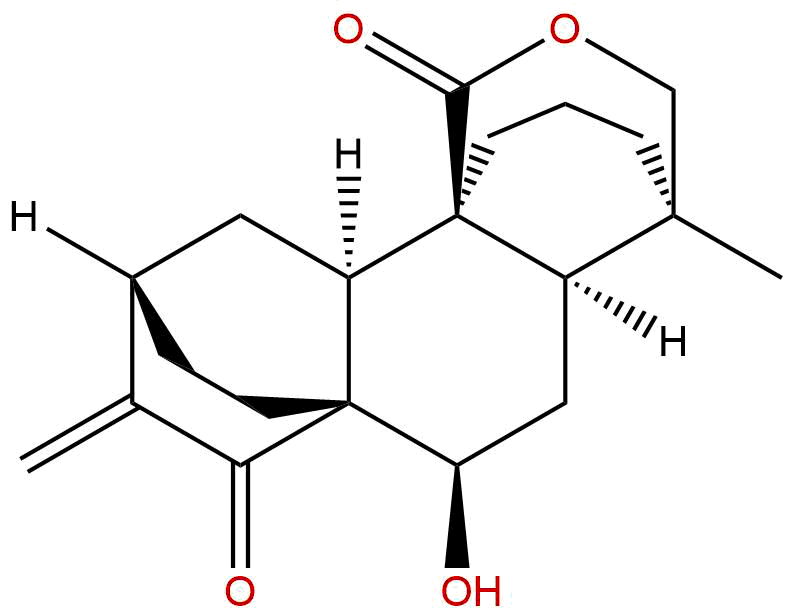
| Catalog No | Package | Original Price | Price | Inventory | Quantity | Operating |
|---|---|---|---|---|---|---|
| BP4731-5mg | 5mg | $490.00 | Sign in |
|


Storage conditions:Short-term storage at 2~8℃, long-term storage at -20 ~ -80℃
15 Oxospiramilactone (CAS number: 1053172-87-4) is a natural plant derived diterpenoid compound that has received widespread attention in recent years for its potential pharmacological activities in tumor suppression and anti-inflammatory fields. As one of the active ingredients in the genus Echinochloa, 15 oxo Echinochloa lactone exhibits significant inhibitory effects on the Wnt/β - catenin signaling pathway, thereby inhibiting the proliferation and tumorigenesis of colon cancer cells. In addition, its ability to regulate multiple inflammation related targets makes it equally valuable for research in the field of anti-inflammatory therapy. This article will provide a systematic review of the chemical structure and physicochemical properties, plant sources and extraction methods, pharmacological activity and mechanism of action, pharmacological evaluation and pharmacokinetic characteristics of 15 oxo steviol lactone, and explore its clinical application prospects and future research directions.
15 oxo steviol lactone belongs to the diterpenoid class, with a molecular formula of C20H26O4 and a molecular weight of 330.4240. Its structural feature is a typical diterpenoid lactone skeleton, containing key 15 oxo groups, which are considered an important determinant of its biological activity. There are multiple cyclic structures and unsaturated bonds in the molecule, giving it a certain spatial conformation and chemical reactivity.
In terms of physical and chemical properties, the LogP value of 15 oxo spironolactone is 2.1593, indicating its moderate lipid solubility, which is beneficial for membrane penetration and bioavailability. The topological polar surface area (TPSA) of the molecule is 63.6 Å ², indicating good balance between polar and non-polar environments. The low water solubility (0.0416 mg/mL) poses a certain challenge to its drug formulation design. It is worth noting that this compound has a high ability to penetrate the blood-brain barrier, suggesting its potential role in central nervous system diseases. In terms of safety, 15 oxo spironolactone did not exhibit hERG channel inhibition, and the Ames mutagenicity test result was negative, indicating its preliminary good safety.
15 oxo steviol lactone mainly comes from Spiraea spp. plants, especially species with high levels of steviol lactone such as Spiraea japonica and Spiraea prunifolia. This plant is widely distributed in East Asia, and its whole plant or roots are commonly used in traditional Chinese medicine. It has the effects of clearing heat, detoxifying, reducing swelling, and relieving pain.
The extraction method usually uses organic solvent extraction combined with column chromatography separation technology. The specific steps include:
In recent years, supercritical CO2 extraction and microwave-assisted extraction techniques have also been attempted to be applied to the extraction of this compound to improve extraction efficiency and purity.
The research on 15 oxo spironolactone in tumor biology mainly focuses on colon cancer. Multiple in vitro cell experiments have shown that this compound can significantly inhibit the proliferation and migration of colon cancer cell lines such as HCT116 and SW480. The mechanism of its anti-tumor effect is closely related to the inhibition of the Wnt/β - catenin signaling pathway. The Wnt signaling pathway plays a crucial role in the occurrence and development of tumors, and abnormal activation can promote the proliferation, invasion, and drug resistance of cancer cells. 15 oxo spironolactone blocks the proliferation signal of tumor cells by reducing the nuclear translocation of β - catenin and inhibiting the expression of downstream target genes such as c-Myc and Cyclin D1.
In addition, animal model studies have shown that 15 oxo spironolactone can significantly slow down the growth of colon cancer xenografts, suggesting its potential in vivo anti-tumor activity.
Inflammatory response plays an important role in various chronic diseases and tumor microenvironments. 15 oxo spironolactone has regulatory effects on various inflammation related targets, including IL-6, STAT3, TNF, NFKB1, PTGS1/2, NOS2, etc. In vitro experiments have shown that the compound can effectively inhibit the secretion of inflammatory factors IL-6 and TNF - α, block the activation of STAT3 and NF - κ B signaling pathways, and alleviate inflammatory reactions.
In addition, 15 oxo spironolactone also showed regulatory effects on pain related ion channels such as TRPV1 and TRPA1, suggesting its potential in alleviating inflammatory pain. Its inhibitory effect on CASP1 further suggests that it may alleviate inflammatory cell apoptosis and cytokine release by regulating inflammasome activity.
Although there is currently limited research, the high blood-brain barrier permeability of 15 oxospironolactone suggests its potential role in neuroprotection and central nervous system diseases. Future related research is expected to reveal its potential application value in neuroinflammation and neurodegenerative diseases.
The main mechanism of action of 15 oxo spironolactone is focused on the regulation of signaling pathways, especially Wnt/β - catenin and inflammation related pathways.
Abnormal activation of the Wnt signaling pathway is a key driving factor in the development of various tumors. 15 oxo spironolactone inhibits the expression of Wnt target genes by promoting the degradation of β - catenin and blocking its nuclear translocation, thereby suppressing the proliferation and migration of tumor cells. This process may involve the regulation of GSK-3 β kinase activity and its phosphorylation modification of β - catenin.
15 oxo spironolactone significantly inhibits the expression of IL-6 and TNF - α, blocks the activation of STAT3 and NF - κ B signaling pathways, and alleviates inflammatory responses. Its inhibitory effect on PTGS1 (COX-1) and PTGS2 (COX-2) reduces prostaglandin synthesis and alleviates inflammatory symptoms. Inhibition of NOS2 (inducible nitric oxide synthase) reduces the production of inflammatory mediator NO, further alleviating tissue damage.
In addition, the regulation of TRPV1 and TRPA1 ion channels by 15 oxo spironolactone may regulate neuroinflammation and pain conduction by affecting calcium ion influx.
CASP1 (caspase-1) is a key enzyme involved in the activation of inflammasomes and the maturation and release of pro-inflammatory cytokines. The inhibitory effect of 15 oxo spironolactone on CASP1 suggests that it may protect tissue function by regulating inflammasomes, reducing cell apoptosis and inflammatory response.
15 oxo spironolactone has shown good potential in medicinal properties. Its molecular weight of 330.4240 conforms to Lipinski's rule, and its LogP value of 2.1593 shows moderate lipid solubility, which is beneficial for the drug's membrane permeability and bioavailability. The TPSA is 63.6 Å ², indicating a good balance between polar and non-polar environments, which is conducive to oral absorption.
The low water solubility (0.0416 mg/mL) may limit the dissolution and absorption of its oral formulation, and it is necessary to improve its bioavailability through formulation modifications such as nanoparticles and solid dispersions. Its high blood-brain barrier permeability provides the possibility for the treatment of central nervous system diseases, but at the same time, potential central neurotoxicity should also be considered.
In terms of safety, 15 oxo spironolactone did not exhibit hERG channel inhibition, reducing the risk of cardiac toxicity. The Ames mutagenicity test is negative, indicating a low risk of genetic toxicity. In the future, more comprehensive toxicological evaluations are needed, including long-term toxicity, teratogenicity, and reproductive toxicity studies.
In terms of pharmacokinetics, existing literature reports are limited. Preliminary in vivo studies have shown that this compound has a moderate half-life and good tissue distribution, especially enriched in tumor tissues. The metabolic pathway may involve the liver cytochrome P450 enzyme system, and further research is needed on the metabolites and their activities.
15 oxo spironolactone has shown promising application prospects in the treatment of solid tumors such as colon cancer due to its inhibitory effect on the Wnt/β - catenin signaling pathway. Its anti-inflammatory activity provides a new therapeutic approach for chronic inflammatory diseases such as rheumatoid arthritis and inflammatory bowel disease. The high blood-brain barrier permeability suggests its potential value in the fields of neuroinflammation and neurodegenerative diseases.
Future research should focus on the following aspects:
As a natural diterpenoid compound with significant biological activity, 15 oxo spironolactone has shown broad application prospects in the fields of anti-tumor and anti-inflammatory. It exerts multi-target and multi pathway pharmacological effects by regulating the Wnt/β - catenin signaling pathway and various inflammation related targets, providing valuable lead molecules for the development of natural product drugs. In the future, by combining modern medicinal chemistry, molecular biology, and pharmaceutical technology, in-depth exploration of the pharmacological mechanism and optimization of the pharmacokinetic properties of 15 oxo spironolactone will help promote its clinical translation and benefit more patients.
