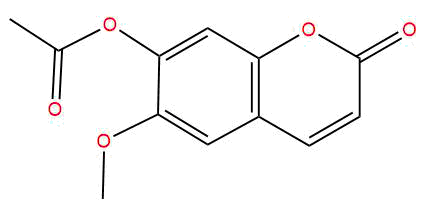


Product name: Scopoletin acetate
Synonym name: O-Acetyl-Scopoletin; Scopoletin monoacetate;Acetylscopoletin
Catalogue No.: BP4289
Cas No.: 56795-51-8
Formula: C12H10O5
Mol Weight: 234.207
Botanical Source:
Type of Compound:
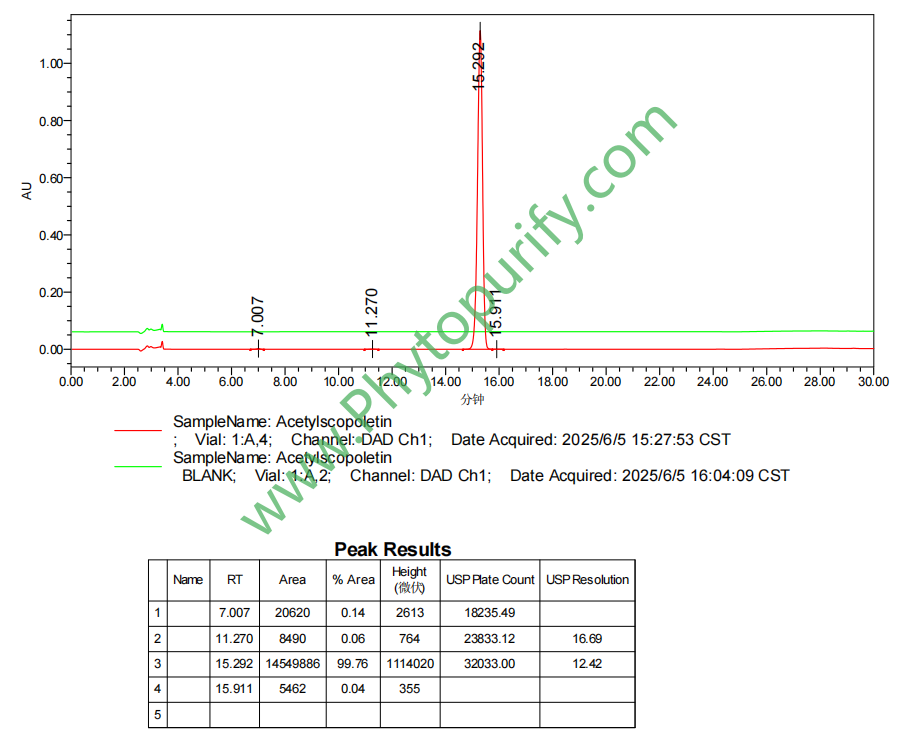
Purity: 95%~99%
Analysis Method: HPLC-DAD or/and HPLC-ELSD
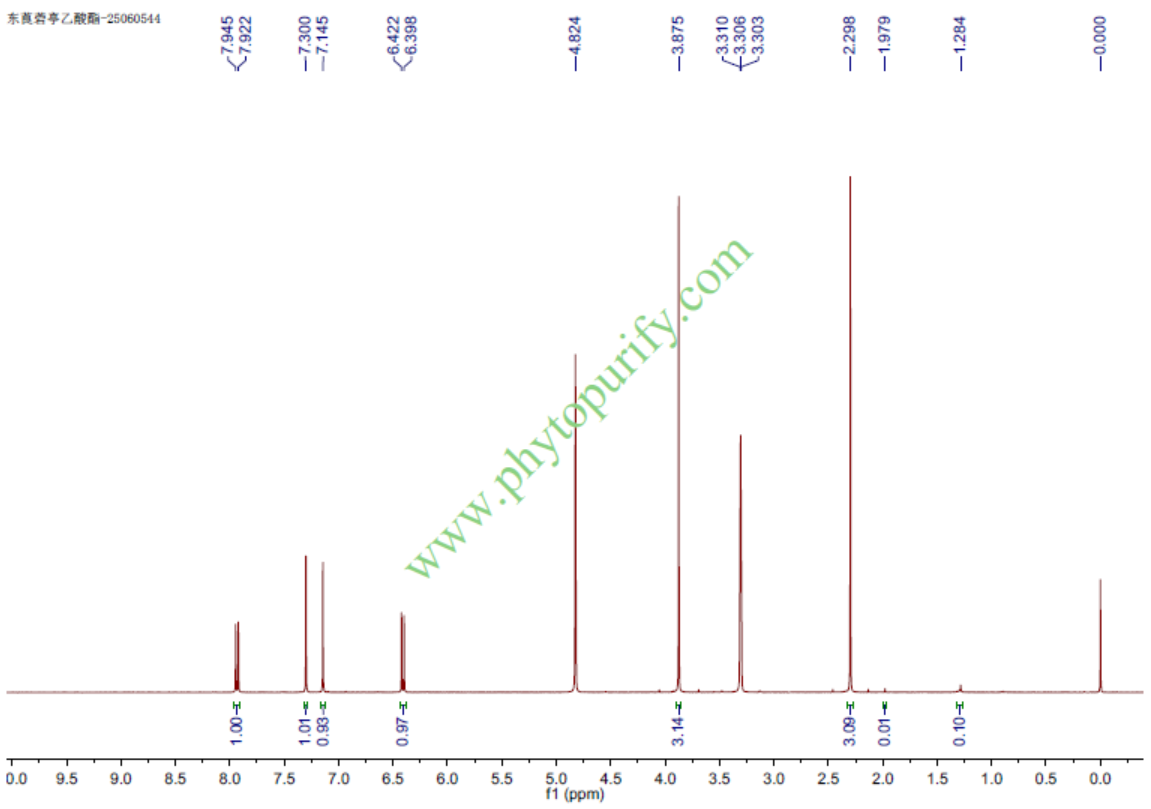
Identification Method: Mass, NMR
Packing: Brown vial or HDPE plastic bottle
Storage: Store in a well closed container, protected from air and light. Put into refrigerate or freeze for long term storage.
Whenever possible, you should prepare and use solutions on the same day. However, if you need to make up stock solutions in advance, we recommend that you store the solution as aliquots in tightly sealed vials at -20℃. Generally, these will be useable for up to two weeks.
The product could be supplied from milligrams to grams
Inquire for bulk scale.
For Reference Standard and R&D, Not for Human Use Directly.
HPLC of Scopoletin acetate
HNMR of Scopoletin acetate
Storage conditions:Short-term storage at 2~8℃, long-term storage at -20 ~ -80℃
72.8300
1.3700
1.3700
Low
No
No
No
Unknown
No
Unknown
Natural products, as an important source of drug discovery, play an irreplaceable role in the long history of human struggle against diseases. Coumarin compounds, as a class of secondary metabolites widely present in the plant kingdom, have attracted much attention due to their structural diversity and significant biological activity. Scopolatin acetate, also known as 6-methoxy-7-acetoxycoumarin, is a type of coumarin derived from the Artemisia genus in the Asteraceae family(Artemisia granatensis)Natural coumarin derivatives. As an acetylated product of Scopolatin, this compound retains the core features of the coumarin parent nucleus in its structure, while exhibiting unique physicochemical properties and biological activity due to the introduction of acetoxy groups.
In recent years, with the deepening of research on the active ingredients of traditional medicinal plants, scopolamine acetate has gradually entered the field of researchers' vision. Preliminary pharmacological studies have shown that the compound has significant anticholinergic activity and can interact with various muscarinic acetylcholine receptors (mAChRs) and acetylcholinesterase (AChE), indicating its potential application value in the treatment of diseases related to cholinergic system dysfunction, such as Alzheimer's disease, Parkinson's disease, and organophosphate poisoning. However, compared to its prototype compound scopolamine, systematic research on scopolamine acetate is still relatively limited, and its comprehensive pharmacological activity spectrum, exact molecular mechanism, and pharmacological characteristics still need to be further elucidated. This article aims to provide a systematic review of the chemical structure, plant origin, pharmacological activity, mechanism of action, and medicinal properties of scopolamine acetate, in order to provide comprehensive scientific basis for the subsequent research and development of this natural product.
The chemical structure of scopolamine acetate is based on the classical coumarin (benzo [a] - pyranone) parent nucleus. The coumarin skeleton is composed of a benzene ring fused with an alpha pyranone ring, and its core structure is 1,2-benzopyranone. In the acetate molecule of scopolamine, the C-6 position of the coumarin parent nucleus is connected to a methoxy group (- OCH ∝), while the C-7 position is connected to an acetoxy group (- OCOCH ∝) through an ester bond. From the perspective of structural derivation, scopolamine acetate can be regarded as the product of acetylation of the 7-hydroxyl group of scopolamine (7-hydroxy-6-methoxycoumarin). This acetylation modification is a key structural feature that distinguishes the compound from its prototype, and has a significant impact on its physicochemical properties, bioavailability, and pharmacological activity.
In terms of physicochemical properties, the molecular formula of scopolamine acetate is C ₁₂ H ₁₀ O ₅, with a molecular weight of 234.20 g/mol. Its lipid water partition coefficient (LogP) is 1.37, indicating that the compound has moderate lipophilicity, which is beneficial for its crossing of biofilm structures, but may also affect its solubility in aqueous environments. The topological polar surface area (TPSA) is 72.83 Å ², which is lower than the recommended upper limit of 140 Å ² for oral medications, indicating its good oral absorption potential. The molecule contains 5 hydrogen bond acceptors (all oxygen atoms), but no hydrogen bond donors, which may affect its binding mode and hydration with target proteins. It is worth noting that drug prediction data shows that the blood-brain barrier penetration ability of scopolamine acetate is low (Low), which poses potential limitations for its application in central nervous system diseases, but may also imply a lower risk of central nervous system related side effects. In addition, preliminary toxicity prediction results showed that the compound had no significant hepatotoxicity, cardiotoxicity, or hERG (human Ether - à - go Related Gene) potassium channel inhibitory activity, providing preliminary positive signals for its safety assessment. However, the Ames test results are still unknown, and the genetic toxicity risk needs to be experimentally verified.
Scopolamine acetate was originally derived from plants of the Artemisia genus in the Asteraceae family Artemisia granatensis Separation and identification in the middle. Artemisia genus(Artemisia)It is one of the largest genera in the Asteraceae family, containing over 500 plant species, widely distributed in temperate and cold temperate regions of the Northern Hemisphere. This genus of plants is known for its rich secondary metabolites and long medicinal history, with many species such as Artemisia annua(A. annua Artemisinin source, Artemisia annua(A. argyi)And Artemisia scoparia(A. capillaris)All of them are important medicinal plants.Artemisia granatensis As a specific species, there is relatively little research on its chemical composition, and the discovery of scopolamine acetate enriches the chemical diversity of this genus of plants.
Except Artemisia granatensis Moreover, scopolamine acetate may also be present in other plants, especially those species rich in scopolamine and its derivatives. For example, belladonna(Atropa belladonna)Western Gold Flower(Datura metel)Solanaceae plants, as well as some Rutaceae plants, have been reported to contain compounds of the scopolamine class. However, as the natural acetylation form of scopolamine acetate, its distribution may be more limited, and its biosynthesis may involve the esterification reaction of scopolamine catalyzed by specific enzymes such as acetyltransferase.
There is currently no standardized process specifically for the extraction of scopolamine acetate, and the general extraction strategy for coumarin compounds is usually used as a reference. A typical extraction process includes: first, drying the plant material (such as...)Artemisia granatensis Grind the above ground parts and extract them by soaking or percolation using organic solvents such as methanol, ethanol, or ethyl acetate. After the extraction solution is concentrated under reduced pressure, crude extract is obtained. Subsequently, the crude extract was preliminarily separated by liquid-liquid extraction (such as stepwise extraction using petroleum ether, chloroform, ethyl acetate, and n-butanol), and scopolamine acetate is usually enriched in the chloroform or ethyl acetate extraction sites due to its moderate polarity. Further purification depends on a variety of chromatographic techniques, including silica gel column chromatography, Sephadex LH-20 gel column chromatography, preparative thin layer chromatography, and high performance liquid chromatography (HPLC). During the separation process, the characteristic blue fluorescence of coumarin compounds (observed under ultraviolet light) is often used as a tracking method, combined with thin-layer chromatography (TLC) and HPLC analysis, to ultimately obtain high-purity scopolamine acetate monomer.
The pharmacological activity research of scopolamine acetate is still in its early stages, and existing evidence mainly focuses on its effects on the cholinergic system, especially in terms of anticholinergic activity.
Anticholinergic activity This is the pharmacological effect of scopolamine acetate that has received the most attention. The cholinergic system plays a central role in human physiological functions, including nerve conduction, muscle contraction, glandular secretion, cognitive function, and more. Anticholinergic drugs inhibit the function of the parasympathetic nervous system by blocking the binding of acetylcholine to cholinergic receptors. Preliminary studies have shown that scopolamine acetate can bind to various subtypes of muscarinic acetylcholine receptors (mAChRs), including CHRM1 to CHRM5, and exert antagonistic effects. This broad receptor affinity may have an impact on various cholinergic mediated physiological processes. In addition, the compound has been found to inhibit the activity of acetylcholinesterase (AChE). AChE is a key enzyme in the degradation of acetylcholine, and its inhibition leads to an increase in the concentration of acetylcholine in the synaptic cleft, thereby enhancing cholinergic signaling. Therefore, the antagonistic effect of scopolamine acetate on mAChRs and the inhibitory effect on AChE may seem contradictory, but in fact, it may constitute a complex regulatory network. Under specific pathological conditions (such as organophosphate poisoning leading to excessive inhibition of AChE), its AChE inhibitory activity may help restore cholinergic balance; In other cases, its mAChRs antagonistic effect may dominate its pharmacological effects.
Other potential activities Given its identity as a coumarin parent nucleus and derivative of scopolamine, scopolamine acetate may also possess other common biological activities of coumarin compounds, such as antioxidant, anti-inflammatory, antibacterial, etc. Scopolamine itself has been reported to have significant antioxidant and anti-inflammatory effects, and its acetylated derivatives may retain or enhance these activities. However, there is currently insufficient direct experimental evidence on the effects of scopolamine acetate in these areas, and further research is needed. In addition, based on its interaction with the cholinergic system, this compound has shown potential applications in neuroprotection, improving cognitive function, alleviating smooth muscle spasms (such as gastrointestinal and bronchial spasms), and serving as an antidote for organophosphate poisoning.
The pharmacological mechanism of scopolamine acetate mainly involves its interaction with key proteins in the cholinergic system, and its molecular target network includes acetylcholinesterase (AChE) and various muscarinic acetylcholine receptors (mAChRs).
Inhibition mechanism of acetylcholinesterase (AChE)AChE is a member of the serine hydrolase family, and its active center contains a catalytic triad composed of serine, histidine, and glutamate. Scopolamine acetate may bind to the active site of AChE through its coumarin nucleus, forming reversible or irreversible enzyme inhibitor complexes. Specifically, its acetoxy group may form hydrogen bonds or covalent interactions with the serine hydroxyl group at the active site through carbonyl oxygen, while the methoxy group and coumarin ring bind to the aromatic amino acid residues of the enzyme (such as Trp86, Tyr337, etc.) through hydrophobic interactions and π - π stacking. This binding mode may hinder the entry of acetylcholine into the active site, thereby inhibiting its hydrolysis. However, unlike classical amino ester or organophosphate AChE inhibitors, the inhibitory kinetics of scopolamine acetate (reversible/irreversible, competitive/non competitive) still need to be clarified through enzyme kinetics experiments (such as Lineweaver Burk plot analysis) and molecular docking simulations.
Antagonistic mechanism against muscarinic acetylcholine receptors (mAChRs)MAChRs belong to the G protein coupled receptor (GPCR) superfamily, which includes five subtypes M1 to M5 that mediate different downstream signaling pathways. As an mAChRs antagonist, the mechanism of action of scopolamine acetate is similar to classical anticholinergic drugs such as atropine and scopolamine. This compound may competitively bind to the orthosteric binding site of mAChRs with acetylcholine, thereby blocking acetylcholine induced receptor conformational changes and G protein activation. Due to the affinity of scopolamine acetate for CHRM1 to CHRM5, it suggests that it may be a non selective mAChRs antagonist. This non selectivity means that while it exerts therapeutic effects, it may also cause various peripheral and central side effects. For example, blocking M1 receptors (mainly distributed in the central nervous system and autonomic ganglia) may affect cognitive function; Blocking M2 receptors (mainly distributed in the heart) may lead to tachycardia; Blocking M3 receptor (mainly distributed in gland, smooth muscle and pupillary sphincter) will lead to dry mouth, blurred vision, urinary retention, etc. Therefore, improving the selectivity for specific subtypes is a key direction for future drug optimization based on this structure.
Multi-target action network The simultaneous action of scopolamine acetate on AChE and mAChRs makes it a compound with "multi-target" characteristics. This dual mode of action may have advantages in treating complex diseases such as Alzheimer's disease. For example, in Alzheimer's disease, cholinergic neurons in the patient's brain regress and acetylcholine levels decrease. In theory, AChE inhibitors can increase the concentration of acetylcholine in the synaptic cleft, while mAChRs agonists can directly activate receptors. However, as an mAChRs antagonist, scopolamine acetate acts in the opposite direction of therapeutic demand. Therefore, its application in Alzheimer's disease may not be directly achieved by enhancing cholinergic signaling, but by regulating the overactivity of the cholinergic system or interacting with other neurotransmitter systems. A more reasonable application scenario may be for treating diseases related to cholinergic hyperfunction, such as organophosphate poisoning, cholinergic dopaminergic imbalance in Parkinson's disease, or as a pre anesthetic medication to reduce glandular secretion.
The evaluation of drug properties is a crucial step in determining whether natural products can be transported from the laboratory to clinical applications. Based on existing computational predictions and preliminary experimental data, analyze the pharmacological characteristics of scopolamine acetate.
Analysis of drug properties According to Lipinski's "Rule of Five", the molecular weight (234.2<500), LogP (1.37<5), number of hydrogen bond acceptors (5 ≤ 10), and number of hydrogen bond donors (0<5) of scopolamine acetate meet the basic requirements for oral medication, indicating its good drug like properties. The TPSA value (72.83 Å ²) is also within the ideal range, which is beneficial for oral absorption and cell membrane permeation. However, its blood-brain barrier penetration ability is predicted to be 'Low', which may limit its application in central nervous system diseases. This characteristic may stem from the presence of polar groups (such as carbonyl oxygen of acetoxy) in its molecule and the possibility of P-glycoprotein (P-gp) efflux.
Pharmacokinetic characteristics At present, experimental data on the pharmacokinetics of scopolamine acetate in vivo is extremely scarce. The following analysis is mainly based on its structural characteristics and knowledge of similar compounds for inference.
- absorb Due to its moderate lipid solubility and small molecular weight, it is speculated that scopolamine acetate can be absorbed by the gastrointestinal tract through passive diffusion after oral administration. However, its ester bond structure may make it easily hydrolyzed by esterases in the gastrointestinal tract or liver, producing scopolamine and acetic acid. This first pass metabolic effect may lead to a decrease in its oral bioavailability. Therefore, the systemic exposure of its prototype drug may be limited, and scopolamine may become the main circulating form in the body.
- distribution After absorption, scopolamine acetate and its metabolites (mainly scopolamine) may be widely distributed throughout the body tissues. The binding rate with plasma proteins is still unclear. Low blood-brain barrier penetration suggests limited distribution in the central nervous system.
- Metabolism Metabolism is a key link in the in vivo disposal of scopolamine acetate. The main metabolic pathways may include: ① Ester hydrolysis Under the catalysis of esterases in plasma, liver, and small intestine, it rapidly hydrolyzes into scopolamine and acetic acid. ② Glucuronic acid/sulfuric acid binding The 7-phenolic hydroxyl group of the hydrolyzed product scopolamine can further bind with glucuronic acid or sulfuric acid to form a more water-soluble complex, which can be excreted through urine or bile. ③ O-demethylation The 6-methoxy group of scopolamine may undergo demethylation reaction to generate 6,7-dihydroxycoumarin (Esculetin).
- excretion Metabolites are mainly excreted through the kidneys (urine) and liver (bile). The excretion of prototype drugs may be extremely low.
safety assessment The preliminary toxicological predictions are encouraging, showing that scopolamine acetate has no hepatotoxicity, cardiotoxicity, or hERG inhibitory activity. However, these predicted results cannot replace rigorous experimental verification. Its potential genetic toxicity (Ames test results unknown), acute toxicity, long-term toxicity, and reproductive toxicity all need to be evaluated through systematic in vitro and in vivo toxicology studies. In addition, as a non selective antagonist of mAChRs, it may cause a series of peripheral anticholinergic side effects at the therapeutic dose, such as dry mouth, constipation, blurred vision, tachycardia, urinary retention, etc., which is a challenge that needs to be focused on in its clinical application.
Based on existing pharmacological and pharmacological data, the clinical application prospects of scopolamine acetate are mainly reflected in the following directions, but it also faces many challenges.
Potential application areas:
1. Treatment of anticholinergic syndrome This is the most direct application direction of scopolamine acetate. Anticholinergic syndrome can be caused by excessive use of anticholinergic drugs (such as atropine, diphenhydramine) or ingestion of plants containing such compounds (such as mandala, belladonna), manifested as dry mouth, skin flushing, tachycardia, delirium, high fever, and other symptoms. Scopolamine acetate, as an mAChRs antagonist, can theoretically be used to treat this type of syndrome. However, it is already an anticholinergic drug and should be used with extreme caution to avoid exacerbating symptoms. A more reasonable application may be as an adjuvant or alternative drug to huperzine (an AChE inhibitor used to treat anticholinergic syndrome), but its AChE inhibitory activity may bring complex effects.
2. Detoxification of organophosphate poisoning Organophosphorus compounds (such as pesticides and nerve agents) irreversibly inhibit AChE, leading to a large accumulation of acetylcholine and causing cholinergic crisis. The standard treatment regimen includes atropine (mAChRs antagonist) and pralidoxime (AChE activator). Scopolamine acetate has dual activities of mAChRs antagonism and AChE inhibition, which theoretically may provide a new therapeutic approach. Its AChE inhibitory activity may seem contradictory in the context of organophosphate poisoning, but it may partially protect the enzyme from irreversible modification by organophosphates through competitive binding to AChE, thereby producing a synergistic effect with phosphate solubilizing agents. However, this hypothesis requires rigorous animal models and clinical studies to validate.
3. Digestive system diseases As an mAChRs antagonist, scopolamine acetate may be used to alleviate gastrointestinal smooth muscle spasms (such as irritable bowel syndrome, biliary colic) and inhibit gastric acid secretion. Its non selective effects may lead to side effects such as dry mouth and constipation, but if administered locally (such as rectal suppositories) or the dosage is properly controlled, it still has development value.
4. Respiratory system diseases By blocking the M3 receptor on airway smooth muscle, this compound may have bronchodilator effects and can be used to treat asthma or chronic obstructive pulmonary disease (COPD). Similarly, its systemic side effects are the main limitation.
Challenges faced and future research directions:
1. Selective optimization The non selective mAChRs antagonistic effect is the biggest obstacle to the clinical application of scopolamine acetate. Future research should focus on improving the selectivity of specific receptor subtypes (such as M3 receptors for smooth muscle spasms or M1 receptors for cognitive improvement) through structural modifications to reduce side effects. For example, different substituents can be introduced at different positions of the coumarin core, or the chain length and structure of the acetoxy group can be altered.
2. Pharmacokinetic improvement The easy hydrolysis of ester bonds leads to low oral bioavailability and metabolic instability. Its pharmacokinetic characteristics can be improved through prodrug design (such as replacing acetoxy groups with more stable amide or ether bonds), nano formulations (such as liposomes, polymer nanoparticles), or changing the route of administration (such as transdermal or inhalation administration).
3. In depth elucidation of the mechanism of action Molecular biology techniques such as surface plasmon resonance, radioligand binding assays, and functional cell assays are required to accurately determine the affinity and functional activity (excitatory/antagonistic/partially excitatory) of each mAChRs subtype. Meanwhile, through X-ray crystallography or molecular simulation, the binding modes of AChE and mAChRs can be analyzed to provide guidance for structural optimization.
4. Toxicological evaluation of the system A comprehensive toxicological assessment including acute toxicity, long-term toxicity, reproductive toxicity, genetic toxicity (Ames test, micronucleus test), and cardiac safety (hERG channel, action potential) must be completed to determine its safety window.
5. Expand the scope of active research In addition to the cholinergic system, the activity of scopolamine acetate in antioxidant, anti-inflammatory, anti-tumor, antibacterial and other aspects should be systematically evaluated to explore its new therapeutic potential. Especially, its prototype scopolamine has significant anti-inflammatory and antioxidant activities. It is worth further studying whether acetylation modification enhances or alters these activities.
Scopolamine acetate, as a medicinal plant derived substance Artemisia granatensis Natural coumarin derivatives have attracted attention for their unique chemical structure (7-acetylation product of scopolamine) and remarkable anticholinergic activity (acting on both AChE and mAChRs). The preliminary pharmacological evaluation shows that it has the basic characteristics of an oral drug and is predicted to have low toxicity, providing a basis for its further development. However, the research on this compound is still in a very early stage, and its comprehensive pharmacological activity spectrum, exact molecular mechanism of action, systematic pharmacokinetic characteristics, and complete toxicological profile all need to be elucidated. The non selective receptor mode of action and potential metabolic instability are the main challenges facing its clinical translation. Future research should focus on optimizing the structure through medicinal chemistry to improve receptor subtype selectivity, utilizing advanced formulation techniques to improve its pharmacokinetic behavior, and conducting in-depth mechanism studies and systematic preclinical evaluations. Only in this way can the medicinal value of this natural product be fully explored, and it can truly move from a "candidate molecule" in the laboratory to a "candidate drug" for clinical application, providing new chemical entities and ideas for the treatment of cholinergic system related diseases.
