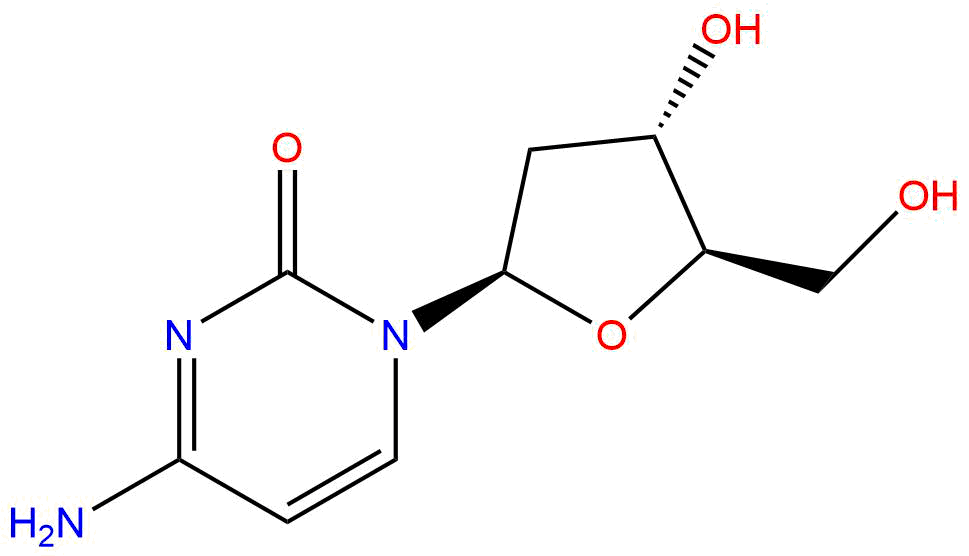


Product name: Deoxycytidine
Synonym name: Deoxyribose cytidine;Cytosine deoxyribonucleoside; Cytosine deoxyriboside
Catalogue No.: BP4233
Cas No.: 951-77-9
Formula: C9H13N3O4
Mol Weight: 227.22
Botanical Source:
Type of Compound:
Purity: 95%~99%
Analysis Method: HPLC-DAD or/and HPLC-ELSD
Identification Method: Mass, NMR
Packing: Brown vial or HDPE plastic bottle
Storage: Store in a well closed container, protected from air and light. Put into refrigerate or freeze for long term storage.
Whenever possible, you should prepare and use solutions on the same day. However, if you need to make up stock solutions in advance, we recommend that you store the solution as aliquots in tightly sealed vials at -20℃. Generally, these will be useable for up to two weeks.
The product could be supplied from milligrams to grams
Inquire for bulk scale.
For Reference Standard and R&D, Not for Human Use Directly.
Storage conditions:Short-term storage at 2~8℃, long-term storage at -20 ~ -80℃
110.6000
-1.7199
-1.7204
14.1122
.5195
.9400
High
12.8507
3.5062
Yes
Yes
No
No
Yes
No
0.9
No
Yes
Yes
No
Deoxycytidine (CAS number 951-77-9) is an important pyrimidine 2 '- deoxyribonucleoside containing cytosine as a nucleobase in its structure. As one of the fundamental building blocks of DNA synthesis, 2 '- deoxycytidine plays a crucial role in nucleic acid metabolism, biosynthesis, and cellular function maintenance. It is widely present in various organisms, including mice, brewing yeast, Escherichia coli, and humans, demonstrating its importance in metabolic networks of different species. In recent years, with the deepening of research on nucleic acid drugs and anti-tumor drugs, the pharmacological properties and mechanisms of action of 2 '- deoxycytidine and its derivatives have gradually become a research hotspot in the field of natural product pharmacology.
This article aims to systematically review the chemical structure and physicochemical properties, plant sources and extraction methods, pharmacological activity and mechanism of action, pharmacological evaluation and pharmacokinetic characteristics of 2 '- deoxycytidine, and prospects its potential in clinical applications. By integrating the latest research progress, we strive to provide comprehensive and in-depth reference materials for researchers in related fields.
The molecular formula of 2 '- deoxycytidine is C9H13N3O4, with a molecular weight of 227.2200. Its structure is composed of a cytosine nucleotide and 2 '- deoxyribose connected by a β - N1 glycosidic bond. Unlike cytidine, the ribose ring of 2 '- deoxycytidine lacks a hydroxyl group at the 2' position, endowing it with unique chemical stability and biological activity.
In terms of physical and chemical properties, the LogP value of 2 '- deoxycytidine is -1.7199, indicating its strong hydrophilicity and easy solubility in water (with a water solubility of approximately 14.1122 mg/mL). Its polar surface area (TPSA) is 110.6 Å ², indicating that the molecule has high polarity and hydrogen bond donor/acceptor ability, which is conducive to binding with biomolecules. The high permeability of the blood-brain barrier suggests that it may pass through the barrier of the central nervous system and has potential neuropharmacological application value. The negative result of hERG inhibition experiment indicates a low risk of cardiac toxicity; The Ames test value is 0.9, indicating a low risk of genotoxicity.
2 '- deoxycytidine mainly exists as a nucleic acid metabolite in various organisms, with lower levels in natural plants, and is usually obtained through biosynthetic pathways. Its main sources include plant tissues rich in nucleic acids and microbial fermentation products. Traditional extraction methods often rely on nucleic acid hydrolysis, combined with enzymatic or acid-base hydrolysis methods, to degrade nucleic acids into monomeric nucleosides, which are then purified and separated by high performance liquid chromatography (HPLC).
In recent years, with the development of biotechnology, microbial fermentation has become an effective way to obtain high-purity 2 '- deoxycytidine. By genetically engineering microorganisms such as brewing yeast and Escherichia coli, their nucleoside biosynthesis ability can be improved to achieve large-scale production. In addition, the application of modern separation technologies such as supercritical fluid extraction and membrane separation has significantly improved extraction efficiency and purity.
2 '- deoxycytidine, as a precursor for DNA synthesis, exhibits pharmacological activities mainly in regulating cell proliferation, gene expression, and metabolic homeostasis. In anti-tumor research, derivatives of 2 '- deoxycytidine such as cytarabine have been widely used in the treatment of leukemia and lymphoma, showing significant cytotoxicity and anti proliferative effects.
Basic research has shown that 2 '- deoxycytidine itself is involved in DNA repair and replication processes, and can affect cell cycle progression. Its metabolic pathway abnormalities in tumor cells have become an important entry point for targeted therapy. In addition, the potential roles of 2 '- deoxycytidine in immune regulation, neuroprotection, and other aspects are gradually being revealed. For example, in certain neurodegenerative disease models, metabolic abnormalities of 2 '- deoxycytidine are associated with pathological progression, suggesting its potential as a biomarker or therapeutic target.
The main mechanism of action of 2 '- deoxycytidine involves its participation in nucleic acid metabolism as a substrate for DNA synthesis. It is phosphorylated into 2 '- deoxycytidine monophosphate (dCMP) by nucleoside kinase inside the cell, and further converted into diphosphate and triphosphate forms for DNA polymerase to synthesize DNA strands. This process is regulated by various enzymes, including deoxyribonucleoside kinase, nucleotide kinase, and nucleotide reductase.
In addition, 2 '- deoxycytidine and its metabolites can regulate DNA methylation status and affect gene expression regulation. Its role in cell signaling is gradually being recognized, especially in regulating cell apoptosis and stress response. Molecular targets mainly include DNA polymerase, nucleotide metabolizing enzymes, and related regulatory proteins.
In the anti-tumor mechanism, derivatives of 2 '- deoxycytidine induce chain termination and DNA damage by doping into DNA strands, activating the apoptotic pathway of cells. In addition, its inhibitory effect on DNA repair enzymes enhances the sensitivity of tumor cells to chemotherapy drugs.
From the perspective of pharmacological parameters, 2 '- deoxycytidine has good water solubility and low lipid solubility (LogP-17199), which is beneficial for oral absorption and in vivo distribution. Its higher polar surface area (TPSA 110.6) facilitates binding with enzymes and receptors, but may limit its transmembrane diffusion rate.
The high permeability of the blood-brain barrier suggests its potential application value in central nervous system diseases. HERG channel inhibition is negative, indicating good cardiac safety and reducing the risk of arrhythmia. The Ames test results showed that its genotoxicity was low and met the drug safety requirements.
In terms of pharmacokinetics, 2 '- deoxycytidine is mainly metabolized through nucleoside kinase mediated phosphorylation in vivo, with a short half-life. Optimization of administration methods or structural modifications are needed to improve stability and bioavailability. Its metabolites and excretion pathways are clear, which is beneficial for clinical dose adjustment and toxicological monitoring.
2 '- deoxycytidine, as a key intermediate in nucleic acid metabolism, its derivatives have been maturely applied in fields such as anti-tumor and antiviral, and have enormous potential for future development. Based on its good pharmaceutical properties and safety, 2 '- deoxycytidine itself and its structurally modified derivatives are expected to play a greater role in precision medicine, gene therapy, and the treatment of neurological diseases.
With the advancement of nucleic acid drug technology, the design of nucleoside analogues related to 2 '- deoxycytidine will become more diverse, and targeting and selectivity will be significantly improved. In addition, the application of combined immunotherapy and nanocarrier delivery technology will broaden its clinical indications and improve treatment efficacy.
Future research should focus on in-depth analysis of the molecular mechanism of action of 2 '- deoxycytidine, optimizing its pharmacokinetic characteristics, and exploring its potential value in central nervous system diseases and immune regulation. At the same time, strengthen its safety evaluation and clinical translational research, and promote its smooth transition from basic research to clinical application.
2 '- deoxycytidine, as a fundamental and crucial pyrimidine 2' - deoxyribonucleoside, plays an irreplaceable role in the body. Its unique chemical structure and physicochemical properties endow it with a wide range of biological functions and pharmacological activities. Through a systematic review of its pharmacological mechanisms, drug properties, and clinical application prospects, this article provides important references for the field of natural product pharmacology.
In the future, with the continuous advancement of biotechnology and medicinal chemistry, 2 '- deoxycytidine and its derivatives will show broader application prospects in disease treatment and precision medicine, promoting the deeper development of natural product pharmacology.
