

Storage conditions:Short-term storage at 2~8℃, long-term storage at -20 ~ -80℃
8-Methylchrysophanol (CAS number: 3300-25-2) is a typical anthraquinone natural product that was first isolated from Senna macranth bark. As an important member of anthraquinone compounds, 8-methyl emodin has attracted much attention in the field of natural medicine research in recent years due to its unique chemical structure and diverse biological activities. Especially in terms of its laxative effect, it exhibits significant pharmacological effects by regulating intestinal ion channels and transporters, affecting water salt balance. This article will provide a systematic review of the chemical structure and physicochemical properties, plant sources and extraction methods, pharmacological activity and mechanism of action, pharmacological evaluation and pharmacokinetic characteristics of 8-methyl emodin, and explore its clinical application prospects and development directions.
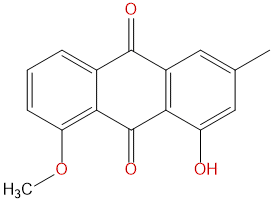
8-Methylchrysophanol belongs to the anthraquinone class of compounds, with a chemical formula of C16H12O4 and a molecular weight of 268.2680. The core of its structure is the anthraquinone skeleton, with a methyl substituent introduced at position 8, endowing it with unique chemical properties and biological activity. The molecular structure contains two hydroxyl groups and two ketone groups, forming a stable conjugated system with strong electron cloud density distribution, which is conducive to interaction with biomolecules.
In terms of physical and chemical properties, the LogP value of 8-methyl emodin is 3.1531, indicating that it has moderate lipid solubility and is conducive to cell membrane penetration. The polarization surface area (TPSA) is 63.6 Å ², indicating a balance between molecular polarity and hydrophilicity, which is beneficial for improving bioavailability. The low water solubility (0.0136 mg/mL) poses certain challenges for its formulation development. The high penetration ability of the blood-brain barrier suggests that it may have some impact on the central nervous system. The hERG channel inhibition experiment showed a negative result, indicating a low risk of cardiac toxicity. The Ames test result is 1.2, indicating a low risk of genotoxicity and good safety.
8-Methylchrysophanol is mainly present in the bark of Senna macranth (large leaved boxwood). Senna macranth, as a traditional Chinese medicinal herb, is widely distributed in tropical and subtropical regions and has always been used to treat constipation and related intestinal diseases. The bark of this plant contains abundant anthraquinone compounds, among which 8-methyl emodin is one of the important active ingredients.
The extraction process usually adopts a combination of organic solvent extraction and column chromatography separation. Common extraction solvents include ethanol, methanol, and ethyl acetate, which can effectively dissolve anthraquinone compounds. The extraction process generally includes: crushing plant materials → extraction → concentration → solvent extraction → silica gel column chromatography separation → high performance liquid chromatography (HPLC) purification. In recent years, ultrasound assisted extraction and microwave-assisted extraction techniques have also been applied to improve extraction efficiency and purity. During the extraction and purification process, attention should be paid to avoiding high temperature and strong acid-base conditions to prevent the degradation of anthraquinone skeleton.
The pharmacological activity research of 8-methyl emodin mainly focuses on its laxative effect and related intestinal regulatory functions. Multiple in vitro and in vivo experiments have shown that this compound can significantly promote intestinal peristalsis, increase the water content of intestinal contents, and thus exert a laxative effect.
In animal models, 8-methyl emodin promotes the secretion of sodium and chloride ions by regulating intestinal ion channels and aquaporin proteins, enhances intestinal osmotic pressure, and causes water to passively enter the intestinal lumen, softening feces and shortening defecation time. In addition, the compound also exhibits anti-inflammatory and antioxidant activities, which may help alleviate intestinal inflammation and improve intestinal dysfunction.
In addition to its laxative effect, preliminary studies have also found that 8-methyl emodin has the potential to inhibit the proliferation of certain tumor cells, but the relevant mechanism still needs further clarification.
The laxative effect of 8-methyl emodin is mainly achieved by regulating various intestinal ion channels and transporters, involving key targets including:
By regulating the above targets, 8-methyl emodin can coordinate the transport of intestinal ions and water, promote intestinal peristalsis and secretion, and achieve a laxative effect. In addition, its inhibitory effect on intestinal inflammatory factors may indirectly improve intestinal barrier function and enhance drug efficacy.
In terms of medicinal properties, 8-methyl emodin exhibits ideal medicinal properties. Its molecular weight is moderate, and its LogP value shows good lipid solubility, which is beneficial for oral absorption and cell membrane penetration. TPSA is moderate and supports good bioavailability. Low water solubility suggests the need to improve dissolution and bioavailability through formulation optimization.
The high penetration ability of the blood-brain barrier suggests that it may have some impact on the central nervous system, and potential central side effects need to be considered. HERG channel inhibition is negative, reducing the risk of cardiac toxicity. The Ames test results showed a low risk of genotoxicity and good safety.
Pharmacokinetic studies are still in the preliminary stage. Metabolism in the body may mainly be carried out through the liver enzyme system, involving corresponding oxidation and reduction reactions. The main excretion pathways may be bile and urine. In the future, it is necessary to systematically conduct absorption, distribution, metabolism, excretion (ADME) and toxicological assessments to provide a basis for clinical development.
As a natural anthraquinone laxative, 8-methyl emodin has a clear pharmacological basis and good safety, and has the potential to be developed as a new laxative. It regulates intestinal ion channels and water channels through multiple targets, with clear mechanisms and significant effects, providing new treatment options for chronic constipation, intestinal dysfunction and other diseases.
In addition, its anti-inflammatory and antioxidant activities provide the possibility for comprehensive treatment of intestinal diseases, and its application value in fields such as inflammatory bowel disease and irritable bowel syndrome can be explored in the future. Given its blood-brain barrier penetration ability, its potential role in central nervous system related diseases can also be considered.
However, there are still shortcomings in current research, such as incomplete pharmacokinetic characteristics, lack of long-term safety evaluation, and insufficient clinical trial data. In the future, we should strengthen the research on in vitro and in vivo mechanisms, optimize formulation technology, conduct systematic toxicology and clinical evaluations, and promote their clinical translation.
8-Methylchrysophanol, as a natural anthraquinone compound derived from Senna macranth bark, has shown broad research and application prospects in the field of natural product pharmacology due to its unique chemical structure and multi-target diarrhea mechanism. Its good pharmacological parameters and safety lay the foundation for the development of new laxatives. In the future, by combining modern drug research and development technology, in-depth exploration of its pharmacological mechanisms and clinical applications is expected to promote 8-methyl emodin as an important drug for treating intestinal diseases, providing a model for the development of natural product drugs.
