| Catalog No | Package | Original Price | Price | Inventory | Quantity | Operating |
|---|---|---|---|---|---|---|
| BP5096-5mg | 5mg | $250.00 | Sign in |
|


Storage conditions:Short-term storage at 2~8℃, long-term storage at -20 ~ -80℃
Ferulic acid, as a natural phenolic compound widely present in plant cell walls, has attracted much attention due to its significant antioxidant, anti-inflammatory, and various pharmacological activities. Its derivative - (Z) - ferulic acid-4-O-glucoside (hereinafter referred to as "cis-Ferroic acid 4-O - β - D-glucoside") is a natural product with unique structural characteristics, which has shown potential pharmacological value in the field of antiplatelet aggregation in recent years. As the key link of thrombosis, platelet aggregation is the important pathological basis of many cardiovascular and cerebrovascular diseases. The regulation of platelet function has become an important strategy to prevent atherosclerosis, myocardial infarction and stroke. This article provides a systematic review of the chemical structure, plant origin, pharmacological activity, mechanism of action, and pharmacological evaluation of cis ferulic acid glucoside, aiming to provide theoretical support and research direction for its clinical application and new drug development.
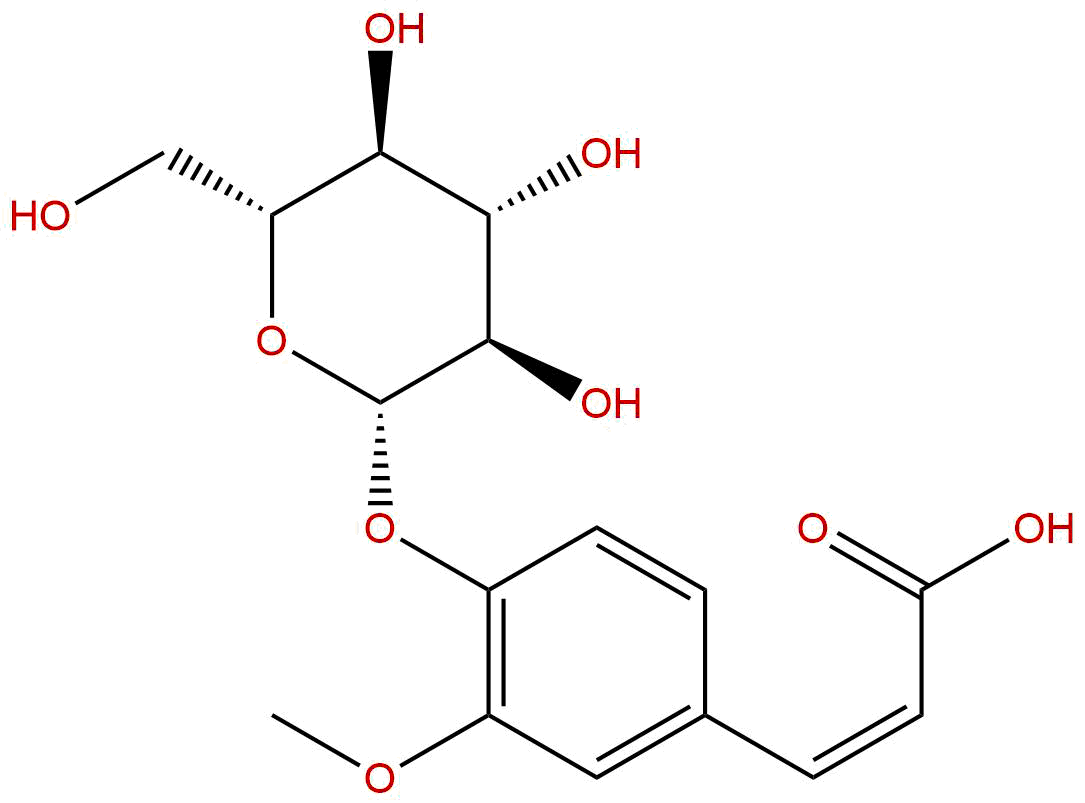
The chemical structure of cis ferulic acid glucoside is based on the skeleton of ferulic acid, characterized by the cis configuration of ferulic acid connected to the β - D-glucoside bond at position 4. Its molecular formula is C17H20O9, with a molecular weight of 356.3270. The structure contains phenolic hydroxyl, methylene, and glucose units, giving it high polarity and water solubility. In terms of physical and chemical properties, its LogP value is -0.1251, indicating low lipid solubility, suggesting good solubility in aqueous phase (approximately 21.2449 mg/mL). The TPSA (topological polar surface area) is 145.9100 Å ², indicating that its molecule has strong polarity and hydrogen bond donor/acceptor ability, which has a positive impact on its binding to biological targets. The low penetration ability of the blood-brain barrier suggests that it mainly acts on the peripheral system, reducing the risk of adverse reactions in the central nervous system. The hERG channel inhibition test result was negative, indicating a low risk of cardiac toxicity. The Ames test result was 0.0, indicating no significant genotoxicity.
Cis ferulic acid glucoside is mainly found in various traditional Chinese medicinal materials and edible plants, especially in certain grasses and medicinal herbs where its content is relatively abundant. For example, certain types of ferulic acid derivatives have been reported in Angelica sinensis, Astragalus membranaceus, and other traditional Chinese medicinal herbs. The extraction method usually uses water or alcohol solvents (such as ethanol, methanol) for extraction, combined with ultrasound assisted extraction or microwave-assisted extraction to improve extraction efficiency. Subsequently, separation, purification, and qualitative/quantitative analysis were performed using liquid chromatography (HPLC) or high-performance liquid chromatography-mass spectrometry (HPLC-MS/MS) techniques. The stability of glucosidic bonds is good, and attention should be paid to avoiding high temperature and strong acid-base conditions during the extraction process to prevent hydrolysis.
Cis ferulic acid glucoside showed significant anti platelet aggregation effects in vitro platelet function experiments. It reduces the activation and aggregation ability of platelets by inhibiting their response to various aggregation inducers such as ADP, collagen, thromboxane A2, etc., thereby reducing the risk of thrombosis. Experimental data shows that the compound can significantly inhibit platelet aggregation at concentrations as low as micromolar, and its efficacy is superior to non glycosylated ferulic acid, indicating that the glucoside structure enhances its biological activity.
As a derivative of ferulic acid, cis ferulic acid glucoside also has good antioxidant properties, which can clear free radicals and alleviate oxidative stress damage to vascular endothelium and platelets. In addition, it also shows potential in regulating inflammatory mediators, inhibiting the expression of inflammatory factors such as TNF - α and IL-6, reducing vascular inflammatory responses, and indirectly promoting vascular health.
Some studies also suggest that the compound may have the effect of regulating blood lipids, protecting myocardium and nerve cells, but the relevant mechanisms still need further clarification.
The antiplatelet aggregation effect of cis ferulic acid glucoside is mainly achieved through multi-target synergistic regulation, involving the following key targets:
Overall, cis ferulic acid glucoside effectively inhibits platelet activation and aggregation through multi-target and multi pathway synergistic effects, demonstrating good antithrombotic potential.
From the analysis of pharmacological parameters, cis ferulic acid glucoside has good potential for drug development. It has a moderate molecular weight and good water solubility, which is beneficial for oral absorption and distribution in the body. The low fat solubility and high TPSA value suggest that it may have certain bioavailability limitations, but also reduce non-specific lipid binding and toxicity risks. The low penetration rate of the blood-brain barrier reduces the possibility of central side effects. HERG channel inhibition is negative and Ames test is non mutagenic, indicating high safety.
In terms of pharmacokinetics, existing research is relatively limited, but it is speculated that its glucoside structure may be hydrolyzed by β - glucosidase in the intestine, releasing active ferulic acid, which affects its bioavailability and metabolic kinetics. In the future, it is necessary to systematically study its absorption, distribution, metabolism, and excretion (ADME) characteristics to clarify its in vivo transformation pathways and the activity of metabolites.
Given the significant activity of cis ferulic acid glucoside in antiplatelet aggregation, antioxidant and anti-inflammatory aspects, this compound has broad clinical application prospects. Firstly, as a natural product derivative, it has high safety and is suitable as an adjuvant therapy for cardiovascular and cerebrovascular diseases or as a component of health products. Secondly, for the prevention and treatment of atherosclerosis, coronary heart disease and stroke, cis ferulate glucoside can be used as a candidate molecule of antiplatelet drugs, especially for patients with poor tolerance to traditional antiplatelet drugs or with bleeding risk.
Future research should focus on:
In addition, by combining modern molecular biology and computer-aided drug design technology, the mechanism of action and target interactions are deeply analyzed, providing a theoretical basis for the development of new antiplatelet drugs.
As a natural product derivative with multi-target antiplatelet aggregation activity, cis ferulic acid glucoside exhibits excellent pharmacological activity and potential for drug development. Its unique chemical structure endows it with excellent water solubility and safety, and by regulating key targets such as PTGS1/2, ITGA2B/ITGB3, P2RY12, it effectively inhibits platelet function and reduces the risk of thrombosis. Although its pharmacokinetics and clinical application research in vivo are still in the preliminary stage, its prospects as a new drug candidate for the prevention and treatment of cardiovascular and cerebrovascular diseases are worth looking forward to. In the future, interdisciplinary research will provide solid support for the drug development and clinical application of cis ferulic acid glucoside, promoting the widespread use of natural products in modern medicine.
