| Catalog No | Package | Original Price | Price | Inventory | Quantity | Operating |
|---|---|---|---|---|---|---|
| BP3611-5mg | 5mg | $260.00 | Sign in |
|


Storage conditions:Short-term storage at 2~8℃, long-term storage at -20 ~ -80℃
209.1200
5.1293
4.7095
.0137
2.4104
6.5793
Low
95.2364
4.5798
No
No
Yes
No
Yes
Yes
0.0
Yes
No
Yes
No
The discovery and development of antibacterial drugs have always been a key area of modern pharmaceutical research, especially in dealing with drug-resistant bacteria such as Methicillin resistant Staphylococcus aureus (MRSA) infections. MRSA, as an important clinically drug-resistant pathogen, poses a serious challenge to global public health. Its infection treatment is difficult and the recurrence rate is high, which urgently requires the development of new antibiotics. Natural products have become important resources for the development of antibacterial drugs due to their structural diversity and wide range of biological activities. In recent years, as a traditional medicinal plant, various natural compounds with potential pharmacological activities have been found in the root extracts of mulberry plants.
Multicaulisin is a Diels Alder adduct recently isolated from the roots of mulberry trees in the genus Morus, exhibiting significant antibacterial activity, particularly with good inhibitory effects on MRSA isolates. In addition to antibacterial activity, Multicaflisin also exhibits anti-inflammatory effects, targeting various inflammation related molecules such as IL-6, STAT3, CASP1, TRPV1, etc., indicating its broad research and application prospects in the fields of anti infection and inflammation regulation. This article will provide a systematic review of the chemical structure and physicochemical properties, plant sources and extraction methods, pharmacological activity and mechanism of action, pharmacological evaluation and pharmacokinetic characteristics of Multicaulisin, and explore its clinical application prospects.
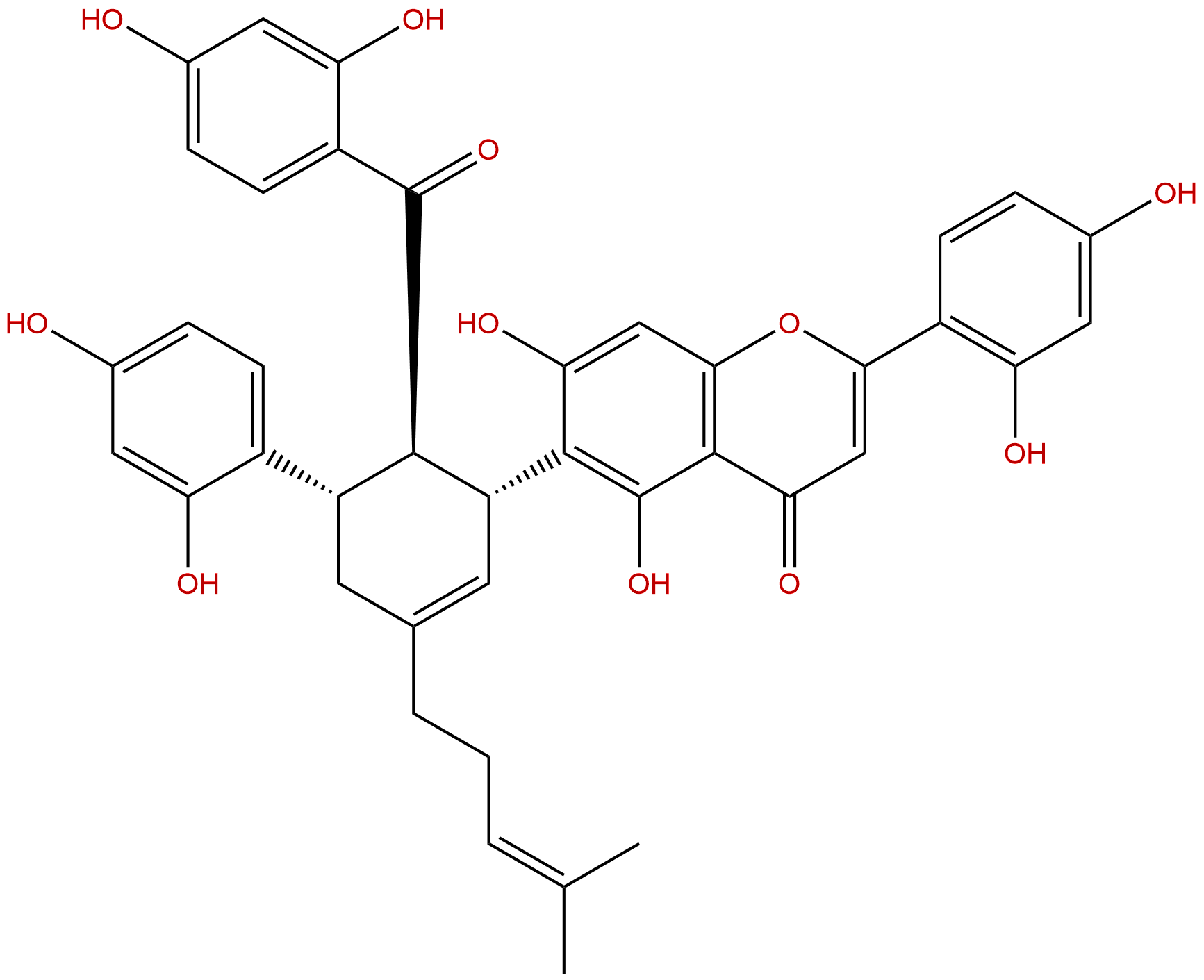
Multicaulisin (CAS number: 286461-76-5) is a typical Diels Alder addition product with a molecular weight of 692.7170, belonging to high molecular weight natural products. Its structure incorporates multiple cyclic structures, reflecting a complex three-dimensional conformation, which provides the basis for its biological activity. According to the physical and chemical properties data, the distribution coefficient LogP value of Multicaulisin is 5.1293, indicating its high lipid solubility, which may affect its in vivo distribution and cell membrane penetration ability. The polar surface area (TPSA) is 209.1200, and higher TPSA is usually associated with lower cell membrane permeability, which is consistent with its low water solubility (0.0137 mg/mL), suggesting that its solubility and bioavailability in vivo may be limited.
In addition, Multicaulisin does not have blood-brain barrier penetration ability and the hERG channel inhibition test result is negative, indicating a low risk of cardiac toxicity. The Ames test result is 0.0, indicating no significant genotoxicity. These pharmacological parameters provide preliminary basis for the safety evaluation of Multicaulisin.
Multicaulisin was isolated for the first time from the roots of Morus spp. Mulberry trees, as an important traditional medicinal plant in China and East Asia, contain abundant secondary metabolites in their roots, including flavonoids, phenylpropanoids, and various cyclic adducts. Multicaulisin is one of the novel Diels Alder adducts with a unique structure and significant activity.
During the extraction process, organic solvents such as ethanol and methanol are usually used to extract the roots of mulberry trees, followed by multi-step separation and purification techniques such as liquid-liquid distribution and column chromatography (silica gel column, reverse phase C18 column), combined with high-performance liquid chromatography (HPLC) for purity detection and component analysis. Structural identification relies on various modern analytical methods such as nuclear magnetic resonance (NMR), mass spectrometry (MS), infrared spectroscopy (IR), and ultraviolet spectroscopy (UV). In recent years, with the advancement of separation technology, extraction efficiency and purification level have significantly improved, laying the foundation for multi-scale preparation and pharmacological research.
Multicaflisin exhibits inhibitory effects on various bacteria, particularly Gram positive bacteria such as methicillin-resistant Staphylococcus aureus (MRSA). In vitro antibacterial experiments have shown that Multicaflisin significantly reduces the colony forming units (CFU) of MRSA by inhibiting bacterial growth and reproduction, and its minimum inhibitory concentration (MIC) is competitive among similar natural products. Compared with traditional antibiotics, Multicaflisin exhibits better activity against drug-resistant strains, suggesting that it may exert its effects through a mechanism different from conventional antibiotics.
Inflammatory response is an important component of host defense during bacterial infection. Multicaulisin exhibits excellent anti-inflammatory effects by regulating various inflammation related molecules. In vitro cell models and animal experiments have shown that Multicaflisin can significantly reduce the expression of pro-inflammatory factors IL-6 and TNF - α, inhibit the activation of STAT3 and NF - κ B signaling pathways, and reduce the activity of inflammasomes mediated by CASP1. In addition, the regulatory effect of Multicaulisin on TRPV1 and TRPA1 plasma channels may be involved in the relief of inflammatory pain. Its effects on NOS2 and PTGS1/2 further demonstrate its multi-target role in regulating the synthesis of inflammatory mediators.
Although current research on Multicaulisin mainly focuses on antibacterial and anti-inflammatory fields, its complex chemical structure and multi-target effects suggest that it may have a wider range of biological activities, such as antioxidant and immune regulatory functions. Future research is expected to further explore its potential.
The antibacterial mechanism of Multicaulisin has not been fully elucidated, and it is speculated that its antibacterial effect may be achieved by interfering with bacterial cell wall synthesis, membrane structure integrity, or key enzyme activity. Based on its inhibitory activity against MRSA, Multicaflisin may target bacterial resistance related proteins or signaling pathways, blocking bacterial resistance mechanisms.
In terms of anti-inflammatory effects, Multicaflisin exerts its effects through multi-target regulation of inflammatory signaling pathways. Its inhibitory effect on IL-6 and TNF - α reduces the release of inflammatory mediators and lowers the cascade amplification of inflammatory responses. STAT3 and NF - κ B are key transcription factors in inflammatory signaling, and Multicaflisin blocks the expression of inflammatory genes by inhibiting their activity. CASP1, as the core enzyme of inflammasomes, reduces its activity and decreases the maturation and release of pro-inflammatory cytokines. The regulation of TRPV1 and TRPA1 ion channels helps alleviate inflammation related pain and neuroinflammatory responses. The regulation of PTGS1/2 and NOS2 affects the synthesis of prostaglandins and nitric oxide, further regulating the inflammatory environment.
In summary, Multicaulisin demonstrates its complex pharmacological properties of antibacterial and anti-inflammatory through multi-target and multi pathway synergistic effects, providing a theoretical basis for its development as a novel anti infective drug.
The pharmacological parameters of Multicaflisin show that it has a high molecular weight and lipid solubility, but low water solubility, which may limit its oral bioavailability and in vivo distribution. A high TPSA value indicates limited ability to penetrate cell membranes, especially the blood-brain barrier, which may reduce the risk of central nervous system related side effects. The negative inhibition and no genotoxicity results of hERG indicate its good safety and suitability for further drug development.
At present, there is a lack of pharmacokinetic (PK) data on Multicaulisin. In the future, it is necessary to systematically study its absorption, distribution, metabolism, and excretion (ADME) characteristics, clarify its in vivo half-life, metabolic pathways, and potential drug interactions. Considering its high lipid solubility and poor water solubility, it may be necessary to improve its bioavailability and targeting through pharmaceutical modifications such as nanocarriers and liposomes.
Multicaulisin, as a novel natural Diels Alder adduct, exhibits significant anti MRSA activity and multi-target anti-inflammatory effects, with the potential to become a new anti infective drug. Its unique structure and mechanism of action provide new ideas for overcoming traditional antibiotic resistance. In the future, Multicaulisin can be used as a candidate molecule for antibacterial drugs, further optimizing its structure and enhancing its efficacy and pharmacokinetic performance.
In addition, the multi-target role of Multicaulisin in regulating inflammatory responses provides the possibility for its application in inflammatory diseases such as chronic inflammation and immune-mediated diseases. Combining its safety advantages, Multicaulisin is expected to be developed as a therapeutic drug with dual functions of anti infection and anti-inflammatory.
However, the clinical translation of Multicaulisin still faces many challenges, including the improvement of large-scale preparation techniques, systematic pharmacokinetic and toxicological evaluations, preclinical animal model validation, and the design and implementation of clinical trials. Future research needs to focus on in-depth analysis of its mechanism of action, formulation development, and clarification of clinical indications, in order to promote its early entry into the clinical application stage.
Multicaulisin, as a newly discovered natural Diels Alder adduct in the roots of mulberry plants, has shown broad prospects for drug development due to its significant anti MRSA activity and multi-target anti-inflammatory effects. Its unique chemical structure and good safety provide valuable resources for the development of new anti infective drugs. Although further research is still needed on its pharmacokinetics and clinical applications, Multicaulisin has become an important research hotspot in the field of natural product pharmacology. In the future, through interdisciplinary collaborative innovation, it is expected to achieve the transformation from laboratory to clinical practice, and assist in the treatment of drug-resistant infections and inflammatory diseases.
