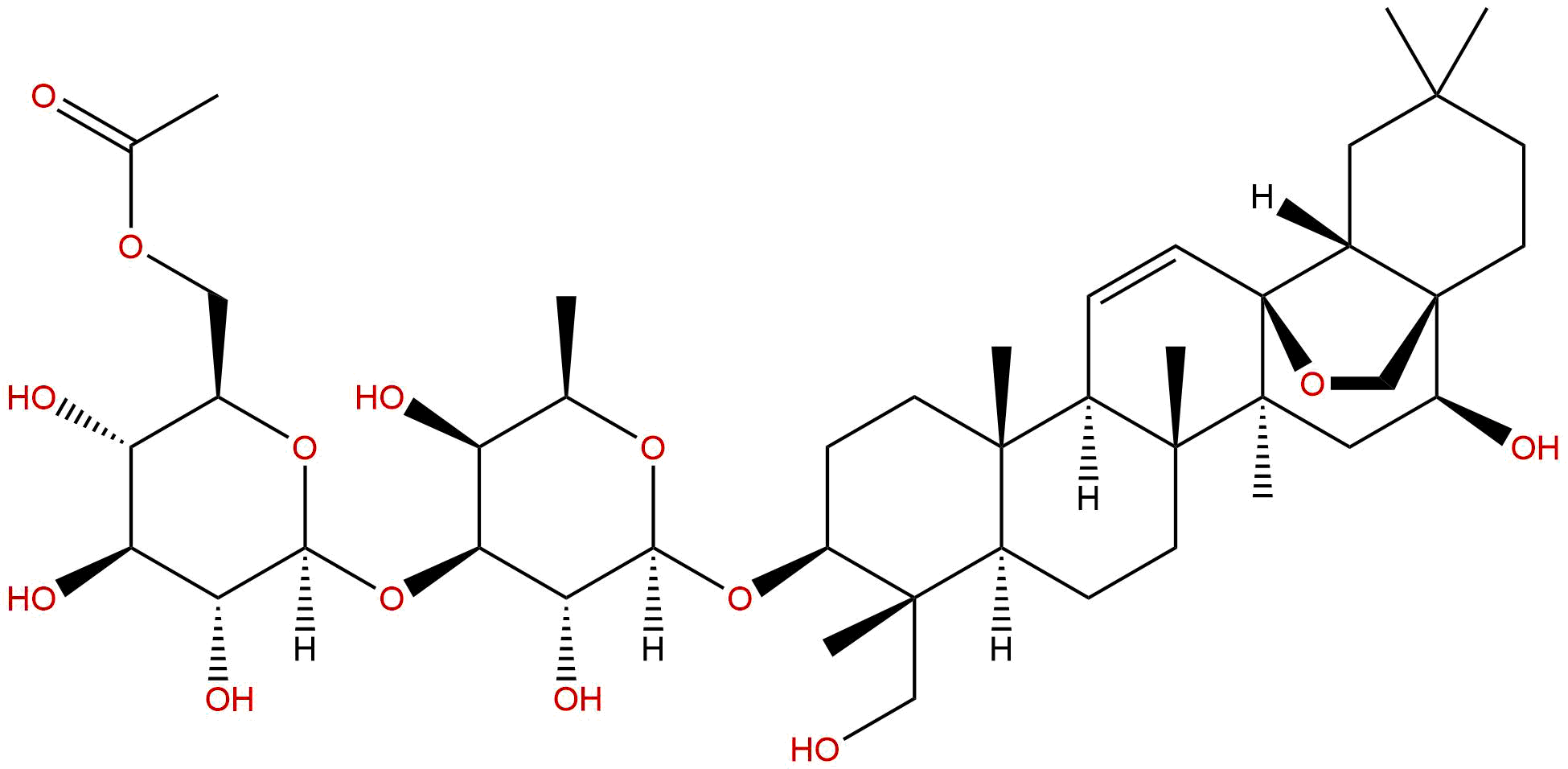


Product name: 6''-O-Acetylsaikosaponin A
Synonym name:
Catalogue No.: BP4432
Cas No.: 64340-46-1
Formula: C44H70O14
Mol Weight: 823.03
Botanical Source:
Type of Compound:
Purity: 95%~99%
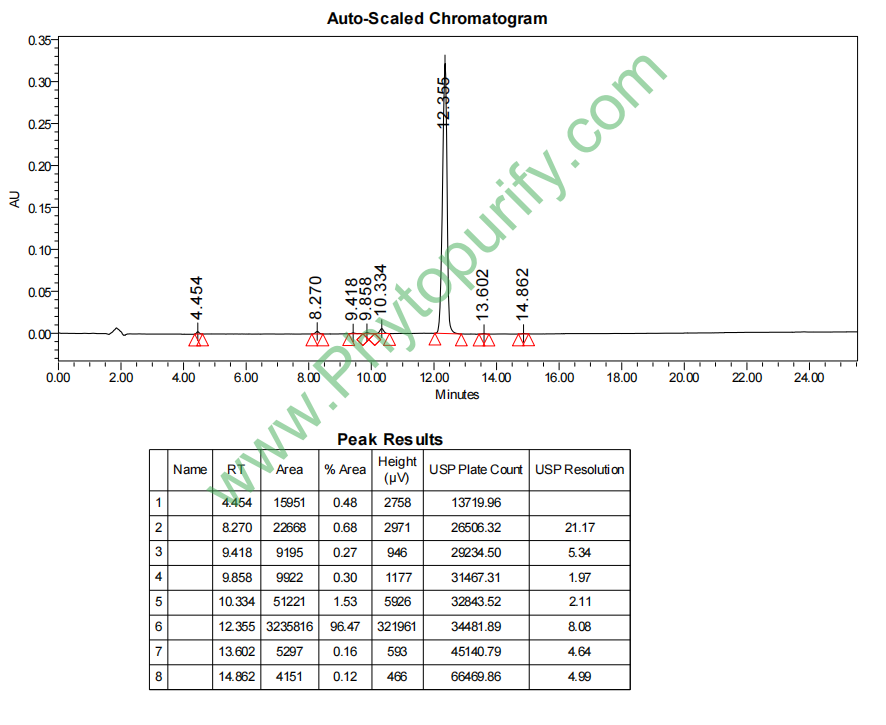
Analysis Method: HPLC-DAD or/and HPLC-ELSD
Identification Method: Mass, NMR
Packing: Brown vial or HDPE plastic bottle
Storage: Store in a well closed container, protected from air and light. Put into refrigerate or freeze for long term storage.
Whenever possible, you should prepare and use solutions on the same day. However, if you need to make up stock solutions in advance, we recommend that you store the solution as aliquots in tightly sealed vials at -20℃. Generally, these will be useable for up to two weeks.
The product could be supplied from milligrams to grams
Inquire for bulk scale.
For Reference Standard and R&D, Not for Human Use Directly.
HPLC of 6''-O-Acetylsaikosaponin A
Storage conditions:Short-term storage at 2~8℃, long-term storage at -20 ~ -80℃
214.0600
3.1454
3.1457
.0281
.6189
1.4089
Low
74.5000
7.3167
No
No
No
No
No
No
0.0
Yes
No
Yes
Yes
In the field of natural product chemistry and pharmacology research, triterpenoid saponins have attracted much attention due to their structural diversity and wide range of biological activities. Chaihu saponins, as the main active ingredient of traditional Chinese medicine Bupleurum spp., have been proven to have significant pharmacological effects such as anti-inflammatory, hepatoprotective, antiviral, and immune regulation. Among them, Saikosaponin A (SSA) is one of the most extensively studied components. Its structurally modified derivatives, especially acetylation products, often alter the physicochemical properties and biological activity of the parent compound, potentially leading to better drug efficacy or lower toxicity. 6 '' - O-Acetylsaikosaponin A (6 '' - O-Acetylsaikosaponin A, 6 '' - O-Ac SSA) is an important structural modifier with a CAS number of 64340-46-1. In recent years, as the incidence rate of inflammation related diseases (such as rheumatoid arthritis, neuroinflammation, enteritis, etc.) continues to rise, it is urgent to develop efficient and low toxic anti-inflammatory drugs. 6 '' - O-Ac-SSA has shown great potential in anti-inflammatory activity, involving the regulation of multiple key inflammatory targets such as interleukin-6 (IL-6), signal transduction and transcription activator 3 (STAT3), and nuclear factor kappa B (NF - κ B), making it a promising candidate molecule in the development of natural anti-inflammatory drugs. This article aims to systematically review the chemical properties, plant sources, pharmacological activities, molecular mechanisms of action, and pharmacological properties of 6 '' - O-acetyl saikosaponin A, and to provide prospects for its clinical application.
6 '' - O-Acetylsaikosaponin A is an acetylated derivative of saikosaponin A. Its parent nucleus structure is a pentacyclic triterpenoid of oleanane type, which has undergone specific acetylation modification in the sugar moiety.
chemical structure The molecular formula is C ₄₈ H ₇₈ O ₁∝, and the molecular weight is 823.0300. Its basic skeleton is consistent with saikosaponin A, consisting of a hydrophobic oleanolic acid derived glycoside (sapogenin) and a hydrophilic sugar chain. The sugar chain is usually connected to the C-3 position of the aglycone, forming a disaccharide structure (such as glucose fucose). The modification site of the 6 '' - O-acetyl group is located on the 6 '' - hydroxyl group at the end of the sugar chain (usually fucose), connected by an ester bond to an acetyl group (- COOCH3). Although this modification is small, it significantly changes the polarity, spatial conformation, and interaction mode with biomolecules of the molecule.
Physicochemical properties:
1. Lipid water partition coefficient (LogP)The calculated value is approximately 3.1454, indicating that the compound has moderate lipophilic properties. Compared to the maternal saikosaponin A, the introduction of acetyl groups increases the hydrophobicity of the molecule, which may affect its cell membrane penetration ability and in vivo distribution.
2. Topological Polarity Surface Area (TPSA)The value is 214.0600 Å ², which is relatively high and reflects the presence of multiple hydroxyl and sugar epoxy atoms in the molecule, indicating strong polarity. High TPSA is usually associated with poor cell membrane permeability, but acetylation modification reduces the polarity of the glycosyl moiety to some extent.
3. Water solubility The predicted water solubility is low, about 0.0281 mg/mL, and it belongs to insoluble compounds. This poses a challenge for the development of its formulations, such as the need for solubilization technology to produce cyclodextrin inclusion complexes, nanocrystals, or liposomes.
4. Other According to the given pharmacological parameters, its ability to cross the blood-brain barrier is predicted to be "low", suggesting that it may not be suitable for direct use in treating inflammation of the central nervous system unless special delivery systems are utilized. In the preliminary safety screening, there was no risk of hERG potassium channel inhibition (indicating low risk of cardiac toxicity) and a negative Ames test (indicating no mutagenicity), providing a preliminary safety basis for its further development.
6 '' - O-Acetyl saikosaponin A is not the main saponin in Chaihu, and its content is usually much lower than saikosaponin A, B, C, D, etc. It mainly exists in the roots of various plants in the Bupleurum genus of the Umbelliferae family, such as Bupleurum chinense DC. and Bupleurum scorzonerifolium Willd. In addition, the acetylation product may also be produced or enriched in certain cell cultures of Bupleurum chinense or through biotransformation methods.
Extraction and Separation Methods:
1. Extract Usually, organic solvent reflux extraction method is used. Heat and reflux the dried Chaihu root powder several times with 70% -95% ethanol or methanol, combine the extracts, and concentrate under reduced pressure to obtain the crude extract of total saponins. Ultrasound assisted extraction or microwave-assisted extraction can also be used to improve efficiency.
2. Separation and Purification The isolation of 6 '' - O-Ac-SSA from total saponins requires multi-step chromatographic techniques.
* Preliminary enrichment The crude extract is often subjected to macroporous adsorption resin (such as D101, AB-8) column chromatography, eluted with water and different concentrations of ethanol gradient, to enrich the saponin site.
* Fine separation Further separation was performed using normal phase silica gel column chromatography, reverse phase silica gel column chromatography (such as C18 packing), and high performance liquid chromatography (HPLC). Preparation HPLC is currently the most commonly used and effective method for obtaining high-purity 6 '' - O-Ac-SSA, often using acetonitrile water or methanol water as the mobile phase.
* appraisal The isolated monomer compounds need to be structurally confirmed by nuclear magnetic resonance (NMR, including ¹ H-NMR, ¹ ³ C-NMR, 2D-NMR), mass spectrometry (MS), and comparison with literature data.
Biological synthesis and transformation In addition to directly extracting from plants, using enzyme catalysis or microbial transformation to selectively acetylate abundant saikosaponin A is a potential green pathway for obtaining 6 '' - O-Ac-SSA, but it is still in the research stage.
The pharmacological research of 6 '' - O-acetyl saikosaponin A is currently mainly focused on the anti-inflammatory field, and has shown activity characteristics that are superior or different from saikosaponin A.
Core pharmacological activity: anti-inflammatory effect
Numerous in vitro and in vivo experiments have confirmed that 6 '' - O-Ac-SSA has strong anti-inflammatory effects.
* in vitro model In the lipopolysaccharide (LPS) - induced macrophage (such as RAW264.7 cells) inflammation model, 6 '' - O-Ac-SSA can dose dependently inhibit the production of nitric oxide (NO), prostaglandin E2 (PGE2), and key inflammatory cytokines such as tumor necrosis factor - α (TNF - α), interleukin-1 β (IL-1 β), and interleukin-6 (IL-6).
* In vivo model:
* Acute inflammation model In the mouse ear xylene induced inflammation model or carrageenan induced paw swelling model, 6 '' - O-Ac-SSA pretreatment can significantly reduce tissue edema and inflammatory cell infiltration.
* Chronic inflammation model In a rat model of rheumatoid arthritis induced by Freund's complete adjuvant, this compound can improve joint swelling, reduce arthritis index, and alleviate damage to joint cartilage and bone. Its effect may be related to the inhibition of synovitis and osteoclast activity.
* Other inflammatory models In the experimental colitis model induced by sodium dextran sulfate in mice, 6 '' - O-Ac-SSA also showed intestinal protective effects, reducing colon shortening, tissue damage, and pro-inflammatory cytokine levels.
Other potential activities:
Based on the extensive activity of saikosaponin A and the potential impact of acetylation modification, 6 '' - O-Ac-SSA may also have potential in other aspects, but there is limited direct research on this topic. Speculation or preliminary research may involve:
* Liver protection May alleviate chemical liver damage through anti-inflammatory and antioxidant pathways.
* antiviral Chaihu saponins have anti hepatitis virus, influenza virus and other activities, and acetylated derivatives are worth exploring.
* Antidepressant/neuroprotective Although its blood-brain barrier permeability is low, it may indirectly affect neuroinflammation through peripheral anti-inflammatory effects or require the development of special delivery systems.
The anti-inflammatory effect of 6 '' - O-acetyl saikosaponin A is not achieved through a single target, but through the synergistic regulation of multiple targets and pathways. The core of its functional network revolves around inhibiting key inflammatory signaling pathways such as NF - κ B and STAT3.
Inhibition of NF - κ B signaling pathway NF - κ B is the core transcription factor of inflammatory response. Research has shown that 6 '' - O-Ac-SSA can inhibit LPS induced degradation and phosphorylation of I κ B α protein, thereby preventing the translocation of NF - κ B p65 subunit to the nucleus. In the nucleus, it can also inhibit the DNA binding activity of p65, ultimately leading to downregulation of downstream pro-inflammatory genes such as TNF - α, IL-6, IL-1 β, NOS2, and PTGS2. target NFKB1(encoding p105/p50)TNF、NOS2 Inducible nitric oxide synthase (iNOS)PTGS2 Both cyclooxygenase-2 and COX-2 are regulated by this pathway.
Regulating the JAK/STAT signaling pathway Especially:STAT3 The pathway. Cytokines such as IL-6 activate JAK through their receptors, leading to phosphorylation and activation of STAT3, which enters the nucleus and drives the expression of genes related to inflammation and cell survival. 6 '' - O-Ac-SSA has been shown to inhibit the phosphorylation (Tyr705 site) and transcriptional activity of STAT3, thereby blocking the inflammatory amplification effect mediated by IL-6. target IL-6 and STAT3 This pathway is crucial.
Regulating inflammasome activity Activation of inflammasomes (such as NLRP3) leads to CASP1 The activation of cysteine protease-1 leads to the cleavage of pro-IL-1 β and pro-IL-18 into mature forms, triggering a strong inflammatory response. There is evidence to suggest that saikosaponin compounds can inhibit the assembly and activation of NLRP3 inflammasomes, and 6 '' - O-Ac-SSA may also have a similar effect by reducing the maturation and release of IL-1 β by inhibiting the activity of CASP1.
Affects ion channels and enzyme activity:
In summary, 6 '' - O-Ac-SSA acts on IL-6、STAT3、NFKB1、TNF、CASP1、PTGS2、NOS2 Multiple targets are formed to form a complex anti-inflammatory network, which inhibits the inflammatory process at multiple levels including cytokine production, signal transduction, transcriptional regulation, and effector molecule release.
Although 6 '' - O-acetyl saikosaponin A exhibits excellent pharmacological activity, its druggability still faces challenges, and related pharmacokinetic studies are currently limited.
Drug analysis:
* Advantage Moderate molecular weight (823 Da), meeting the boundary of the Rule of Five for drugs; No hERG inhibition or mutagenic risk (Ames test negative), preliminary safety is good; Acetylation modification may enhance its metabolic stability (compared to glycosides).
* challenge:
* Solubility and permeability Due to its low water solubility and high TPSA, it belongs to the Biopharmaceutical Classification System (BCS) Class IV (low solubility, low permeability), and its oral bioavailability may be extremely low.
* blood-brain barrier Low predictive transparency limits its direct application in central nervous system diseases.
* Metabolism and stability As saponin compounds, they are easily hydrolyzed by acids or enzymes in the gastrointestinal tract, losing their sugar or acetyl groups and converting into aglycones or other secondary glycosides, resulting in low exposure to the prototype drug. The liver metabolism (such as Phase I/II reactions) is not yet clear.
Prospects of pharmacokinetics (PK):
Currently, there are few detailed pharmacokinetic studies on 6 '' - O-Ac-SSA that have been publicly reported. Based on the study of similar saikosaponin, its PK characteristics can be inferred as follows:
* absorb Oral absorption is poor and may require partial hydrolysis under the action of gut microbiota before it can be absorbed. Developing new drug delivery systems, such as self microemulsions, phospholipid complexes, and nano formulations, is key to improving their oral bioavailability.
* distribution Due to its increased lipophilicity, it may have better tissue distribution than saikosaponin A, but specific tissue distribution characteristics (such as whether it is enriched in inflammatory sites) need to be experimentally confirmed. Low blood-brain barrier permeability.
* Metabolism The liver may be its main metabolic site, involving the CYP450 enzyme system and binding reactions (glucuronidation, sulfation). Acetyl may be a metabolic site that undergoes deacetylation reactions.
* excretion The prototype drug and its metabolites may be mainly excreted through bile and kidneys.
Future research urgently needs to establish sensitive and specific biological analysis methods (such as LC-MS/MS) to systematically investigate their in vivo processes, absolute bioavailability, tissue distribution, and major metabolites under different administration routes, providing a basis for dosage form design and clinical administration regimens.
As a natural product derivative with clear multi-target anti-inflammatory activity, 6 '' - O-acetyl saikosaponin A has broad prospects for clinical application and development, but there are also many obstacles that need to be overcome.
Potential application directions:
1. Treatment of inflammatory diseases:
* Rheumatoid arthritis (RA)As an anti-inflammatory and analgesic drug for oral or local administration, when used in combination with traditional DMARDs such as methotrexate, it may reduce the dosage and side effects of the latter.
* Inflammatory bowel disease (IBD)Develop a colon targeted delivery system for ulcerative colitis and Crohn's disease, allowing it to be locally released at the lesion site, exerting anti-inflammatory and mucosal repair effects.
* Dermatitis and Skin Inflammation: Use its anti-inflammatory properties to develop topical creams, gel and other preparations to treat atopic dermatitis, psoriasis, etc.
* Other It may also have application value for respiratory inflammations such as chronic obstructive pulmonary disease (COPD) and asthma.
As a lead compound for structural optimization Using it as the parent nucleus, more in-depth medicinal chemical modifications (such as glycosylation modification, glycoside modification, and preparation of prodrugs) are carried out with the aim of further improving activity, water solubility, enhancing metabolic stability, and targeting, thereby obtaining better candidate drugs.
Modernization of Traditional Chinese Medicine and Quality Markers In depth research on the content and pharmacological correlation of 6 '' - O-Ac-SSA in Bupleurum chinense and its preparations is expected to use it as one of the key quality markers for evaluating the quality and anti-inflammatory efficacy of Bupleurum chinense.
Challenges faced and future research directions:
1. Systematic drug research It is necessary to comprehensively conduct research on its ADMET (absorption, distribution, metabolism, excretion, and toxicity) properties, especially in preclinical safety evaluations such as long-term toxicity and reproductive toxicity.
2. Advanced delivery technology development Actively developing new formulation technologies such as nanocrystals, liposomes, polymer micelles, and transdermal drug delivery systems to address the bottleneck of poor solubility and permeability.
3. Deep analysis of the mechanism of action Using chemical biology methods such as affinity fishing, molecular docking, gene knockout/knockdown to more accurately identify its direct target and elucidate the synergistic relationship of its multi-target effects.
4. Clinical translational research After completing preclinical research on the system, gradually advance clinical trials to verify its safety and effectiveness in humans.
6 '' - O-Acetylsaikosaponin A is an important acetylated derivative of saikosaponin A, which occupies a unique position in the development of natural anti-inflammatory drugs due to its significant multi-target anti-inflammatory activity. It exhibits the potential to treat various inflammatory diseases by synergistically inhibiting key inflammatory signaling pathways such as NF - κ B and STAT3, regulating key effector molecules such as IL-6, TNF - α, COX-2, iNOS, etc. However, its inherent pharmaceutical defects, such as low solubility, low permeability, and possible metabolic instability, are the main obstacles that restrict its translation into clinical applications. Future research should focus on using modern medicinal chemistry and pharmaceutical technology to optimize its structure and innovate its dosage form, while conducting in-depth systematic pharmacokinetic and toxicological evaluations. Only through interdisciplinary collaboration can we fully tap into the value of this natural molecular treasure, promote its transition from laboratory research to clinical practice, and ultimately provide a new treatment option derived from traditional drugs for patients with inflammatory diseases.
