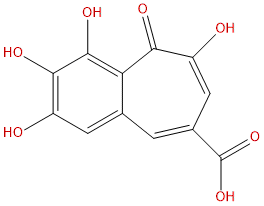


Product name: Purpurogallin carboxylic acid
Synonym name:
Catalogue No.: BP2106
Cas No.: 5146-12-3
Formula: C12H8O7
Mol Weight: 264.189
Botanical Source:
Type of Compound:
Purity: 95%~99%
Analysis Method: HPLC-DAD or/and HPLC-ELSD
Identification Method: Mass, NMR
Packing: Brown vial or HDPE plastic bottle
Storage: Store in a well closed container, protected from air and light. Put into refrigerate or freeze for long term storage.
Whenever possible, you should prepare and use solutions on the same day. However, if you need to make up stock solutions in advance, we recommend that you store the solution as aliquots in tightly sealed vials at -20℃. Generally, these will be useable for up to two weeks.
The product could be supplied from milligrams to grams
Inquire for bulk scale.
For Reference Standard and R&D, Not for Human Use Directly.
Storage conditions:Short-term storage at 2~8℃, long-term storage at -20 ~ -80℃
135.2900
.8159
-1.4758
1.0956
2.6650
1.7159
Low
85.6396
2.6386
Yes
No
No
No
Yes
Yes
0.6
Yes
No
Yes
No
Purpurogalin carboxylic acid (PPGCA) is a natural phenolic compound initially isolated from the Macleaya microcarpa (Maxim.) Fedde plant in the family Papaveraceae. In recent years, with the rapid development of natural product pharmacology, PPGCA has gradually become a research hotspot due to its unique chemical structure and significant biological activity, especially its anti-cancer and neuroprotective effects. In addition, PPGCA is also an oxidized product of gallic acid in fermented tea, demonstrating its potential value in food science and functional beverages. This article provides a systematic review of the chemical structure, plant origin, pharmacological activity, mechanism of action, and pharmacological evaluation of PPGCA, aiming to provide theoretical basis and research direction for its future drug development and clinical application.
The molecular formula of PPGCA is C12H8O7, with a molecular weight of 264.1890, and it belongs to the class of polyhydroxyphenolic compounds. Its structural core is the purpurpurogalin skeleton, with one carboxyl group substitution, giving it strong polarity and water solubility (1.0956, unit not specified but usually in mg/mL or g/L). The LogP value of PPGCA is 0.8159, indicating that it has moderate lipophilicity, which is beneficial for cell membrane penetration but not too hydrophobic, balancing bioavailability and solubility. The polar surface area (TPSA) is 135.29 Å ², indicating that the molecule has strong polar groups that may affect its ability to pass through biological barriers. The low permeability of the blood-brain barrier indicates limited distribution in the central nervous system. The hERG channel inhibition experiment result was negative, indicating that PPGCA has good cardiac safety. The Ames mutagenicity test score is 0.6, indicating a low risk of genotoxicity and meeting the safety requirements for drug development.
PPGCA mainly comes from Macleaya microcarpa (Maxim.) Fedde, a plant that plays an important role in traditional Chinese medicine and modern plant medicine research. M. Microcarpa belongs to the poppy family and is widely distributed in China and East Asia, containing various bioactive ingredients. PPGCA, as a secondary metabolite, usually exists in the roots, stems, and leaves of plants.
The common methods for extracting PPGCA include solvent extraction, liquid-liquid partitioning, and chromatographic purification. Generally, ethanol or methanol aqueous solution is used for reflux extraction of dried plant materials, followed by liquid-liquid extraction to remove lipid soluble impurities. Using silica gel column chromatography or high-performance liquid chromatography (HPLC) technology for separation and purification, high-purity PPGCA is ultimately obtained. In recent years, ultrasound assisted extraction and microwave-assisted extraction technologies have been applied to improve extraction efficiency and reduce solvent usage, providing technical support for industrial production. In addition, PPGCA, as an oxidation product of gallic acid in fermented tea, can also be indirectly obtained through fermentation processes, expanding its source pathways.
The anticancer activity of PPGCA is currently the focus of research. Several in vitro cell experiments showed that PPGCA had significant inhibitory effects on a variety of cancer cell lines, including breast cancer, lung cancer, liver cancer and colorectal cancer. Its anti-cancer mechanism mainly involves inducing cancer cell apoptosis, inhibiting cell proliferation, and blocking tumor related signaling pathways. PPGCA can regulate the expression of cell cycle related proteins, promote cell cycle arrest, and activate the mitochondrial pathway to induce cell apoptosis. In addition, PPGCA also exhibits the ability to inhibit tumor cell migration and invasion, indicating its potential in anti metastasis.
PPGCA exhibits good protective effects in neurodegenerative disease models. Its targets include antioxidant related enzymes such as NFE2L2 (nuclear factor erythroid 2-related factor 2), SOD1 (superoxide dismutase 1), CAT (catalase), GPX1 (glutathione peroxidase 1), and HMOX1 (heme oxygenase 1). These targets play a crucial role in cellular antioxidant defense and inflammation regulation. PPGCA activates the NFE2L2 signaling pathway, enhances the expression of intracellular antioxidant enzymes, reduces oxidative stress damage, and delays the degenerative process of nerve cells. In addition, PPGCA can also inhibit neuroinflammatory responses, regulate neuronal microenvironment, and protect neural function.
In addition to anti-cancer and neuroprotective effects, PPGCA also exhibits multiple biological activities such as anti-inflammatory, antibacterial, and antioxidant properties. Its anti-inflammatory effect is mainly achieved by inhibiting the release of inflammatory mediators and regulating inflammatory signaling pathways. The antioxidant activity originates from its multi hydroxyl structure, which can effectively scavenge free radicals and protect cells from oxidative damage. Some studies also found that PPGCA has a protective effect on the cardiovascular system, can improve vascular endothelial function, and inhibit the occurrence of atherosclerosis.
The biological effects of PPGCA are based on its interactions with multiple molecular targets, particularly in the fields of anti-cancer and neuroprotection.
PPGCA exerts anti-cancer effects through multiple signaling pathways. Firstly, PPGCA can activate mitochondrial dependent apoptotic pathways, regulate Bcl-2 family protein expression, promote cytochrome C release, activate caspase cascade reactions, and ultimately lead to cancer cell apoptosis. Secondly, PPGCA inhibits the PI3K/Akt and MAPK signaling pathways, blocking tumor cell proliferation and survival signals. In addition, PPGCA regulates the NF - κ B pathway, reduces the expression of pro-inflammatory cytokines, inhibits inflammatory responses in the tumor microenvironment, and blocks tumor progression.
The role of PPGCA in neurodegenerative diseases mainly depends on its antioxidant and anti-inflammatory properties. PPGCA activates the NFE2L2 transcription factor, promotes the expression of downstream antioxidant enzymes such as SOD1, CAT, GPX1, and HMOX1, and enhances the cell's resistance to oxidative stress. PPGCA alleviates neuronal damage by clearing excess reactive oxygen species (ROS). In addition, PPGCA inhibits inflammatory signaling pathways such as NF - κ B and MAPK, reduces pro-inflammatory cytokine levels, and protects nerve cells from inflammation mediated damage. This mechanism helps to slow down the progression of neurodegenerative diseases such as Parkinson's disease and Alzheimer's disease.
PPGCA may also participate in maintaining cellular homeostasis and disease prevention and treatment by regulating intracellular metal ion homeostasis, inhibiting lipid peroxidation, and modulating autophagy pathways. Future research needs to further elucidate its specific molecular action network and upstream and downstream signaling pathways.
The pharmacological parameters of PPGCA indicate that it has good potential for drug development. The molecular weight of 264.1890 conforms to Lipinski's rule, and the LogP value is moderate at 0.8159, which is beneficial for oral absorption. A higher TPSA (135.29 Å ²) and water solubility (1.0956) indicate strong hydrophilicity, but may also limit its ability to pass through the blood-brain barrier, consistent with its low blood-brain barrier permeability.
In terms of safety, PPGCA did not exhibit hERG channel inhibitory activity, reducing the risk of cardiac toxicity. The Ames test results showed low genotoxicity, supporting its safety evaluation. In terms of pharmacokinetics, existing research is relatively limited, but preliminary data suggests that PPGCA has moderate metabolic stability and bioavailability in vivo. Its polar structure may lead to limited intestinal absorption, and it is necessary to optimize its oral absorption and in vivo distribution through drug design.
Future research should focus on the in vivo metabolic pathway, half-life, tissue distribution, and excretion mechanism of PPGCA, and improve its pharmacokinetic properties through pharmaceutical methods such as nanocarrier encapsulation and structural modification, in order to enhance its clinical application value.
PPGCA, as a natural product with multiple biological activities, has broad clinical application prospects. Its significant anti-cancer activity makes it an important candidate molecule for the development of anti-tumor drugs, especially in combination chemotherapy and targeted therapy, which may exert synergistic effects. The neuroprotective effect provides new ideas for the treatment of neurodegenerative diseases, especially in the fields of diseases such as Parkinson's disease and Alzheimer's disease that lack effective treatment methods.
In addition, the anti-inflammatory and antioxidant properties of PPGCA make it potentially applicable in chronic inflammatory diseases and metabolic syndrome. Based on its natural sources and good safety, PPGCA is expected to be developed as a functional food or health supplement ingredient, promoting health management and disease prevention.
However, clinical research on PPGCA is still in its early stages and lacks systematic clinical trial data. In the future, it is necessary to strengthen the evaluation of its pharmacokinetics, toxicology, and clinical efficacy, and improve its drug development chain. At the same time, combining modern drug design technology, optimizing molecular structure and formulation form, improving its bioavailability and targeting, and promoting the clinical translation of PPGCA.
Purpurogallin carboxylic acid, as a natural phenolic compound derived from Macleaya microcarpa and fermented tea, exhibits rich pharmacological activity, especially in the fields of anti-cancer and neuroprotection. Its unique chemical structure endows it with good drug properties and safety, and has the potential to become a candidate molecule for new drugs. Although the current research on its mechanism of action and pharmacokinetics is not sufficient, the existing research results have laid a solid foundation for further exploration. In the future, through interdisciplinary collaboration and modern drug development technologies, PPGCA is expected to play an important role in the treatment of anti-cancer and neurodegenerative diseases, promoting the development and innovation of natural product pharmacology.
