Introduction/Overview
Natural products, as an important treasure trove for drug discovery and development, play an irreplaceable role in the long history of human fight against diseases. Among them, pentacyclic triterpenoids have attracted much attention due to their widespread distribution in the plant kingdom and diverse biological activities. Betulinic acid, as an outstanding representative of such compounds, has been extensively studied for its anti-tumor, anti-inflammatory, antiviral and other pharmacological effects. Betulinic acid methyl ester (BAME, CAS: 2259-06-5) is a derivative of betulinic acid obtained by simple esterification modification. This structural modification not only changes its physicochemical properties, but also significantly expands its biological activity spectrum, especially in the field of antigen derived animals, showing unique potential. Parasitic diseases of protozoa, such as malaria, leishmaniasis, Chagas disease, etc., remain a major public health challenge globally, especially in developing countries in tropical and subtropical regions. Existing drugs have problems such as drug resistance and strong toxic side effects, and there is an urgent need to develop new, efficient, and safe treatment drugs. Therefore, a systematic review of methyl betulinate, a natural product derivative with clear biological activity, and its chemical, pharmacological, mechanistic, and pharmacological characteristics is of great scientific significance for promoting its transformation as a lead compound into clinical drugs. This article aims to comprehensively summarize the research status of methyl betulinate and look forward to its future development direction.
Chemical structure and physicochemical properties
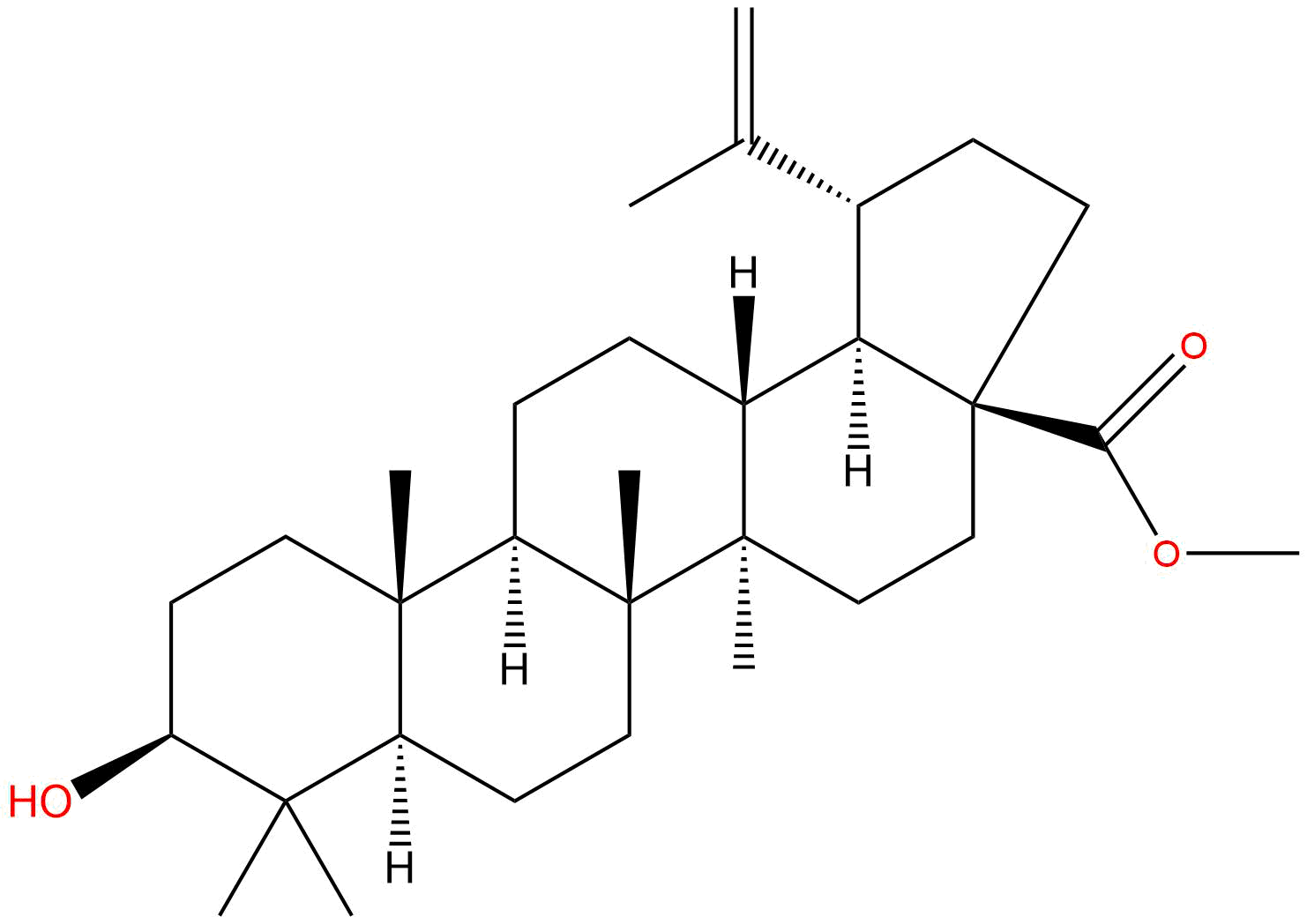
The chemical name of methyl betulinate is 3 β - hydroxy-2-en-28-carboxylic acid methyl ester, with a molecular formula of C ∝₁ H ₅₀ O3 and a molecular weight of 470.7380. Its structural skeleton is a pentacyclic triterpenoid of the lupine type, which is a characteristic structure of its parent nucleus betulinic acid. Specifically, its structure consists of five fused rings (A/B/C/D/E ring), where the E ring is a five membered ring and has an isopropyl group at C-20 (29) position, which is an important hydrophobic structural unit. The key difference between betulinic acid (carboxyl group at C-28) and betulinic acid methyl ester is that the carboxyl group at C-28 is methylated, forming an ester bond (- COOCH ∝). Although this modification is minor, it profoundly affects the properties of the compound.
From the analysis of physical and chemical properties, esterification significantly enhances the hydrophobicity of the molecule. The calculated lipid water partition coefficient (LogP) is as high as 6.8495, indicating that the compound has strong lipophilicity. This characteristic directly leads to its extremely low water solubility, only 0.0006 mg/mL, which poses the primary challenge for its formulation development. The topological polar surface area (TPSA) of the molecule is 46.5300 Å ², which is relatively small and consistent with its hydrophobic properties. Based on its high LogP value and small TPSA, the predictive model shows that it has a high blood-brain barrier permeability, which suggests that it may have potential advantages in the treatment of central nervous system related parasitic infections such as cerebral malaria and African trypanosomiasis. The preliminary drug risk assessment showed that the Ames test result was negative (0.0), indicating no direct genetic toxicity; Meanwhile, the hERG inhibition test showed a negative result, indicating a low risk of inducing QT interval prolongation in the heart, providing preliminary favorable data for its safety.
Plant sources and extraction methods
Betulinic acid methyl ester is not a widely present major component in nature, and it usually appears as a trace derivative or artificially modified product of betulinic acid. Its most direct natural precursor, betulinic acid, is widely present in various plants, especially in the Betulaceae family. The most common sources include the bark of Betula platyphylla and Betula pendula, as well as some plants in the boxwood family such as Buxus hainanensis. In addition, it has also been found in the bark and leaves of plants such as Ziziphus jujuba and Olea europaea.
At present, there are two main ways to obtain methyl betulinate:
1. Direct extraction and separation of plants Starting from plant materials rich in betulinic acid (such as birch bark), after extraction and concentration with organic solvents (such as methanol, ethanol, chloroform), various chromatographic techniques (such as silica gel column chromatography, high-performance liquid chromatography HPLC) are used for separation and purification. Due to its extremely low natural content, it is difficult and inefficient to directly separate and obtain a large amount of methyl betulinate.
2. Chemical semi synthesis This is currently the most important and economical method for obtaining methyl betulinate. Starting from a large amount of betulinic acid, esterification reaction is carried out under mild conditions. The most commonly used method is to react diazomethane (CH ₂ N ₂) in ether solvents. The reaction conditions are mild, the yield is high, and the selectivity is good, specifically esterifying carboxyl groups without affecting other functional groups (such as the hydroxyl group at C-3 position). Dimethyl sulfate [(CH3) ₂ SO ₄] or iodomethane (CH3 I) can also be used for methylation under alkaline conditions (such as potassium carbonate). The semi synthetic method can achieve preparation on a gram or even kilogram scale, providing sufficient material basis for in-depth pharmacological activity screening and mechanism research.
Pharmacological activity research
Although the pharmacological activity of methyl betulinate is not as in-depth as its parent betulinic acid, several noteworthy biological effects have been revealed, among which its anti protozoan activity is the most prominent.
-
Antiprotozoan activity This is the most distinctive pharmacological activity of methyl betulinate. Research has shown that it exhibits significant in vitro inhibitory activity against various pathogenic protozoa.
- Antimalarial activity Malignant malaria parasites sensitive and resistant to chloroquine(Plasmodium falciparum)All showed inhibitory activity, with IC ₅₀ values typically in the micromolar range. Compared with betulinic acid, methylation has shown enhanced activity in some studies, which may be related to improved cell membrane penetration ability.
- Anti Leishmania parasite activity Regarding the Leishmania parasite that causes visceral leishmaniasis(Leishmania donovani)The Mexican Leishmania parasite without flagella and causing cutaneous leishmaniasis(Leishmania mexicana)Both flagella have inhibitory effects. Its activity may be related to the disruption of mitochondrial function in protozoa.
- Anti trypanosomal activity Regarding the Brucella parasite that causes African trypanosomiasis(Trypanosoma brucei)And the Trypanosoma cruzi that causes Chagas disease(Trypanosoma cruzi)It also exhibits inhibitory potential and is one of the lead compounds for developing novel anti trypanosomal drugs.
-
Antitumor activity Inheriting from Betulinic Acid, Betulinic Acid Methyl Ester also exhibits cytotoxicity towards various human tumor cell lines, including melanoma, neuroblastoma, ovarian cancer, lung cancer, etc. Its mechanism of action may involve inducing apoptosis of tumor cells, but the specific pathway may differ from betulinic acid.
-
Anti inflammatory and immune regulatory activity Partial studies have shown that methyl betulinate can inhibit the production of nitric oxide (NO) and pro-inflammatory cytokines (such as TNF - α, IL-6) in macrophages induced by lipopolysaccharide (LPS), indicating its anti-inflammatory potential. This may have a synergistic benefit in treating excessive inflammatory reactions caused by protozoan infections.
-
Antibacterial and antiviral activity There are sporadic reports showing that it has inhibitory effects on certain Gram positive bacteria and fungi, and has a slight inhibition on HIV virus replication, but these activities are usually weaker than its anti protozoan activity and are not its main research direction.
Overall, the pharmacological activity spectrum of methyl betulinate is centered around anti protozoa, with both anti-tumor and anti-inflammatory auxiliary activities, demonstrating the possibility of multi-target action.
Mechanism of action and molecular targets
The exact mechanism of action of methyl betulinate has not been fully elucidated, but based on existing research, its anti protozoan and anti-tumor activities may be related to the following key targets and pathways:
-
Mitochondrial functional interference and induction of cell apoptosis This is one of the most classic mechanisms of betulinic acid and its derivatives. Betulinic acid methyl ester may affect mitochondria in multiple ways:
- Mitochondrial membrane permeability transition pore (mPTP) is open Promote the opening of mPTP, leading to the breakdown of mitochondrial transmembrane potential (Δ PSI m), the release of apoptotic factors such as cytochrome c, and the activation of caspase cascade reaction, inducing cell apoptosis. This is evidenced in tumor cells and certain protozoa, such as Leishmania parasites.
- Directly acting on the mitochondrial respiratory chain Possible inhibition of electron transport chain complexes in protozoan or tumor cell mitochondria, interference with oxidative phosphorylation, resulting in ATP depletion and excessive production of reactive oxygen species (ROS), leading to cell death.
- Interaction with Voltage Dependent Anion Channels (VDAC)Some studies speculate that its lipophilicity may make it easy to bind to VDAC proteins on the outer membrane of mitochondria, affecting the transport of metabolites and mitochondrial function.
-
Proteasome inhibition Studies have shown that betulinic acid analogues can inhibit the chymotrypsin like activity of the 20S proteasome. Betulinic acid methyl ester may also possess this ability, leading to cellular misfolding and accumulation of damaged proteins, triggering endoplasmic reticulum stress and cell apoptosis. This is particularly important in malaria parasites, as proteasomes are essential for their survival.
-
Inhibition of DNA Topoisomerase Some triterpenoids have been reported to inhibit DNA topoisomerases I and II. Further verification is needed to determine whether betulinic acid methyl ester interferes with DNA replication and repair in protozoa or tumor cells through this mechanism.
-
Membrane structure and functional degradation Its extremely high lipophilicity makes methyl betulinate easy to insert into the lipid bilayer of biological membranes, which may disrupt the ordered structure of the membrane, affect membrane protein function, membrane potential, and ion homeostasis. This may be fatal for protozoa that rely on specific membrane structures for survival.
-
Specific protozoan targets Regarding malaria parasites, studies suggest that they may interfere with their food bubble function or hemoglobin degradation process; Regarding Leishmania parasites, it may affect their unique glycolysis pathway or sphingolipid metabolism.
It should be pointed out that the effect of methyl betulinate may not be singular, but rather through the synergistic action of multiple targets and pathways, which may help delay the development of drug resistance.
Evaluation of drug properties and pharmacokinetics
Although methyl betulinate has shown good biological activity in vitro, its potential to develop from an active compound into an effective drug faces a series of challenges, mainly reflected in its pharmacokinetic properties.
-
Absorption and bioavailability The high lipophilicity (high LogP) and extremely low water solubility are the main obstacles to its drug development. Low water solubility can lead to poor oral absorption and low bioavailability. Although high lipid solubility may facilitate passive diffusion across intestinal epithelial cells, poor solubility limits its dissolution rate and degree in gastrointestinal fluids. Developing appropriate dosage forms (such as nanocrystals, liposomes, micelles, solid dispersions) to enhance their solubility and dissolution is key to improving oral absorption.
-
distribution As mentioned earlier, it is predicted to have high blood-brain barrier permeability, which is a positive attribute for the treatment of central nervous system parasitic infections. Its high lipophilicity also means that it may be widely distributed in adipose tissue and easily bound to plasma proteins (especially albumin), which can affect its free drug concentration and efficacy.
-
Metabolism As an ester compound, methyl betulinate is likely to be hydrolyzed by esterases in the body and metabolized into its parent compound betulinic acid. This process may occur in the blood, liver, or intestines. Therefore, the substances that actually exert pharmacological effects in its body may be methyl betulinate itself, its hydrolyzed product betulinic acid, or a combination of both. Detailed metabolic studies are needed to elucidate its in vivo fate. The CYP450 enzyme system may be involved in further metabolic reactions such as hydroxylation.
-
excretion Metabolites such as betulinic acid and its complexes may be mainly excreted through bile and feces, with some excreted through the kidneys.
-
Preliminary evaluation of safety The existing preliminary data (Ames negative, hERG negative) provide a good starting point. But more comprehensive preclinical safety evaluations are needed, including acute/subacute toxicity tests, genotoxicity comprehensive tests, reproductive toxicity, and long-term toxicity studies on major organs (liver, kidney, heart). The parent compound betulinic acid has shown relatively low systemic toxicity, which provides a certain optimistic expectation for the safety evaluation of methyl betulinic acid.
In summary, the core issue of the medicinal properties of methyl betulinate is its extremely poor solubility, which requires advanced formulation strategies to address. At the same time, in vivo pharmacokinetic and toxicological studies of the system are essential for its advancement.
Clinical application prospects and prospects
The clinical application prospects of methyl betulinate, as a potential anti protozoan lead compound, are closely related to the following development directions:
-
As a lead compound for novel antiparasitic drugs Betulinic acid methyl ester provides a new chemical framework for neglected tropical diseases such as malaria, leishmaniasis, and Chagas disease. Future research should focus on:
- structural optimization Through medicinal chemical methods, while retaining its core triterpenoid skeleton and essential pharmacophores (such as C-3 hydroxyl and C-20 isopropenyl), its structure is further modified (such as C-28 ester modification, introduction of polar groups, synthesis of heterocyclic fused derivatives, etc.), aiming to balance its lipid water partition coefficient, improve water solubility and selectivity, and reduce potential toxicity.
- combination therapy Explore its combination therapy with existing first-line antiparasitic drugs (such as artemisinin, antimony, nitroimidazole) in order to generate synergistic effects, reduce individual doses, minimize toxic side effects, and potentially overcome or delay drug resistance.
-
Formulation innovation Given its serious solubility issues, developing new drug delivery systems is key to pushing it into clinical practice. Research directions include:
- Nano drug delivery system Preparation of nanocrystals, polymer nanoparticles, liposomes, or nanoemulsions of methyl betulinate can significantly increase its specific surface area, improve dissolution and absorption, and can be enriched in parasitic infected organs such as the liver and spleen through passive targeting (such as the reticuloendothelial system).
- Prodrug strategy Design prodrugs that release active drugs only in specific parts of the body (such as when hydrolyzed by parasite specific enzymes) to improve targeting and reduce systemic exposure.
-
In depth exploration of the mechanism of action Using chemical biology methods such as affinity chromatography probes and proteomics to identify the molecular targets it directly acts on and elucidate its precise mechanism of action. This will provide a basis for structure based rational drug design and help discover biomarkers for predicting efficacy and toxicity.
-
Expand indications In addition to parasitic diseases, its anti-tumor and anti-inflammatory activities also deserve further in vivo pharmacological evaluation in specific disease models (such as melanoma and autoimmune diseases) to explore its new therapeutic uses.
Conclusion
Methyl betulinate, as a structural derivative of betulinic acid, has become a valuable research object in natural product medicinal chemistry research due to its unique chemical structure and significant anti protozoan activity. It inherits the pleiotropic biological potential of the pentacyclic triterpenoid skeleton and exhibits advantages in specific activity directions through simple esterification modifications. The current research has preliminarily outlined its pharmacological activity profile and suggests that its effects may be related to multi-target factors such as mitochondrial function interference and proteasome inhibition. However, its extremely poor solubility and other drug defects are the main bottlenecks restricting its clinical application. In the future, through interdisciplinary collaboration such as medicinal chemistry, formulation studies, and pharmacology, in-depth research will be conducted on structural optimization, mechanism elucidation, and dosage form innovation. It is expected that methyl betulinate will gradually develop from a promising lead compound into a new weapon against global parasitic diseases, contributing the wisdom and strength of natural products to human health.