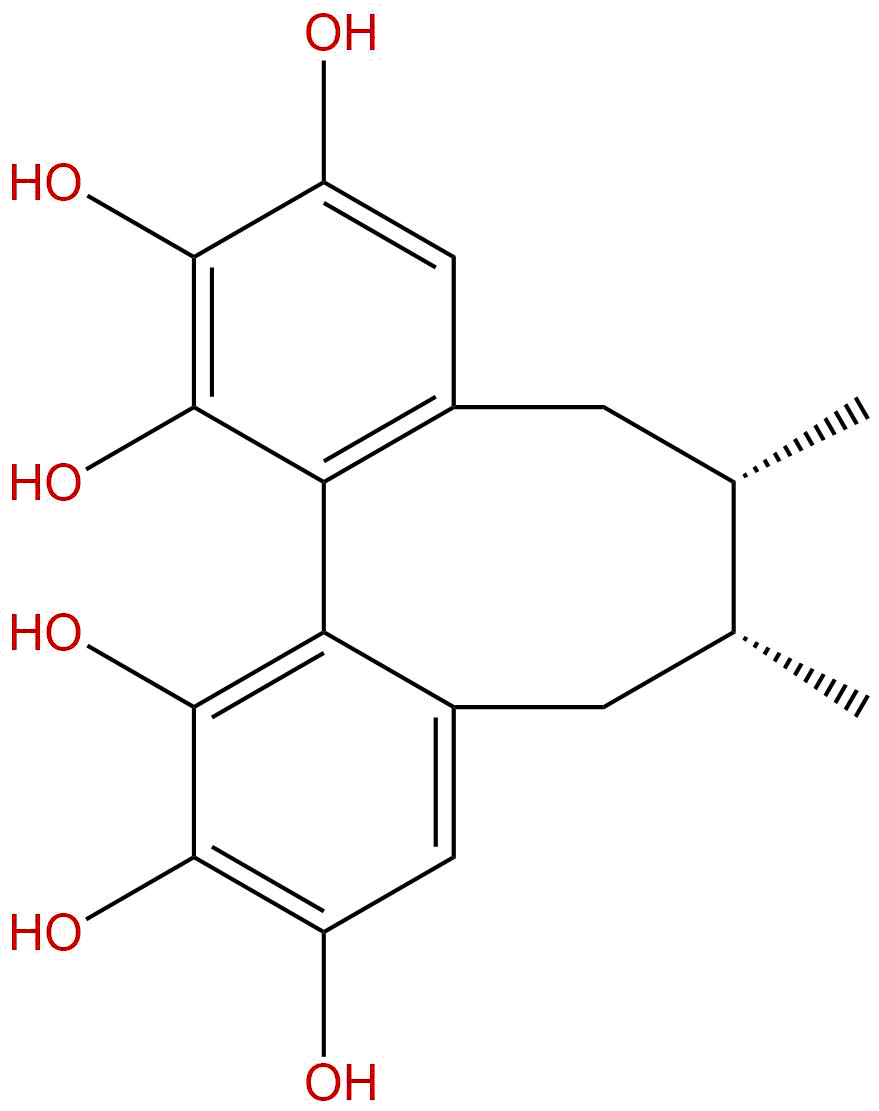


Product name: Hexademethylation Schisandrin A
Synonym name:
Catalogue No.: BP2205
Cas No.:
Formula: C18H20O6
Mol Weight: 332.352
Botanical Source:
Type of Compound:
Purity: 95%~99%
Analysis Method: HPLC-DAD or/and HPLC-ELSD
Identification Method: Mass, NMR
Packing: Brown vial or HDPE plastic bottle
Storage: Store in a well closed container, protected from air and light. Put into refrigerate or freeze for long term storage.
Whenever possible, you should prepare and use solutions on the same day. However, if you need to make up stock solutions in advance, we recommend that you store the solution as aliquots in tightly sealed vials at -20℃. Generally, these will be useable for up to two weeks.
The product could be supplied from milligrams to grams
Inquire for bulk scale.
For Reference Standard and R&D, Not for Human Use Directly.
Storage conditions:Short-term storage at 2~8℃, long-term storage at -20 ~ -80℃
97.2000
2.8000
2.5000
No
.8500
No
Negative
Hexademethylation Schisandrin A is a compound derived from the active lignan component in traditional Chinese medicine Schisandrin A through structural modification or natural metabolism. Its name directly reveals its chemical essence: the product of removing or replacing the six methyl groups (- CH3) in the molecular structure of schisandrin. Schisandrin A is Schisandra chinensis(Schisandra chinensis)One of the most widely studied lignans in China, it has significant hepatoprotective, antioxidant, and neuroprotective activities. Hexademethylated schisandrin, as a deeply demethylated derivative, theoretically has the potential to have higher polarity, improved solubility, and potentially enhanced or altered biological activity, thus attracting attention in the field of natural product pharmacy research in recent years.
Although its specific CAS number, complete molecular formula, and molecular weight data are currently lacking, based on its naming and known target disease associations, it can be inferred that it is a class of lead compounds with important research value. Existing research data indicates that this compound is associated with multiple key cellular signaling pathways and biomarkers, including the oxidative stress regulator NFE2L2 (Nrf2), inflammatory factors TNF - α and IL-6, as well as antioxidant enzymes SOD1, GPX1, HMOX1, and drug metabolizing enzyme CYP3A4. These targets indicate that they are Non alcoholic fatty liver disease, liver fibrosis, neurodegenerative diseases, oxidative stress-related diseases, and drug-induced liver injury It has potential therapeutic value in various chronic diseases. This article will provide a systematic professional scientific interpretation of this compound from the perspectives of chemistry, pharmacology, drug properties, and prospects.
Hexademethylated Schisandrin A is a structural analogue of Schisandrin A. Schisandrin A is a biphenyl cyclooctadiene type lignan, with a typical structure consisting of two benzene rings and an eight membered fatty ring. The benzene ring is usually connected to multiple methoxy (- OCH3) or methyl groups. The so-called "six demethylation" means that the six methyl groups on the original Schisandrin molecule (possibly from demethylation of methoxy groups to form phenolic hydroxyl groups, or removal of methyl groups from the fatty chain) are replaced by hydrogen atoms.
This structural modification will significantly alter its physicochemical properties:
1. Molecular polarity and water solubility Removing methyl, especially converting methoxy to phenolic hydroxyl, will significantly increase the polarity of the molecule. This usually means that the water solubility of the compound may increase, while the lipid solubility (LogP value) will correspondingly decrease. LogP (octanol/water partition coefficient) is a key parameter for measuring the lipophilicity of compounds, which has a decisive impact on the absorption, distribution, metabolism, and excretion (ADME) of drugs.
2. Hydrogen bond donor/acceptor capability The introduction of phenolic hydroxyl groups increases the number of hydrogen bond donors (HBDs) and hydrogen bond acceptors (HBAs), thereby affecting the binding ability of compounds to biological targets and their membrane permeability.
3. Molecular weight and topological polarity surface area The molecular weight will slightly decrease due to the removal of methyl groups. More importantly, the increase of polar groups will significantly improve Topological polarity surface area TPSA is an important parameter for predicting the intestinal absorption and blood-brain barrier penetration ability of compounds. The larger the TPSA value, the weaker the passive transmembrane diffusion ability.
Due to the lack of specific molecular formula and parameters, we can make a reasonable speculation that compared with the original schisandrin A, hexademethylated schisandrin A may have Lower LogP value, higher TPSA, and more hydrogen bonds for receptors These changes make its physicochemical properties more inclined towards "hydrophilicity", which may facilitate its distribution in aqueous environments (such as cytoplasm) and binding to polar targets, but may also pose challenges to its oral bioavailability and ability to penetrate the blood-brain barrier.
Hexademethylated schisandrin itself may not be a prototype component abundant in plants, but rather a product of schisandrin metabolism in vivo, or a derivative obtained through chemical semi synthetic means. Therefore, its root still needs to be traced back to the plant source of its parent compound, schisandrin.
Schisandrin A is mainly derived from traditional Chinese medicine schisandra(Schisandra chinensis Dry and ripe fruit of (Turcz.) Baill. Schisandra chinensis, also known as North Schisandra chinensis, has the effects of astringency, tonifying qi and generating fluids, nourishing the kidneys and calming the heart in traditional Chinese medicine theory. It is commonly used to treat symptoms such as chronic cough and asthma, nocturnal emission, frequent enuresis and urination, persistent diarrhea, spontaneous sweating and night sweats, fluid damage and thirst, internal heat and thirst, palpitations and insomnia. Its characteristic of having a complete set of five flavors (sweet and sour skin, hard work in the nucleus, and overall saltiness) is unique in traditional Chinese medicine.
Modern pharmacological research has confirmed that the main active ingredients of Schisandra chinensis are lignans, including Schisandrin A, B, C, and Schisandrin A. These components together make up Schisandra chinensis liver protection The material basis of action. In East Asia, Schisandra chinensis has long been used to treat hepatitis, liver dysfunction, and as an anti fatigue tonic. Schisandrin A, as a representative component, has been proven to have various effects such as anti liver injury, induction of hepatic drug enzymes, antioxidant and anti-inflammatory properties.
Therefore, the study of hexademethylated schisandrin can be seen as a modern research paradigm that seeks better pharmacological activity or pharmacokinetic properties through structural optimization based on the active ingredients of traditional Chinese medicine. It is a bridge connecting traditional wisdom with modern drug development.
The pharmacological activity prediction of hexademethylated schisandrin A is mainly based on its clear Multi target action characteristics The seven associated targets (NFE2L2, TNF, IL6, SOD1, GPX1, HMOX1, CYP3A4) form a synergistic network that collectively targets Antioxidant, anti-inflammatory, and cell protective properties The core mechanism is associated with various related diseases.
Summary Hexademethylated Schisandrin A Multi target, multi pathway A synergistic effect was established to construct a three-dimensional pharmacological network that activates endogenous antioxidant defense (Nrf2-SOD1/GPX1/HMOX1) upstream, inhibits inflammatory storm (TNF - α/IL-6) in the middle and downstream, and simultaneously regulates drug metabolism (CYP3A4). This demonstrates unique advantages in the treatment of complex diseases based on oxidative stress and chronic inflammation, such as metabolic liver disease and neurodegenerative diseases.
Drug efficacy assessment aims to predict the likelihood of a compound developing into a successful drug, involving multiple aspects such as absorption, distribution, metabolism, excretion, and toxicity. Although the complete pharmacological parameters of hexademethylated schisandrin are currently lacking, we can conduct reasonable analysis and prediction based on its structural characteristics (deep demethylation) and known targets, combined with classical evaluation rules.
The Lipinski Five Rules are empirical rules for evaluating the oral activity of compounds, and compounds that meet all five criteria (molecular weight<500, LogP<5, hydrogen bond donor<5, hydrogen bond acceptor<10) have better oral absorption potential.
- molecular weight The molecular weight of Schisandrin A is approximately 432. Removing six methyl groups (each - CH3, with a mass of 15) will reduce the molecular weight by approximately 90, suggesting that its molecular weight may be Around 340 Far below 500, in compliance with the rules.
- LogP The LogP value of Schisandrin A is relatively high (about 4-5, indicating strong lipophilicity). Removing six methyl groups, especially forming phenolic hydroxyl groups, will significantly Reduce LogP value It is speculated that its LogP may decrease to Below 3 Even lower, which is beneficial for compliance with the rules (<5), but too low may affect its transmembrane absorption.
- Hydrogen bond donor and acceptor The amount of HBD and HBA in Schisandrin A is relatively small. Demethylation produces phenolic hydroxyl groups Significantly increase the number of HBDs If all six methyl groups are converted to phenolic hydroxyl groups, HBD may reach 6 or more, which is likely violate The rule of HBD<5. At the same time, the number of HBA (oxygen atoms) will also increase.
- Preliminary assessment Hexademethylated Schisandrin A May have advantages in molecular weight and LogP, but may exceed the limit in the number of hydrogen bond donors This indicates that it Oral bioavailability may face challenges Passive absorption in the intestine may be poor.
Hexademethylated Schisandrin A, as a lead compound Clear pharmacological activity and multi-target synergy, with outstanding advantages However, in terms of medicinal properties, it The structural characteristics of excessive hydrophilicity and excessive hydrogen bond donors may become the main obstacles for oral absorption and penetration of biological barriers (such as the blood-brain barrier)It may be more suitable for development as injection Or as a new starting point for further structural optimization (such as moderate esterification or etherification modification of phenolic hydroxyl groups to balance their lipid water partition and hydrogen bonding ability). In the early stages of development, it is necessary to experimentally determine its key ADMET parameters to validate the above predictions and guide subsequent research.
At present, there are relatively few independent and systematic research literature on "hexademethylated schisandrin", which appears more in the study of schisandrin metabolites or structural modifications based on its parent nucleus. The existing data (such as targets, disease associations) are likely to come from computer-aided prediction, network pharmacology analysis, or preliminary in vitro activity screening. This indicates that the compound is currently in Early detection and validation stage。
Conclusion Hexademethylated Schisandrin A is a multi-target pharmacological new star developed from the traditional Chinese medicine Schisandra chinensis. It has demonstrated broad application potential in multiple major chronic disease fields due to its unique synergistic mechanism targeting oxidative stress and inflammatory core pathways. Although the challenges in drug development, especially oral absorption and distribution, urgently need to be addressed on the path towards drugs, this is precisely the core work of modern drug research and development. Whether it ultimately becomes a directly applied drug or a "paving stone" for optimizing better molecules, its research value is immeasurable. In the future, close cooperation among multiple disciplines such as chemistry, pharmacology, and pharmacy is needed to gradually transform this natural gift into practical achievements that benefit human health through solid basic research and rigorous preclinical development.
Batch can search by a CAS number,one per line
