Introduction/Overview
Natural products have always been an important source of innovative drug discovery, among which terpenoids have attracted much attention due to their structural diversity and wide range of biological activities. Rotundifuran (CAS number: 50656-65-0) is a species of monocotyledonous plant in the genus Crassulaceae(Vitex rotundifolia L. F.) The isolated diterpenoid compounds of the decane type. Since its isolation and identification, research has mainly focused on its anti-tumor activity, especially its inhibitory effect on the cell cycle progression and induction of apoptosis in human bone marrow leukemia cells. In recent years, with the deepening of research, its antiviral potential has gradually emerged, showing inhibitory activity against multiple viral targets, providing a new perspective for its multi-target pharmacological effects. This article aims to systematically review the chemical properties, plant sources, pharmacological activities, mechanisms of action, pharmacological evaluation, and clinical application prospects of trifoliate furan, in order to provide comprehensive academic references for the in-depth research and development of this compound.
Chemical structure and physicochemical properties
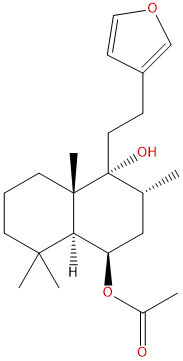
The molecular formula of cranberry furan is C22H34O4, with a molecular weight of 362.5100. Its core structure belongs to the diterpenes of the Ladanane type, which is composed of three hexagonal rings (A/B/C rings) and one pentagonal ring (D ring) fused together, and contains a characteristic furan ring structure. This combination of rigidity and flexibility is the structural basis for its interaction with various biomolecules and the production of diverse pharmacological activities.
From the analysis of physicochemical parameters related to drug properties, the lipid water partition coefficient (LogP) of Sophora japonica is 4.4495, indicating that the compound has high lipophilicity. Its topological polar surface area (TPSA) is 59.6700 Å ², which is relatively small. These two parameters together determine its poor predictive water solubility (approximately 0.0116 mg/mL), suggesting that in formulation development, it may be necessary to improve its bioavailability through salt formation, inclusion complex formation, or the use of special delivery systems. It is worth noting that its predicted blood-brain barrier permeability is "high", which provides the possibility for the treatment of potential central nervous system related diseases such as certain viral encephalitis or brain tumors. In addition, preliminary computer simulation toxicity predictions showed no inhibitory risk on hERG potassium channels (hERG inhibition: No), and the Ames test predicted a result of 0.0, suggesting that it may not have mutagenicity, providing preliminary positive signals for its safety evaluation.
Plant sources and extraction methods
The main source of trifoliate furan comes from the single leaf trifoliate plant of the family Verbenaceae in the genus Vitex(Vitex rotundifolia)Fruit, leaves, or whole grass. This plant is widely distributed in coastal sandy areas of East Asia and is commonly used in traditional medicine to treat headaches, colds, and eye inflammation.
Its extraction and separation usually follow the conventional process of natural product chemistry. Firstly, the dried plant material is crushed and subjected to leaching or reflux extraction with organic solvents such as methanol, ethanol, or ethyl acetate to obtain the crude extract. Subsequently, the crude extract was preliminarily separated using solvent partitioning methods such as petroleum ether, ethyl acetate, and n-butanol fractional extraction. The part rich in diterpenoids (usually ethyl acetate) is purified by a series of column chromatography techniques. The commonly used stationary phases include silica gel, reverse silica gel (such as C18) and dextran gel (such as Sephadex LH-20). The final separation and identification of mangiferin are often combined with high-performance liquid chromatography (HPLC) or preparative thin layer chromatography (PTLC), and its planar and stereochemical structures are determined by techniques such as nuclear magnetic resonance (NMR), mass spectrometry (MS), and X-ray single crystal diffraction. Optimizing the extraction process, such as using ultrasound assisted extraction or microwave-assisted extraction, is expected to improve its extraction efficiency.
Pharmacological activity research
The pharmacological activity research of trifoliate furan shows a diversified trend from anti-tumor to antiviral.
-
Antitumor activity This is the earliest reported and extensively studied activity of resveratrol. Research has shown that resveratrol can effectively inhibit the proliferation of various human leukemia cell lines, such as HL-60 and K562. Its function is not only manifested in inhibiting the cell cycle process (such as blocking cells in the G0/G1 phase), but more importantly, it can activate endogenous and exogenous apoptotic pathways, leading to cell apoptosis. In addition, some studies suggest that it may also have inhibitory potential on certain solid tumor cells, but there are relatively few related reports.
-
Antiviral activity This is an emerging research direction with great potential for the development of oxyfuran. Computer simulations (such as molecular docking) and some in vitro experiments have shown that trifoliate furan may exert broad-spectrum antiviral effects by acting on key targets throughout the lifecycle of multiple viruses.
- Antiherpesvirus: UL42 (DNA polymerase helper subunit), UL54 (ICP27, post transcriptional regulatory protein), thymidine kinase (TK), and viral glycoprotein D (gD) that may target herpes simplex virus (HSV) interfere with viral DNA replication, gene expression, and cell-cell transmission.
- Anti human immunodeficiency virus (HIV)Research shows that it may act on HIV-1 protease (HIV1-PR) and integrase (INT), which are important targets of anti AIDS drugs. At the same time, it may also act as an antagonist of CCR5 and CXCR4, two key co receptors for HIV invasion into host cells, blocking virus entry.
- Other The potential inhibitory effect on myeloperoxidase (MPO) suggests that it may play a role in reducing excessive inflammatory response caused by viral infection.
-
Other activities As a plant derived compound, oxyfuran is often reported to have antioxidant and anti-inflammatory activities, which may have synergistic effects with its more complex pharmacological effects such as anti-tumor and antiviral effects.
Mechanism of action and molecular targets
The multiple pharmacological activities of mangiferin stem from its interactions with multiple molecular targets within cells.
-
Antitumor mechanism In leukemia cells, the cell cycle arrest and apoptosis induced by resveratrol involve multiple signaling pathways. Research has shown that it may cause cell cycle arrest by upregulating the expression of cyclin dependent kinase inhibitors (such as p21, p27), while downregulating the levels of cell cycle proteins (such as Cyclin D1) and cyclin dependent kinases (such as CDK4, CDK6). In terms of inducing apoptosis, trifoliate furan can cause a decrease in mitochondrial membrane potential, promote cytochrome c release, and activate the cascade reaction of caspase-9 and caspase-3 (endogenous pathway); Meanwhile, it is also possible to upregulate the expression of death receptors (such as Fas) and activate caspase-8 (an exogenous pathway). In addition, its regulation of Bcl-2 family proteins (upregulation of pro apoptotic protein Bax and downregulation of anti apoptotic protein Bcl-2) is also a key link.
-
Antiviral mechanism Its antiviral mechanism exhibits multi-target characteristics.
- Inhibit viral enzyme activity Molecular simulations show that it can effectively embed into the active pockets of HIV-1 protease and integrase, or bind to the active sites of enzymes such as TK and UL42 in HSV, thereby competitively inhibiting the catalytic function of these enzymes and hindering the synthesis and integration of viral nucleic acids.
- Block virus entry Its structure is similar to that of some chemokine receptor small molecule antagonists, and it may change its conformation by binding to the transmembrane regions of CCR5 and/or CXCR4 receptors, preventing the binding of HIV gp120 protein to the receptor and thus blocking the first step of virus entry into host cells.
- Interference with viral protein function: The interaction with regulatory proteins such as HSV ICP27 may interfere with the post transcriptional regulation and nuclear output of viral genes and inhibit the synthesis of viral proteins.
These multi-target mechanisms of action make it difficult for trifoliate furan to develop resistance, but also pose challenges for optimizing its specificity.
Evaluation of drug properties and pharmacokinetics
Although triflumens have shown good biological activity in vitro, their pharmacological properties still require systematic evaluation.
-
Absorption, distribution, metabolism, excretion (ADME)Currently, there are few reports on the in vivo pharmacokinetic studies of the resveratrol system. Based on its physicochemical properties (high LogP, low water solubility), it can be predicted that its oral absorption may be limited by dissolution rate, and its bioavailability may not be high. Its high lipophilicity and high blood-brain barrier permeability predicted values suggest that it has good tissue permeability, especially the possibility of entering the central nervous system. In the body, as a diterpenoid compound, it is likely to be mainly metabolized through the liver cytochrome P450 enzyme system (CYP450), undergoing phase I reactions such as hydroxylation and demethylation, and then binding with glucuronic acid or sulfuric acid (phase II binding) before being excreted through bile or urine. Identifying its main metabolic enzyme subtypes and metabolites is key to evaluating its potential drug drug interactions.
-
Challenges and optimization directions in drug development:
- Poor water solubility This is the main development obstacle. The strategy includes: preparing its soluble salts (if suitable ionized groups are present), forming cyclodextrin inclusion complexes, developing nano delivery systems such as nanocrystals, liposomes, or micelles.
- structural optimization By using medicinal chemical methods to modify the structure, while retaining pharmacological activity, it improves its water solubility and metabolic stability. For example, introducing hydrophilic groups or blocking easily metabolized sites.
- safety evaluation Although computers predict no hERG inhibition or mutagenic risk, complete preclinical safety pharmacology, genotoxicity, and long-term toxicity studies are still needed to confirm its safety window.
Clinical application prospects and prospects
The clinical application prospects of mangiferin depend on the depth and direction of its subsequent research and transformation.
-
As a lead compound for anti-tumor drugs Especially for hematological malignancies, such as acute myeloid leukemia. The mechanism by which it induces apoptosis through multiple pathways deserves further exploration. It is possible to explore its combination therapy with existing chemotherapy drugs to enhance efficacy or overcome drug resistance.
-
As a lead compound for novel antiviral drugs Its unique broad-spectrum and multi-target antiviral mechanism (especially targeting both the entry and replication stages of HIV simultaneously) has significant advantages. In the field of HIV treatment, developing CCR5/CXCR4 dual antagonists or protease/integrase dual function inhibitors based on the trefoil furan skeleton may become a new strategy to address drug resistance issues. In the treatment of herpes virus, it may also provide new options.
-
Potential applications in neurological diseases Its high blood-brain barrier permeability gives it a natural advantage in treating central nervous system viral infections (such as HSV encephalitis) or certain brain tumors.
-
Outlook and Challenges:
- In depth study of mechanisms More precise biochemical and cellular biology experiments (such as surface plasmon resonance, isothermal titration calorimetry, gene knockout/knockdown validation) are needed to confirm its direct interaction and functional impact with predicted targets.
- Strengthen in vivo research Establishing relevant animal disease models (such as leukemia mouse models, HIV infected humanized mouse models) and systematically evaluating their in vivo efficacy, pharmacokinetics, and toxicity is a necessary step towards clinical application.
- Interdisciplinary research and development Combining computational chemistry and structural biology for rational structural design and optimization; Using pharmaceutical technology to solve delivery challenges; Comprehensively evaluate its risks and benefits through pharmacology and toxicology.
Conclusion
Vineberry furan is a natural diterpene with a pullulane skeleton, and its unique chemical structure endows it with the ability to inhibit tumor cell proliferation and induce apoptosis, as well as potential multi-target antiviral activity. From the perspective of its mechanism of action, it exhibits multi pathway pharmacological characteristics by intervening in cell cycle regulatory proteins, apoptosis related proteins, as well as various viral key enzymes and host factors. Despite facing challenges such as poor water solubility in drug development, its high blood-brain barrier permeability and good preliminary safety prediction provide favorable conditions for its development. In the future, through systematic chemical modification of drugs, advanced pharmaceutical strategies and in-depth preclinical and clinical research, Vitex Furan is expected to develop from a potential natural active molecule into a new drug or lead compound in the treatment of leukemia, AIDS, herpes virus infection and other fields, fully demonstrating the continuous vitality of natural products in the research and development of innovative drugs.