| Catalog No | Package | Original Price | Price | Inventory | Quantity | Operating |
|---|---|---|---|---|---|---|
| BP5062-5mg | 5mg | $650.00 | Sign in |
|


Storage conditions:Short-term storage at 2~8℃, long-term storage at -20 ~ -80℃
Isoarcinol, also known as Cambogin, is a polyphenolic compound derived from natural plants and has received widespread attention in the fields of pharmacology and natural product chemistry due to its significant biological activity. This compound, as an effective inhibitor of acetylcholinesterase (AChE) and butyrylcholinesterase (BChE), exhibits potential neuroprotective effects and strong killing activity against the parasite Leishmania donovani. In addition, bishanzhusu exhibits multi-target regulatory ability in the field of anti-tumor, involving multiple key signaling pathways and cancer-related proteins, demonstrating its enormous potential as a candidate molecule for anti-cancer drug development. This article will provide a systematic review of the chemical structure and physicochemical properties, plant sources and extraction methods, pharmacological activity and mechanism of action, evaluation of drug properties and pharmacokinetic characteristics of Yi Shan bamboo extract. Finally, the clinical application prospects of this natural product will be discussed, providing a theoretical basis and reference for further research and drug development.
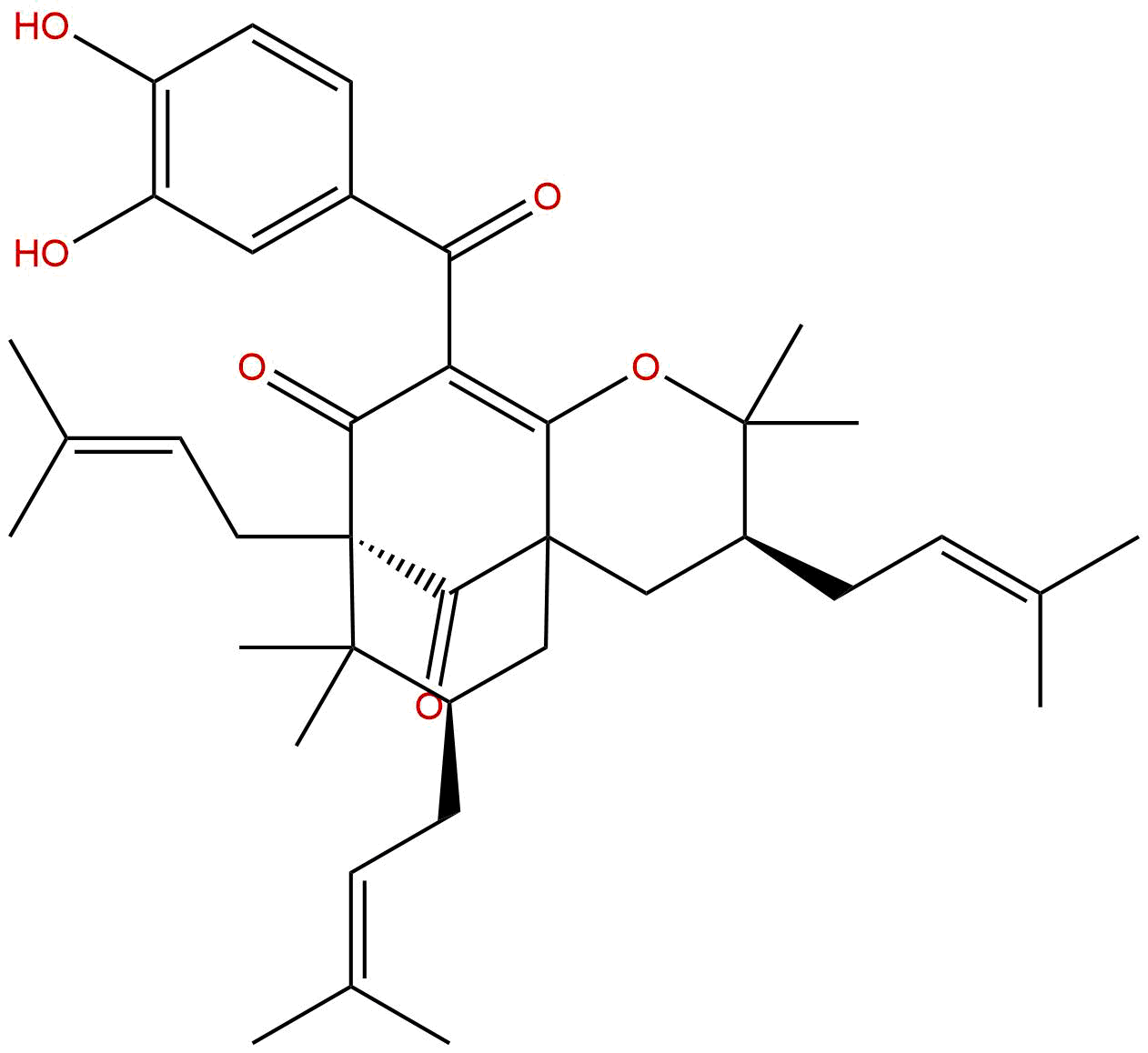
The molecular formula of Yi Shan Zhu Zi Su is C34H42O11, with a molecular weight of 602.8120, belonging to the polyphenolic diterpenoid class. Its structure contains multiple phenolic hydroxyl groups and a cyclic terpene skeleton, endowing it with strong biological activity. The LogP value of Yishan bamboo extract is 7.6424, indicating high lipid solubility, which may affect its in vivo distribution and cell membrane penetration ability. Its topological polar surface area (TPSA) is 100.9 Å ², indicating that the molecule has a certain polarity, which is conducive to binding with biomolecules. The extremely low water solubility (0.0006 mg/mL) suggests limited solubility in the aqueous phase, which may pose a challenge to the formulation process. The low permeability of the blood-brain barrier suggests limited utilization in the central nervous system. The negative result of hERG channel inhibition experiment indicates a low risk of cardiac toxicity. The Ames mutagenicity test result was 0, indicating no significant genetic toxicity risk.
The main source of gibberellin is from plants in the Theaceae family, especially from plants in the Garcinia spp. genus, such as Garcinia cambogia and other related species. This type of plant is widely distributed in Southeast Asia, and its skin and bark are rich in various bioactive diterpenes and polyphenolic compounds. The extraction of bamboo extract from Yishan bamboo is usually carried out using organic solvent extraction method, with ethanol, methanol or ethyl acetate commonly used as extractants. The extraction process generally includes crude extraction, liquid-liquid distribution, column chromatography separation, and high-performance liquid chromatography (HPLC) purification. In recent years, green technologies such as ultrasound assisted extraction and supercritical CO2 extraction have also been applied to improve the extraction efficiency and purity of gibberellin. After purification, the structure of the purified bamboo extract was identified by nuclear magnetic resonance (NMR), mass spectrometry (MS), and infrared spectroscopy (IR).
Yishan bamboo extract showed significant inhibitory effects on acetylcholinesterase (AChE) and butyrylcholinesterase (BChE), with IC50 values of 1.13 μ M and 8.30 μ M, respectively. AChE and BChE are key enzymes in the nervous system that break down acetylcholine. Inhibiting their activity helps to increase acetylcholine levels, improve nerve conduction function, and has the potential to treat neurodegenerative diseases such as Alzheimer's disease. The dual enzyme inhibitory properties of Isodendrobine give it an advantage in improving cognitive function, especially in advanced Alzheimer's disease patients with increased BChE activity, where it may play a greater role.
Yishan bamboo extract exhibits strong bactericidal activity against Leishmania donovani, with an IC50 of 0.33 μ M. Leishmaniasis is a parasitic disease caused by Leishmania parasites, widely distributed worldwide, with limited treatment options and drug resistance issues. The highly efficient antigen insecticidal activity of Yishan bamboo extract provides important clues for the development of new anti leishmania drugs.
Yishan bamboo extract exhibits inhibitory effects on proliferation and induces apoptosis in various tumor cell lines. Its anti-tumor mechanism involves the regulation of multiple signaling pathways and key molecules, including:
These multi-target effects make bishanzhusu a natural product with broad anti-tumor potential.
The pharmacological activity of Yi Shan Zhu Su is based on its interactions with multiple molecular targets. As an inhibitor of AChE and BChE, isoleucine blocks the hydrolysis of acetylcholine and enhances neurotransmission by binding to enzyme active sites. Its anti Leishmania activity may involve disrupting the integrity of the parasite's cell membrane and interfering with the function of key metabolic enzymes. The anti-tumor effect is achieved by regulating signaling pathways related to cell apoptosis, proliferation, migration, and metabolism. The specific mechanism includes:
Molecular docking and cell experiments both support the high affinity and regulatory effects of Isoxacin on the aforementioned targets, providing a molecular basis for its multi-target pharmacological activity.
The pharmacological evaluation of Yishan bamboo extract presents certain challenges. Its high molecular weight (602.8 Da) and high lipid solubility (LogP 7.64) may lead to low oral bioavailability, and its extremely poor water solubility (0.0006 mg/mL) limits its dissolution and absorption in the aqueous phase. The low permeability of the blood-brain barrier limits its potential application in central nervous system diseases, but it may also reduce the risk of central nervous system related side effects. The hERG channel inhibition test was negative, indicating a low risk of cardiac toxicity, and the Ames mutagenicity test was negative, indicating good safety.
At present, there is limited pharmacokinetic data available on the production of Isoxastrobin. Preliminary in vivo studies indicate that its metabolism is mainly through the liver enzyme system, which may involve the involvement of CYP450 family enzymes. High lipid solubility may lead to its accumulation in tissues in the body, affecting distribution and clearance. In the future, further research is needed on its absorption, distribution, metabolism, and excretion (ADME) characteristics, optimizing the administration route and formulation form to improve its clinical feasibility.
Due to its multi-target and multifunctional pharmacological properties, Yishan Zhuzi Su has shown broad application prospects in the fields of neurodegenerative diseases, parasitic infections, and tumor treatment. Its properties as an AChE and BChE inhibitor make it a potential drug candidate for cognitive impairment diseases such as Alzheimer's disease; Its efficient killing ability against Leishmania parasites provides new ideas for the development of antiparasitic drugs; Its anti-tumor activity covers multiple signaling pathways, making it suitable for development as a multi-target anti-cancer drug.
However, the low water solubility and poor pharmacokinetic properties of isosorbide limit its clinical translation. Future research should focus on:
Through interdisciplinary collaboration, bishanzhusu is expected to become an important candidate molecule in the development of natural product drugs.
As a polyphenolic diterpenoid compound derived from natural plants, Yishan bamboo extract exhibits multiple biological activities, covering multiple fields such as neuroprotection, anti parasitic and anti-tumor effects. Its significant inhibitory effects on AChE and BChE provide a new direction for the treatment of neurodegenerative diseases; The efficient killing activity against Leishmania parasites brings hope for the development of antiparasitic drugs; Multi targeted regulation of anti-tumor mechanisms provides potential innovative strategies for cancer treatment. Although there are certain limitations to its medicinal properties, the clinical translation prospects of Isoxastrobin are worth looking forward to through structural optimization and the application of advanced drug delivery technologies. Future research should focus on in-depth analysis of its pharmacological mechanisms, systematic evaluation of pharmacokinetics, and comprehensive verification of safety, in order to promote it as a model for natural product drug development and contribute new solutions to the treatment of related diseases.
