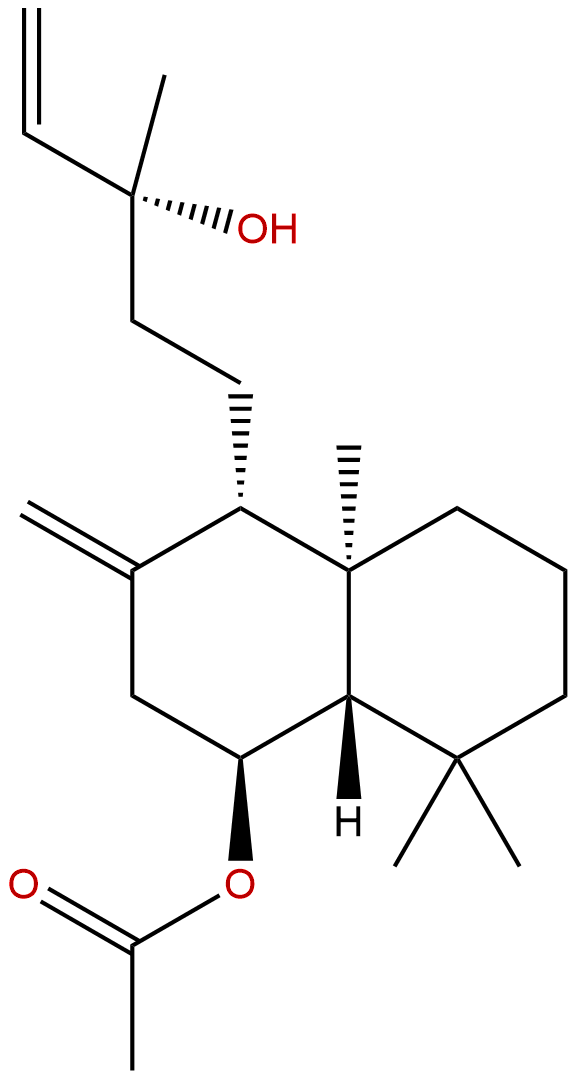


Product Name: Larixyl Acetate
Synonym name: 6-Acetyllarixol
Catalogue No.: BP0844
Cas No.: 4608-49-5
Formula: C22H36O3
Mol Weight: 348.527
Botanical Source:
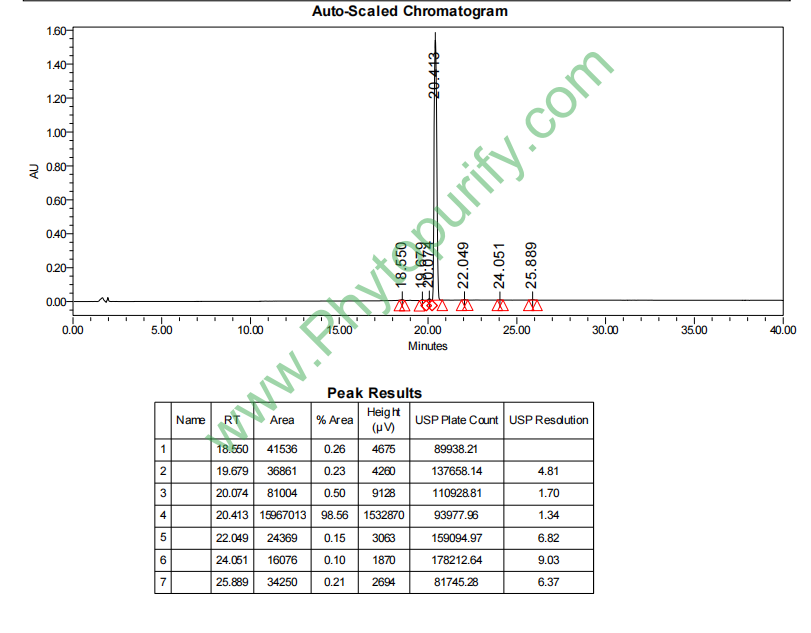
Purity: 95%~99%
Analysis Method: HPLC-DAD or/and HPLC-ELSD
Identification Method: Mass, NMR
Packing: Brown vial or HDPE plastic bottle
Can be supplied from milligrams to grams.
For Reference Standard and R&D, Not for Human Use Directly.
Inquire for bulk scale.
HPLC of Larixyl Acetate
Storage conditions:Short-term storage at 2~8℃, long-term storage at -20 ~ -80℃
Larixyl acetate (CAS number: 4608-49-5) is a natural compound initially isolated from plants of the Larix genus. As an effective and selective TRPC6 channel inhibitor, larch acetate exhibits significant biological activity in regulating cellular calcium homeostasis and signal transduction. In recent years, with the deepening of research on the mechanism of action of TRPC (Transient Receptor Potential Canonical) channels in various diseases, larch acetate has gradually become an important candidate molecule for the research and development of new anti-inflammatory drugs and neuroprotective agents due to its unique selectivity and low toxicity.
This review aims to systematically summarize the chemical structure and physicochemical properties, plant sources and extraction methods, pharmacological activity and mechanism of action, pharmacological evaluation and pharmacokinetic characteristics of larch acetate, and explore its potential and challenges for future clinical translation in disease models such as anti-inflammatory, neuroprotective, and endothelial dysfunction, providing reference for researchers in the field of natural product pharmacology.
The molecular formula of acetic acid larch ester is C22H32O3, with a molecular weight of 348.5270. Its chemical structure belongs to sesquiterpene compounds, with the core skeleton being the sesquiterpene skeleton unique to larch esters, containing an acetate group. This structure endows it with high lipid solubility (LogP of approximately 4.72), making it easy to penetrate cell membranes and the blood-brain barrier (BBB permeability is high), making it suitable for drug development in central nervous system related diseases.
In terms of physicochemical properties, the polar surface area (TPSA) of larch acetate is 46.53 Å ², indicating that its molecular polarity is moderate and conducive to binding to various protein targets. The low water solubility (about 0.0099 mg/mL) suggests that appropriate formulation techniques may be needed in vivo to improve its bioavailability. The hERG channel inhibition experiment showed a negative result, indicating a low risk of cardiac toxicity. The Ames mutagenicity test result is 0, indicating a low risk of genotoxicity.
Acetic acid larch ester mainly comes from plants of the Larix genus, especially the abundant content in larch wood, resin, and leaves. Larch plants are widely distributed in temperate regions of the Northern Hemisphere, traditionally used for wood processing and folk medicine.
The extraction method usually uses solvent extraction combined with chromatographic separation technology. The specific steps include:
In recent years, the application of ultrasound assisted extraction and supercritical CO2 extraction technology has improved the extraction efficiency and purity of larch acetate, which is beneficial for its large-scale production and pharmaceutical development.
Acetate larch ester, as an effective inhibitor of TRPC6 channel, has an IC50 of 0.58 μ M for the human TRPC6-YFP fusion protein, demonstrating high selectivity and efficacy. In contrast, the inhibition of TRPC3-YFP is weaker, with an IC50 of approximately 6.83 μ M, indicating that its targeting of TRPC6 is significantly better than TRPC3. This selectivity makes it potentially therapeutic in regulating the TRPC6 related calcium signaling pathway.
Multiple in vitro and in vivo experiments have shown that larch acetate has significant anti-inflammatory effects. Its main mechanism involves inhibiting various inflammatory mediators and signaling pathways, including:
Lacquer acetate exhibits good neuroprotective effects in a traumatic brain injury (TBI) model. It stabilizes intracellular calcium ion concentration by regulating TRPC6 channels, preventing cell apoptosis and inflammatory reactions caused by calcium overload. In addition, larch acetate can effectively prevent high-risk human papillomavirus (HPV) infection, indicating its potential application in viral infections and related inflammatory diseases.
In terms of systemic endothelial dysfunction, larch acetate has a good vascular protective effect by improving calcium signaling in endothelial cells, restoring vasodilation function, reducing vascular inflammation.
The main molecular target of larch acetate is the TRPC6 channel. TRPC6 belongs to the TRP channel family and is a non selective cation channel widely distributed in the cardiovascular system, nervous system, and immune cells. The calcium influx mediated by TRPC6 channel is crucial for regulating cellular function, but its excessive activation is closely related to various diseases such as inflammation, fibrosis, neurodegenerative diseases, etc.
Acetate larch ester specifically binds to TRPC6 channel, blocking its calcium ion permeability and reducing intracellular calcium ion concentration, thereby inhibiting downstream inflammatory signaling pathway activation. The specific mechanism includes:
In addition, the weak inhibitory effect of larch acetate on TRPC3 channel may have a synergistic effect on its overall pharmacological effects, but its dominant effect is still concentrated on TRPC6.
The molecular weight (348.53) and moderate polarity (TPSA 46.53) of larch acetate comply with Lipinski's rules and have good oral bioavailability potential. Its high lipid solubility (LogP 4.72) facilitates membrane penetration and blood-brain barrier permeability, making it suitable for drug development in neurological diseases.
Low water solubility (0.0099 mg/mL) suggests the need for formulation optimization (such as nanocarriers, liposomes, etc.) to enhance solubility and bioavailability. HERG channel inhibition was negative and Ames test showed no mutagenicity, indicating good safety.
At present, there is limited systematic pharmacokinetic research on larch acetate. Preliminary in vivo experiments have shown that its oral absorption is fast, the plasma half-life is moderate, and it can effectively penetrate the blood-brain barrier, reaching an effective concentration for the central nervous system. Liver metabolism is mainly through the CYP450 enzyme system, and the safety of metabolites is good.
Further detailed pharmacokinetic (PK) and pharmacodynamic (PD) studies are needed in the future to clarify their in vivo distribution, metabolic pathways, and excretion characteristics, laying the foundation for clinical development.
Acetate larch ester, as a natural TRPC6 selective inhibitor, has broad clinical application prospects, mainly reflected in the following aspects:
Anti inflammatory treatment By inhibiting inflammatory mediators and signaling pathways through multiple targets, larch acetate can be used to treat chronic inflammatory diseases such as rheumatoid arthritis and inflammatory bowel disease.
neuroprotection Its excellent blood-brain barrier penetration and protective effect against traumatic brain injury make it a potential candidate drug for neurodegenerative diseases (such as Alzheimer's disease, Parkinson's disease) and post-traumatic brain injury rehabilitation.
cardiovascular disease Through regulating endothelial function and vasodilation, larch acetate is expected to be used to treat cardiovascular diseases such as hypertension and atherosclerosis.
Antiviral applications The preventive effect of HPV suggests its potential in the prevention of viral infections and related tumors.
However, the low water solubility and pharmacokinetic properties of larch acetate still need to be optimized through drug design and formulation techniques. In addition, preclinical safety evaluation and clinical trial data are still lacking, and systematic research needs to be strengthened in the future to verify its efficacy and safety.
Acetate larch ester, as a natural sesquiterpene compound derived from larch plants, exhibits unique pharmacological advantages in anti-inflammatory, neuroprotective, and endothelial function improvement due to its ability to selectively inhibit TRPC6 channels. Its good pharmacokinetic parameters and safety provide a solid foundation for the development of new drugs. In the future, through in-depth mechanism of action research, pharmacokinetic optimization, and preclinical evaluation, larch acetate is expected to become a novel drug for treating various inflammatory and neurological diseases.
In summary, larch acetate not only enriches the research field of natural product pharmacology, but also provides new ideas and directions for the development of multi-target anti-inflammatory and neuroprotective drugs. Looking forward to more basic and clinical research in the future to promote its clinical translation and realize its application value in modern medicine.
