

Storage conditions:Short-term storage at 2~8℃, long-term storage at -20 ~ -80℃
Neotriptohenolide (CAS number: 81827-74-9) is a natural sesquiterpene pyridine alkaloid isolated from the root bark of Tripterygium wilfordii, a traditional Chinese medicine. As a traditional Chinese medicinal herb, Tripterygium wilfordii has been widely studied for its significant anti-inflammatory, immune regulating, and anti-tumor activities. As one of the important active ingredients in Tripterygium wilfordii Hook. f., neonicotinoid has gradually become a research hotspot in the field of natural product pharmacology in recent years due to its unique chemical structure and multi-target pharmacological effects. This article provides a systematic review of the chemical structure and physicochemical properties, plant sources and extraction methods, pharmacological activity and mechanism of action, pharmacological evaluation, and clinical application prospects of neonicotinoid, aiming to provide a theoretical basis and research direction for its subsequent drug development and clinical application.
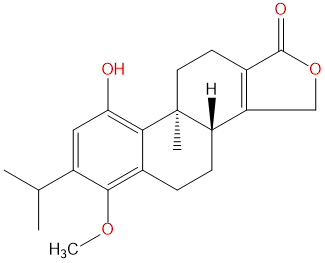
Xinlei phenol lactone is a tetracyclic triterpenoid compound with a molecular formula of C21H26O4 and a molecular weight of 342.4350. Its structural features include phenols, aromatic ethers, gamma lactones, and organic heterocyclic frameworks, exhibiting high structural complexity and diversity. The LogP value of Xinlei phenol lactone is 4.5192, indicating that it has strong lipid solubility and is conducive to penetrating cell membranes and the blood-brain barrier (BBB permeability is high). Its topological polar surface area (TPSA) is 55.76 Å ², and moderate polarity contributes to its bioavailability and distribution in vivo. Low water solubility (0.0241 mg/mL) suggests limited solubility in aqueous phase, which may affect its oral absorption and formulation development. The hERG channel inhibition test result was negative, indicating a low risk of cardiac toxicity, and the Ames mutagenicity test result was 0.0, indicating a low risk of genotoxicity and good drug efficacy.
Xinrui phenol lactone is mainly isolated from the root bark of Tripterygium wilfordii. Leigongteng plants are distributed in southern China and Southeast Asia, and their root bark contains abundant active ingredients of sesquiterpenes and triterpenes. Traditional extraction methods often use organic solvents such as ethanol, methanol, or ethyl acetate for extraction, combined with separation and purification techniques such as column chromatography, thin layer chromatography (TLC), and high performance liquid chromatography (HPLC), to ultimately obtain high-purity neochlorophenol lactone. In recent years, new green extraction technologies such as ultrasound assisted extraction, microwave-assisted extraction, and supercritical fluid extraction have also been applied to the extraction of active ingredients from Tripterygium wilfordii, improving extraction efficiency and purity and reducing the use of harmful solvents.
Xinlei phenol lactone exhibits significant anti proliferative and pro apoptotic effects in various tumor cell lines. In vitro experiments show that it can inhibit the proliferation of a variety of cancer cells (such as breast cancer, lung cancer, liver cancer, colorectal cancer, etc.), and induce cell cycle arrest and apoptosis. In vivo animal model studies have also confirmed its potential to inhibit tumor growth and metastasis. Its anti-tumor activity is closely related to the regulation of multiple signaling pathways.
Tripterygium wilfordii and its active ingredients are widely used in the field of immune regulation. Neocatechol lactone exhibits good anti-inflammatory effects by regulating immune cell function and inhibiting the release of inflammatory factors. It can reduce the expression of pro-inflammatory cytokines (such as TNF - α, IL-6, etc.), alleviate inflammatory reactions, and has potential therapeutic value for autoimmune diseases.
Given the excellent blood-brain barrier penetration of neonicotinoid, some studies have explored its application in neurodegenerative diseases. Preliminary data suggests that it may have a protective effect on nerve cells through antioxidant and anti-inflammatory mechanisms, but related research is still in its infancy.
The pharmacological effects of Xinlei phenol lactone involve multiple molecular targets and signaling pathways, mainly including:
In summary, neonicotinoid exhibits complex and effective anti-tumor mechanisms through multi-target and multi pathway synergistic effects.
The pharmacological parameters of Xinlei phenol lactone show that it has good potential for drug development. Its molecular weight of 342.4350 conforms to Lipinski's rule, and although the LogP value of 4.5192 is high, it is still within an acceptable range, indicating good lipid solubility, which is beneficial for cell membrane penetration and oral absorption. The TPSA is 55.76 Å ², suitable for crossing cell membranes and the blood-brain barrier. Low water solubility may limit oral bioavailability, and formulation optimization is needed to improve solubility and stability.
In terms of toxicological evaluation, neonicotinoid does not inhibit hERG channels, reducing the risk of cardiac toxicity; The Ames test is negative, indicating no significant genotoxicity. In addition, preliminary pharmacokinetic studies have shown that it is widely distributed in the body, especially at high concentrations in the central nervous system, which is consistent with its high blood-brain barrier permeability. The metabolic pathway is not yet fully understood, and it is speculated that it is mainly metabolized by the liver CYP450 enzyme system. In the future, further systematic studies are needed to investigate its metabolic kinetics and potential drug interactions.
Given the multiple activities of neonicotinoid in anti-tumor, anti-inflammatory, and immune regulation, its clinical application prospects are broad. Currently, Tripterygium wilfordii and its extracts have shown therapeutic effects in autoimmune diseases such as rheumatoid arthritis and systemic lupus erythematosus. Neocatechol lactone, as the main active ingredient, is expected to become a candidate molecule for the next generation of anti-tumor and immunomodulatory drugs.
Future research should focus on:
In addition, combining modern drug design and synthetic biology techniques to develop derivatives and analogues of neonicotinoid to further enhance its efficacy and selectivity is also an important direction for the future.
As an important natural active ingredient in Tripterygium wilfordii, neonicotinoid lactone has shown great potential in the fields of anti-tumor and immune regulation due to its unique tetracyclic triterpenoid skeleton structure and multi-target pharmacological activity. Its good pharmacokinetic parameters and low toxicity risk have laid a solid foundation for its drug development. Although the research on its mechanism of action and clinical application is still in its preliminary stage, with the advancement of modern pharmacology and medicinal chemistry technology, neonicotinoid is expected to become an important breakthrough in the development of natural product drugs. In the future, interdisciplinary collaboration will accelerate its transition from the laboratory to clinical practice, benefiting more patients.
