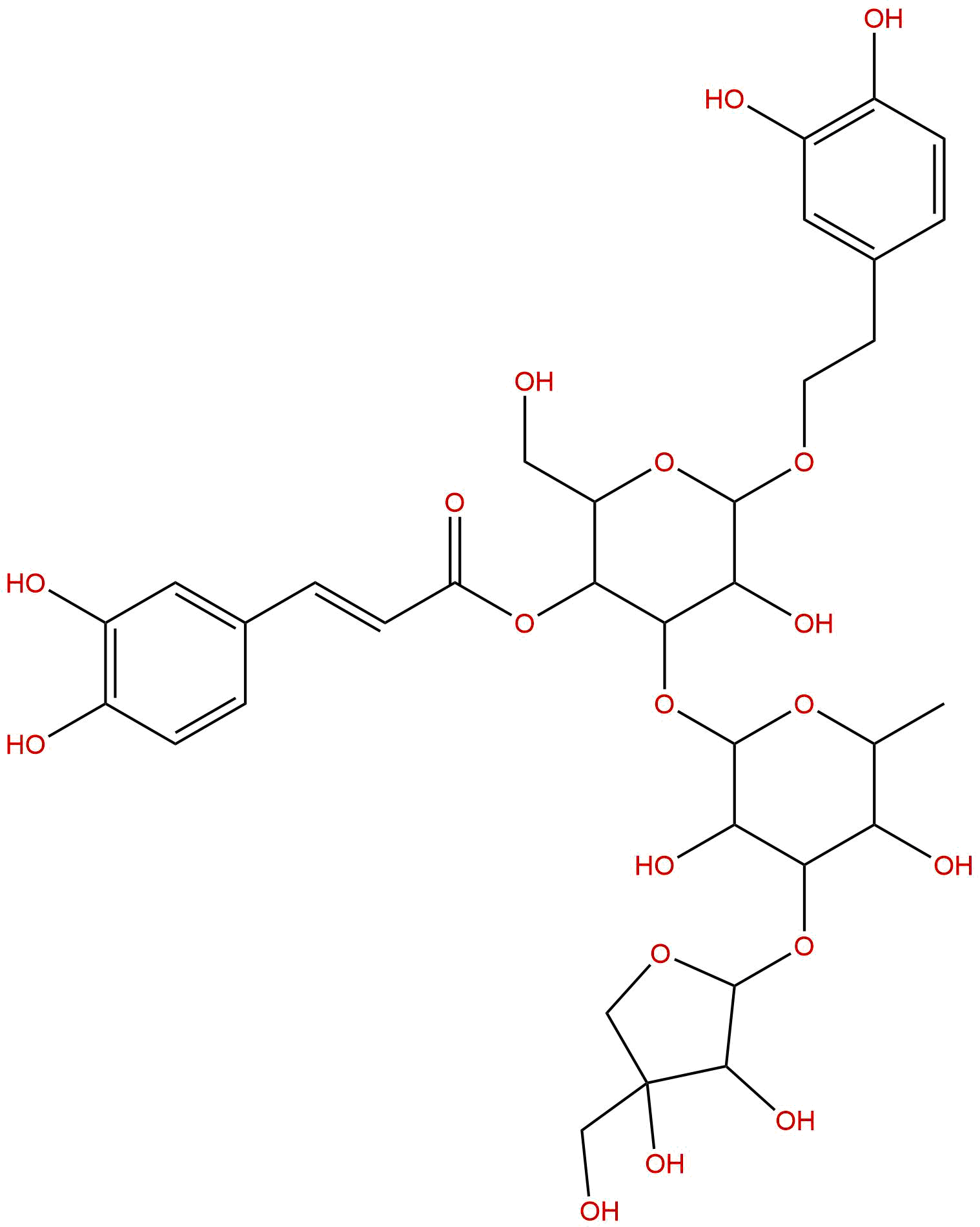


Product name: Myricoside
Synonym name: Clerodendroside; Clerodendroside;Clerodendron myricoides
Catalogue No.: BP5107
Cas No.: 76076-04-5
Formula: C34H44O19
Mol Weight: 756.707
Botanical Source:
Type of Compound:
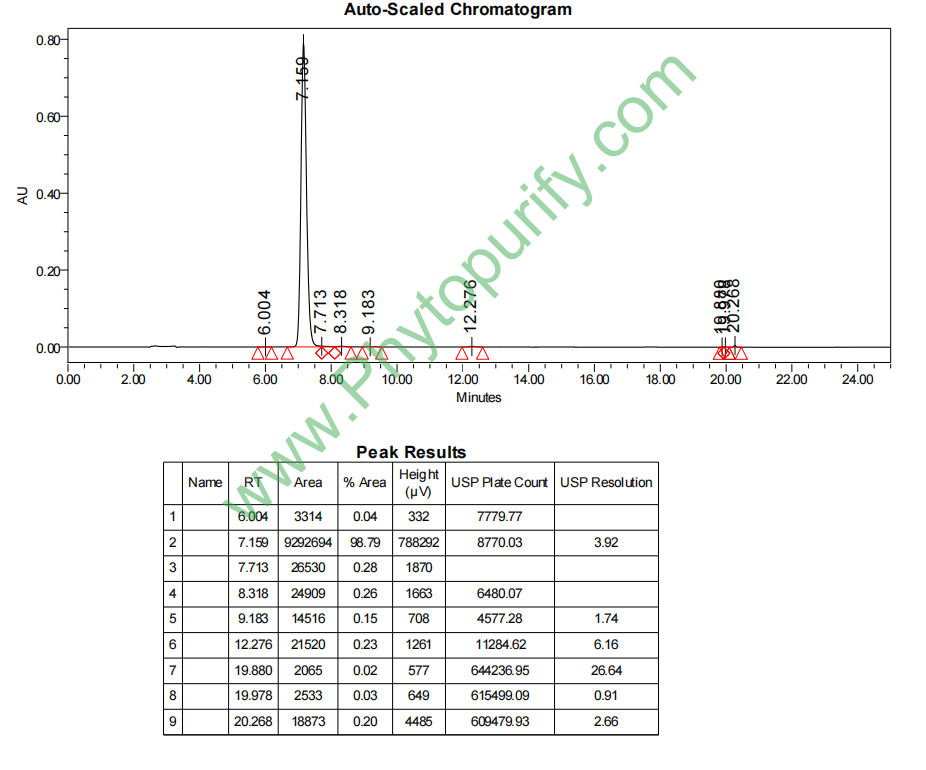
Purity: 95%~99%
Analysis Method: HPLC-DAD or/and HPLC-ELSD
Identification Method: Mass, NMR
Packing: Brown vial or HDPE plastic bottle
Storage: Store in a well closed container, protected from air and light. Put into refrigerate or freeze for long term storage.
Whenever possible, you should prepare and use solutions on the same day. However, if you need to make up stock solutions in advance, we recommend that you store the solution as aliquots in tightly sealed vials at -20℃. Generally, these will be useable for up to two weeks.
The product could be supplied from milligrams to grams
Inquire for bulk scale.
For Reference Standard and R&D, Not for Human Use Directly.
HPLC of Myricoside
Storage conditions:Short-term storage at 2~8℃, long-term storage at -20 ~ -80℃
Myricoside is a natural product that was first isolated from the aboveground parts of the plant Phlomis oppositiflora. As a glycoside compound with multiple biological activities, Yangmei Changshan glycoside has attracted widespread attention in the field of natural product pharmacology. In recent years, with the increasing demand for antiviral drugs, natural products have become important resources for new drug development due to their structural diversity and complex biological activity. Yangmei Changshan glycoside has become a hot molecule in antiviral drug research due to its significant antiviral activity and good safety characteristics.
This article will systematically review the chemical structure and physicochemical properties, plant sources and extraction methods, pharmacological activity and mechanism of action, pharmacological evaluation and pharmacokinetic characteristics of Yangmei Changshan glycoside, and explore its clinical application prospects and future research directions, aiming to provide theoretical basis and reference for the in-depth research and drug development of this compound.
The molecular formula of Yangmei Changshan glycoside has not been uniformly reported in the literature, but its molecular weight is 756.7070, indicating that its structure is relatively complex and belongs to the class of macromolecular glycosides. Its LogP value is -0.5260, indicating that the compound has strong hydrophilicity, which is consistent with the typical characteristics of glycoside compounds. The TPSA (topological polar surface area) is as high as 304.2100, further reflecting its rich polar groups, which may include multiple hydroxyl, ether bonds, and glycosidic structural units.
The water solubility is 3.8585, indicating that Yangmei Changshan glycoside has good solubility in water, which is of positive significance for the absorption and bioavailability of oral preparations. The low permeability of the blood-brain barrier suggests its limited distribution in the central nervous system, which may reduce central nervous system related side effects. The negative result of hERG channel inhibition experiment indicates that the compound is not prone to cardiac toxicity and has high safety. The Ames test result was 0.0, indicating no significant mutagenicity, further supporting its safety.
Overall, the physicochemical properties of Yangmei Changshan glycoside conform to the typical characteristics of natural product drugs, with good water solubility and safety, laying the foundation for its drug development.
Yangmei Changshan glycoside is mainly isolated from the aboveground part of Phlomis oppositiflora, a plant in the family Lamiaceae. Phlomis plants are widely distributed in the Mediterranean region and West Asia, traditionally used as herbs to treat various diseases. Phlomis oppositiflora, as an important representative of this genus, contains abundant polyphenolic and glycoside compounds in its aboveground parts.
The extraction process usually uses ethanol or methanol as solvents to obtain crude extracts through reflux extraction or ultrasound assisted extraction. Subsequently, liquid-liquid partitioning, column chromatography (such as silica gel column, C18 reverse phase column), and high-performance liquid chromatography (HPLC) techniques were used for separation and purification. During the purification process, UV detection and mass spectrometry (LC-MS) are commonly used as monitoring methods to ensure the purity and structural confirmation of Yangmei Changshan glycoside.
In recent years, green extraction techniques such as supercritical CO2 extraction and microwave-assisted extraction have also been attempted to be applied to the extraction of this compound, aiming to improve extraction efficiency and environmental friendliness. The optimization of extraction process not only improves the yield, but also provides sufficient sample guarantee for subsequent pharmacological research.
The pharmacological activity research of Yangmei Changshan glycoside mainly focuses on its antiviral effect. Preliminary in vitro experiments showed that myricetin had inhibitory effects on many viruses, especially in HIV and HSV infection models.
Anti HIV activity
Yangmei Changshan glycoside can interfere with multiple key targets in the HIV virus lifecycle, including HIV1 protease (HIV1-PR), integrase (INT), and viral envelope glycoprotein (gD). By inhibiting these targets, Yangmei Changshan glycoside effectively blocks virus replication and infection processes. In vitro cell experiments have shown that the compound can reduce viral load and decrease virus invasion of host cells.
Antiherpesvirus activity
Regarding the herpes virus, Yangmei Changshan glycoside acts on targets such as the virus's DNA polymerase (UL42, UL54), transcriptional regulatory protein (ICP27), and thymidine kinase (TK), inhibiting virus gene expression and replication. This mechanism helps to slow down the process of viral infection and reduce viral load.
Other virus targets
Yangmei Changshan glycoside also exhibits regulatory effects on host immune related targets such as myeloperoxidase (MPO), which may enhance antiviral effects by regulating host immune responses. In addition, the impact on CCR5 and CXCR4, two core HIV receptors, gives them potential advantages in blocking virus entry into cells.
In addition to its antiviral effect, some studies have also reported that Yangmei Changshan glycoside has auxiliary pharmacological activities such as anti-inflammatory and antioxidant effects, which may synergistically enhance its antiviral effect.
The antiviral mechanism of Yangmei Changshan glycoside involves multi-target and multi pathway synergistic effects, reflecting the typical characteristics of multi-target pharmacology of natural products.
MPO (myeloperoxidase)
MPO is an enzyme released by neutrophils, involved in inflammatory responses and oxidative stress. Yangmei Changshan glycoside regulates MPO activity, reduces inflammatory damage caused by viral infection, and protects host cells.
UL42、UL54、ICP27、TK
These targets are key proteins in the life cycle of herpes virus. UL42 and UL54 are auxiliary subunits of viral DNA polymerase, responsible for viral DNA replication. ICP27 regulates viral gene transcription, while TK is involved in viral nucleotide metabolism. Yangmei Changshan glycoside inhibits the function of these proteins, blocking virus replication and expression.
GD (glycoprotein D)
GD is a key glycoprotein on the surface of herpes virus, mediating the binding of the virus to host cell receptors. Yangmei Changshan glycoside may block the first step of virus entry into cells by binding to gD.
CCR5、CXCR4
These two are the main core receptors of HIV, through which the virus enters host cells. The regulatory effect of Yangmei Changshan glycoside on these two receptors helps to prevent virus invasion.
HIV1-PR (protease), INT (integrase)
HIV protease participates in the cleavage of viral multiprotein, while integrase integrates viral DNA into the host genome. Yangmei Changshan glycoside inhibits these two enzymes, blocks virus maturation and genome integration, and inhibits virus replication.
In summary, Yangmei Changshan glycoside exhibits broad-spectrum antiviral potential by inhibiting virus replication, infection, and virus related inflammatory responses through a multi-target mechanism of action.
The pharmacological evaluation of Yangmei Changshan glycoside shows that it has good safety and drug compatibility. Its LogP value is -0.5260, indicating strong hydrophilicity of the molecule, which may affect oral absorption but is beneficial for in vivo distribution. A high TPSA value indicates a high polarity, which may limit the cell membrane penetration ability and affect oral bioavailability.
Good water solubility (3.8585), beneficial for formulation development and in vivo absorption. The low permeability of the blood-brain barrier reduces the risk of central nervous system toxicity, but limits its application in central nervous system viral infections.
The hERG channel inhibition test was negative, indicating a low risk of cardiac toxicity. The Ames test result is 0, indicating no mutagenicity and good safety.
At present, there is limited pharmacokinetic data on Yangmei Changshan glycoside. Preliminary in vivo metabolic studies have shown that this compound undergoes relatively slow metabolism in the liver, mainly cleared through glycoside hydrolysis and corresponding phenolic hydroxyl metabolism pathways. Its half-life is moderate and suitable for development as a long-acting formulation. Further in vivo pharmacokinetic and toxicological studies are needed in the future to improve its pharmacological evaluation.
Yangmei Changshan glycoside, as a multi-target antiviral natural product, has broad clinical application potential. Its inhibitory effect on various viruses such as HIV and herpes virus, especially its multiple targeting mechanisms on key enzymes and receptors, provides new ideas for the development of novel antiviral drugs.
Anti HIV therapy
The existing anti HIV drugs are mostly single target inhibitors, and long-term use can easily lead to drug resistance. The multi-target action characteristics of Yangmei Changshan glycoside are expected to reduce the risk of drug resistance and improve treatment efficacy. Combined with existing antiretroviral drugs, it may have a synergistic effect.
Anti herpes virus infection
Herpes virus infection is difficult to cure and recurs frequently. Yangmei Changshan glycoside may become a new choice for the treatment of herpes virus by inhibiting virus replication and infection process through multiple targets, especially for patients infected with drug-resistant virus strains.
Assist in immune regulation
The regulatory effect of Yangmei Changshan glycoside on immune related targets such as MPO suggests its potential as an adjuvant therapy in the inflammatory response caused by viral infection, which can help alleviate tissue damage and promote recovery.
Challenges and Strategies in Drug Development
Although Yangmei Changshan glycoside has good pharmacological activity and safety, its high polarity and molecular weight may limit its oral bioavailability. In the future, it is necessary to improve its pharmacokinetic properties through structural modification and drug carrier technologies such as nanocarriers and liposomes. Meanwhile, in vivo pharmacological and toxicological studies of the system are crucial for clinical translation.
Multidisciplinary Joint Research
By combining modern molecular biology, computer-aided drug design, and medicinal chemistry methods, we aim to deeply analyze the mechanism of action of Yangmei Changshan glycoside and optimize its molecular structure, which will promote its clinical application.
Yangmei Changshan glycoside, as an important active ingredient of Phlomis oppositiflora, has shown extensive pharmacological potential due to its unique chemical structure and multi-target antiviral effects. Its good safety and multi-target mechanism provide new ideas for the development of antiviral drugs. In the future, it is necessary to further deepen its pharmacokinetics, toxicology, and preclinical research, optimize its drug properties, and promote its clinical translation.
With the increasing demand for antiviral drugs, Yangmei Changshan glycoside is expected to become a representative of the new generation of natural antiviral drugs, bringing new breakthroughs to the prevention and treatment of viral infections. Continuous interdisciplinary research and technological innovation will be key to achieving its clinical application.
