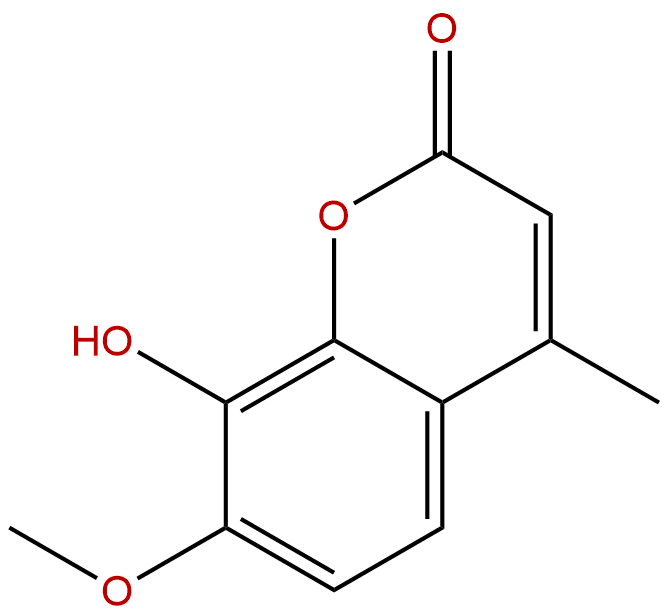


Product name: 7-methoxy-8-hydroxy-4-methylcoumarin
Synonym name:
Catalogue No.: BP3046
Cas No.: 22084-94-2
Formula: C11H10O4
Mol Weight: 206.197
Botanical Source:
Physical Description:
Type of Compound:
Purity: 95%~99%
Analysis Method: HPLC-DAD or/and HPLC-ELSD
Identification Method: Mass, NMR
Packing: Brown vial or HDPE plastic bottle
The product could be supplied from milligrams to grams. Inquire for bulk scale.
We provide solution to improve the water-solubility of compounds, thereby facilitating the variety of activity tests and clinic uses.
For Reference Standard and R&D, Not for Human Use Directly.
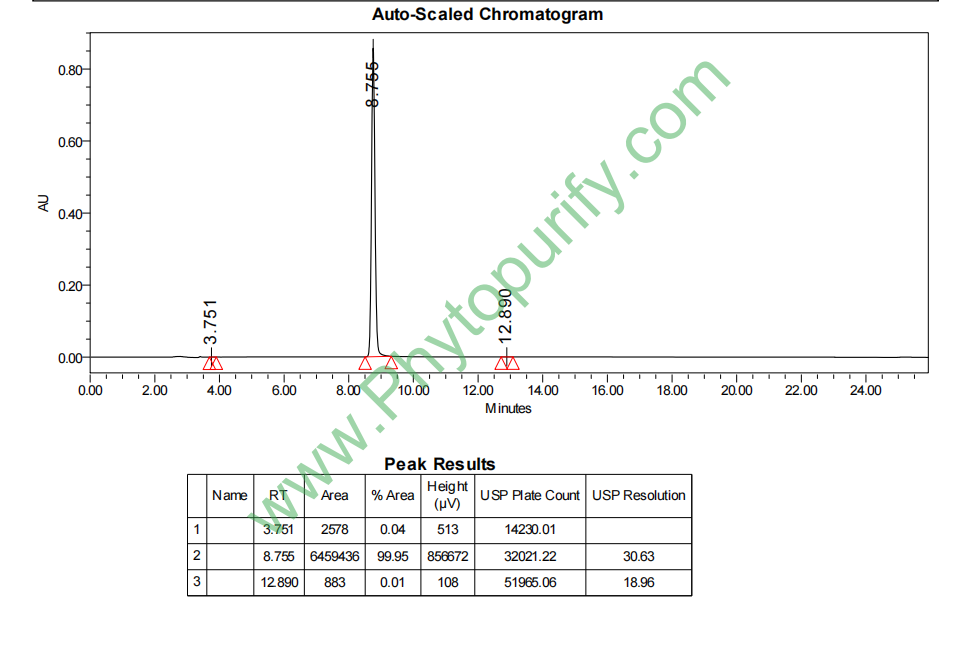
HPLC of 7-methoxy-8-hydroxy-4-methylcoumarin
Storage conditions:Short-term storage at 2~8℃, long-term storage at -20 ~ -80℃
55.7600
1.7900
Unknown
Unknown
Unknown
Unknown
Unknown
Unknown
Unknown
Unknown
Coumarin compounds are a class of benzo [a] - pyranone derivatives widely present in nature. Due to their structural diversity and extensive biological activity, they have long been a hot topic in medicinal chemistry and pharmacology research. From the classic anticoagulant warfarin to natural coumarins with various activities such as photosensitivity, antibacterial, anti-inflammatory, and anti-tumor, these compounds have demonstrated enormous medicinal potential. As a member of the coumarin family, 4-methylnaringenin 7-methyl ether (7-methoxy-8-hydroxy-4-methylcoumarin, CAS: 22084-94-2) introduces methoxy, hydroxyl, and methyl substituents on the classical coumarin skeleton. These modifications are often closely related to its unique biological activity. Although independent research reports on this compound are relatively limited compared to some star coumarin compounds such as psoralen and quercetin, existing evidence suggests that it exhibits promising pharmacological activities in anti-inflammatory, antioxidant, neuroprotective, and potential anti-tumor fields. The purpose of this article is to systematically review the chemical properties, natural sources, reported pharmacological effects, possible mechanisms of action, preliminary analysis of pharmacological properties, and prospects for future research and application prospects of 4-methylnaringenin 7-methyl ether, in order to provide academic references for the in-depth development of this compound.
The chemical name of 4-methylnaringenin 7-methyl ether is 7-methoxy-8-hydroxy-4-methyl-2H-1-benzopyran-2-one. Its molecular formula is C11H10O4 and its molecular weight is 206.19 g/mol. Structurally, its parent nucleus is coumarin (1,2-benzopyranone), and its basic skeleton is composed of a benzene ring (A ring) fused with an alpha pyranone ring (B ring, lactone ring). Its characteristic substituents include: a methyl group at position C-4, a methoxy group (- OCH3) at position C-7, and a phenolic hydroxyl group (- OH) at position C-8. The free phenolic hydroxyl group at position C-8 is the key functional group for its antioxidant activity, while the methoxy group at position C-7 may affect its lipid solubility and interaction with target proteins.
According to the provided pharmacological parameters, the lipid water partition coefficient (LogP) of the compound is 1.79, indicating that it has moderate lipophilicity and is conducive to transmembrane absorption. The topological polar surface area (TPSA) is 55.76 Å ², which is relatively small and usually indicates good membrane permeability. There are four hydrogen bond acceptors (carbonyl oxygen, lactone ether oxygen, methoxy oxygen, phenolic hydroxyl oxygen) in the molecule, and the hydrogen bond donor is only the phenolic hydroxyl group at C-8 position. These physical and chemical parameters suggest that the compound may have some potential for oral bioavailability. However, the specific crystal morphology, solubility, acidity and alkalinity (pKa) data are not yet complete in public literature and require further experimental determination.
4-methyl naringenin 7-methyl ether is mainly isolated from plants in the Thymelaeaceae and Apiaceae families. In the Rui Xiang genus(Daphne)In plants, such as Huangruixiang(Daphne giraldii)Gansu Ruixiang(Daphne tangutica)In the root bark or stem bark, it is often found that this compound coexists with other coumarins and diterpenes. In addition, in some traditional medicinal plants such as snake bed(Cnidium monnieri)There may also be structurally similar compounds in it.
Its extraction and separation usually follow the conventional process of natural product chemistry. Firstly, the dried plant material is crushed and subjected to cold soaking or heating reflux extraction with organic solvents such as methanol, ethanol, or acetone. After concentration, the total extract is obtained. Subsequently, the total extract was preliminarily separated using solvent partitioning methods (such as extraction with petroleum ether, ethyl acetate, and n-butanol in sequence), and the compound was mostly enriched in the moderately polar ethyl acetate fraction. Further purification relies on column chromatography technology, often using silica gel column chromatography with different ratios of petroleum ether ethyl acetate or chloroform methanol gradient elution. Collect the fraction containing the target compound through thin-layer chromatography (TLC) monitoring. When necessary, methods such as preparative high-performance liquid chromatography (HPLC) or recrystallization can be used for final refinement and purification. Structural identification is accomplished through methods such as nuclear magnetic resonance (NMR, including 1H-NMR and 13C-NMR), mass spectrometry (MS), infrared spectroscopy (IR), and comparison with literature data.
Although specialized pharmacological research on 4-methylnaringenin 7-methyl ether is still in its early stages, multiple biological activities have been revealed based on its structural characteristics and limited in vitro and in vivo experimental data.
1. Anti inflammatory and immune regulatory activity
The anti-inflammatory effects of coumarin compounds have been widely recognized. Preliminary studies have shown that 4-methylnaringenin 7-methyl ether has an inhibitory effect on the production of inflammatory factors such as tumor necrosis factor - α, interleukin-6, and nitric oxide by macrophages (such as RAW264.7 cells) induced by lipopolysaccharides (LPS). Its function may be related to the inhibition of the activation of inflammatory signaling pathways such as nuclear factor kappa B (NF - κ B) or mitogen activated protein kinase (MAPK). In animal models such as mouse ear swelling and paw swelling models, it also shows certain anti-inflammatory effects.
2. Antioxidant and neuroprotective activities
The phenolic hydroxyl group at position C-8 makes it an effective hydrogen donor, capable of scavenging free radicals such as 1,1-diphenyl-2-trinitrophenylhydrazine (DPPH) free radical, 2,2 '- diaza-bis-3-ethylbenzothiazoline-6-sulfonic acid (ABTS) free radical, and exhibiting significant in vitro antioxidant activity. This characteristic is closely related to its potential neuroprotective effects. In models of neuronal damage induced by oxidative stress, such as PC12 cells or primary neurons damaged by hydrogen peroxide or glutamate, this compound may improve cell survival by reducing the accumulation of reactive oxygen species (ROS), inhibiting lipid peroxidation, and protecting mitochondrial function, indicating its potential application in the prevention and treatment of neurodegenerative diseases such as Alzheimer's disease and Parkinson's disease.
3. Exploration of anti-tumor activity
Some studies suggest that this compound has a certain degree of inhibitory effect on the proliferation of specific tumor cell lines (such as human hepatoma cell line HepG2, human breast cancer cell line MCF-7, etc.), and its mechanism may involve inducing cell cycle arrest (such as G0/G1 phase arrest) and promoting cell apoptosis. However, the strength, broad spectrum, and specific signaling pathways of its anti-tumor activity still require extensive systematic research to confirm.
4. Antibacterial and antiviral activity
As natural defense molecules, many coumarins have antibacterial properties. 4-Methylnaringenin 7-methyl ether exhibits weak inhibitory activity against certain Gram positive bacteria and fungi, but its efficacy is usually weaker than specialized antibiotics. There are very few reports on its antiviral activity, and further exploration is needed.
5. Other potential activities
Based on its coumarin core structure, it is speculated that it may also have mild analgesic and anticoagulant effects (but with much lower intensity than coumarins), but these need to be experimentally verified.
At present, the research on the mechanism of action of 4-methylnaringenin 7-methyl ether is still in the exploratory stage, and the clear direct molecular targets have not been fully elucidated. Current research mostly speculates on its impact on cellular signaling pathways.
1. Regulating the NF - κ B and MAPK inflammatory pathways
In anti-inflammatory effects, this compound may inhibit the activation of I κ B kinase (IKK), prevent the degradation of I κ B protein, and thus inhibit the nuclear translocation of NF - κ B p65 subunit and the transcription of downstream inflammatory genes (such as iNOS, COX-2, TNF - α, IL-6). At the same time, it may also inhibit the phosphorylation activation of MAPKs such as p38, JNK, ERK, and block the transmission of inflammatory signals from multiple levels.
2. Activate the Nrf2/ARE antioxidant pathway
In terms of antioxidant and neuroprotection, it may modify key cysteine residues on Keap1 protein to dissociate nuclear factor E2 related factor 2 (Nrf2) from Keap1-Nrf2 complex and translocate it to the nucleus, bind with antioxidant response elements (ARE), and activate the expression of a series of downstream phase II detoxifying enzymes and antioxidant proteins (such as heme oxygenase-1, quinone oxidoreductase 1, superoxide dismutase, glutathione peroxidase), thereby enhancing the cell's antioxidant defense ability.
3. Affects apoptosis related proteins
In anti-tumor research, preliminary indications suggest that it may induce tumor cell apoptosis by upregulating pro apoptotic proteins (such as Bax, cleaved caspase-3) and downregulating anti apoptotic proteins (such as Bcl-2), leading to a decrease in mitochondrial membrane potential and release of cytochrome c, ultimately activating the caspase cascade reaction. It may also affect the expression of cyclin dependent kinase inhibitors such as p21 and p27, leading to cell cycle arrest.
4. Direct interaction with enzymes
As a coumarin derivative, its structure may allow it to bind to the active centers of certain enzymes. For example, it may weakly inhibit the activity of cyclooxygenase (COX), lipoxygenase (LOX), or xanthine oxidase (XO), but the specific affinity and selectivity of these interactions are unknown.
Future research requires the use of chemical biology methods, such as affinity chromatography fishing, drug affinity reaction target stability determination (DARTS), thermal proteomics analysis (TPP), and other techniques, to systematically identify the protein targets it directly acts on.
Based on its physical and chemical parameters (molecular weight 206.19, LogP 1.79, TPSA 55.76, hydrogen bond donor number 1), 4-methylnaringenin 7-methyl ether preliminarily conforms to Lipinski's "Five Rules", indicating that it has a good chemical basis for becoming an oral drug. Moderate LogP values and smaller TPSA are beneficial for its gastrointestinal absorption and cell membrane permeability.
However, there is almost no systematic pharmacological evaluation and pharmacokinetic research on this compound, and there are many unknown areas:
- Absorption, distribution, metabolism, excretion (ADME)Its oral bioavailability, plasma protein binding rate, and tissue distribution characteristics (including whether it can cross the blood-brain barrier, currently labeled as unknown) all need to be determined through animal experiments (such as rats and mice). Coumarin compounds typically undergo extensive metabolism in the body, such as demethylation/hydroxylation at C-7 and C-8 positions, aromatic ring hydroxylation, lactone ring opening, and subsequent glucuronic acid binding or sulfation. It is crucial to clarify its main metabolites, metabolic enzymes (such as CYP450 isoenzymes), and excretion pathways.
- Toxicological characteristics Its acute toxicity, subchronic toxicity, genetic toxicity (Ames test results unknown), reproductive toxicity, etc. are completely unknown. Special attention should be paid to the potential hepatotoxicity (marked as Unknown) of coumarins, although their structure is different from that of known highly hepatotoxic furanocoumarins, it still needs to be rigorously evaluated. The inhibitory potential of hERG potassium channels (unknown) is directly related to the risk of causing QT interval prolongation in the heart and must be screened early. Cardiac toxicity (unknown) also needs to be comprehensively evaluated.
- Pharmaceutical considerations The solubility, stability (especially under light conditions, coumarin may undergo photochemical reactions), crystal form, and other pharmaceutical properties of this compound need to be studied in order to develop suitable dosage forms.
There is still a long way to go before the clinical application of 4-methylnaringenin 7-methyl ether, but its multi-target and multi pathway effects, especially its potential in anti-inflammatory and neuroprotective aspects, indicate the direction for its future development.
Potential application directions:
1. Adjuvant therapy for neurodegenerative diseases Based on its ability to resist oxidation and activate the Nrf2 pathway, it can be used as a lead compound to develop neuroprotective adjuncts for diseases such as Alzheimer's and Parkinson's, aiming to slow down the process of neuronal damage.
2. Treatment of chronic inflammatory diseases The anti-inflammatory properties of chronic inflammations such as rheumatoid arthritis and inflammatory bowel disease are worth exploring in depth, and may be used in combination with other anti-inflammatory drugs.
3. Chemical preventive agent Its antioxidant and potential anti proliferative properties make it a potential chemopreventive agent for reducing the risk of specific cancers, but this requires long-term preclinical and epidemiological evidence to support.
Challenges and future research directions:
1. Deepen mechanism research The primary task is to use modern omics techniques and chemical biology methods to identify its direct molecular targets and precise signal regulatory networks.
2. Conduct preclinical evaluation of the system It is necessary to strictly follow the new drug development standards, complete comprehensive in vitro and in vivo ADME studies, pharmacological validation (in more reliable disease models), and systematic safety toxicology evaluations, and fill all "unknown" data gaps.
3. Research on Structural Optimization and Structure Performance Relationship Using it as the parent nucleus, structural modifications are carried out through medicinal chemical means (such as modifying C-8 hydroxyl, C-7 methoxy, or introducing other heterocycles), aiming to improve activity, selectivity, metabolic stability, or reduce potential toxicity, and obtain better candidate compounds.
4. Exploring the potential of combination therapy Studying its synergistic effect with existing standard therapeutic drugs such as nonsteroidal anti-inflammatory drugs and neuroprotective agents may lead to the discovery of new treatment strategies.
As a naturally occurring coumarin derivative with a well-defined structure, 4-methyl naringenin 7-methyl ether, although not the most prominent member of the family, its unique substitution pattern endows it with noteworthy biological activities in anti-inflammatory, antioxidant, and neuroprotective fields. The current research is like the tip of an iceberg, preliminarily revealing the possibility of its pharmacological effects. However, there are still many unknown areas regarding its precise molecular mechanism of action, systematic pharmacokinetic behavior, and comprehensive safety features. This compound is more like a valuable 'probe' or 'lead structure', providing a starting point for subsequent research. In the future, through in-depth interdisciplinary cooperation and modern drug discovery technology, fully revealing its scientific connotation and evaluating its development risks and value will determine whether this natural molecule can move from the laboratory to clinical applications, ultimately contributing to the cause of human health.
