

Storage conditions:Short-term storage at 2~8℃, long-term storage at -20 ~ -80℃
Methylmalonidine citrate (MLA citrate) is a natural product derived from plants and has attracted much attention due to its unique regulatory effects on the nervous system. As a potent and highly selective competitive antagonist of α 7 nicotinic acetylcholine receptor (α 7nAChR), MLA citrate plays an important role in neuropharmacological research. Alpha 7nAChR is widely distributed in the central nervous system and participates in various physiological functions such as cognition, memory, inflammation regulation, and neuroprotection. Its abnormal functions are closely related to various neurological diseases. MLA citrate has become an important tool molecule for studying the mechanisms of Alzheimer's disease (AD), neuroinflammation, and neurotoxicity due to its ability to penetrate the blood-brain barrier and high selectivity towards α 7nAChR.
In recent years, multiple studies on MLA citrate in cell and animal models have shown that this compound not only alleviates amyloid beta peptide (A β) - induced neuronal toxicity, but also prevents methamphetamine induced damage to the mouse striatum, demonstrating its potential neuroprotective effect. In addition, the role of MLA citrate in regulating pain perception and neuroinflammation has gradually been revealed, involving multiple ion channels and neurotransmitter receptors. This article will provide a systematic review of the chemical structure, pharmacological activity, mechanism of action, pharmacological evaluation, and application prospects of MLA citrate in neurological diseases, aiming to provide theoretical basis and practical guidance for research in related fields.
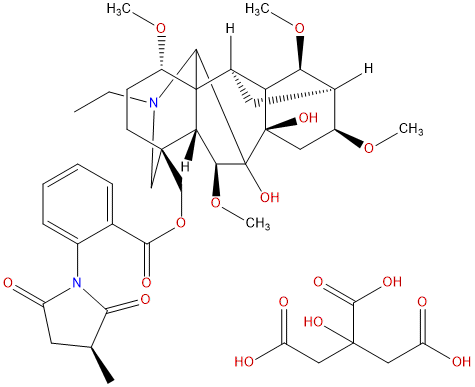
Citrate methyl alkaloid is a complex alkaloid compound with a molecular weight of 682.8110, and its molecular formula reflects its multi ring structure and rich functional groups. The structural core of MLA citrate is methyllyconine, which contains multiple cyclic structures and ester groups in its molecule. The citrate form gives it a certain degree of water solubility and stability. The LogP value of this compound is 2.5348, indicating that it has moderate lipid solubility and is beneficial for penetrating cell membranes and the blood-brain barrier. The topological polar surface area (TPSA) is 144.3 Å ², reflecting the number of polar groups. A higher TPSA value is usually associated with lower passive diffusion ability, but MLA citrate can still effectively penetrate the blood-brain barrier, possibly due to its specific molecular conformation and receptor-mediated transport mechanism.
The water solubility is 0.0580, indicating a low solubility in water, but with the improvement of citrate form, the water solubility has been enhanced. The hERG channel inhibition test result was negative, indicating that the compound has a low risk of cardiac toxicity. The Ames test result is 0.6, indicating that its genetic toxicity risk is relatively low and meets safety requirements. Overall, MLA citrate possesses excellent physicochemical properties, laying the foundation for its pharmacological activity and drug development.
Methyl alkaloid alkaloids are mainly found in Aconitum plants, especially in Aconitum and related species. MLA citrate, as the citrate form of methyl bovine, is usually prepared by further purification after plant extraction. The traditional extraction methods include alcohol extraction, acid-base separation, and column chromatography purification.
The specific extraction process is generally as follows: first, ethanol or methanol is used to reflux extract the dried plant materials. After concentration, the extract is adjusted to pH with an acidic aqueous solution to promote the formation of alkaloid salts. Subsequently, non-polar impurities were removed by liquid-liquid extraction, and the target compound was separated and purified by column chromatography (such as silica gel column, C18 reverse phase column). Finally, MLA citrate was obtained by improving its water solubility and stability through citrate reaction. Modern technologies such as high-performance liquid chromatography (HPLC) and mass spectrometry (MS) are widely used for the identification and purity detection of extracts.
In recent years, with the development of synthetic methods, the total synthesis route of MLA citrate has gradually been reported, providing the possibility for its large-scale preparation and structural modification, and promoting its application in pharmacological research.
MLA citrate, as a high affinity competitive antagonist of α 7nAChR, mainly exhibits pharmacological activity by selectively blocking this receptor. α 7nAChR is a highly permeable calcium ion channel that mediates rapid neurotransmitter transmission and neural regulation. MLA citrate inhibits receptor activation and regulates neuronal excitability and downstream signaling pathways by occupying the binding sites of receptors, blocking the binding of acetylcholine or other agonists.
This effect makes MLA citrate an important tool for studying the function of α 7nAChR, especially in models of neuroinflammation, cognitive impairment, and neurodegenerative diseases. Related studies have shown that MLA citrate can significantly alleviate A β - induced SH-SY5Y neuronal toxicity, suggesting its potential intervention role in the pathological mechanism of Alzheimer's disease.
MLA citrate exhibits the ability to protect neurons in animal models. For example, in the methamphetamine induced mouse striatal injury model, MLA citrate pretreatment significantly reduced neurotoxicity and improved neurological function. This effect may be related to its regulation of neuroinflammation and excitotoxicity mediated by α 7nAChR.
In addition, MLA citrate has been reported to have a regulatory effect on neuroinflammatory responses, which may alleviate chronic inflammation of the nervous system by inhibiting the activation of microglia and the release of inflammatory factors.
Although MLA citrate mainly targets α 7nAChR, its role in analgesic mechanisms has also attracted attention. Pain related targets include TRPV1, CNR1, OPRD1, PTGS1, TRPA1, PTGS2, SLC6A4, OPRM1, OPRK1, and DRD2. MLA citrate may indirectly affect these pathways and exert analgesic effects by regulating neurotransmitter release and receptor activity. Related research is exploring its potential applications in chronic pain and neuropathic pain.
The main mechanism of action of MLA citrate is based on its competitive antagonism against α 7nAChR. α 7nAChR is a ligand gated ion channel widely distributed in neurons and immune cells, regulating calcium influx and intracellular signaling. The activation of this receptor is involved in the regulation of neuroprotection, cognitive function, and inflammatory response.
MLA citrate binds to the acetylcholine binding site of α 7nAChR, blocking receptor activation and inhibiting calcium influx, thereby regulating downstream signaling pathways such as PI3K/Akt, MAPK, and NF - κ B pathways. This regulation helps alleviate neuroinflammation, inhibit cell apoptosis, and reduce oxidative stress.
In addition, MLA citrate regulates the interaction between neurons and glial cells, affecting the release of inflammatory mediators and neuronal excitability. Its indirect regulation of pain related receptors and channels also provides a molecular basis for its analgesic effect.
From the perspective of drug development, MLA citrate has multiple advantages. Although its molecular weight is 682.8, its moderate lipophilicity (LogP 2.53) and high polarity (TPSA 144.3) make it perform well in blood-brain barrier penetration, making it suitable for central nervous system drug development. Although its water solubility is low, the citrate form improves its solubility and bioavailability.
In terms of safety, MLA citrate does not inhibit hERG channels, reducing the risk of cardiac toxicity. The Ames test results show that its genetic toxicity risk is low and meets the drug safety requirements. Pharmacokinetic data is still limited, but previous studies have shown that it can achieve effective brain tissue concentrations after oral and injection administration, with a moderate half-life and suitable for further development.
Further systematic evaluation of its metabolic pathways, in vivo distribution, and excretion characteristics is needed in the future to optimize dosing regimens and formulation design.
MLA citrate, as a selective antagonist of α 7nAChR, has broad application prospects in neurological diseases. Alzheimer's disease, as a typical disease with abnormal α 7nAChR function, may delay cognitive decline by reducing A β - induced neurotoxicity through MLA citrate. In addition, its regulatory effects on neuroinflammation and neurotoxicity provide new ideas for the treatment of diseases such as Parkinson's disease, schizophrenia, and drug dependence.
In the field of analgesia, MLA citrate may become a novel drug candidate for the treatment of chronic pain and neuropathic pain through multi-target regulation. Its good safety and central penetration make it have good clinical translational potential.
Future research should focus on preclinical pharmacological and toxicological evaluation, dosage form optimization, and clinical trial design of MLA citrate, exploring its specific efficacy and safety in neurodegenerative diseases, psychiatric disorders, and pain management, and promoting it as an effective drug for clinical application.
Citrate methyl bovine, as a structurally unique and functionally significant natural product, has shown great potential in basic research and drug development of neurological diseases due to its highly selective antagonistic effect on α 7nAChR. Its multiple pharmacological activities such as neuroprotection, anti-inflammatory, and analgesic provide new targets and strategies for the treatment of Alzheimer's disease and related neurological disorders. Although research on its pharmacokinetics and clinical applications is still in its infancy, with the deepening of synthetic technology and pharmacological research, MLA citrate is expected to become an important drug molecule in the field of neuropharmacology in the future. Continuous systematic research will lay a solid foundation for its clinical translation and promote the development and innovation of natural product pharmacology.
