Introduction/Overview
Natural products have always been an important source of innovative drug discovery, among which medicinal plants have contributed many lead compounds with novel structures and diverse activities. Paeonia lactiflora(Paeonia lactiflora Pall., as the original plant of traditional Chinese medicine "Radix Paeoniae Alba" and "Radix Paeoniae Rubra", has a long history of clinical application and is commonly used to treat rheumatoid arthritis, inflammation, pain, menstrual disorders, and liver disease. Its pharmacological activity is mainly attributed to a series of monoterpenoid glycosides, namely paeoniflorin and its derivatives. Benzoylalbiflorin (CAS: 184103-78-4) is one of the important benzoylated monoterpenoid glycosides, which has attracted much attention in recent years due to its significant activity in neuroprotection and other fields. This article aims to systematically review the chemical structure, plant origin, pharmacological activity, mechanism of action, pharmacological evaluation, and clinical application prospects of benzoyl paeoniflorin, in order to provide comprehensive scientific references for the in-depth research and development of this compound.
Chemical structure and physicochemical properties
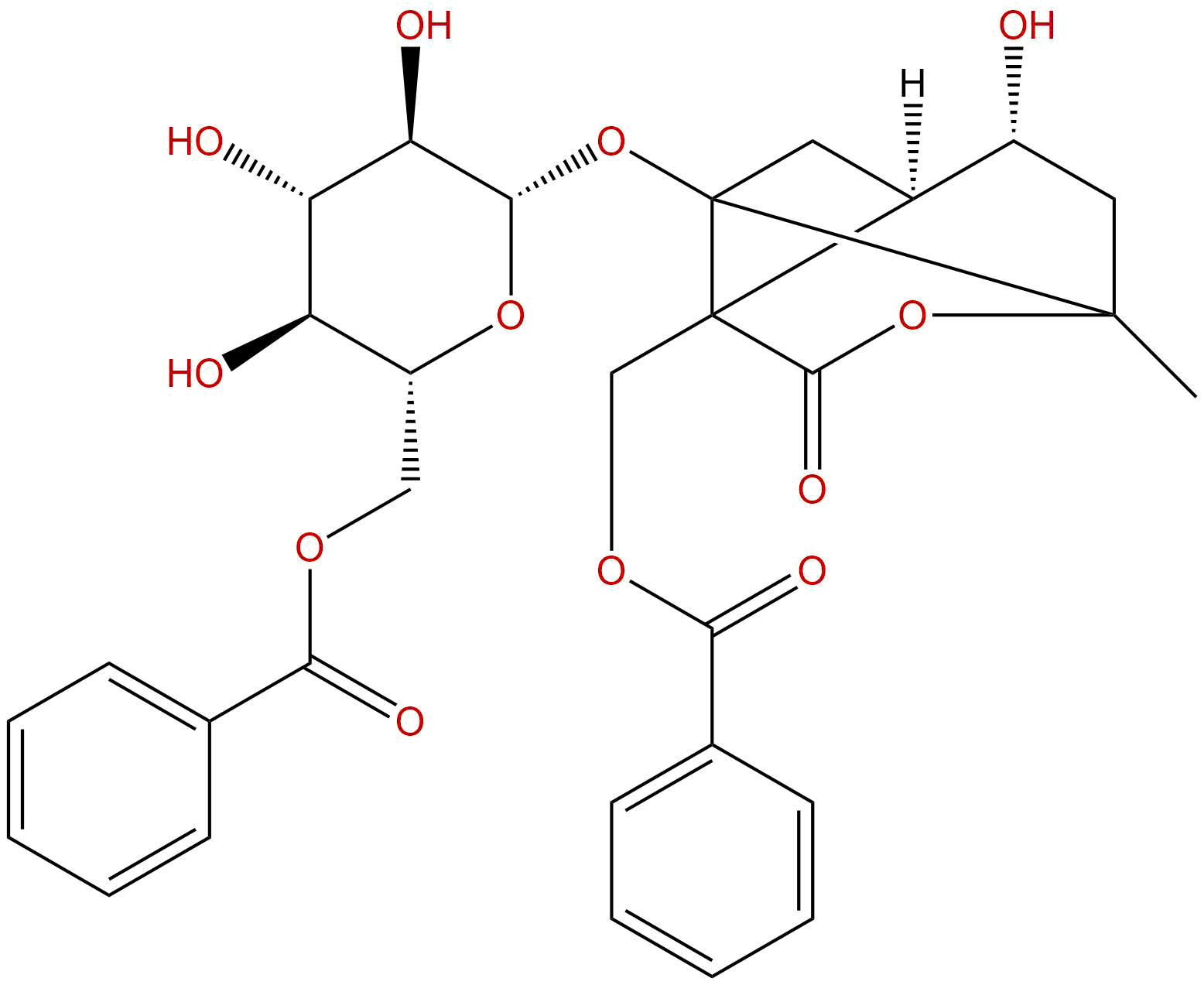
Benzoyl paeoniflorin is a monoterpenoid glycoside compound, and its chemical structure can be described as a benzoyl derivative of albiflorin. Its molecular formula is C30H32O12 and its molecular weight is 584.5740. Structurally, it consists of a unique "cage like" pinane type monoterpene skeleton (paeoniflorin glycoside) connected to a molecule of glucose through glycosidic bonds, and the hydroxyl group on the sugar group is esterified by benzoyl. The introduction of this benzoyl group significantly altered its physicochemical properties and biological activity.
According to calculations and experimental data, its lipid water partition coefficient (LogP) is approximately 1.4937, indicating that it has a certain degree of lipophilicity, but not highly hydrophobic. Its topological polar surface area (TPSA) is as high as 178.2800 Å ², mainly attributed to the numerous oxygen atoms (from sugar, ester, and hydroxyl groups) in the molecule, indicating its strong ability to form hydrogen bonds. The water solubility data (approximately 0.0609 mg/mL) shows that its solubility in water is low, which is consistent with its larger molecular weight and partially hydrophobic structure. These basic physicochemical parameters are the basis for understanding its absorption, distribution, and bioavailability in the body.
Plant sources and extraction methods
Benzoyl paeoniflorin is mainly derived from plants of the Paeonia genus, especially Paeonia(Paeonia lactiflora)The root, which is the main medicinal part of traditional Chinese medicine Paeonia lactiflora and Paeonia lactiflora. It usually coexists with other monoterpenoid glycosides such as paeoniflorin, oxidized paeoniflorin, and galloyl paeoniflorin in plants, but the content is relatively low.
The extraction and separation method follows the conventional process of natural product chemistry. Firstly, the dried peony root powder is subjected to reflux or ultrasonic extraction using alcohol solvents (such as methanol, ethanol) or alcohol water mixed solvents. After vacuum concentration, the crude extract obtained was subjected to liquid-liquid distribution extraction using organic solvents such as petroleum ether, ethyl acetate, and n-butanol. Benzoyl paeoniflorin was mainly enriched in the n-butanol fraction. Further purification relies on various chromatographic techniques, including macroporous adsorption resin column chromatography (such as D101, AB-8), silica gel column chromatography, reverse phase silica gel column chromatography (such as ODS, C18), and high performance liquid chromatography (HPLC). Modern analytical techniques such as liquid chromatography-mass spectrometry (LC-MS) and nuclear magnetic resonance (NMR) are used for online monitoring, structural identification, and content determination. Optimizing the extraction process (such as solvent ratio, temperature, time) and adopting new separation technologies such as high-speed countercurrent chromatography are key research directions to improve its yield and purity.
Pharmacological activity research
Numerous in vitro and in vivo pharmacological studies have shown that benzoyl paeoniflorin has multiple biological activities, among which the most prominent is its neuroprotective effect.
1. Neuroprotective effect:
This is the most in-depth field of research on benzoyl paeoniflorin. It exhibits significant protective effects in various neural injury models. In Alzheimer's disease (AD) related models, benzoyl paeoniflorin can improve neuronal cell damage and apoptosis induced by β - amyloid (A β) or oxidative stress. In Parkinson's disease (PD) models, it can alleviate the damage of neurotoxins (such as MPP+, 6-OHDA) to dopaminergic neurons. In addition, in models of cerebral ischemia/reperfusion injury, glutamate excitotoxicity, and chronic stress-induced neurodegeneration, this compound has also shown effects in improving learning and memory impairment, reducing cerebral infarction area, and inhibiting neuronal loss.
2. Anti inflammatory and immune regulatory effects:
Originating from the traditional use of the medicinal herb Paeonia lactiflora, benzoyl paeoniflorin also has anti-inflammatory activity. Research has shown that it can inhibit the excessive production of inflammatory mediators (such as nitric oxide, prostaglandin E2, tumor necrosis factor - α, interleukin-6, etc.) in macrophages induced by stimuli such as lipopolysaccharides (LPS). Its anti-inflammatory effect is closely related to regulating the inflammatory signaling pathway.
3. Antidepressant and anti anxiety effects:
Some studies suggest that total paeoniflorin and its monomeric components may exert antidepressant and anti anxiety effects by regulating the monoamine neurotransmitter system and hypothalamic pituitary adrenal (HPA) axis function. Benzoyl paeoniflorin, as one of its members, may contribute to this, but its specific role and status need to be further clarified.
4. Other activities:
There are also studies reporting its potential activities such as pain relief and liver protection, which are consistent with the overall pharmacological spectrum of Paeonia lactiflora. However, research on the monomers of benzoyl paeoniflorin is not yet sufficient.
Mechanism of action and molecular targets
The neuroprotective effect of benzoyl paeoniflorin involves synergistic regulation of multiple targets and pathways, and its main mechanism of action and molecular targets can be summarized as follows:
1. Inhibit cell apoptosis:
This compound can upregulate the expression of anti apoptotic protein Bcl-2, while downregulating the expression of pro apoptotic protein Bax, and inhibit the activation of Caspase-3, thereby suppressing neuronal apoptosis through the mitochondrial pathway.
2. Reduce oxidative stress:
Benzoyl paeoniflorin can activate the key transcription factor NRF2 (nuclear factor E2 related factor 2) in the cellular defense system. Activated NRF2 is transferred into the nucleus, initiating gene expression driven by downstream antioxidant response elements (ARE) such as heme oxygenase-1 (HO-1) and quinone oxidoreductase 1 (NQO1), thereby enhancing the cell's antioxidant capacity and clearing excess reactive oxygen species (ROS).
3. Combat the pathological process of AD:
For Alzheimer's disease, this compound may reduce the production of A β by inhibiting the activity of β - secretase 1 (BACE1). Meanwhile, it may regulate the metabolism of amyloid precursor protein (APP) and inhibit the excessive phosphorylation of Tau protein (encoded by MAPT gene), which is the main component of neurofibrillary tangles.
4. Regulating signal pathways:
It can regulate key cellular signaling pathways. For example, inhibiting the MAPK signaling pathways that promote inflammation and apoptosis (such as p38 MAPK, JNK, and abnormal activation of ERK/MAPK1 in certain contexts). At the same time, it may activate SIRT1 (deacetylase Sirtuin 1), which is involved in energy metabolism, stress resistance, and neuroprotection. Its activation helps improve mitochondrial function and inhibit inflammation.
5. Affects other targets:
The study also suggests that it may have a mild inhibitory effect on acetylcholinesterase (ACHE), which helps to increase the level of acetylcholine in synaptic cleft; And it has a potential inhibitory effect on the abnormal aggregation of alpha synuclein (SNCA), which is related to the pathology of Parkinson's disease.
In summary, benzoyl paeoniflorin forms a complex neuroprotective network by acting on a series of targets such as BCL2, CASP3, NRF2, BACE1, APP, MAPT, MAPK1, SIRT1, ACHE, SNCA, etc.
Evaluation of drug properties and pharmacokinetics
The drug like evaluation based on calculations and preliminary experimental data shows that benzoyl paeoniflorin meets most of the requirements of Lipinski's Rule of Five (hydrogen bond donor<5, hydrogen bond acceptor<10, slightly beyond the boundary of molecular weight<500, LogP<5), indicating its basic potential as an oral drug. The key safety warning indicator shows that the hERG channel inhibition risk is "no", indicating a low potential risk of cardiac toxicity; The Ames test result is 0.0, indicating no mutagenicity in this testing system and preliminary good safety.
However, its pharmacokinetic properties may face challenges. Higher TPSA and molecular weight may affect its transmembrane permeability. The calculation predicts that its blood-brain barrier (BBB) permeability is "low", which is a major obstacle for the treatment of central nervous system diseases and requires various strategies such as structural modification, formulation technology, and the use of drug delivery systems to improve. Its lower water solubility may also limit oral absorption. At present, there is limited publicly available data on the in vivo pharmacokinetics of the benzoyl paeoniflorin system, including absorption, distribution, metabolism, and excretion. It is known that paeoniflorin compounds are easily hydrolyzed and converted by intestinal microbiota and liver metabolic enzymes in vivo, and their bioavailability is usually not high. Therefore, in the future, it is necessary to conduct in-depth ADME research, clarify the pharmacokinetic characteristics of its prototype drug and main metabolites, and provide a basis for dosage form design and administration scheme optimization.
Clinical application prospects and prospects
Benzoyl paeoniflorin has shown broad clinical application prospects, especially in the field of neurodegenerative diseases.
1. Treatment of neurodegenerative diseases: Its multi-target neuroprotective mechanism makes it potentially valuable in the prevention and treatment of diseases such as Alzheimer's disease, Parkinson's disease, vascular dementia, and post-stroke nerve repair. It may act as a disease modifier, delaying the pathological process rather than just relieving symptoms.
2. Anti inflammatory adjuvant therapy: In diseases closely related to inflammation such as rheumatoid arthritis and neuroinflammation, it can be developed as an adjuvant anti-inflammatory drug.
3. Modernization of Traditional Chinese Medicine and Quality Markers: As one of the characteristic components of Paeonia lactiflora, the quantitative analysis of benzoyl paeoniflorin can be used to improve the quality control standards of Paeonia lactiflora medicinal materials and their preparations (such as Paeoniae Glycyrrhiza Decoction, Xiaoyao Powder, etc.), becoming a potential quality marker (Q-Marker) to ensure the stability and reproducibility of drug efficacy.
Despite its promising prospects, its clinical application still faces many challenges and future research directions
- Improve bioavailability and BBB penetration: This is the primary challenge. It is necessary to study its prodrug strategy, nano drug delivery system (such as liposomes, polymer nanoparticles), or combination with penetration enhancers.
- In depth mechanism research: It is necessary to use technologies such as gene knockout/knock in animals, molecular docking, and chemical biology probes to more accurately elucidate their direct targets and upstream and downstream signaling networks.
- Conduct systematic preclinical evaluation: Long term pharmacological and safety evaluations need to be conducted in animal models that are closer to human diseases, such as transgenic AD mice, and standardized preclinical toxicology studies need to be completed.
- Exploring combination therapy: Consider combining with neuroprotective agents or existing drugs with other mechanisms of action in order to generate synergistic effects and reduce their respective dosages and side effects.
Conclusion
Benzoyl paeoniflorin glycoside is an active monoterpene glycoside isolated from traditional Chinese medicine Paeonia lactiflora. Its unique benzoyl structure endows it with significant neuroprotective and other pharmacological activities. Research has shown that it acts on a complex target network by regulating multiple pathways such as apoptosis, oxidative stress, inflammation, and abnormal protein metabolism, demonstrating enormous potential for treating neurodegenerative diseases. Although there are challenges in drug development, particularly in blood-brain barrier permeability and bioavailability, they are expected to be overcome through modern medicinal chemistry and pharmaceutical methods. In the future, with the in-depth study of its pharmacological mechanism, pharmacokinetics, and toxicology, benzoyl paeoniflorin is expected to be developed into an innovative neuroprotective drug derived from traditional Chinese medicine, or as one of the core material bases for the treatment of modern diseases with traditional Chinese medicine formulas, providing an important example for the translational medicine research of natural products.