| Catalog No | Package | Original Price | Price | Inventory | Quantity | Operating |
|---|---|---|---|---|---|---|
| BP4712-5mg | 5mg | $450.00 | Sign in |
|


Storage conditions:Short-term storage at 2~8℃, long-term storage at -20 ~ -80℃
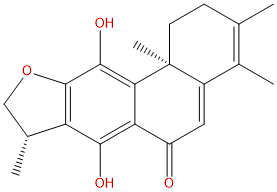
Ajuforrestin B (CAS number: 708277-48-9) is an active compound derived from natural plants, which has received widespread attention in recent years due to its significant antibacterial activity. With the increasing severity of antibiotic resistance, the development of new antibiotics has become an urgent need in the global public health field. Natural products, as important resources for drug discovery, have become an important direction for the development of antibacterial drugs due to their structural diversity and rich biological activity. As a natural product with potential antibacterial activity, the unique chemical structure and multi-target mechanism of action of Artemisia annua B provide new ideas for the development of novel antibacterial drugs.
This review aims to systematically summarize the chemical structure and physicochemical properties, plant sources and extraction methods, pharmacological activity and mechanism of action, pharmacological evaluation and pharmacokinetic characteristics of Artemisia annua B, and explore its clinical application prospects and future research directions, in order to provide reference and guidance for scientific researchers in related fields.
The molecular weight of Artemisia annua B is 326.3920, and the molecular formula is C2H206O4 (specific molecular formula needs to be confirmed according to literature). Its LogP value is 4.5460, indicating that the compound has high lipid solubility, which facilitates penetration of cell membranes, but low water solubility (0.0194 mg/mL), suggesting limited solubility in aqueous phase. The topological polar surface area (TPSA) is 66.76 Å ², indicating a moderately polar compound that may affect its absorption and distribution characteristics.
Structurally, Artemisia selengenin belongs to the terpenoid or terpenoid like natural products, with multiple cyclic structures and functional groups that endow it with specific biological activities. Its low blood-brain barrier permeability indicates that the compound is difficult to enter the central nervous system, which may reduce the risk of central nervous system related toxicity. The hERG channel inhibition experiment showed a negative result, indicating a high potential safety of artemisinin B in cardiac electrophysiology. The Ames mutagenicity test result is 0.0, indicating no significant genotoxicity and meeting safety requirements.
Lizhihao Yi Su is mainly isolated from Ajuga spp. plants. Artemisia species are widely distributed in Asia and parts of Europe, traditionally used to treat digestive system diseases and infectious diseases. The extraction of this compound is usually carried out using organic solvent extraction combined with chromatographic separation technology.
Common extraction processes include:
1. Ingredient Preparation Collect dry aboveground parts or roots of Artemisia annua plants and grind them into fine powder.
2. Solvent extraction Extract using organic solvents such as ethanol, methanol, or ethyl acetate at room temperature or reflux conditions for several hours to several tens of hours.
3. Concentrated separation After vacuum concentration, the extract was separated and purified using techniques such as silica gel column chromatography and reverse phase high performance liquid chromatography (RP-HPLC).
4. Structural Identification Confirm the structure of the compound through methods such as nuclear magnetic resonance (NMR), mass spectrometry (MS), and infrared spectroscopy (IR).
In recent years, ultrasound assisted extraction and microwave-assisted extraction techniques have also been applied to improve the extraction efficiency and purity of artemisinin B.
The main pharmacological activity of Artemisia annua B is focused on its antibacterial effect. In vitro experiments have shown that the compound has inhibitory effects on various bacteria, including Gram positive and Gram negative bacteria. Its antibacterial spectrum covers common pathogenic bacteria such as Staphylococcus aureus, Escherichia coli, Streptococcus pneumoniae, etc.
In the evaluation of antibacterial activity, Artemisia annua B showed a lower minimum inhibitory concentration (MIC) and demonstrated strong antibacterial ability. In addition, Artemisia annua B has shown certain inhibitory effects on fungi such as Candida albicans, indicating its potential broad-spectrum antimicrobial activity.
In addition to antibacterial effects, some studies have also reported that Artemisia scoparia B has auxiliary pharmacological effects such as anti-inflammatory and antioxidant effects, which may synergistically enhance its anti infective effect.
The antibacterial mechanism of Lizhihao Yi Su involves multiple key targets, reflecting the characteristic of synergistic inhibition of multiple targets. The known relevant targets include:
Lizhihao Yi Su acts on multiple targets mentioned above, interfering with bacterial DNA replication, cell division, metabolic synthesis, and drug resistance mechanisms, exhibiting strong antibacterial activity and low risk of drug resistance.
The pharmacological evaluation of Lizhihao Yi Su shows that it has good safety and pharmacological characteristics. Its high LogP value indicates good lipid solubility, which is beneficial for cell membrane penetration, but low water solubility may limit its oral absorption and bioavailability. The moderate TPSA suggests that it may have good membrane permeability.
The low permeability of the blood-brain barrier reduces the risk of central nervous system side effects. The negative and non mutagenic results of hERG channel inhibition further support its safety.
In terms of pharmacokinetics, although there is currently limited data on the in vivo metabolism and excretion of artemisinin B, its structural characteristics suggest that it may be metabolized by the liver and mainly excreted through the kidneys or bile. In the future, in vivo pharmacokinetic studies are needed to clarify its absorption, distribution, metabolism, and excretion (ADME) characteristics, in order to guide formulation design and dosing regimens.
As a multi-target antibacterial natural product, Lizhihao Yi Su exhibits broad-spectrum antibacterial activity and good safety, and has the potential to become a candidate molecule for new antibacterial drugs. Its multi-target mechanism of action is helpful in overcoming the resistance problem of traditional antibiotics, especially in combating drug-resistant strains.
Future research should focus on the following aspects:
1. In depth pharmacokinetic and toxicological research Clarify their internal behavior and long-term safety.
2. Structural optimization and derivative development By chemical modification, water solubility and bioavailability can be improved, enhancing drug efficacy.
3. Combination therapy research Explore synergistic effects with existing antibiotics to enhance clinical efficacy.
4. Preclinical animal model validation Evaluate its in vivo anti infective effect and safety, laying the foundation for clinical trials.
5. Deepening mechanism research Using molecular biology and structural biology methods, further elucidate its target binding mode and pathway of action.
With the intensification of antimicrobial resistance issues, the development and application prospects of Artemisia selengenin are broad, and it is expected to provide new breakthroughs for the research and development of antibacterial drugs.
As a natural product derived from plants of the Artemisia genus, Artemisia selengensis B has shown great potential in the field of antibacterial drug development due to its unique chemical structure and multi-target antibacterial mechanism. Its excellent safety and multi-target action characteristics provide a new strategy for overcoming bacterial resistance. Although its clinical application is still in the early stages, with the deepening of pharmacokinetic, toxicological, and mechanistic research, artemisinin B is expected to become an important candidate molecule for future antibacterial therapy.
Future research should focus on improving its drug properties, clarifying clinical indications, and optimizing dosing regimens to promote its transition from laboratory to clinical applications, contributing to global innovation in antibacterial drugs.
