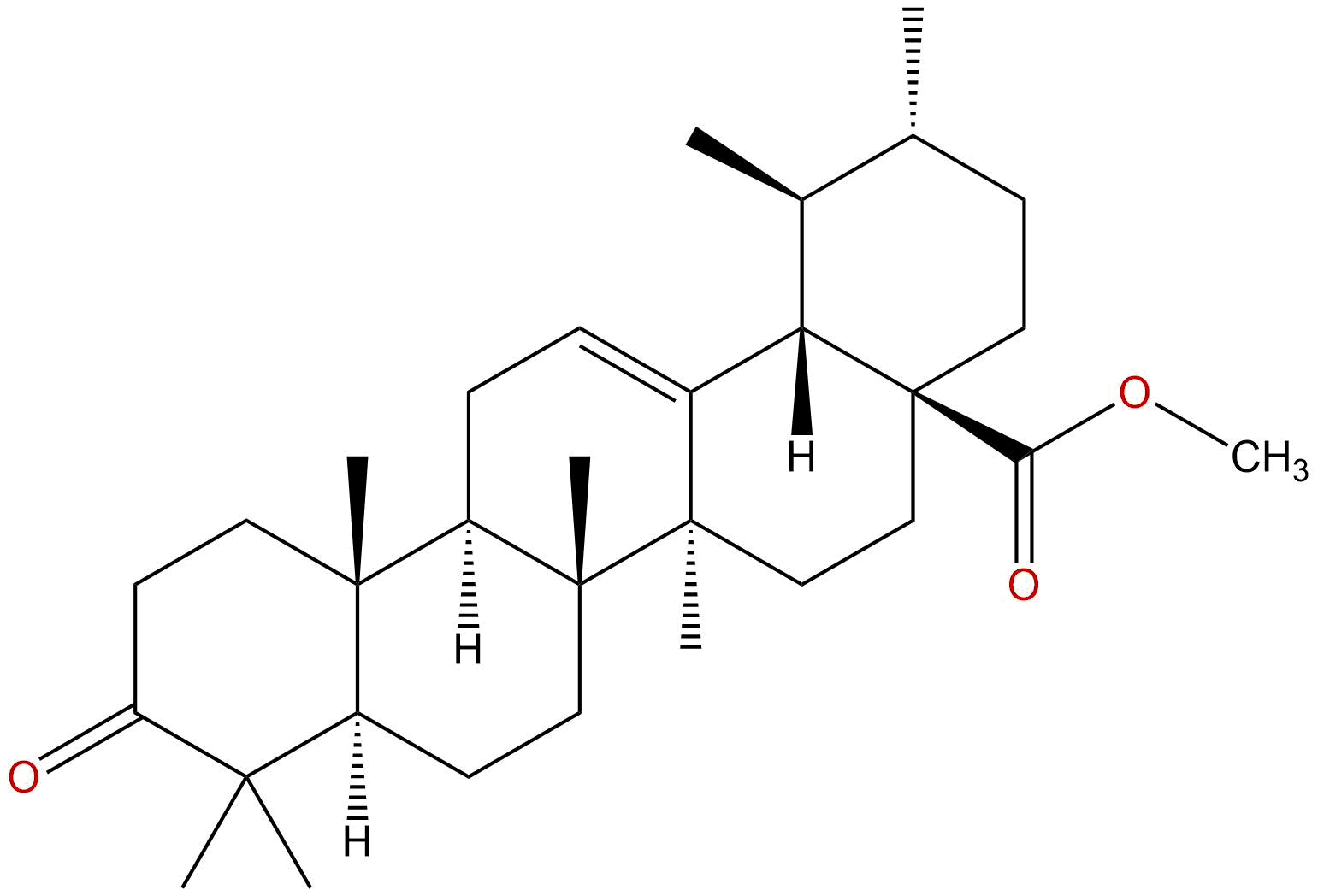


Product name: Ursonic acid methyl ester
Synonym name: Methyl 3-oxoursolate; Methyl ursonate;3-OXO-URS-12-EN-28-OIC ACID METHYL ESTER
Catalogue No.: BP4415
Cas No.: 989-72-0
Formula: C31H48O3
Mol Weight: 468.722
Botanical Source:
Type of Compound:
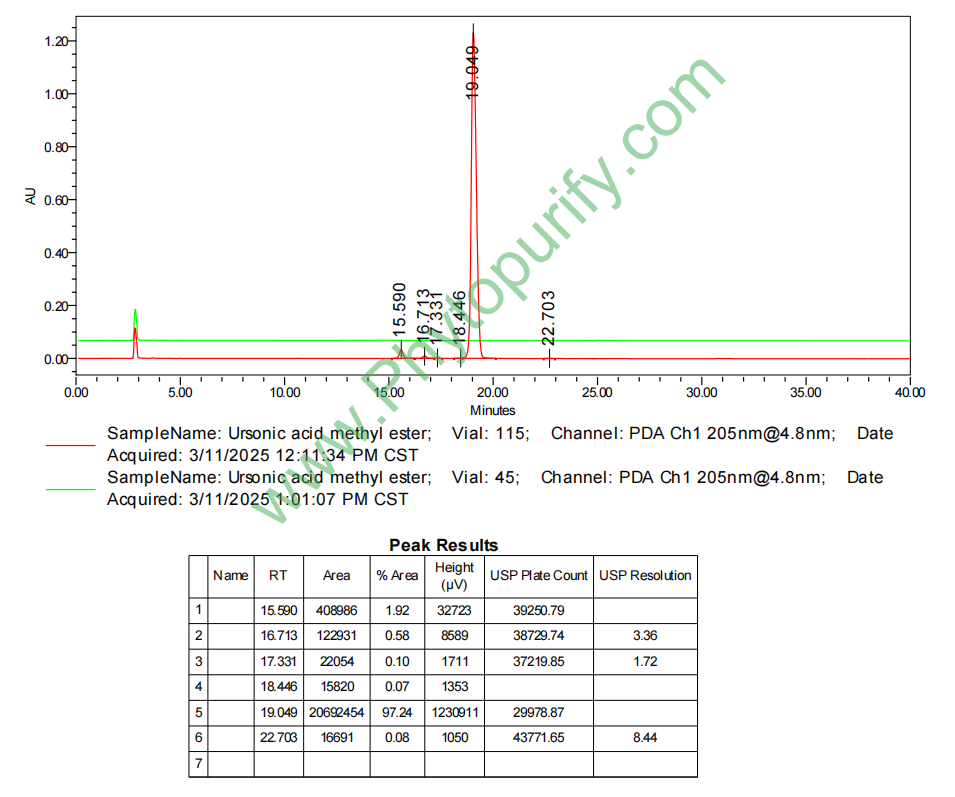
Purity: 95%~99%
Analysis Method: HPLC-DAD or/and HPLC-ELSD
Identification Method: Mass, NMR
Packing: Brown vial or HDPE plastic bottle
Storage: Store in a well closed container, protected from air and light. Put into refrigerate or freeze for long term storage.
Whenever possible, you should prepare and use solutions on the same day. However, if you need to make up stock solutions in advance, we recommend that you store the solution as aliquots in tightly sealed vials at -20℃. Generally, these will be useable for up to two weeks.
The product could be supplied from milligrams to grams
Inquire for bulk scale.
For Reference Standard and R&D, Not for Human Use Directly.
HPLC of Ursonic acid methyl ester
Storage conditions:Short-term storage at 2~8℃, long-term storage at -20 ~ -80℃
43.3700
7.0608
7.0597
.0003
9.1184
18.0078
High
90.9045
4.7228
No
No
No
No
No
No
0.0
No
No
No
No
Natural products have long been an important treasure trove for innovative drug discovery, among which pentacyclic triterpenoids have attracted much attention due to their broad biological activity and relatively low toxicity. Ursolic acid, as an oleane type pentacyclic triterpenoid widely present in various medicinal plants, has been extensively studied and proven to have various pharmacological activities such as anti-inflammatory, hepatoprotective, and anti-tumor effects. However, its poor solubility and bioavailability to some extent limit its potential as a drug. In order to overcome these shortcomings and explore more active lead compounds, researchers have made various structural modifications to ursolic acid. 3-Keto-oursolic acid-28-methyl ester, also known as ursolic acid-3-one-28-methyl ester, is one of the important semi synthetic derivatives. This compound changes its physicochemical properties and biological activity spectrum by oxidizing the hydroxyl group at C-3 position of ursolic acid to carbonyl group and esterifying the carboxyl group at C-28 position to methyl ester. Although preliminary cytotoxicity screening showed that its half maximal inhibitory concentration (ED50) for some tumor cell lines was greater than 100 µ g/ml, indicating weak direct cytotoxicity, modern pharmacological studies have revealed that its anti-tumor potential may be more reflected in mechanisms such as multi-target regulation, induction of cell differentiation and apoptosis, and inhibition of invasion and metastasis. This article aims to provide a systematic review of the chemical properties, sources, pharmacological activities, mechanisms of action, and pharmacological properties of 3-Keto-oursolic acid-28-methyl ester, in order to provide comprehensive scientific references for the in-depth research and development of this compound.
The chemical name of 3-Keto-oursolic acid-28-methyl ester is (4aS, 6aR, 6aS, 6bR, 8aR, 10S, 12aR, 12bR, 14bS) -10-hydroxy-4a, 6a, 6b, 9,9,12a-hexamethyl-13-oxo-1,2,3,44a, 5,6,6a, 6b, 7,8,8a, 9,10,11,11,12,12a, 12b, 13,14b-eicosahedrol-3-carboxylic acid methyl ester, and its CAS number is 989-72-0. Structurally, it retains the classic oleanane type pentacyclic triterpenoid skeleton of ursolic acid, consisting of five fused rings (A-E rings). Compared with the parent ursolic acid, its key structural modification lies in: 1) the β - oriented hydroxyl group at C-3 position is oxidized to a ketone group (C=O); 2) The carboxyl group at position C-28 (- COOH) is esterified to form methyl ester (- COOCH3). These modifications significantly affect the polarity, spatial conformation, and electronic distribution of the molecule.
Its molecular weight is 468.7220 g/mol. The esterification reaction and the introduction of ketone groups significantly enhance its lipophilicity, and the calculated lipid water partition coefficient (LogP) is as high as 7.0608, indicating that the compound has strong lipophilicity. Correspondingly, its theoretical polar surface area (TPSA) is 43.37 Å ², which is relatively small. These physicochemical parameters directly determine its extremely low water solubility, predicted to be around 0.0003 mg/mL, which poses the primary challenge for its formulation development. The high lipid solubility also indicates that it is easy to penetrate cell membranes, but at the same time, it may also lead to its unique distribution in the body, such as predicted high blood-brain barrier permeability. In early safety screening, the compound did not show hERG potassium channel inhibitory activity (hERG inhibition: No), indicating a low potential risk of arrhythmia. Meanwhile, the Ames test result was 0.0, indicating that it has no mutagenicity in this testing system, providing preliminary safety basis for its further development.
3-Keto-oursolic acid-28-methyl ester is not a widely present major component in nature. It is usually present as a trace component in some plants containing ursolic acid, or more commonly, obtained through the chemical semi synthesis of ursolic acid.
Natural plant sources Ursolic acid is widely distributed in various plants of the Oleaceae family (such as Ligustrum lucidum), Lamiaceae family (such as Prunella vulgaris), Rosaceae family (such as hawthorn), Rhododendron family (such as bear fruit leaves), etc. In theory, trace amounts of 3-Keto-28-methyl ursolic acid may be present in the extracts of these plants through their own metabolism or oxidation, esterification, and other reactions during the extraction process. However, separation and identification are difficult and usually not the main way to obtain the compound.
Semi synthetic preparation This is the standard method for obtaining sufficient and high-purity 3-Keto-oursolic acid-28-methyl ester for research. The synthesis route usually starts with a large amount of ursolic acid extracted from plants and is completed in two or one steps:
Although direct cytotoxicity data (ED50>100 µ g/ml) indicate that it is not a potent cytotoxic agent, numerous studies have shown that 3-Keto-oursolic acid-28-methyl ester exhibits significant anti-tumor and other biological activities through multiple non cytotoxic pathways.
Antitumor activity This is the core area of research for this compound. Its activity is not limited to inhibiting proliferation, but is also reflected in multi link interference with tumor progression.
Anti inflammatory and immune regulatory activity As a triterpenoid derivative, it has certain anti-inflammatory potential. Research has shown that it can inhibit the excessive production of nitric oxide, prostaglandin E2, and pro-inflammatory cytokines in macrophages induced by lipopolysaccharides, and its mechanism may be related to the inhibition of inflammatory signaling pathways such as NF - κ B and MAPK.
Other potential activities: Based on the pharmacological spectrum of ursolic acid, its derivatives may also have research value in liver protection, antioxidant, anti diabetes complications and other aspects, but there are relatively few reports on these activities of 3-Keto-ursolic acid-28-methyl ester, which is an expandable direction in the future.
Modern molecular pharmacology studies have revealed that the anti-tumor effect of 3-Keto-oursolic acid-28-methyl ester is not achieved through a single target, but rather through a complex signaling network, with key molecular targets including:
Apoptosis regulatory targets:
Proliferation and survival signaling pathway:
Invasion and metastasis related targets:
DNA metabolism related targets:
cell cycle regulation By affecting the expression of cyclins, CDKs, and other cyclic proteins, the cell cycle is arrested in the G0/G1 or G2/M phase.
This multi-target action characteristic makes 3-Keto-oursolic acid-28-methyl ester promising in overcoming the disadvantage of single target drug resistance, but it also makes its mechanism of action network more complex and requires further clarification through systems biology methods.
Based on its physicochemical properties and preliminary biological data, a preliminary evaluation of the pharmacological properties of 3-Keto-oursolic acid-28-methyl ester is conducted
Advantage:
Main challenges:
Prospects of Pharmacokinetic Research Currently, there is a significant lack of publicly available pharmacokinetic data for systems such as absorption, distribution, metabolism, and excretion. Future research requires the use of technologies such as liquid chromatography-mass spectrometry to measure the blood drug concentration time curve after administration in animal models such as mice and rats, calculate key pharmacokinetic parameters (such as Cmax, Tmax, AUC, t1/2, Vd, CL), and investigate their distribution in major tissues (such as liver, kidney, lung, and tumor). At the same time, it is necessary to use liver microsomes, recombinant CYP enzymes and other systems to study their in vitro metabolic characteristics, identify the main metabolic enzymes and metabolites.
Formulation strategy To improve its water solubility and bioavailability, advanced drug delivery technologies such as nanocrystals, liposomes, micelles, solid dispersions, cyclodextrin inclusion complexes, etc. can be considered. These technologies can effectively increase its solubility and dissolution rate, improve oral absorption efficiency, or achieve intravenous administration.
As a natural product derivative with a unique chemical structure and multi-target mechanism of action, the clinical application prospects and future research directions of 3-Keto-oursolic acid-28-methyl ester mainly focus on the following aspects:
As a candidate for anti-tumor adjuvant therapy or combination therapy Given its weak direct cytotoxicity but strong ability to regulate signaling pathways, it may not be suitable as a first-line cytotoxic drug, but it has great potential as an adjuvant therapy drug. For example, when used in combination with conventional chemotherapy drugs (such as topoisomerase inhibitors, microtubule inhibitors) or targeted drugs, it may produce synergistic effects, reduce chemotherapy dosage, minimize toxic side effects, and reverse drug resistance. Its anti metastatic and anti angiogenic properties also make it valuable in inhibiting tumor recurrence and metastasis.
Targeting specific tumor subtypes Its potential effects on estrogen receptor and aromatase suggest that it is worth further studying in the treatment of hormone dependent breast cancer. Similarly, in tumor types with abnormal activation of STAT3 or MAPK signaling pathways, it may exhibit better therapeutic efficacy.
Research on Structural Optimization and Structure Performance Relationship The current bottleneck in the pharmacological properties of compounds is clear. In the future, further structural modifications can be made through rational drug chemistry design. For example, introducing polar groups at other positions of the parent nucleus to balance LogP and improve water solubility; Replace methyl ester with other more stable or prodrug like ester groups; Explore the modification of C-3 ketone groups, etc. Systematically studying its structure-activity relationship is expected to discover a new generation of derivatives with better activity and drug properties.
In depth mechanism of action and systemic pharmacology research Using proteomics, transcriptomics, metabolomics, and network pharmacology methods, comprehensively and systematically depict its functional network in cells and animals, discover new key targets and biomarkers, and provide a basis for precision medicine.
Expand into new therapeutic fields Based on the extensive activity of ursolic acid and triterpenoids, exploring the potential therapeutic effects of this compound in non tumor diseases such as fibrosis, metabolic diseases, and neuroinflammatory related diseases may open up new research directions.
3-Keto-oursolic acid-28-methyl ester, as an important structural modification product of ursolic acid, has research value in that it provides an example of changing the physical, chemical, and biological properties of natural products through rational chemical modification. Although facing the classic challenges of poor water solubility and low bioavailability, its unique multi-target anti-tumor mechanism and good preliminary safety characteristics make it a promising lead compound. Future research should focus on overcoming its delivery challenges through pharmaceutical methods, elucidating its complex network of action through systems pharmacology, and optimizing its structure through rational drug chemistry design. With the deepening of these studies, 3-Keto-oursolic acid-28-methyl ester is expected to provide important scientific basis and candidate molecules for the development of novel multi-target anti-tumor drugs, especially for combination therapy and metastasis inhibition.
