Introduction/Overview
Natural products have always been an important treasure trove for innovative drug discovery, among which flavonoids have attracted much attention due to their wide range of biological activities. Wushanicaritin, as a unique isopentenyl flavonoid, has gradually entered the field of pharmacology researchers in recent years. This compound mainly comes from traditional kidney tonifying and yang strengthening Chinese medicine plants of the Epimedium genus, especially Epimedium wushanense. Early research focused on its antioxidant activity, such as showing significant efficacy in DPPH radical scavenging experiments (IC50=35.3 μ M). With the deepening of research, its pharmacological activities such as anti-tumor and anti-inflammatory have been successively revealed, especially showing potential application value in the field of male reproductive health. Male infertility is a complex global health issue that involves multiple aspects such as hormone regulation, spermatogenesis, oxidative stress, and inflammatory response. Wushan icariin has been found to have potential interactions with multiple key targets closely related to sex hormone synthesis, metabolism, and spermatogenesis, such as CYP19A1, AR, SRD5A2, FSHR, LHB, STAR, providing scientific clues for its transition from traditional medicinal experience to modern precision therapy. This article aims to systematically review the chemical properties, plant sources, pharmacological activities, mechanisms of action, and medicinal properties of Epimedium from Wushan, and to explore its clinical application prospects in related diseases, especially in the treatment of male infertility.
Chemical structure and physicochemical properties
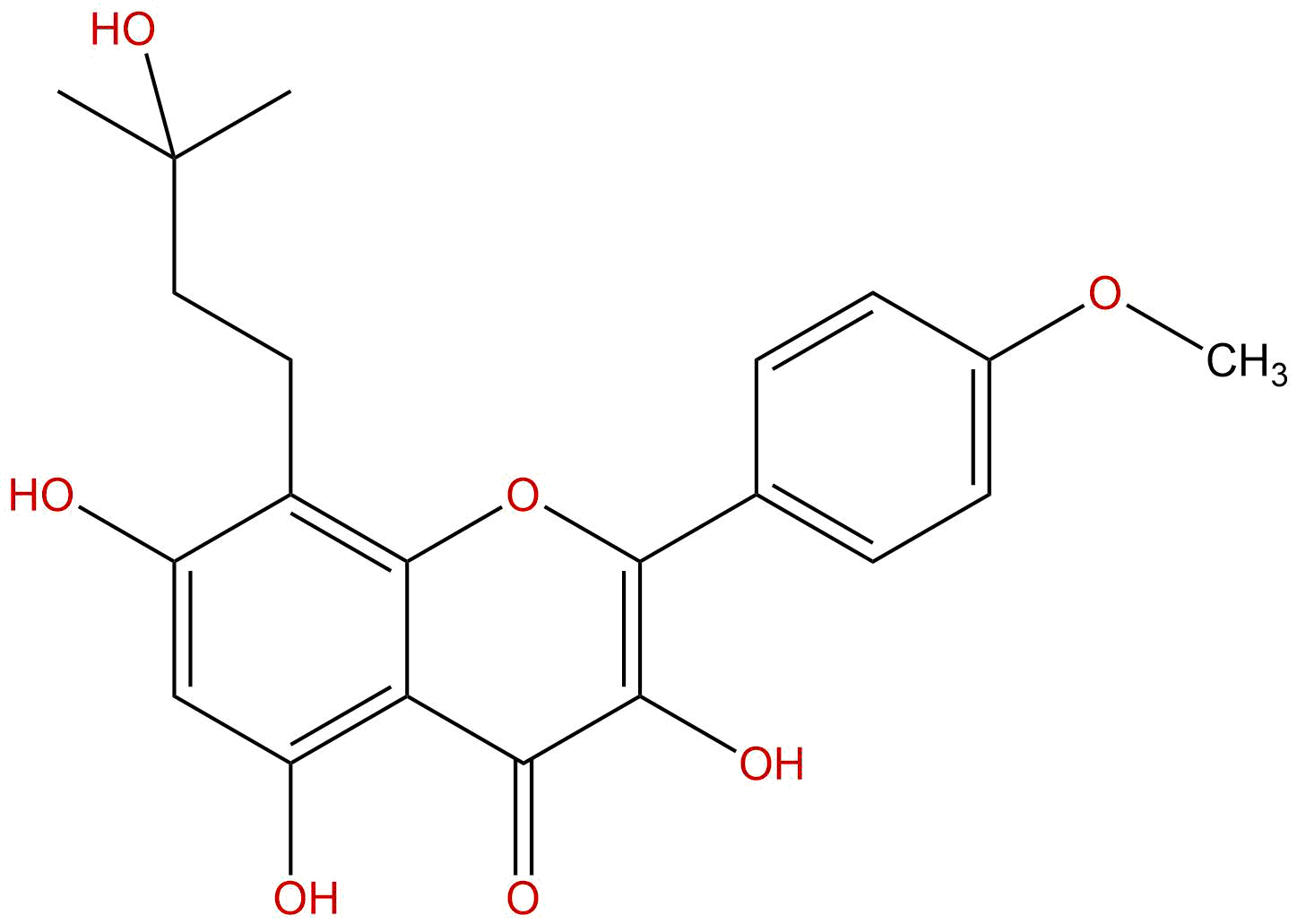
Wushan Epimedium, chemical name 5,7-dihydroxy-4 '- methoxy-8-isoprenyl flavonoid, CAS number 521-45-9. Its molecular formula is C21H22O7 and its molecular weight is 386.4000. Structurally, it has a typical flavonoid core structure and is connected to an isopentenyl group (- C5H9) at position 8 of the A ring, with a methoxy group at position 4 'of the B ring. This modification of isopentenyl groups is a key characteristic that distinguishes it from many common flavonoid compounds, typically associated with enhanced lipid solubility and unique biological activity.
Its physical and chemical properties determine its bioavailability and functional characteristics. The calculated lipid water partition coefficient (LogP) is 2.9645, indicating that the compound has moderate lipophilic properties, which facilitate its penetration of cell membranes but may also affect its water solubility. Its topological polar surface area (TPSA) is 120.3600 Å ², reflecting the contribution of polar groups (such as hydroxyl groups) in the molecule. The experimental or predicted water solubility values are relatively low (about 0.1006 mg/mL), indicating that strategies such as salt formation, micronization, or the use of solubilizers may be needed in formulation development to improve its solubility. Preliminary pharmacological evaluation shows that its ability to penetrate the blood-brain barrier is relatively low, which to some extent limits its direct effects on central nervous system diseases, but may also reduce related side effects. In early safety screening, the hERG channel inhibition risk was negative, indicating a low potential risk of arrhythmia; The Ames test result is 0.6 (usually considered negative if it is less than 2), which suggests that its mutagenic risk may be low, but further genetic toxicity research is still needed to confirm.
Plant sources and extraction methods
Wushan Epimedium mainly comes from plants of the Epimedium genus in the Berberidaceae family, among which Epimedium wushanense is more abundant. It is also distributed in other Epimedium varieties such as E. koreanum and E. pubescens. Epimedium plants are known in traditional Chinese medicine theory for their effects of tonifying kidney yang, strengthening muscles and bones, and dispelling wind and dampness. They are commonly used to treat conditions such as erectile dysfunction, nocturnal emissions, and weak muscles and bones. This provides a traditional medical basis for the modern pharmacological research of Epimedium extract from Wushan.
The extraction of icariin from plant materials is often carried out using organic solvent extraction method. Methanol or ethanol (such as 70% -95% concentration) has become a commonly used solvent due to its good solubility in flavonoids. The extraction methods include hot reflux extraction, ultrasound assisted extraction, and microwave-assisted extraction, the latter of which can effectively shorten the extraction time and improve the extraction efficiency. After filtration and concentration, the crude extract needs to be further separated and purified to obtain high-purity monomeric compounds. The conventional purification strategy includes initial enrichment using macroporous adsorption resin (such as AB-8, D101 type) column chromatography, followed by fine separation using silica gel column chromatography, polyamide column chromatography, and high-performance liquid chromatography (HPLC) or preparative thin layer chromatography (PTLC). Modern technologies such as high-speed countercurrent chromatography (HSCCC) are increasingly being used for the preparation and separation of isopentenyl flavonoids due to their advantages of not requiring solid carriers and high recovery rates. The optimization of extraction and purification processes is crucial for ensuring the stability of compound supply and conducting in-depth pharmacological and clinical research.
Pharmacological activity research
A large number of in vitro and in vivo studies have revealed various pharmacological activities of Wushan icariin, laying the foundation for its potential therapeutic applications.
-
antioxidant activity This is one of the earlier confirmed activities of Wushan Epimedium extract. Its DPPH radical scavenging IC50 value is 35.3 μ M, demonstrating clear free radical scavenging ability. This antioxidant effect may stem from its phenolic hydroxyl structure, which can neutralize reactive oxygen species (ROS) by providing hydrogen atoms or electrons. Excessive oxidative stress is a common pathological basis for various chronic diseases, including male infertility, neurodegenerative diseases, inflammation, and cancer. Therefore, its antioxidant properties are one of the important mechanisms for its multifunctional pharmacological effects.
-
antitumor activity Research has shown that icariin Wushan has inhibitory effects on proliferation and induces apoptosis in various tumor cell lines. For example, in liver cancer, breast cancer, prostate cancer and other cell models, it can activate Caspase cascade reaction through mitochondrial pathway or death receptor pathway, regulate the balance of Bcl-2/Bax protein expression, and thus induce tumor cell apoptosis. In addition, it can inhibit cell migration and invasion, demonstrating potential anti metastatic ability. Its anti-tumor activity may be related to its induction of cell cycle arrest (such as G2/M phase arrest), inhibition of pro survival signaling pathways (such as NF - κ B), and inherent antioxidant properties.
-
Anti inflammatory properties Inflammation is the body's response to injury or infection, but chronic inflammation is associated with many diseases. Wushan icariin has shown inhibitory effects on the production of nitric oxide (NO), prostaglandin E2 (PGE2), and pro-inflammatory cytokines (such as TNF - α, IL-6, IL-1 β) in lipopolysaccharide (LPS) - induced macrophage inflammation models and other experiments. Its anti-inflammatory mechanism involves inhibition of key inflammatory signaling pathways such as NF - κ B and MAPK.
-
Potential effects on the male reproductive system Based on the traditional use of its source plants, this field has become a research hotspot. Preliminary research suggests that icariin from Wushan may affect male reproductive function through multiple targets. It may simulate or regulate hormone effects related to spermatogenesis, protecting testicular Sertoli cells and stromal cells from oxidative stress and inflammatory damage, thereby improving the microenvironment for spermatogenesis. Although in-depth research on male infertility models is still accumulating, its potential to regulate related molecular targets (see next chapter) provides strong theoretical support for its application in this field.
Mechanism of action and molecular targets
The multiple pharmacological activities of Wushan icariin, especially its potential value in the field of male infertility, are closely related to its regulation of multiple key biomolecule targets. These targets form a network related to precise regulation of sex hormone synthesis, metabolism, and spermatogenesis.
-
CYP19A1 (aromatase)This is the key rate limiting enzyme that converts androgens (testosterone) into estrogens (estradiol). In men, moderate levels of estrogen are crucial for reproductive health, but excessive aromatase activity may lead to an imbalance in the testosterone/estrogen ratio, affecting sperm production. Wushan icariin may maintain a suitable hormonal environment by regulating the activity or expression of CYP19A1.
-
AR (androgen receptor)Testosterone and dihydrotestosterone (DHT) play a core role in promoting spermatogenesis, maintaining sexual function, and male secondary sexual characteristics by binding and activating AR. Wushan icariin may act as a regulator of AR (possibly as a partial agonist or regulating its signal transduction), enhancing the efficacy of the androgen signaling pathway. This may have therapeutic significance for oligoasthenozoospermia caused by low androgen levels or insufficient AR sensitivity.
-
SRD5A2 (5 α - reductase type 2)This enzyme irreversibly converts testosterone into the more active DHT, which is crucial for prostate development and sperm maturation. Wushan icariin may affect the activity of SRD5A2, thereby finely regulating the level of DHT production.
-
FSHR (follicle stimulating hormone receptor) and LHB (luteinizing hormone beta subunit)FSH acts on the FSHR on testicular supporting cells, which is essential for initiating and maintaining spermatogenesis. LH stimulates interstitial cells to produce testosterone. Wushan Epimedium may regulate the spermatogenic process upstream by affecting the hypothalamic pituitary gonadal axis or directly acting on the gonads, regulating the biological effects or secretion of FSH and LH.
-
STAR (acute steroidogenic regulatory protein)This protein is responsible for transporting cholesterol from the outer membrane to the inner membrane of mitochondria, and is the first and rate limiting step in the biosynthesis of steroid hormones (including testosterone). Upregulation of STAR expression can promote testosterone synthesis. Wushan icariin may enhance the testosterone synthesis ability of testicular interstitial cells by activating STAR.
In summary, icariin Wushan may act synergistically through multiple targets and pathways: on the one hand, it regulates the synthesis of sex hormones (via STAR, CYP19A1, SRD5A2), metabolism, and signal transduction (via AR); on the other hand, it protects germ cells from damage through its antioxidant and anti-inflammatory properties, jointly creating a favorable microenvironment for spermatogenesis and maturation.
Evaluation of drug properties and pharmacokinetics
Based on its physicochemical parameters and preliminary biological data, a preliminary evaluation of the pharmacological properties of Wushan icariin was conducted. Its molecular weight (386.4) conforms to the Rule of Five and its LogP value is within the ideal range (<5), but its high TPSA and low water solubility may pose challenges for oral absorption. The low permeability of the blood-brain barrier limits its scope of action. In terms of early safety pharmacological indicators, hERG inhibition negative and Ames test negative results are favorable factors for its further development.
Currently, there are relatively limited reports on the pharmacokinetic studies of icariin Wushan, which is a key information gap that must be filled for its clinical translation. Based on the commonality of its flavonoids and the influence of isopentenyl modification, it can be inferred that its pharmacokinetic behavior may have the following characteristics:
* absorb Moderate lipid solubility is beneficial for its passive transmembrane absorption, but low water solubility may limit its dissolution rate in the gastrointestinal tract, becoming the rate limiting step of absorption. Isopentenyl may increase its interaction with gut microbiota.
* distribution It is expected to have a wide tissue distribution in the body, but due to low blood-brain barrier permeability, the concentration in the central nervous system may be limited. Its distribution and concentration in reproductive organs such as testes and prostate deserve special attention.
* Metabolism Flavonoids undergo extensive phase II metabolism in the body, such as glucuronidation and sulfation. The liver is the main metabolic organ. Its isopentenyl group may become a site for phase I metabolism (such as oxidation catalyzed by cytochrome P450 enzymes), generating active or inactive metabolites.
* excretion Metabolites are mainly excreted through the kidneys with urine, and some prototypes or metabolites may also be excreted through bile and feces.
In the future, systematic preclinical pharmacokinetic studies are needed, including absolute bioavailability, plasma protein binding rate, tissue distribution characteristics, identification of major metabolites, and excretion pathways in different animal models, to comprehensively evaluate its potential as a drug and provide a basis for clinical dosing regimen design.
Clinical application prospects and prospects
Wushan icariin exhibits various biological activities, and its clinical application prospects mainly focus on the following areas:
- Assistive or innovative treatment for male infertility This is the most promising direction. Wushan icariin can provide a multi mechanism synergistic treatment strategy for idiopathic oligozoospermia and oxidative stress-related male infertility through its multi-target hormone regulatory effects and strong antioxidant/anti-inflammatory abilities. It may serve as a supplement or alternative to existing therapies such as hormone replacement and antioxidant supplementation, and be developed into drugs or functional foods specifically designed to improve sperm quality and function.
- Chronic inflammatory diseases Based on its clear anti-inflammatory mechanism, it can be used to explore the treatment of diseases related to chronic inflammation, such as chronic prostatitis/pelvic pain syndrome, arthritis, certain types of dermatitis, etc.
- neoadjuvant therapy Its anti-tumor activity and potential chemotherapy sensitization make it a potential adjuvant drug for comprehensive cancer treatment, used to alleviate oxidative damage or inflammatory reactions caused by radiotherapy and chemotherapy, or for chemoprevention of certain cancers.
- Antioxidant health products As a natural and potent antioxidant, it can be used to develop health food or cosmetic ingredients for preventing aging and related degenerative diseases.
However, pushing it from laboratory research to clinical application still faces many challenges and prospects:
* In depth research and mechanism verification More rigorous in vivo studies are needed, especially in male infertility animal models that conform to clinical pathological characteristics, to confirm its efficacy and elucidate the specific regulatory details of its multi-target network.
* Complete pharmacokinetics and safety evaluation Systematic preclinical pharmacokinetic and toxicological (long-term toxicity, reproductive toxicity, etc.) studies must be completed to ensure a safe window for human use.
* Formulation technology research and development To address the issue of poor water solubility, it is necessary to develop suitable drug delivery systems, such as nanocrystals, liposomes, solid dispersions, or cyclodextrin inclusion complexes, to improve their oral bioavailability.
* Clinical conversion pathway Clarify its main clinical indications, design a reasonable clinical trial plan, and verify its effectiveness and safety in stages.
Conclusion
Wushan icariin, as a traditional Chinese medicine derived isopentenyl flavonoid, has become a promising candidate molecule in natural product pharmacology research due to its significant antioxidant, anti-tumor, anti-inflammatory activities, and unique potential in regulating key male reproductive targets such as CYP19A1, AR, SRD5A2, FSHR, LHB, STAR. It not only provides modern scientific annotations for understanding the traditional efficacy of Epimedium in "tonifying the kidney and strengthening yang", but also provides new ideas and lead compounds for the development of new drugs for the treatment of reproductive system diseases such as male infertility. Although there is still a long way to go in drug optimization, system pharmacology validation, and clinical translation, with the continuous deepening of interdisciplinary research, Wushan icariin is expected to move from the laboratory to clinical application, bringing new treatment options for patients with related diseases and further demonstrating the immortal value of natural products in innovative drug development.