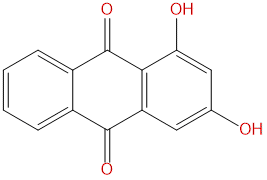


Storage conditions:Short-term storage at 2~8℃, long-term storage at -20 ~ -80℃
Xanthopurpurin (CAS number: 518-83-2) is a natural anthraquinone compound with significant oral biological activity. As an important natural product, isorubicin is mainly isolated from the rhizomes of Rubia akane, a plant in the Rubiaceae family. In recent years, with the rapid development of natural product pharmacology, isorubicin has become a research hotspot due to its diverse biological activities, especially its potential in antiviral, anti-tumor, and immune regulation. This article aims to systematically review the chemical structure and physicochemical properties, plant sources and extraction processes, pharmacological activity and mechanism of action, pharmacological evaluation and pharmacokinetic characteristics of isorubicin, and finally explore its clinical application prospects and future development directions, providing theoretical basis and reference for research in related fields.
Isorubicin belongs to anthraquinone compounds, with a molecular formula of C14H8O4 and a molecular weight of 240.2140. The core of its chemical structure is the anthraquinone skeleton, with the specific structure being 1,3,8-trihydroxyanthraquinone, which has three hydroxyl substituents that endow it with specific chemical and biological activities. The LogP value of isorubicin is 2.7555, indicating that it has moderate lipid solubility, which is beneficial for cell membrane penetration and oral absorption. Its topological polar surface area (TPSA) is 74.6 Å ², indicating moderate polarity and facilitating binding with biological targets. Low water solubility (0.0911 mg/mL) may limit its solubility and bioavailability in the aqueous phase. The low permeability of the blood-brain barrier suggests its limited distribution in the central nervous system. The negative result of hERG channel inhibition experiment indicates a low risk of cardiac toxicity. The Ames mutagenicity test value is 1.2, indicating a low risk of genotoxicity and good safety.
Isorubicin mainly comes from the rhizomes of Rubia akane, a plant in the Rubiaceae family. Rubia plants are widely distributed in Asia and traditionally used for dyes and traditional Chinese medicine. Isorubicin, as one of its main active ingredients, has important medicinal value.
The process of extracting isoquercetin usually includes the following steps: first, the dried Rubia akane rhizome is crushed and refluxed with polar solvents such as ethanol or methanol for extraction. After concentration, the extraction solution is used to remove impurities through liquid-liquid extraction. Subsequently, high-purity isorubicin was obtained through separation and purification using silica gel column chromatography or high-performance liquid chromatography (HPLC). In recent years, the application of ultrasound assisted extraction and microwave-assisted extraction technologies has improved extraction efficiency and purity, reduced solvent usage, and complied with green chemistry principles.
Isorubicin exhibits broad-spectrum antiviral activity, particularly significant inhibitory effects on rotavirus and HIV virus. In vitro experiments have shown that isorubicin can inhibit virus replication and infection processes, and reduce viral load. Its anti rotavirus effect may be achieved by interfering with the assembly of viral capsid proteins or blocking the binding of the virus to host cells; The inhibitory effect on HIV may involve inhibition of reverse transcriptase activity and interference with virus integration processes.
Isorubicin has a strong inhibitory effect on collagen induced platelet aggregation. Platelet aggregation is a crucial step in thrombus formation, and its abnormal activation is closely related to cardiovascular and cerebrovascular diseases. Isorubicin may reduce the risk of thrombosis by inhibiting collagen mediated platelet activation, and has potential antithrombotic therapeutic value.
Isorubicin can prevent peanut allergic reactions, demonstrating its potential in regulating the immune system. Related studies have shown that isorubicin may alleviate allergic symptoms by inhibiting mast cell degranulation and regulating Th1/Th2 immune balance, and has the potential to serve as an adjuvant therapy for allergic diseases.
Isorubicin exhibits significant anti proliferative and pro apoptotic effects in various tumor cell lines. Its anti-tumor activity involves multiple signaling pathways and molecular targets, including MCL1, BCL2, STAT3, MMP2, TOP1, HIF1A, TOP2A, MAPK1, ESR1, and CYP19A1. By regulating these key targets, isorubicin can inhibit the proliferation, migration, and invasion of tumor cells, induce cell cycle arrest and apoptosis, and demonstrate good anti-cancer potential.
The multi-target mechanism of action of isorubicin is the basis for its broad pharmacological activity. The specific mechanism is as follows:
MCL1 and BCL2 These two anti apoptotic proteins are important regulatory factors for cell survival. Isorubicin promotes tumor cell apoptosis and enhances chemotherapy sensitivity by downregulating the expression of MCL1 and BCL2.
STAT3 signaling pathway STAT3 is abnormally activated in various tumors, promoting cell proliferation and immune escape. Isorubicin inhibits the phosphorylation of STAT3, blocks its transcriptional activity, and suppresses tumor growth.
MMP2 Matrix metalloproteinase-2 is involved in matrix degradation and metastasis of tumor cells. Isorubicin inhibits MMP2 expression, preventing tumor cell invasion and metastasis.
TOP1 and TOP2A DNA topoisomerase is a key enzyme involved in cellular DNA replication and transcription. Isorubicin inhibits the activity of TOP1 and TOP2A, interferes with the normal metabolism of tumor cell DNA, and induces cell death.
HIF1A Hypoxia inducible factor 1 alpha regulates the adaptive response of tumors. Isorubicin inhibits HIF1A expression, blocks tumor hypoxia adaptation, and suppresses angiogenesis.
MAPK1 Signal pathways involved in cell proliferation and differentiation. Isorubicin regulates MAPK1 activity and affects the fate of tumor cells.
ESR1 and CYP19A1 The estrogen receptor and aromatase are involved in the development of hormone dependent tumors. Isoalizarin may play an anti breast cancer role by regulating these two targets.
In addition, the inhibitory effect of isorubicin on platelet aggregation may involve its intervention in collagen receptors and downstream signaling pathways, weakening platelet activation. Its antiviral mechanism may be achieved by interfering with virus replication and host cell interactions.
The pharmacological parameters of isorubicin show that it has good potential for drug development. The molecular weight of 240.2140 meets the requirements for oral medication in Lipinski's rules. The LogP value of 2.7555 indicates moderate lipid solubility, which is beneficial for cell membrane permeability. The TPSA is 74.6, indicating that its polarity is moderate and helpful for target binding and bioavailability.
Low water solubility (0.0911 mg/mL) may limit its oral absorption and bioavailability, and it is necessary to improve solubility through formulation optimization techniques such as nanocarriers and solid dispersions. Low blood-brain barrier permeability reduces the risk of central nervous system side effects. HERG channel inhibition is negative, indicating good cardiac safety. The Ames test has low mutagenicity and high safety.
At present, there is limited pharmacokinetic data on isorubicin. Preliminary in vivo studies have shown good oral absorption, but the metabolic pathways and clearance mechanisms still require further investigation. In the future, systematic pharmacokinetic and toxicological evaluations should be conducted to clarify their in vivo behavioral characteristics, providing a foundation for clinical development.
Isorubicin, as a multifunctional natural product, exhibits a wide range of pharmacological activities and good safety, and has great potential for clinical development. Its antiviral effect provides a new candidate drug direction for the treatment of rotavirus infection and HIV. The anti-tumor activity covers multiple tumor related targets, especially in hormone dependent tumors and invasion and metastasis, and can be used as an adjuvant drug for monotherapy or combination chemotherapy in the future.
In addition, the role of isorubicin in antiplatelet aggregation and allergic reactions provides new ideas for the treatment of cardiovascular and cerebrovascular diseases and allergic diseases. By combining its pharmacological advantages and improving drug design and dosage forms, it is expected to overcome the limitations of insufficient water solubility and enhance clinical application value.
Future research should focus on the following directions:
In depth mechanism research Combining multiple omics techniques, systematically analyze the action network and signaling pathway of isorubicin, and clarify its multi-target synergistic mechanism.
Pharmacokinetics and toxicology Improve metabolism, distribution, excretion, and long-term safety evaluation in the body, laying the foundation for clinical trials.
Formulation development Utilizing new formulations such as nanotechnology and solid dispersions to enhance bioavailability and targeting.
Preclinical and clinical research Conduct systematic animal models and clinical trials to verify their efficacy and safety, and promote their translational applications.
Structural optimization and derivative development Enhance activity and pharmacokinetic properties through chemical modification, and expand its application scope.
Isorubicin, as a natural anthraquinone compound derived from Rubia akane, has shown broad application prospects in antiviral, anti-tumor, antiplatelet aggregation, and anti allergic fields due to its unique chemical structure and multi-target pharmacological activity. Its good pharmacological parameters and safety provide favorable conditions for drug development. In the future, through in-depth mechanism research, pharmacokinetic evaluation, and formulation optimization, isorubicin is expected to become an important candidate molecule in the development of natural product drugs, providing new strategies and choices for the treatment of related diseases. Continuous basic and clinical research will drive the transition of isorubicin from laboratory to clinical use, benefiting patients.
