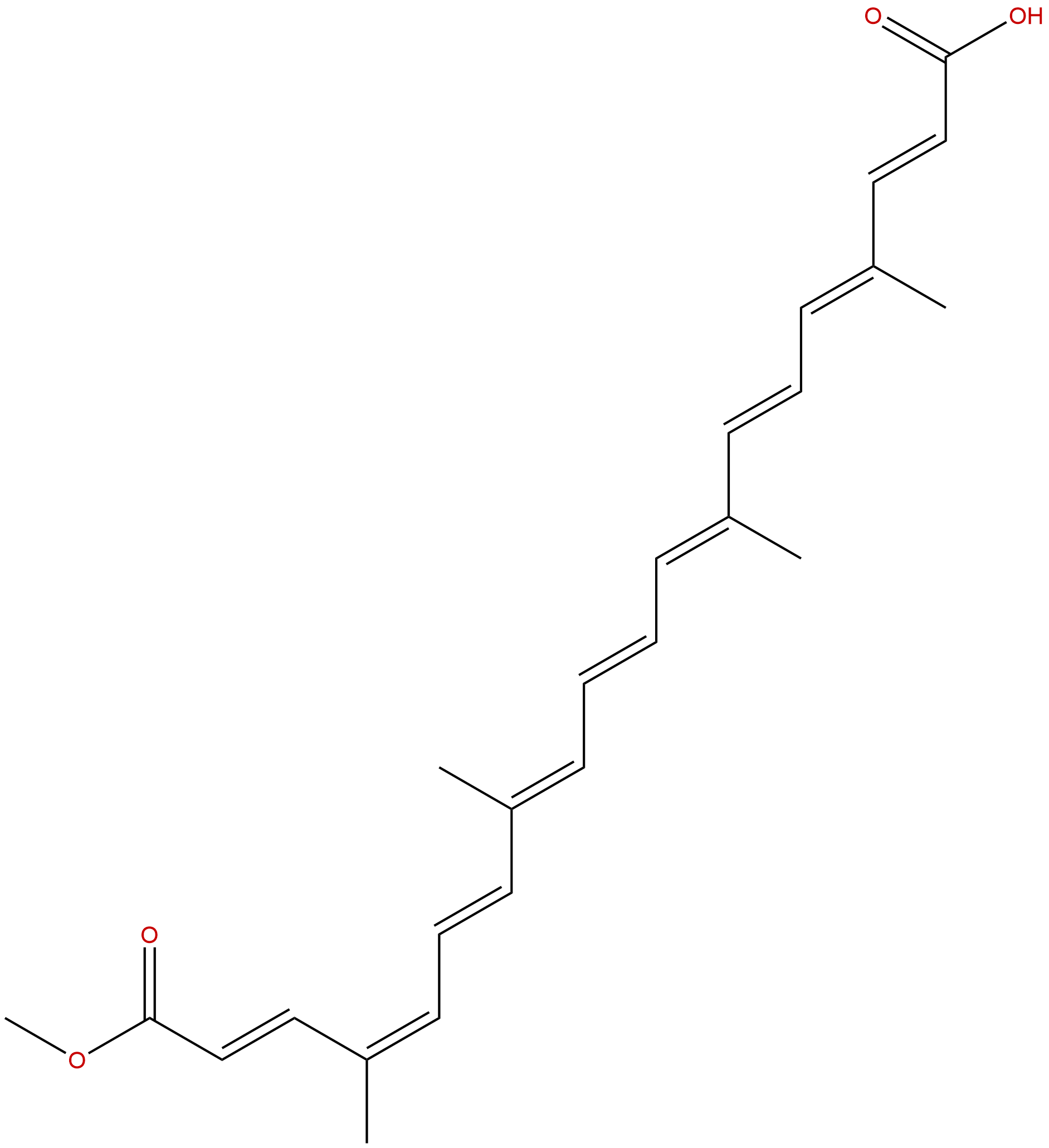


Product name: Bixin
Synonym name: 6-Methyl hydrogen (9Z)-6,6'-diapocarotene-6,6'-dioate
Catalogue No.: BP2092
Cas No.: 6983-79-5
Formula: C25H30O4
Mol Weight: 394.511
Botanical Source:
Type of Compound:
Purity: 95%~99%
Analysis Method: HPLC-DAD or/and HPLC-ELSD
Identification Method: Mass, NMR
Packing: Brown vial or HDPE plastic bottle
Storage: Store in a well closed container, protected from air and light. Put into refrigerate or freeze for long term storage.
Whenever possible, you should prepare and use solutions on the same day. However, if you need to make up stock solutions in advance, we recommend that you store the solution as aliquots in tightly sealed vials at -20℃. Generally, these will be useable for up to two weeks.
The product could be supplied from milligrams to grams
Inquire for bulk scale.
For Reference Standard and R&D, Not for Human Use Directly.
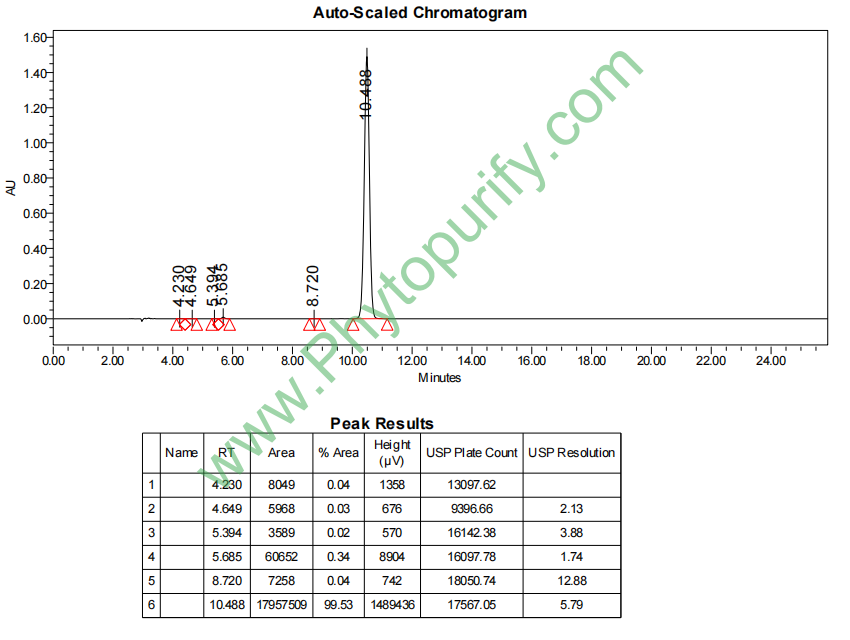
HPLC of Bixin
Storage conditions:Short-term storage at 2~8℃, long-term storage at -20 ~ -80℃
63.6000
5.2160
2.7279
.0065
2.9523
5.5299
Low
94.5966
3.4461
Yes
Yes
Yes
No
No
No
0.3
No
Yes
Yes
Yes
Bixin, also known as cochineal orange, is a natural carotenoid product mainly found in the seeds of the cochineal tree (Bixa orellana). As a natural pigment, redwood pigment has been widely used in the fields of food, cosmetics, and traditional medicine since ancient times. In recent years, with the development of natural product pharmacology and molecular biology techniques, the biological activity and potential medicinal value of redwood extract have gradually attracted attention. Numerous studies have shown that rosewood extract not only has significant antioxidant, anti-inflammatory, and anti-tumor activities, but also can regulate cell apoptosis, inhibit fibrosis, and improve cardiac dysfunction through various molecular mechanisms, demonstrating broad therapeutic potential.
This article aims to systematically review the chemical structure and physicochemical properties, plant sources and extraction methods, pharmacological activity and mechanism of action, pharmacological evaluation and pharmacokinetic characteristics of redwood extract, and explore its clinical application prospects and future research directions, providing theoretical basis and reference for related research in the field of natural product pharmacology.
The chemical name of Bixin is (C25H30O4), with a molecular weight of 394.5110 and a CAS number of 6983-79-5. Its structure belongs to the carotenoid family, specifically a diterpenoid compound containing a conjugated double bond system. The molecular structure of rosewood contains a long-chain conjugated double bond system and two carboxyl functional groups, which give it strong light absorption ability and antioxidant properties.
In terms of physical and chemical properties, the LogP value of redwood pigment is 5.2160, indicating its high lipid solubility and extremely low water solubility (0.0065 mg/mL), which also limits its solubility and bioavailability in aqueous phase. Its topological polar surface area (TPSA) is 63.6 Å ², indicating that the molecule has a certain polarity that facilitates interaction with biological targets. The low blood-brain barrier permeability of redwood pigment suggests its limited distribution in the central nervous system. The hERG channel inhibition experiment showed a negative result, indicating a low risk of cardiac toxicity from redwood extract. The Ames test results showed that its mutagenicity was extremely low (0.3), indicating good safety.
Redwood pigment mainly comes from the seeds of the cochineal tree (Bixa orellana). The cochineal tree is a plant of the Malvaceae family, widely distributed in tropical America and some parts of Asia. Its seed shell is rich in rosewood pigment, traditionally used as a natural pigment and dye.
There are various methods for extracting rosewood extract, including organic solvent extraction, supercritical fluid extraction, and enzyme assisted extraction. Traditional extraction often uses organic solvents such as ethanol, ethyl acetate, or hexane to obtain crude extract of rosewood through leaching and concentration. Supercritical carbon dioxide extraction has become a research hotspot in recent years due to its green environmental protection and high selectivity. In addition, to improve extraction efficiency and purity, researchers also used column chromatography, thin layer chromatography, and high-performance liquid chromatography (HPLC) for purification and quantitative analysis.
Redwood extract has significant antioxidant properties. Its conjugated double bond structure enables it to effectively scavenge free radicals, inhibit the generation of reactive oxygen species (ROS), and alleviate oxidative stress damage. In vitro experiments have shown that rosewood extract can enhance the activity of superoxide dismutase (SOD), catalase (CAT), and glutathione peroxidase 1 (GPX1), protecting cells from oxidative damage. In animal models, redwood extract significantly reduces the levels of lipid peroxidation products (such as malondialdehyde, MDA), enhances the expression of antioxidant enzymes, and plays a protective role in the heart, liver, and nerve tissues.
Redwood extract exhibits good anti-inflammatory effects by inhibiting the production and release of various inflammatory mediators. It can downregulate the nuclear factor kappa B (NF - κ B) signaling pathway, reduce the expression of pro-inflammatory cytokines such as tumor necrosis factor alpha (TNF - α), interleukin-6 (IL-6), and nitric oxide (NO), thereby alleviating the inflammatory response. Related studies have shown that rosewood extract significantly reduces tissue inflammation and cell infiltration in inflammatory disease models, suggesting its potential as an anti-inflammatory drug.
The ability of rosewood extract to induce apoptosis in cancer cells has been confirmed by multiple in vitro and in vivo studies. It activates the mitochondrial pathway, regulates Bcl-2 family proteins, promotes cytochrome C release, activates the caspases cascade reaction, and induces programmed cell death in tumor cells. In addition, rosewood extract can inhibit tumor cell proliferation, migration, and invasion, regulate cell cycle related proteins, and demonstrate a multi-target anti-tumor mechanism. Some studies have also found that rosewood extract can enhance the sensitivity of chemotherapy drugs and has potential adjuvant therapeutic value.
Redwood extract improves cardiac dysfunction by inhibiting fibrosis, inflammation, and oxidative stress in cardiac tissue. It can reduce collagen deposition, regulate matrix metalloproteinase (MMP1, MMP3) activity, and alleviate myocardial remodeling. Redwood extract also activates the nuclear factor erythroid 2-related factor 2 (Nrf2) signaling pathway, promotes the expression of antioxidant enzyme genes, and protects myocardial cells from oxidative damage. Animal experiments have shown that redwood extract significantly improves cardiac function in models of heart failure and ischemia-reperfusion injury, indicating its potential application in the prevention and treatment of cardiovascular diseases.
The multiple pharmacological effects of redwood extract depend on its regulation of multiple molecular targets. Its main mechanism of action includes:
Antioxidant mechanism
Redwood extract activates the Nrf2 (NFE2L2) signaling pathway, promotes the expression of downstream antioxidant enzymes such as SOD1, SOD2, CAT, GPX1, and HMOX1, enhances cellular antioxidant defense ability, reduces ROS generation, and protects cells from oxidative damage.
Anti inflammatory mechanism
Redwood extract inhibits the NF - κ B signaling pathway, reduces the release of pro-inflammatory factors TNF - α, IL-6, and nitric oxide, and lowers the inflammatory response. It may also further inhibit the expression of inflammatory mediators by regulating the MAPK pathway.
Antitumor mechanism
Redwood extract induces apoptosis in cancer cells, involving activation of mitochondrial pathways and regulation of caspase family proteins. It inhibits cell cycle proteins and related signaling pathways, blocking tumor cell proliferation and metastasis.
Anti fibrotic mechanism
By regulating the activity of MMP1 and MMP3, redwood extract inhibits collagen deposition, reduces tissue fibrosis, and improves organ function.
Other targets
Redwood pigment also has a certain regulatory effect on enzymes such as tyrosinase (TYR), which may affect pigment metabolism and related physiological processes.
The pharmacological evaluation of redwood extract shows that it has certain advantages and challenges. The molecular weight of 394.5110 and high lipid solubility (LogP 5.2160) facilitate membrane penetration, but the extremely low water solubility limits its oral bioavailability. In addition, redwood has low blood-brain barrier permeability, reducing the potential toxicity risk to the central nervous system, but at the same time limiting its application in neurological diseases.
In terms of safety, redwood extract has no significant hERG channel inhibitory effect, low mutagenicity, and has a good safety foundation. Pharmacokinetic studies have shown that redwood extract is mainly metabolized through the liver in vivo, and the activity and metabolic pathways of biotransformation products still need further clarification.
In order to overcome the problems of poor water solubility and low bioavailability, researchers have attempted to improve the solubility and targeting of rosewood pigment through strategies such as nanocarriers, liposome encapsulation, and structural modification in recent years, promoting its clinical translation.
Redwood extract has shown extensive clinical potential due to its significant antioxidant, anti-inflammatory, and anti-tumor activities. Its application is particularly prominent in the treatment of cardiovascular diseases, tumors, and chronic inflammatory diseases. In the future, with the advancement of formulation technology, the bioavailability and targeting of redwood extract are expected to be significantly improved, promoting its transformation into clinical drugs.
In addition, the safety advantage of redwood pigment as a natural pigment provides a good foundation for its application in functional foods, nutritional supplements, and adjuvant therapy. Further clinical trials and pharmacological mechanism studies will help clarify the therapeutic window, dose safety, and long-term application effects of redwood extract.
Future research should focus on the metabolic mechanism, drug interactions, and multi-target synergistic effects of redwood extract. By combining modern drug design and nanotechnology, efficient, safe, and targeted redwood extract derived new drugs should be developed to contribute new therapeutic strategies to the field of natural product pharmacology.
Redwood extract, as an important carotenoid in cochineal tree seeds, has rich pharmacological activity and good safety, and has become a hot topic in natural product pharmacology research. Its multiple biological effects such as antioxidant, anti-inflammatory, anti-tumor, and cardioprotective provide new ideas for the prevention and treatment of various diseases. Although its poor water solubility and low bioavailability have limited its clinical application, the drug development prospects of redwood extract are broad through modern formulation technology and molecular modification.
In the future, in-depth pharmacological mechanism research, optimized pharmacokinetic characteristics, and scientifically rigorous clinical evaluation will be the key to promoting the transformation of quercetin from a natural product to a clinical drug. The study of redwood extract not only enriches the understanding of the biological functions of carotenoids, but also provides valuable examples and inspirations for the development of natural product pharmacology.
