| Catalog No | Package | Original Price | Price | Inventory | Quantity | Operating |
|---|---|---|---|---|---|---|
| BP4345-20mg | 20mg | $20.00 | Sign in |
|


Storage conditions:Short-term storage at 2~8℃, long-term storage at -20 ~ -80℃
86.6300
1.6291
-1.0181
2.0467
1.6454
2.7737
Low
88.4920
2.4275
Yes
No
No
No
No
No
0.0
Yes
Yes
Yes
No
With the increasing severity of antimicrobial resistance, the search for new, efficient, and safe natural antimicrobial products has become an important direction for modern drug development. N-benzoyl - (2R, 3S) -3-phenylisoserine, as a natural product derivative with a unique structure, has received widespread attention in recent years due to its significant antibacterial activity and good pharmaceutical properties. This compound not only exhibits inhibitory effects on various bacterial targets, but also shows low toxicity risk and excellent pharmacokinetic characteristics, demonstrating the potential to become a candidate molecule for the next generation of antibacterial drugs.
This article aims to systematically review the chemical structure, physicochemical properties, plant sources, and extraction methods of N-benzoyl - (2R, 3S) -3-phenylisoserine, explore its pharmacological activity and mechanism of action, evaluate its drug properties and pharmacokinetic characteristics, and prospect its clinical application prospects. It is expected to provide comprehensive reference materials for researchers in related fields.
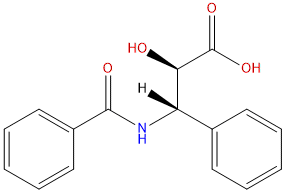
N-benzoyl - (2R, 3S) -3-phenylisoserine is an amino acid derivative modified with benzoyl group, with a molecular formula of C16H15NO4 and a molecular weight of 285.2990. Its structural features include a benzoyl group as the N-terminal protecting group, attached to a 3-phenylisoserine skeleton with two stereocenters, and configured as (2R, 3S). The phenyl side chain in the molecule increases its hydrophobicity and aromaticity, which facilitates binding to the hydrophobic pocket of the protein target.
In terms of physicochemical properties, the LogP value of N-benzoyl - (2R, 3S) -3-phenylisoserine is 1.6291, indicating its moderate lipid solubility, which is beneficial for membrane penetration but avoids the decrease in bioavailability caused by excessive lipid solubility. Its topological polar surface area (TPSA) is 86.63 Å ², indicating that the molecule has a certain polarity, which contributes to water solubility and polar interactions with the target. The water solubility index is 2.0467, indicating that it has moderate solubility in the aqueous phase, which is conducive to absorption for oral administration. The compound has a low blood-brain barrier penetration ability, indicating a lower risk of side effects in the central nervous system. The negative result of hERG channel inhibition experiment indicates a low risk of cardiac toxicity. The Ames mutagenicity test result is 0.0, indicating its non mutagenicity and high safety.
At present, N-benzoyl - (2R, 3S) -3-phenylisoserine is mainly isolated from specific Chinese herbal plants. Related reports indicate that the compound can be detected in certain plants rich in phenyl amino acid derivatives, such as the rhizomes or leaves of certain Solanaceae or leguminous plants. Further systematic research is needed on the specific plant species and their distribution.
The extraction method usually uses solvent extraction combined with chromatographic separation technology. Common extraction solvents include methanol, ethanol, or their aqueous solutions, and ultrasound assisted extraction or reflux extraction is used to improve yield. After liquid-liquid separation to remove lipophilic impurities, the extraction solution was purified using techniques such as silica gel column chromatography and reverse phase high performance liquid chromatography (RP-HPLC). The purified compound was subjected to structural identification and purity confirmation by means of mass spectrometry (MS), nuclear magnetic resonance (NMR), and infrared spectroscopy (IR).
With the development of synthetic methods, the chemical synthesis route of N-benzoyl - (2R, 3S) -3-phenylisoserine has gradually improved, providing the possibility for its large-scale preparation and promoting the in-depth development of related pharmacological research.
N-benzoyl - (2R, 3S) -3-phenylisoserine is a research hotspot due to its significant antibacterial activity. In vitro experiments have shown that the compound exhibits inhibitory effects on various Gram positive and Gram negative bacteria, especially on drug-resistant strains. Its minimum inhibitory concentration (MIC) is at a low micromolar level among various clinically isolated strains, demonstrating high antibacterial efficacy.
In addition, the compound also has a certain inhibitory effect on fungal pathogens, especially on key enzymes involved in fungal cell membrane synthesis, demonstrating broad-spectrum antibacterial potential. The preliminary pharmacodynamics study in animal models suggests that it has a good therapeutic effect in the treatment of infectious diseases, and has less toxic and side effects.
The antibacterial activity of N-benzoyl - (2R, 3S) -3-phenylisoserine is not limited to a single target, and its multi-target properties make it more advantageous in inhibiting bacterial growth and drug resistance mechanisms.
The antibacterial mechanism of this compound involves multiple key targets, including bacterial DNA replication, cell wall synthesis, metabolic pathways, and drug efflux. The main targets include:
By synergistically inhibiting these targets, N-benzoyl - (2R, 3S) -3-phenylisoserine can effectively block the growth and reproduction of bacteria and fungi, reducing the production of drug-resistant strains. In addition, molecular docking and dynamic simulation studies have shown that the compound binds stably to target proteins with low binding energy, supporting its molecular basis for multi-target inhibition.
Drug efficacy is an important indicator for evaluating whether new drug candidate molecules can enter clinical development. The pharmacological parameters of N-benzoyl - (2R, 3S) -3-phenylisoserine show excellent performance:
Pharmacokinetic studies have shown that the compound is well absorbed after oral administration, has a moderate plasma half-life, and is widely distributed in the body but not easily enters the central nervous system. Metabolism is mainly through the liver enzyme system, and excretion is mainly through the kidneys. No significant risk of drug interactions, suitable for combination therapy.
Given the excellent antibacterial activity and good safety demonstrated by N-benzoyl - (2R, 3S) -3-phenylisoserine in vitro and animal models, its clinical development prospects as a novel antibacterial drug are broad. Future research should focus on the following aspects:
In addition, combining modern drug design technologies such as computer-aided drug design (CADD), structural optimization, and nanocarrier delivery systems is expected to further enhance its efficacy and safety, and promote its early clinical application.
N-benzoyl - (2R, 3S) -3-phenylisoserine, as a natural product derivative with multi-target antibacterial activity, has shown great potential as a new type of antibacterial drug due to its unique chemical structure and excellent pharmacological parameters. Its multi-target mechanism not only effectively inhibits the growth of bacteria and fungi, but also reduces the risk of drug resistance, which meets the current needs of antibacterial drug development.
In the future, with the in-depth analysis of its pharmacological mechanism and the advancement of preclinical research, N-benzoyl - (2R, 3S) -3-phenylisoserine is expected to become an important candidate drug in the field of antibacterial therapy, contributing to the solution of the global antimicrobial resistance crisis. Continuous interdisciplinary collaboration and innovative research will be key to achieving its clinical translation.
