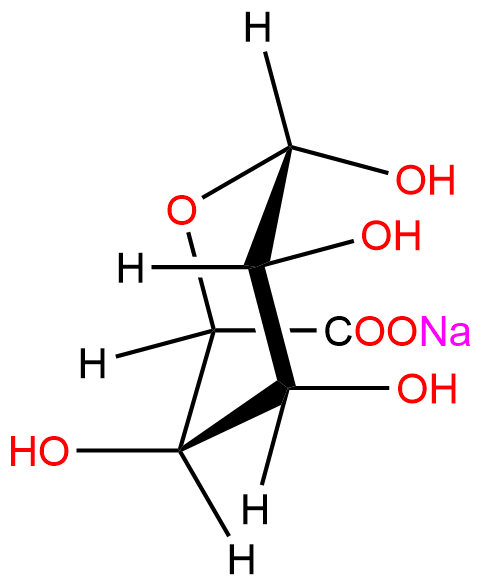


Product name: L-Guluronic Acid Sodium Salt
Synonym name:
Catalogue No.: BP4337
Cas No.: 15769-56-9(Free); Na salt(32510-76-2)
Formula: C6H9O7Na
Mol Weight: 216.12
Botanical Source: Alginate oligosaccharides.
Type of Compound:
Purity: 95%~99%
Analysis Method: HPLC-DAD or/and HPLC-ELSD
Identification Method: Mass, NMR
Packing: Brown vial or HDPE plastic bottle
Storage: Store in a well closed container, protected from air and light. Put into refrigerate or freeze for long term storage.
Whenever possible, you should prepare and use solutions on the same day. However, if you need to make up stock solutions in advance, we recommend that you store the solution as aliquots in tightly sealed vials at -20℃. Generally, these will be useable for up to two weeks.
The product could be supplied from milligrams to grams
Inquire for bulk scale.
For Reference Standard and R&D, Not for Human Use Directly.
Storage conditions:Short-term storage at 2~8℃, long-term storage at -20 ~ -80℃
135.2900
-1.9457
-3.2703
238.3511
.3409
.3051
Low
30.1249
4.8179
Yes
No
No
No
No
No
0.0
Yes
Yes
Yes
Yes
L-Guluronic Acid Sodium Salt (CAS number: 15769-56-9), as an important natural uronic acid compound, has received widespread attention in the field of natural product pharmacology in recent years. Its unique structure, rich in carboxyl and hydroxyl functional groups, endows it with excellent biological activity and pharmacological potential. Especially in the field of anticoagulation, L-guluronic acid monosaccharides exhibit significant regulatory effects, involving targeted regulation of multiple key coagulation factors and regulatory proteins, demonstrating their potential as novel anticoagulant candidate molecules.
This article aims to systematically review the chemical structure and physicochemical properties, plant sources and extraction methods, pharmacological activity and mechanism of action, pharmacological evaluation and pharmacokinetic characteristics of L-guluronic acid monosaccharides. Combined with current research progress, it explores the prospects and challenges of its clinical application, providing theoretical basis and reference for further in-depth research and drug development.
L-guluronic acid monosaccharide is a uronic acid formed by the oxidation of six carbon sugar L-gulurone, with a molecular formula of C6H10O7 and a molecular weight of 194.1390. Its structure contains multiple hydroxyl (- OH) and carboxyl (- COOH) functional groups, endowing it with high polarity and good water solubility (238.3511 mg/mL), with a LogP value of -1.9457, indicating strong hydrophilicity. Its topological polar surface area (TPSA) is 135.29 Å ², indicating strong polarity and potential hydrogen bond donor/acceptor ability.
The structural basis of L-guluronic acid monosaccharides enables them to exhibit good affinity in interactions with biomolecules, especially in binding to proteins. Its low blood-brain barrier permeability and lack of hERG inhibitory activity suggest that it has high safety and is not easily transmitted through the central nervous system, reducing potential central toxicity risks. The Ames test result is 0.0, indicating that it has no mutagenicity and has a good safety basis.
In addition, L-guluronic acid monosaccharides can be converted into D-glucuronic acid through oxidation reactions, further expanding the possibilities of their chemical modification and derivative development.
L-guluronic acid monosaccharides are widely present in various natural polysaccharides, especially as important building blocks in seaweed polysaccharides such as alginate. Alginate is composed of alternating units of β - D-mannuronic acid and α - L-guluronic acid, with L-guluronic acid as its key unit, endowing polysaccharides with unique biological activity and physicochemical properties.
Mainly derived from Phaeophyceae plants, such as Macrocystis pyrifera, Laminaria japonica, Ascophyllum nodosum, etc. These seaweed are rich in alginate, which can be hydrolyzed and decomposed to obtain L-guluronic acid monosaccharides.
Water extraction method
The traditional extraction method is water extraction, which involves crushing seaweed and soaking it in warm water to extract brown alginate. Subsequently, through acid-base treatment, the pH value is adjusted to precipitate or dissolve alginate, and the target component is separated.
Acid hydrolysis
Using dilute acid (such as hydrochloric acid) to hydrolyze brown alginate, breaking polysaccharide chains and releasing monosaccharide components, including L-guluronic acid. The hydrolysis conditions need to be strictly controlled to avoid excessive degradation.
Enzymatic hydrolysis
Using specific alginate lyase to selectively degrade alginate and obtain high-purity L-guluronic acid monosaccharides, the enzymatic hydrolysis method is mild and selective, suitable for industrial production.
Purification technology
After multi-step purification of the extract by ion exchange chromatography and gel filtration chromatography, impurities were removed to obtain high-purity L-guluronic acid monosaccharide.
In recent years, with the development of green extraction technology, new technologies such as ultrasound assisted extraction and microwave-assisted extraction have gradually been applied to the extraction of this compound, improving extraction efficiency and purity, reducing energy consumption and environmental pollution.
Due to its unique structure and functional groups, L-guluronic acid monosaccharides exhibit multiple pharmacological activities, particularly in the field of anticoagulation research where significant progress has been made.
Multiple in vitro and in vivo experiments have shown that L-guluronic acid monosaccharides can significantly inhibit blood clotting processes, prolong clotting time, and reduce the risk of thrombosis. Its anticoagulant mechanism involves the regulation of various coagulation factors and regulatory proteins, including:
In addition to anticoagulant effects, L-guluronic acid monosaccharides also exhibit certain anti-inflammatory, antioxidant, and immune regulatory activities, which may play an adjuvant therapeutic role by regulating cell signaling pathways and oxidative stress responses.
The anticoagulant effect of L-guluronic acid monosaccharides is mainly achieved through interactions with multiple key coagulation factors and regulatory proteins. The molecular mechanism can be summarized as follows:
Computer simulations and molecular docking studies have shown that L-guluronic acid monosaccharides form stable hydrogen bonds and electrostatic interactions with key amino acid residues on the surface of coagulation factors through their carboxyl and hydroxyl groups, enhancing their binding affinity and explaining their efficient anticoagulant activity.
At present, there is limited systematic pharmacokinetic research on L-guluronic acid monosaccharides, but based on their physicochemical properties, it is speculated that:
In the future, in vivo pharmacokinetic and toxicological studies are needed to clarify its absorption, distribution, metabolism, and excretion (ADME) characteristics, and guide clinical dosage form design and medication regimens.
L-guluronic acid monosaccharide, as a naturally occurring anticoagulant active molecule, has the following clinical application potential:
Development of new anticoagulant drugs
Traditional anticoagulant drugs such as warfarin and heparin have disadvantages such as high risk of bleeding and complex drug interactions. L-guluronic acid monosaccharides have multi-target regulatory ability and good safety, and may become safer and more effective anticoagulant candidate drugs.
Adjuvant treatment for thrombotic diseases
It can be used for the prevention and treatment of thrombosis related diseases such as venous thromboembolism, myocardial infarction, and stroke, especially suitable for patients with poor tolerance or contraindications to existing anticoagulants.
Combination therapy strategy
When used in combination with other anticoagulant or antiplatelet drugs, it may have a synergistic effect, reduce monotherapy dosage, and minimize adverse reactions.
Biomaterials and Medical Dressings
Its good biocompatibility and anticoagulant properties make it have potential applications in fields such as vascular stents and medical dressings.
L-guluronic acid monosaccharide, as a natural uronic acid compound with unique structure and diverse functions, exhibits significant anticoagulant activity and good pharmaceutical properties. It has high safety and potential clinical application value by regulating the blood coagulation system through multiple targets. Although relevant research is still in its infancy, with the continuous deepening of extraction and purification techniques, pharmacological mechanism analysis, and pharmacokinetic studies, L-guluronic acid monosaccharides are expected to become important new drug candidate molecules in the field of anticoagulant therapy in the future.
In the future, it is necessary to strengthen the combination of basic and applied research, promote its transition from laboratory to clinical use, benefit more patients with thrombotic diseases, and contribute new strength to the fields of natural product pharmacology and new drug development.
Batch can search by a CAS number,one per line
