

Storage conditions:Short-term storage at 2~8℃, long-term storage at -20 ~ -80℃
With the increasing importance of natural products in drug development, flavonoids have become a hot topic in natural medicine research due to their diverse biological activities and low toxicity. Hibifolin, a type of cotton bark extract, is derived from Agaricus bisporus(Helicteres isora)Flavonol glycosides have attracted widespread attention in recent years due to their unique pharmacological activities. This compound not only exhibits significant neuroprotective effects, but also has antibacterial activity, especially in inhibiting Staphylococcus aureus(Staphylococcus aureus)It has demonstrated potential clinical application value in terms of its pathogenic mechanism. The purpose of this paper is to systematically review the chemical structure, plant origin, pharmacological activity, mechanism of action, and evaluation of the pharmaceutical properties of cotton hulin-8-O-glucuronide, and explore its future application prospects in neurodegenerative diseases and infectious diseases.
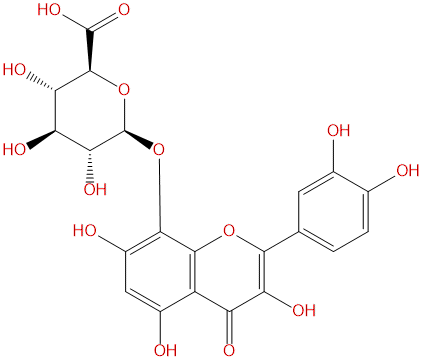
Cottonsen-8-O-glucuronide (CAS number: 55366-56-8) is a flavonol glycoside with a molecular weight of 494.3610 and a molecular formula of C23H2O13. Its structural feature is that the core flavonoid skeleton of Hibifolin forms a glycosidic bond with glucuronic acid through an 8-position hydroxyl group. This structure endows it with high polarity, manifested by a low LogP value (-0.1733), indicating strong hydrophilicity with a water solubility of 1.3225. The TPSA (topological polar surface area) is as high as 247.81 Å ², suggesting that its polar groups are abundant and affect its cell membrane penetration ability.
In terms of physicochemical properties, gossypol-8-O-glucuronide exhibits low blood-brain barrier permeability, suggesting that its direct action in the central nervous system may be limited, but it still has potential value by regulating peripheral neuroprotective mechanisms or indirect pathways. It does not exhibit hERG channel inhibition, and the Ames test result is 0.6, indicating a low risk of genetic toxicity and good safety.
Cotton peelin-8-O-glucuronide is mainly derived from the leaves of Agaricus bisporus(Helicteres isora)Obtained through separation.H. isora It is a plant of the Malvaceae family and the genus Agaricus, widely distributed in tropical and subtropical regions of Asia. It is traditionally used to treat inflammation, digestive system diseases, and infections.
The extraction process usually uses ethanol or methanol as solvents for crude extraction, followed by liquid-liquid distribution and column chromatography techniques (such as silica gel column, reverse phase C18 column) for separation and purification. High performance liquid chromatography (HPLC) and mass spectrometry (LC-MS) are used for component identification and purity detection. In recent years, the application of ultrasound assisted extraction and microwave-assisted extraction technologies has improved extraction efficiency and yield, providing technical support for large-scale preparation.
Cotton peelin-8-O-glucuronide shows significant protective effects in neurodegenerative disease models. β - amyloid protein (A β) aggregation is a key pathological marker of Alzheimer's disease (AD), and the neurotoxicity induced by A β is closely related to cell apoptosis. Research has shown that cotton peelin-8-O-glucuronide can effectively inhibit A β - induced neuronal cell death, significantly reduce the activation levels of caspase-3 and caspase-7, and slow down the process of cell apoptosis. In addition, the compound can induce phosphorylation of the Akt signaling pathway in cortical neurons, promote activation of cell survival signals, and enhance the stress resistance of neurons.
Cottonsen-8-O-glucuronide, as a natural inhibitor of Sortase A (SrtA), has an IC50 value of 31.2 μ M. SrtA is a key enzyme anchored to surface proteins of Gram positive bacteria, involved in bacterial adhesion, invasion, and biofilm formation. By directly binding to SrtA protein, cotton peelin-8-O-glucuronide effectively inhibits the pathogenic behavior of Staphylococcus aureus, reduces its biofilm formation ability, and thus lowers bacterial infectivity and resistance.
In animal experiments, the compound significantly increased the survival rate of Staphylococcus aureus induced pneumonia in mouse models and reduced pathological damage to lung tissue. In addition, the combination of cotton peelin-8-O-glucuronide and cefotaxime showed synergistic antibacterial effects, indicating its potential application value in antibacterial combination therapy.
Flavonoids generally have antioxidant activity, and cotton peelin-8-O-glucuronide is no exception. It works by regulating various antioxidant related targets, including tyrosinase (TYR), matrix metalloproteinase 1 (MMP1), nuclear factor erythroid 2-related factor 2 (NFE2L2/NRF2), superoxide dismutase (SOD1, SOD2), catalase (CAT), glutathione peroxidase 1 (GPX1), heme oxygenase 1 (HMOX1), and matrix metalloproteinase 3 (MMP3). By activating the NRF2 signaling pathway, cotton peelin-8-O-glucuronide enhances the expression of intracellular antioxidant enzymes, reduces oxidative stress damage, and protects cellular function.
Adenosine deaminase (ADA) is an important enzyme involved in purine metabolism, regulating immune responses and cellular signaling. Cotton peelin-8-O-glucuronide, as an ADA inhibitor with a Ki value of 49.92 μ M, competitively inhibits ADA activity, regulates intracellular adenosine levels, indirectly affects immune cell function and inflammatory response, and helps alleviate neuroinflammation and immune-mediated disease progression.
Cotton peelin-8-O-glucuronide directly binds to SrtA protein, inhibits its enzymatic activity, blocks the anchoring process of bacterial surface proteins, and weakens bacterial adhesion and biofilm formation ability. This mechanism not only weakens the pathogenicity of bacteria, but also reduces their resistance to antibiotics, enhancing the effectiveness of antibacterial treatment.
Cotton peelin-8-O-glucuronide induces Akt phosphorylation, activates the PI3K/Akt signaling pathway, promotes cell survival and anti apoptotic response. This signaling pathway plays a central role in neuronal protection, inhibiting the activation of caspase-3 and caspase-7 and reducing cell apoptosis. In addition, by regulating the NRF2 mediated antioxidant response, the damage to neurons caused by oxidative stress is reduced, and the neuroprotective effect is synergistically exerted.
The molecular weight of cotton peelin-8-O-glucuronide is 494.3610, which is close to the upper limit of Lipinski rule. The LogP value is -0.1733, indicating its strong hydrophilicity and potential impact on its oral bioavailability. A high TPSA (247.81 Å ²) suggests a high polarity, which may limit cell membrane permeability and blood-brain barrier penetration ability, consistent with experimental data of low blood-brain barrier penetration.
In terms of safety, the compound does not exhibit hERG channel inhibition, reducing the risk of cardiac toxicity; The Ames test result is 0.6, indicating a low risk of genetic toxicity. Moderate water solubility is beneficial for the development of drug formulations.
At present, there is relatively little systematic research on its pharmacokinetics, and further evaluation of its in vivo absorption, distribution, metabolism, and excretion characteristics (ADME) is needed in the future, especially for optimizing drug delivery strategies for central nervous system diseases. In addition, considering its synergistic antibacterial effect with cefotaxime, the pharmacokinetic interactions of combination therapy also need to be further studied.
Cotton peelin-8-O-glucuronide has shown broad application potential in the fields of neurodegenerative diseases and bacterial infections. Its protective effect against A β - induced neurotoxicity and inhibition of key apoptotic enzymes suggest its potential value in the adjuvant therapy of neurodegenerative diseases such as Alzheimer's disease. Although its blood-brain barrier permeability is low, it is expected to enhance the bioavailability of the central nervous system through drug carrier technology or structural modification.
In terms of antibacterial properties, cotton peelin-8-O-glucuronide, as an SrtA inhibitor, provides a novel anti infection strategy targeting the pathogenic mechanism of Staphylococcus aureus. Its synergistic effect with traditional antibiotics has opened up new avenues for addressing antibiotic resistance issues. In the future, further preclinical and clinical trials can be conducted to verify its safety and effectiveness.
In addition, the antioxidant activity of gossypin -8-O-glucuronide has potential applications in a variety of oxidative stress related diseases, such as cardiovascular diseases, diabetes and inflammatory diseases. By combining modern drug design and nanotechnology, it is expected to achieve the advantages of multi-target synergistic therapy.
Cotton peelin-8-O-glucuronide, as a natural flavonol glycoside derived from Agaricus bisporus, has become an important object of natural medicine research due to its unique chemical structure and diverse biological activities. Its significant effects in neuroprotection, antibacterial, and antioxidant aspects reveal its potential as a candidate molecule for novel drugs. In the future, through in-depth analysis of its mechanism of action, optimization of pharmacokinetic properties, and systematic clinical evaluation, gossypol-8-O-glucuronide is expected to become an effective drug for the treatment of neurodegenerative diseases and bacterial infections, providing new ideas and strategies for the treatment of related diseases.
