Introduction/Overview
7-Prenyloxyaromadendrin (CAS number: 78876-50-3) is a flavonoid compound with significant biological activity, mainly isolated from the plant Pterocaulon alopecuroides. As a member of natural products, 7-Prenyloxyaromadendrin has received widespread attention in recent years due to its unique structural features and diverse pharmacological activities, especially its potential applications in anti-tumor and anti-inflammatory fields. Flavonoids play an important role in the development of natural medicines due to their excellent biocompatibility and multi-target regulatory ability. 7-Prenyloxyaromadendrin not only exhibits significant anti proliferative effects in various tumor cell lines, but also exerts anti-inflammatory effects by regulating multiple inflammation related signaling pathways, demonstrating good potential for drug development.
This article aims to systematically review the chemical structure and physicochemical properties, plant sources, and extraction methods of 7-Prenyloxyaromadendrin, explore its pharmacological activity and mechanism of action in depth, and comprehensively evaluate it based on its pharmacological parameters. It also looks forward to its prospects and challenges in clinical applications, providing theoretical basis and practical guidance for future research and development.
Chemical structure and physicochemical properties
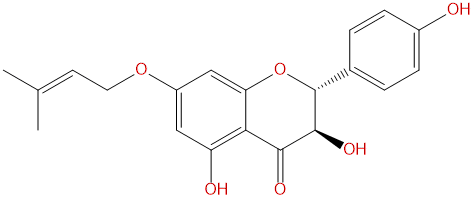
7-Prenyloxyaromadendrin belongs to the flavonoid family and has a typical flavonoid skeleton in structure. It is replaced by an isoprene group at the 7th hydroxyl position to form an alkoxy side chain. Its molecular formula is C21H24O6 and its molecular weight is 356.3740. The introduction of this structure not only increases the hydrophobicity of the molecule (LogP=2.9303), but may also enhance its affinity for biological targets and membrane penetration ability.
In terms of physicochemical properties, the polar surface area (TPSA) of 7-Prenyloxyaromadendrin is 96.22 Å ², indicating its moderate polarity, which is conducive to the penetration and in vivo distribution of biofilms. Low water solubility (0.2407 mg/mL) suggests limited solubility in aqueous phase, which may affect its oral bioavailability. The low permeability of the blood-brain barrier suggests limited distribution in the central nervous system, which helps to reduce the risk of central nervous system toxicity. The negative result of hERG channel inhibition experiment indicates a low risk of cardiac toxicity. The Ames mutagenicity test result is 0.0, indicating a low risk of genetic toxicity.
In summary, the chemical structure and physicochemical properties of 7-Prenyloxyaromadendrin provide a solid foundation for its potential as a drug molecule, especially in terms of safety performance.
Plant sources and extraction methods
7-Prenyloxyaromadendrin mainly comes from the composite plant Pterocaulon alopecuroides, which is widely distributed in South America and tropical Asia, and is traditionally used to treat inflammation and infectious diseases. The whole plant or roots of Pterocaulon alopecuroides contain abundant flavonoids and isoprene compounds, providing important resources for natural medicine research.
The extraction method usually uses organic solvent extraction combined with column chromatography separation technology. The specific steps are as follows:
- Sample Pretreatment Collect fresh or dry plant materials of Pterocaulon alopecaroides and grind them to the appropriate particle size.
- Solvent extraction Ethanol or methanol is used as the main solvent for reflux or ultrasound assisted extraction, and the extraction time is generally 2-4 hours.
- Crude extract concentration Concentrate the extract by rotary evaporation to remove organic solvents.
- Separation and purification Using silica gel column chromatography and solvent gradient elution with different polarities, combined with high performance liquid chromatography (HPLC) for further purification, high-purity 7-Prenyloxyaromadendrin was finally obtained.
- Structural Identification Confirm the structure of the compound through methods such as nuclear magnetic resonance (NMR), mass spectrometry (MS), and infrared spectroscopy (IR).
In recent years, the introduction of supercritical fluid extraction and membrane separation technology is expected to improve extraction efficiency and purity, reduce solvent usage, and promote the development of green extraction processes.
Pharmacological activity research
Antitumor activity
7-Prenyloxyaromadendrin exhibits significant anti proliferative activity in various tumor cell lines. In vitro cell experiments have shown that the compound can inhibit the proliferation of tumor cells, induce cell cycle arrest, and promote cell apoptosis. Its anti-tumor effect is particularly obvious in breast cancer, lung cancer and colorectal cancer cells.
Mechanism studies have shown that 7-Prenyloxyaromadendrin achieves anti-tumor effects by regulating multiple signaling pathways within cells, such as inhibiting STAT3 signaling, reducing the expression of pro proliferative genes, and activating apoptosis related proteins (such as the Caspase family). In addition, the compound can also inhibit the migration and invasion of tumor cells, demonstrating its potential anti metastatic ability.
anti-inflammatory activity
In addition to its anti-tumor effect, 7-Prenyloxyaromadendrin also demonstrates outstanding performance in the field of anti-inflammatory. Inflammation is the fundamental process of the occurrence and development of various diseases, and 7-Prenyloxyaromadendrin exerts anti-inflammatory effects through multi-target regulation. Its main targets include pro-inflammatory cytokines IL-6 and TNF - α, as well as key transcription factors NFKB1 and signal transduction molecule STAT3.
Both in vitro and in vivo experiments have confirmed that this compound can significantly reduce the expression level of inflammatory factors, inhibit the activation of inflammatory cells, and alleviate inflammatory reactions. Especially in CASP1 mediated inflammasome activation and TRPV1 and TRPA1 mediated neuroinflammatory responses, 7-Prenyloxyaromadendrin exhibits good regulatory effects. In addition, its inhibition of NOS2 and PTGS2 (COX-2) helps reduce the production of inflammatory mediators such as nitric oxide and prostaglandins.
Other pharmacological effects
Preliminary studies also suggest that 7-Prenyloxyaromadendrin may have multiple biological activities such as antioxidant and immune regulation, but the relevant mechanisms still need further exploration.
Mechanism of action and molecular targets
The pharmacological effects of 7-Prenyloxyaromadendrin depend on its regulation of multiple molecular targets, reflecting its multi-target and multi pathway characteristics.
-
IL-6/STAT3 signaling pathway
IL-6, as a pro-inflammatory cytokine, promotes cell proliferation and inflammatory response by activating the STAT3 signaling pathway. 7-Prenyloxyaromadendrin can inhibit the secretion of IL-6 and the phosphorylation of STAT3, block the expression of downstream pro proliferative and anti apoptotic genes, and exert dual anti-tumor and anti-inflammatory effects.
-
NFKB1 pathway
NFKB1 is a core transcription factor in inflammatory response, regulating the expression of various inflammatory genes. 7-Prenyloxyaromadendrin alleviates inflammatory damage by inhibiting the activation of NFKB1, reducing the release of pro-inflammatory cytokines such as TNF - α and PTGS2.
-
CASP1 and inflammasome regulation
The activation of inflammasomes mediated by CASP1 is an important link in the inflammatory response. 7-Prenyloxyaromadendrin inhibits CASP1 activity, blocks inflammasome mediated cytokine maturation and release, and alleviates inflammatory response.
-
TRPV1 and TRPA1 receptors
These two ion channels are involved in neuroinflammation and pain transmission. The regulatory effect of 7-Prenyloxyaromadendrin on TRPV1 and TRPA1 can help alleviate neurogenic inflammation and pain symptoms.
-
PTGS1 and PTGS2 enzyme inhibition
PTGS1 (COX-1) and PTGS2 (COX-2) are key enzymes involved in prostaglandin synthesis and are involved in inflammation and pain responses. The selective inhibition of PTGS2 by 7-Prenyloxyaromadendrin is beneficial in reducing the production of inflammatory mediators and lowering the risk of side effects.
-
NOS2 inhibition
NOS2 catalyzes the production of nitric oxide, which plays an important role in the inflammatory process. 7-Prenyloxyaromadendrin reduces the release of inflammatory mediators by inhibiting NOS2 expression.
In summary, 7-Prenyloxyaromadendrin achieves its comprehensive pharmacological effects of anti-tumor and anti-inflammatory through synergistic regulation of multiple targets and pathways.
Evaluation of drug properties and pharmacokinetics
The pharmacological parameters of 7-Prenyloxyaromadendrin show that it has good potential for drug development. The molecular weight is 356.3740, which conforms to the ideal range of Lipinski rule and is beneficial for oral absorption. The LogP value is 2.9303, indicating that it has moderate lipid solubility, which is conducive to cell membrane penetration and in vivo distribution.
The TPSA is 96.22 Å ², which is within the range suitable for penetrating biofilms, and although its water solubility is low (0.2407 mg/mL), its solubility and bioavailability can be improved through pharmaceutical methods. The low permeability of the blood-brain barrier reduces the risk of central nervous system toxicity.
In terms of safety, negative hERG channel inhibition indicates a low risk of cardiac toxicity, and Ames test shows no mutagenicity, suggesting a low risk of genetic toxicity and meeting the requirements for safe medication.
At present, there is limited pharmacokinetic data on 7-Prenyloxyaromadendrin, and it is preliminarily speculated that its in vivo metabolism may involve oxidation and binding reactions of liver enzymes. In the future, in vivo pharmacokinetic studies are needed to clarify its absorption, distribution, metabolism, and excretion (ADME) characteristics, providing a basis for clinical development.
Clinical application prospects and prospects
7-Prenyloxyaromadendrin has broad clinical application prospects due to its significant anti-tumor and anti-inflammatory activities. Its multi-target regulatory mechanism provides new ideas for the treatment of complex diseases, especially for adjuvant therapy of tumors and chronic inflammatory diseases.
In the field of anti-tumor treatment, 7-Prenyloxyaromadendrin can be used as a monotherapy or in combination with existing chemotherapy drugs to enhance efficacy and reduce drug resistance. Its multiple regulation of tumor cell proliferation, migration, and apoptosis is expected to improve treatment efficacy and patient prognosis.
In terms of anti-inflammatory treatment, this compound is suitable for various inflammation related diseases such as rheumatoid arthritis, inflammatory bowel disease, and neuroinflammation by inhibiting key inflammatory factors and signaling pathways. Meanwhile, its low toxicity and good safety provide assurance for long-term use.
However, the clinical translation of 7-Prenyloxyaromadendrin still faces challenges, including improvements in water solubility and bioavailability, systematic studies of in vivo pharmacokinetics, and development of effective routes of administration. In addition, more in vivo animal experiments and preclinical safety evaluations are needed to clarify its toxicological characteristics and potential side effects.
Suggestions for future research directions include:
- Optimize extraction and synthesis processes to increase yield and purity;
- Design structural modifications to improve pharmacokinetic properties;
- Thoroughly analyze the mechanism of action and explore more potential targets;
- Conduct in vivo efficacy and safety evaluations of the system;
- Explore combination therapy strategies to enhance clinical efficacy.
Conclusion
7-Prenyloxyaromadendrin, as a natural flavonoid derived from Pterocaulon alopecaroides, exhibits excellent anti-tumor and anti-inflammatory potential due to its unique structure and diverse pharmacological activities. Its multi-target regulatory mechanism and excellent safety provide a solid foundation for its drug development. Although there are still some research gaps in pharmacokinetics and clinical applications, with the optimization of extraction processes and in-depth analysis of molecular mechanisms, 7-Prenyloxyaromadendrin is expected to become an important candidate molecule for new natural medicines.
In the future, with the combination of modern drug development technology and interdisciplinary collaboration, the clinical translation prospects of 7-Prenyloxyaromadendrin are worth looking forward to, which is expected to bring new breakthroughs to the treatment of tumors and inflammatory diseases.