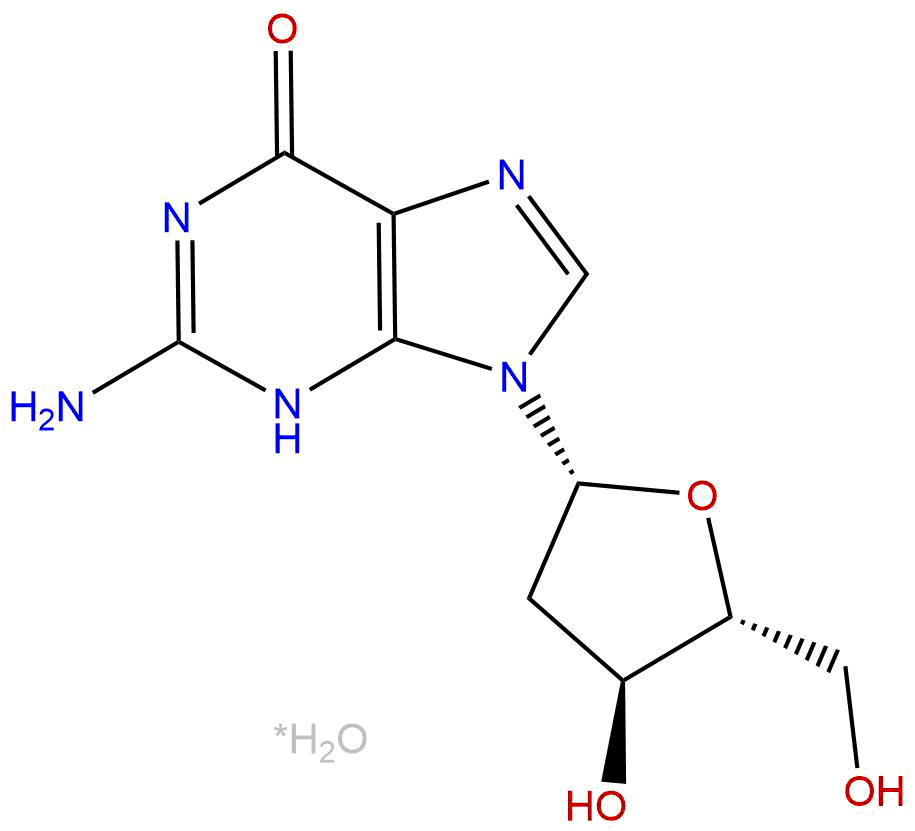


Product name: 2'-Deoxyguanosine monohydrate
Synonym name:
Catalogue No.: BP4232
Cas No.: 312693-72-4
Formula: C10H13N5O4
Mol Weight: 267.245
Botanical Source:
Type of Compound:
Purity: 95%~99%
Analysis Method: HPLC-DAD or/and HPLC-ELSD
Identification Method: Mass, NMR
Packing: Brown vial or HDPE plastic bottle
Storage: Store in a well closed container, protected from air and light. Put into refrigerate or freeze for long term storage.
Whenever possible, you should prepare and use solutions on the same day. However, if you need to make up stock solutions in advance, we recommend that you store the solution as aliquots in tightly sealed vials at -20℃. Generally, these will be useable for up to two weeks.
The product could be supplied from milligrams to grams
Inquire for bulk scale.
For Reference Standard and R&D, Not for Human Use Directly.
Storage conditions:Short-term storage at 2~8℃, long-term storage at -20 ~ -80℃
139.2800
-1.4000
-1.4100
2.3500
.4300
.3100
Low
18.0800
3.6700
Yes
Yes
No
No
Yes
No
1.2
Yes
No
Yes
No
2 '- Deoxyguanosine monohydrate (2' - dG), as an important nucleoside natural product, is widely present in DNA molecules of organisms and plays a core role in storing and transmitting genetic information. As a key component of deoxyribonucleoside, 2 '- dG not only participates in the construction of nucleic acids, but also plays an important role in cellular metabolism, signal transduction, and repair mechanisms. In recent years, with the rapid development of natural product pharmacology, 2 '- dG has gradually become a research hotspot due to its unique chemical structure and biological activity, especially in the fields of anti-tumor, antiviral, and neuroprotection, showing potential application value.
This review aims to systematically summarize the chemical structure and physicochemical properties, plant sources and extraction methods, pharmacological activity and mechanism of action of 2 '- dG, and explore its clinical application prospects and challenges based on drug parameters and pharmacokinetic characteristics, providing theoretical basis and practical guidance for related research.
The chemical formula of 2 '- deoxyguanosine monohydrate is C10H13N5O4 · H2O, with a molecular weight of 267.24. Its core structure is formed by the connection of guanine bases and deoxyribose through β - N9 glycosidic bonds, and the hydrate form contains a molecule of crystalline water. In the molecular structure, the guanine ring system is a nitrogen-containing heterocyclic structure with multiple hydrogen bond donors and acceptors, endowing it with strong polarity and hydrophilicity.
In terms of physical and chemical properties, the LogP value of 2 '- dG is -1.4, indicating its strong hydrophilicity and water solubility of 2.35 mg/mL, making it suitable for biological utilization in aqueous systems. Its topological polar surface area (TPSA) is 139.28 Å ², indicating its high molecular polarity, which affects its cell membrane permeability and pharmacokinetic behavior. The low permeability of the blood-brain barrier suggests limited direct action in the central nervous system. The negative result of hERG channel inhibition experiment indicates a low risk of cardiac toxicity. The Ames test value is 1.2, indicating a low risk of genotoxicity and a good safety basis.
2 '- deoxyguanosine, as a nucleoside compound, mainly exists in the DNA of various organisms. Its content is relatively low in natural plants and is usually obtained through biosynthetic pathways. Trace amounts of 2 '- dG can be detected in some plant tissues with high nucleotide content, such as certain seeds, spores, and tender leaves. As it mainly exists in a bound state in the plant body, direct extraction is difficult.
Common extraction methods include:
At present, chemical synthesis or biosynthetic methods are commonly used in industry to prepare 2 '- dG to meet scientific research and pharmaceutical needs.
2 '- deoxyguanosine, as a nucleoside basic unit, plays multiple biological functions in the body. In recent years, research on its pharmacological activity has gradually deepened, mainly focusing on the following aspects:
2 '- dG serves as a precursor for DNA synthesis and participates in the process of cell proliferation. Research has found that 2 '- dG and its derivatives can affect tumor cell proliferation and apoptosis by regulating DNA synthesis and repair mechanisms. For example, 2 '- dG can be replaced by certain nucleoside analogues, inducing DNA damage and promoting tumor cell apoptosis. In addition, 2 '- dG serves as a precursor molecule in certain drug designs and participates in the synthesis of anti-tumor drugs.
Nucleoside compounds are an important category of antiviral drugs. 2 '- dG, as the deoxygenated form of guanine nucleoside, plays a crucial role in the synthesis of viral DNA. Relevant studies have shown that 2 '- dG derivatives can inhibit the activity of viral DNA polymerase and block viral replication, especially in the treatment of herpes virus, hepatitis B virus and other DNA viruses.
Although 2 '- dG itself has low blood-brain barrier permeability, it plays a fundamental role in neuronal DNA repair and metabolism. Some studies have shown that 2 '- dG and its metabolites can regulate the oxidative stress response of nerve cells, alleviate nerve damage, and have certain neuroprotective potential.
2 '- dG participates in nucleic acid metabolism and affects the proliferation and function of immune cells. Its metabolites can regulate T cell activity and inflammatory response, indicating its potential application value in the field of immune regulation.
The biological function of 2 '- deoxyguanosine is mainly achieved through its involvement in nucleic acid metabolism pathways. Its key mechanism of action includes:
2 '- dG, as an essential nucleoside for DNA synthesis, participates in the extension of DNA strands. It is catalyzed by deoxyribonucleoside kinase to convert into 2 '- deoxyguanosine triphosphate (dGTP), which serves as a substrate for DNA polymerase and participates in DNA replication and repair processes. The balance of dGTP is crucial for cell cycle regulation and genome stability.
2 '- dG and its metabolites can regulate intracellular signaling pathways, such as by affecting the guanine nucleotide cycle and regulating signaling molecules related to cell proliferation, differentiation, and apoptosis. In addition, changes in dGTP levels can affect cellular energy metabolism and redox status.
Nucleoside analogs derived from 2 '- dG competitively inhibit viral DNA polymerase, blocking viral replication. Partial nucleoside analogues can be incorporated into viral DNA strands, leading to strand termination and exerting antiviral effects.
2 '- dG and its metabolites affect immune responses by regulating nucleic acid receptors (such as the cGAS STING pathway), regulating the expression of inflammatory factors, and participating in immune surveillance and anti infection responses.
The pharmacological parameters of 2 '- deoxyguanosine indicate its potential for drug development
In terms of pharmacokinetics, 2 '- dG mainly enters cells through nucleoside transporters in vivo, and is subsequently phosphorylated by deoxyribonucleoside kinase and enters the nucleotide pool. Its metabolic pathways include deamination, methylation, and nucleotide degradation, ultimately excreted through urine. Due to its hydrophilicity and high polarity, oral bioavailability is limited, and in vivo stability and targeting need to be improved through improved drug delivery systems or derivative designs.
2 '- deoxyguanosine, as a nucleoside basic unit, although not widely used as a clinical drug, has important value in drug design and biomedical research. The future clinical application prospects are mainly reflected in the following aspects:
Nucleoside analogues based on the 2 '- dG structure have become the basis for various anti-tumor drugs. By improving its selectivity and cellular uptake efficiency through structural modification, it is expected to develop new highly efficient and low toxicity anti-cancer drugs.
2 '- dG derivatives play an important role in antiviral drugs, especially against DNA viruses. In the future, its pharmacokinetic properties can be optimized to enhance antiviral activity and drug resistance, and expand clinical indications.
Although 2 '- dG has limited permeability to the blood-brain barrier, it is expected to achieve effective delivery to the central nervous system through nanocarrier or prodrug design, exerting neuroprotective effects and promoting nerve repair.
The role of 2 '- dG and its metabolites in immune regulation is gradually being recognized, and future therapeutic strategies for autoimmune diseases and chronic inflammation can be developed.
The changes in the content of 2 '- dG and its metabolites are correlated with various disease states, and have the potential to serve as disease biomarkers to assist in disease diagnosis and efficacy monitoring.
2 '- deoxyguanosine monohydrate, as a typical representative of nucleoside natural products, has a unique chemical structure and diverse biological functions. Its core role in DNA synthesis, repair, signal transduction, and immune regulation makes it an important target for pharmacological research and new drug development. Although it is still in the exploratory stage of clinical application, derivatives based on the 2 '- dG structure have shown broad application prospects.
Future research should focus on in-depth analysis of the molecular mechanism of 2 '- dG, optimizing its pharmacokinetic performance, developing efficient and safe derivatives and drug delivery systems, and promoting its clinical translation in anti-tumor, antiviral, neuroprotective, and immune regulatory fields. Combining modern biotechnology and drug design concepts, 2 '- dG is expected to become another important breakthrough in the field of natural product pharmacology.
