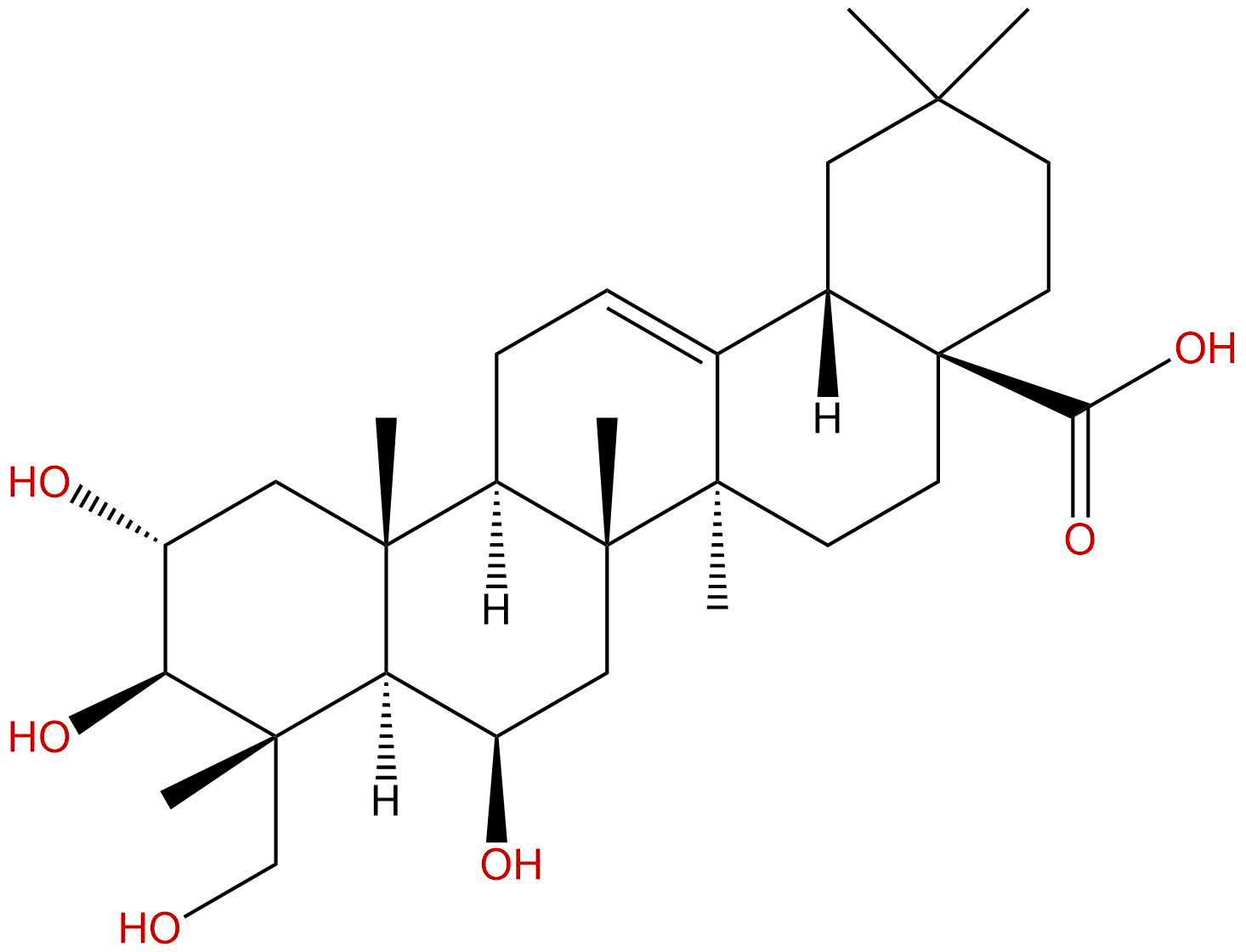


Product name: Terminolic acid
Synonym name: 2α,6β,23-trihydroxyl oleanolic acid;(2α,3β,4α,6β)-2,3,6,23-Tetrahydroxyolean-12-en-28-oic acid
Catalogue No.: BP4376
Cas No.: 564-13-6
Formula: C30H48O6
Mol Weight: 504.708
Botanical Source:
Type of Compound:
Purity: 95%~99%
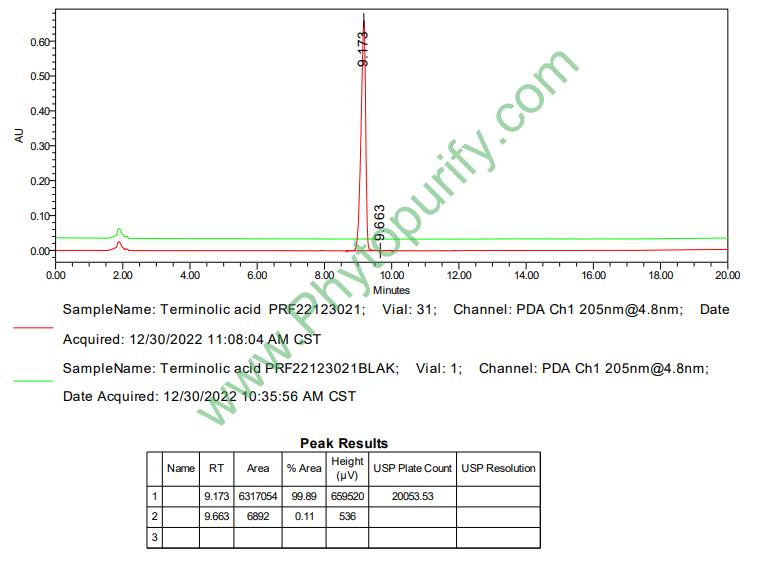
Analysis Method: HPLC-DAD or/and HPLC-ELSD
Identification Method: Mass, NMR
Packing: Brown vial or HDPE plastic bottle
Storage: Store in a well closed container, protected from air and light. Put into refrigerate or freeze for long term storage.
Whenever possible, you should prepare and use solutions on the same day. However, if you need to make up stock solutions in advance, we recommend that you store the solution as aliquots in tightly sealed vials at -20℃. Generally, these will be useable for up to two weeks.
The product could be supplied from milligrams to grams
Inquire for bulk scale.
For Reference Standard and R&D, Not for Human Use Directly.
HPLC of Terminolic acid
Storage conditions:Short-term storage at 2~8℃, long-term storage at -20 ~ -80℃
Terminolic acid (CAS number: 564-13-6) is a natural product of pentacyclic triterpenoid glycosides, mainly isolated from the plant Combretum racemosum. As a natural compound with significant antibacterial and anti-inflammatory activities, the B glycoside of centella asiatica has attracted widespread attention in the field of natural product pharmacology. In recent years, with the in-depth study of its biological activity and mechanism of action, the B glycoside of centella asiatica has shown great potential for application in antibacterial, anti-inflammatory, and tumor treatment, especially in the fields of colon cancer and skin repair. This article aims to systematically review the chemical structure, physicochemical properties, plant origin, pharmacological activity, mechanism of action, pharmacological evaluation, and clinical application prospects of the B aglycone of centella asiatica. It is expected to provide a theoretical basis and reference for subsequent research and drug development.
Centella asiatica glycoside B belongs to the pentacyclic triterpenoid glycoside class, with a molecular formula of C30H48O7 and a molecular weight of 504.7080. Its structural core is a typical pentacyclic triterpenoid skeleton, connected by glycosidic moieties, endowing it with unique physicochemical properties. The LogP value of the B aglycone of centella asiatica is 3.7517, indicating moderate lipid solubility, which facilitates membrane penetration and bioavailability. Its topological polar surface area (TPSA) is 118.2200, indicating that the molecule has a certain polarity, which may affect its binding ability to biological targets and in vivo distribution. Low water solubility (0.0320 mg/mL) suggests limited solubility in aqueous phase, which may pose certain challenges to the formulation process. Centella asiatica glycoside B is not easily able to penetrate the blood-brain barrier, reducing the risk of central nervous system side effects. In addition, the hERG channel inhibition test result was negative, indicating a low risk of cardiac toxicity. The Ames test result was 0.0, indicating no significant mutagenicity and meeting safety requirements.
The B glycoside of centella asiatica was initially isolated from Combretaceae, a plant belonging to the family Combretaceae and widely distributed in tropical and subtropical regions. Traditionally, Combretum racemosum has been used as a folk medicine with antibacterial, anti-inflammatory, and wound healing promoting effects. The extraction of B aglycone from centella asiatica is usually carried out using organic solvent extraction combined with column chromatography separation technology. The specific steps include:
In recent years, ultrasound assisted extraction and microwave-assisted extraction techniques have also been applied to the extraction of B glycosides from centella asiatica, improving extraction efficiency and purity.
The pharmacological activities of Centella asiatica glycoside B mainly include antibacterial, anti-inflammatory, and anti-tumor effects. The main research progress is described below.
Centella asiatica glycoside B has shown significant inhibitory effects on various pathogenic bacteria, especially on common Gram positive and negative strains such as Staphylococcus aureus, Escherichia coli, and Enterococcus faecalis. The minimum inhibitory concentration (MIC) range is 64 to 256 μ g/mL, indicating moderate antibacterial activity. The antibacterial mechanism may involve inhibition of bacterial cell wall synthesis and disruption of cell membrane, but the specific molecular mechanism remains to be further elucidated.
Centella asiatica glycoside B exerts anti-inflammatory effects by regulating pro-inflammatory cytokines. Research has shown that it can bind to and inhibit the active sites of IL-1 β and IL-6 receptors, significantly reducing the expression of pro-inflammatory cytokine IL-8 and alleviating inflammatory responses. The mechanism of action suggests that the B glycoside of centella asiatica may exert anti-inflammatory effects by interfering with the inflammatory signaling pathway and inhibiting the release of inflammatory mediators.
Centella asiatica glycoside B has shown potential anti-tumor effects in colon cancer research. In vitro cell experiments have shown that it can inhibit the proliferation and migration of colon cancer cells, and induce cell apoptosis. Its anti-tumor mechanism may be related to regulating the inflammatory microenvironment, inhibiting the expression of tumor promoting factors, and interfering with cellular signaling pathways. Although current research is still in its early stages, the potential of Asiaticoside B aglycone as a natural anti-tumor candidate drug deserves further exploration.
The research on the application of Asiaticoside B aglycone in the field of skin repair is increasing day by day. It promotes extracellular matrix remodeling and skin tissue repair by regulating various targets related to skin reconstruction, including matrix metalloproteinases (MMP1, MMP2, MMP9), epidermal growth factor receptor (EGFR), fibroblast growth factor 2 (FGF2), transforming growth factor beta 1 (TGFB1), collagen (COL3A1, COL4A1), and integrin beta 1 (ITGB1). This mechanism of action provides a theoretical basis for the application of Asiaticoside B aglycone in wound healing and skin disease treatment.
The biological activity of Centella asiatica glycoside B is mainly achieved through interactions with multiple molecular targets.
Centella asiatica glycoside B binds to the active sites of pro-inflammatory cytokines IL-1 β and IL-6 receptors, blocking their signaling and inhibiting the release of downstream inflammatory mediators. IL-1 β and IL-6 are key mediators in the inflammatory response, and their overexpression is closely related to various inflammatory diseases. The binding inhibition effect of Centella asiatica glycoside B effectively reduces the production of IL-8. IL-8, as a chemokine, participates in the recruitment and activation of inflammatory cells, and its reduction helps alleviate inflammatory damage.
Centella asiatica glycoside B glycoside exhibits inhibitory effects on bacteria such as Staphylococcus aureus, Escherichia coli, and Enterococcus faecalis. Its antibacterial mechanism is speculated to include disrupting the integrity of bacterial cell membranes, interfering with cell wall synthesis, and inhibiting key bacterial enzyme activity, leading to hindered bacterial growth. The specific target has not been fully identified yet, and further analysis is needed in the future through molecular docking and proteomics techniques.
Centella asiatica glycoside B promotes extracellular matrix (ECM) remodeling and cell proliferation and migration by regulating various protein targets related to skin repair. MMPs (MMP1, MMP2, MMP9) are involved in the degradation and remodeling of ECM, and the expression of Asiaticoside B is regulated to maintain the dynamic balance of ECM. EGFR and FGF2 promote the proliferation of keratinocytes and fibroblasts, TGFB1 regulates fibrosis and collagen synthesis, COL3A1 and COL4A1 are the main components of collagen, and ITGB1 mediates cell matrix adhesion and signal transduction. Centella asiatica glycoside B promotes skin tissue repair and regeneration by coordinating these targets.
Centella asiatica glycoside B has shown inhibitory effects on proliferation and induces apoptosis in colon cancer cells, possibly by regulating the inflammatory microenvironment and signaling pathways. Its ability to inhibit pro-inflammatory cytokines helps slow down tumor associated inflammation and suppress the survival and migration of tumor cells. The specific molecular mechanism involves the regulation of inflammatory and tumor related signaling pathways such as NF - κ B and STAT3, and further experimental verification is needed.
The pharmacological parameters of Centella asiatica glycoside B glycoside indicate that it has good potential for drug development. The molecular weight of 504.7 meets the basic requirements of Lipinski's rule, with a LogP of 3.75, indicating moderate lipid solubility and favorable cell membrane penetration. The TPSA value of 118.22 suggests that the molecule has a certain polarity, which may limit oral absorption but also facilitate target binding. Low water solubility suggests that the formulation design needs to use solubilization or nanocarrier technology to improve bioavailability.
Low blood-brain barrier permeability reduces the risk of central nervous system side effects. HERG channel inhibition is negative, indicating a low risk of cardiac toxicity. The Ames test has no mutagenicity and good safety. There is currently a lack of systematic pharmacokinetic (PK) studies on existing data. In the future, in vivo absorption, distribution, metabolism, excretion (ADME) and toxicology studies need to be conducted to clarify its in vivo behavior and safe dose range.
As a multifunctional natural product, Centella asiatica glycoside B has broad clinical application potential.
Antimicrobial drug development Faced with the problem of antibiotic resistance, the B glycoside of centella asiatica has shown inhibitory effects on various bacteria. In the future, it can be used as a lead compound for new antibiotics or in combination with existing antibiotics to enhance antibacterial efficacy.
Anti inflammatory treatment By regulating key inflammatory factors such as IL-1 β, IL-6, and IL-8, Asiaticoside B aglycone is expected to be applied in the treatment of inflammatory diseases, such as chronic inflammation, rheumatic diseases, and skin inflammation.
neoadjuvant therapy The anti-tumor activity of Asiaticoside B aglycone in colon cancer cells suggests its potential as an adjuvant drug for tumor therapy, especially in regulating the tumor microenvironment and inhibiting inflammation related tumor progression.
Skin repair and regeneration Centella asiatica glycoside B regulates various skin repair related targets and is suitable for the treatment of wound healing, burns, and skin diseases. In the future, it can be developed as an external preparation or functional skincare product.
Although the pharmacological effects of Centella asiatica glycoside B have been preliminarily clarified, its clinical translation still faces many challenges, such as drug stability, in vivo metabolic characteristics, and formulation development. In the future, it is necessary to strengthen pharmacokinetics, safety evaluation, and preclinical animal model research to promote its clinical application.
As a natural product of pentacyclic triterpenoid glycosides, Centella asiatica glycoside B exhibits multiple pharmacological activities, especially in the fields of antibacterial, anti-inflammatory, anti-tumor, and skin repair, with broad research and application prospects. Its unique mechanism of action and good safety provide strong support for the development of new drugs. In the future, it is necessary to strengthen its molecular mechanism research, pharmacokinetics, and preclinical evaluation, combined with modern pharmaceutical formulation technology, to promote the clinical translation of Asiaticoside B aglycone and provide new natural drug candidates for the treatment of related diseases.
