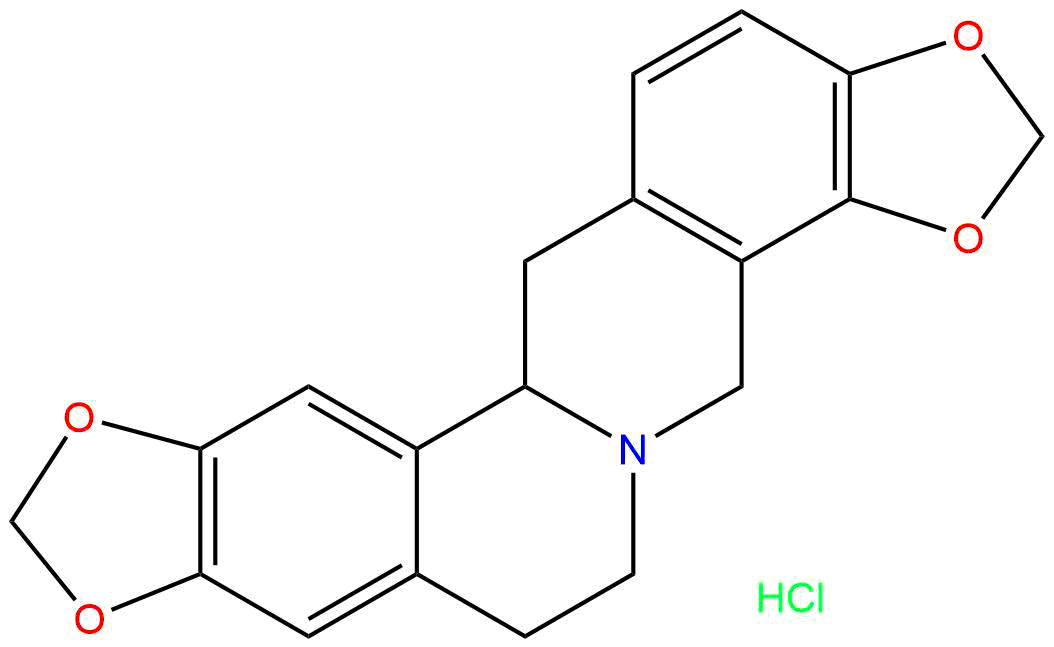


Product name: Stylopine hydrochloride
Synonym name: Tetrahydrocoptisine hydrochloride
Catalogue No.: BP4359
Cas No.: 96087-21-7
Formula: C19H18ClNO4
Mol Weight: 359.806
Botanical Source:
Type of Compound:
Purity: 95%~99%
Analysis Method: HPLC-DAD or/and HPLC-ELSD
Identification Method: Mass, NMR
Packing: Brown vial or HDPE plastic bottle
Storage: Store in a well closed container, protected from air and light. Put into refrigerate or freeze for long term storage.
Whenever possible, you should prepare and use solutions on the same day. However, if you need to make up stock solutions in advance, we recommend that you store the solution as aliquots in tightly sealed vials at -20℃. Generally, these will be useable for up to two weeks.
The product could be supplied from milligrams to grams
Inquire for bulk scale.
For Reference Standard and R&D, Not for Human Use Directly.
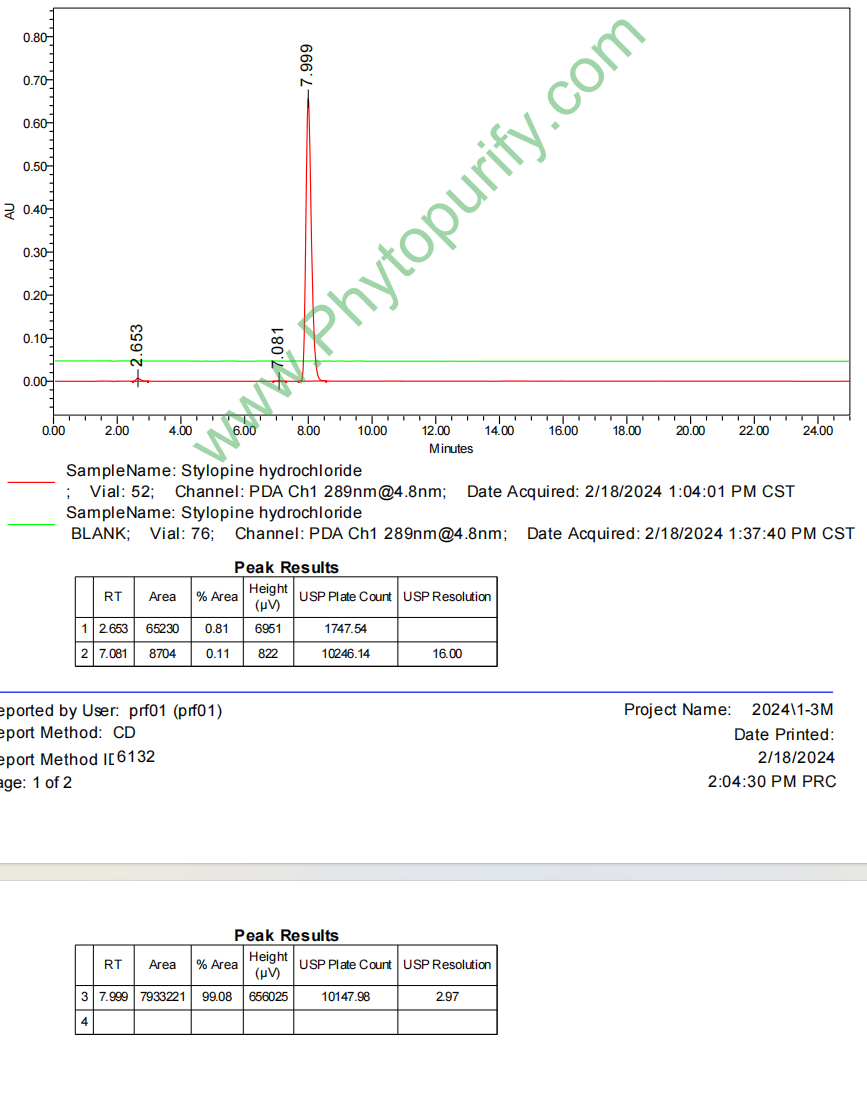
HPLC of Stylopine hydrochloride
Storage conditions:Short-term storage at 2~8℃, long-term storage at -20 ~ -80℃
40.1600
2.4964
2.4219
.0056
8.2972
18.3125
High
86.7192
3.2502
No
No
Yes
No
No
No
0.6
No
No
No
Yes
Arrhythmia is a common and serious cardiovascular disease, which is closely related to disturbances in cardiac electrophysiological activity and can lead to palpitations, fainting, and even sudden death. Although existing antiarrhythmic drugs have achieved certain results in clinical application, their common problems such as arrhythmogenic side effects and insufficient target selectivity have prompted researchers to continuously search for safer and more effective new candidate compounds from natural products. Stylopine hydrochloride, as an isoquinoline alkaloid isolated from traditional medicinal plants, has attracted much attention in recent years due to its significant anti arrhythmic activity. This compound not only inherits the pharmacological basis of some traditional plant medicines, but also demonstrates specific regulatory effects on multiple cardiac ion channels in modern molecular pharmacology research, providing new ideas for the development of multi-target, highly selective antiarrhythmic drugs. This article aims to systematically review the chemical properties, plant sources, pharmacological activities, mechanisms of action, medicinal properties, and clinical application prospects of tetrahydrocoptisine hydrochloride, in order to provide comprehensive scientific references for the in-depth research and development of this compound.
Tetrahydroberberine hydrochloride (CAS number: 96087-21-7) is the hydrochloride form of Stylopine. The parent nucleus structure of tetrahydrocoptisine alkaloid is benzylisoquinoline alkaloid, and its chemical name is 2,3,9,10-tetramethoxy-5,8,13,13a-tetrahydro-6H-dibenzo [a, g] quinoline. Its molecular formula is C19H21NO4, with a molecular weight of 327.37, while the molecular weight of tetrahydrocoptisine hydrochloride after salt formation is 323.3480.
From the analysis of physical and chemical properties, the calculated lipid water partition coefficient (LogP) of the compound is 2.4964, indicating that it has moderate lipophilicity, which is beneficial for its penetration of cell membranes and binding to hydrophobic targets. Its topological polar surface area (TPSA) is 40.1600 Å ², which is relatively small, further indicating its good membrane permeability. The water solubility data (0.0056 mg/mL) shows that its free base form has low solubility in water, but after salt formation (hydrochloride salt), its solubility and bioavailability in aqueous media can be significantly improved, which is crucial for drug formulation development. It is worth noting that its predicted blood-brain barrier permeability is "high", indicating that the compound may easily enter the central nervous system, which may bring about central mediated cardiovascular regulatory effects and potentially increase the risk of neurotoxicity. This is a key aspect that needs to be evaluated in subsequent development.
Tetrahydroberberine is widely present in various plants such as Papaveraceae, Menispermaceae, and Rutaceae, with particularly high levels in many Corydalis and Macleaya plants. These plants are often used in traditional Asian medicine to treat pain, inflammation, and cardiovascular related diseases, providing ethnic pharmacological evidence for the study of their active ingredients.
The extraction of tetrahydrocoptisine from plant materials usually follows the general extraction process for alkaloids. Classic methods include solvent extraction: methanol or ethanol (such as 70-95%) is often used for percolation, reflux, or ultrasound assisted extraction of dried and crushed plant tissues. The good solubility of alkaloids and the precipitation effect on proteins and polysaccharides are preliminarily enriched using alcohol solvents. After the extraction solution is concentrated under reduced pressure, it is dissolved in acidic water (such as dilute hydrochloric acid or dilute sulfuric acid) to convert the alkaloids into salts and transfer them to the aqueous phase. The acid insoluble impurities are filtered out. Subsequently, alkalize the aqueous phase (such as adjusting the pH to 9-10 with ammonia or sodium hydroxide) to allow the alkaloids to precipitate freely, and then extract with organic solvents (such as chloroform, dichloromethane, or ethyl acetate). The crude alkaloids obtained can be further separated and purified by techniques such as silica gel column chromatography and preparative high-performance liquid chromatography (HPLC) to obtain high-purity tetrahydrocoptisine. To meet pharmacological research and potential medicinal needs, purified tetrahydrocoptisine is often salted with hydrochloric acid to produce tetrahydrocoptisine hydrochloride with better stability and easier crystallization. Modern technologies such as high-speed countercurrent chromatography (HSCCC) have also been applied to the efficient preparation and separation of this type of alkaloid due to their advantages of not requiring a solid phase carrier and high recovery rate.
The core pharmacological activity of tetrahydrocoptisine hydrochloride is focused on its anti arrhythmic effect. A large number of preclinical studies, including ex vivo cardiac perfusion and whole animal arrhythmia models, have confirmed its significant therapeutic effect.
At the ex vivo level, this compound can effectively counteract arrhythmias induced by various arrhythmogenic agents such as aconitine, barium chloride, adrenaline, etc. For example, in a Langendorff perfused rat heart model, tetrahydrocoptisine hydrochloride can dose dependently prolong action potential duration (APD) and effective refractory period (ERP), increase ventricular fibrillation threshold, and these effects are typical features of classical class III antiarrhythmic drugs.
In the overall animal model, its protective effect is more clear. In the barium chloride induced arrhythmia model of rats or mice, pretreatment with tetrahydrocoptisine hydrochloride can significantly delay the occurrence time of arrhythmia, shorten the duration of arrhythmia, and reduce the incidence and mortality of severe ventricular arrhythmias (such as ventricular tachycardia and ventricular fibrillation). In the myocardial ischemia-reperfusion induced arrhythmia model, this compound also showed good protective effects, not only improving arrhythmia scores, but also reducing myocardial cell damage, suggesting that it may have dual benefits of antiarrhythmic and myocardial protection. In addition, it also exhibits inhibitory effects on arrhythmias induced by electrical or programmed electrical stimulation.
In addition to its direct cardiac electrophysiological effects, some studies suggest that tetrahydrocoptisine hydrochloride may have mild sedative, anti-inflammatory, and antioxidant activities, which may indirectly contribute to stabilizing myocardial electrical activity, especially in cases of arrhythmia during myocardial ischemia or inflammation.
The antiarrhythmic effect of tetrahydrocoptisine hydrochloride originates from its multi-target regulation of multiple key ion channels and receptors in the heart, which distinguishes its mechanism of action from many traditional drugs with single targets.
Potassium ion channel inhibition This compound is a blocker of various voltage-gated potassium channels.
Sodium ion channel regulation Inhibition of the cardiac voltage-gated sodium channel (Nav1.5) encoded by SCN5A can reduce the maximum rate of action potential rise (V_max) during phase 0 and slow down conduction velocity, which has the characteristics of class I antiarrhythmic drugs (especially class Ib) and helps to suppress reentrant arrhythmias.
Calcium ion channel regulation:
In summary, tetrahydrocoptisine hydrochloride forms a "multi-target synergistic stabilization" mode of action through synergistic effects on repolarized potassium current (I2 Kr, I2 Ks), depolarization sodium current (I2 Na), and calcium treatment system (I2 Ca-L, RyR2). This pattern may enable it to exert therapeutic effects in multiple aspects such as prolonging refractory period, slowing down conduction, and inhibiting triggering activity. At the same time, it may reduce the risk of excessive prolongation of QT interval (mainly due to strong hERG blockade) or excessive inhibition of conduction due to the balance of target effects, thus potentially having a wider treatment window and better safety.
Based on its physicochemical parameters and preliminary biological data, the pharmacological characteristics of tetrahydrocoptisine hydrochloride present both advantages and challenges.
Advantage aspects Moderate LogP values and lower TPSA indicate good membrane permeability and oral absorption potential. Water solubility is improved through salt formation, making it easier for formulation development. The key toxicity warning indicator shows that the Ames test result is 0.6 (usually negative with a mutagenic index MR ≤ 2), indicating no significant genetic toxicity risk. Of particular importance is its annotation of "hERG inhibition: no" (to be interpreted in conjunction with specific experimental conditions and concentrations), which suggests that it may avoid the most severe risk of apical torsion induced ventricular tachycardia associated with traditional Class III drugs. This is a significant potential advantage of it as a candidate antiarrhythmic drug.
Challenges and unknowns High blood-brain barrier permeability is a double-edged sword, and evaluating its central effects through systematic neuropharmacology and toxicology research is both beneficial and detrimental. At present, there is still a relative lack of pharmacokinetic studies (such as absorption, distribution, metabolism, excretion, i.e. ADME) data on the tetrahydrocoptisine hydrochloride system. The key questions that need to be clarified include: What is its oral bioavailability? What are the main metabolic pathways in the body (presumably involving the liver CYP450 enzyme system, especially CYP2D6 and CYP3A4)? Is its main metabolite active or toxic? How long is the half-life of elimination? Can it support a once or twice daily dosing regimen? What is the plasma protein binding rate? These pharmacokinetic characteristics will directly affect the design of its dosing regimen, efficacy, and safety.
In addition, although the preliminary toxicity screening is optimistic, a comprehensive preclinical toxicology evaluation is still needed, including repeated dose toxicity, cardiovascular safety pharmacology (in addition to hERG, the impact on blood pressure, heart rate, and cardiac contractility needs to be evaluated), reproductive toxicity, etc., to comprehensively evaluate its safety window.
As a multi-target antiarrhythmic candidate compound derived from natural products, tetrahydrocoptisine hydrochloride has promising clinical application prospects, but there are still many steps to be taken towards clinical application.
Potential application directions:
1. Complex ventricular arrhythmia Its multi-target mechanism of action is particularly suitable for treating complex and refractory ventricular arrhythmias involving multiple ion channel dysfunction, such as post myocardial infarction arrhythmias, heart failure with concomitant arrhythmias, etc.
2. atrial fibrillation Extending the effective refractory period of the atrium is an important strategy for treating atrial fibrillation. Its inhibitory effect on potassium channels may be applicable for the cardioversion and maintenance of sinus rhythm in atrial fibrillation, but its potential impact on ventricular repolarization needs to be carefully evaluated.
3. Hereditary arrhythmia syndrome The multi-target properties of tetrahydroberberine hydrochloride may provide a "broad-spectrum" stabilizing effect for arrhythmias caused by specific gene mutations (such as KCNH2, KCNQ1, RYR2 mutations), but individualized evaluation is needed.
Future research prospects:
1. Deepening the mechanism of action It is necessary to use techniques such as patch clamp, molecular docking, gene knockout/knock in to accurately elucidate the binding site, IC50, and state dependence (resting, open, inactive) of each target (KCNH2, KCNQ1, SCN5A, etc.), and study the effect changes of target expression changes under pathological conditions (such as heart failure, myocardial ischemia).
2. structural optimization Using it as a lead compound, structural modification and structure-activity relationship studies were conducted with the aim of further improving its selectivity towards cardiac targets (such as enhancing selectivity towards atrial ion channels to reduce ventricular side effects), optimizing pharmacokinetic properties (such as regulating blood-brain barrier permeability and prolonging half-life), and reducing potential toxicity.
3. Systematic evaluation of drug properties Carry out systematic preclinical ADME and toxicology studies as soon as possible, obtain complete drug efficacy data packages, and provide decision-making basis for whether to proceed to clinical trials.
4. Exploration of Compound Preparations Consider combining it with other antiarrhythmic drugs or cardioprotective agents with complementary mechanisms of action to create low-dose formulations, in order to synergistically enhance efficacy, reduce individual dosages and side effects.
5. From the perspective of integrated traditional Chinese and Western medicine Exploring its compatibility with traditional antiarrhythmic Chinese medicine formulas, starting from a holistic perspective, studying its characteristics of action in the "formula" environment, and providing a scientific basis for the development of new modern Chinese medicine formulas.
Hydrochloric acid tetrahydrocoptisine is a natural compound with distinct multi-target effects that has been discovered from traditional medicinal plants as an anti arrhythmic agent. It exhibits significant anti arrhythmic efficacy by synergistically regulating multiple key cardiac ion channels and receptors such as KCNH2, KCNQ1, SCN5A, CACNA1C, and RYR2, and preliminary pharmacological evaluation suggests that it may have a low risk of cardiac toxicity. These characteristics make it a promising lead compound for developing a new generation of multi-target, highly selective antiarrhythmic drugs. However, the road from lead compounds to successful drugs is still long, and there is an urgent need for a more detailed analysis of their mechanisms of action, as well as a systematic and rigorous pharmacokinetic and toxicological evaluation. If future research can overcome these challenges, tetrahydrocoptisine hydrochloride is expected to provide a new treatment strategy for arrhythmia, which is a clinical problem originating from nature and has unique effects. At the same time, it also provides an example for the modernization research and value enhancement of natural products.
