Introduction/Overview
Disodium uridine-5 '- diphosphoglucose (UDP glucose) is an important nucleotide carbohydrate compound widely present in organisms. It serves as a substrate for various glycosyltransferases and participates in various biological processes such as carbohydrate metabolism, cell wall synthesis, and glycosylation modification. UDP glucose is not only a key intermediate in sugar metabolism, but also an active donor for various biosynthetic reactions, thus receiving widespread attention in the field of natural product pharmacology. In recent years, with the deepening understanding of the role of glycosylation modification in the occurrence and development of diseases, the function and potential pharmacological activity of UDP glucose as a sugar donor have gradually become a research hotspot.
This article will provide a systematic review of the chemical structure and physicochemical properties of UDP glucose, plant sources and extraction methods, pharmacological activity and mechanism of action, drug evaluation and pharmacokinetic characteristics, with a focus on exploring its potential applications and future development directions in related diseases. The aim is to provide theoretical basis and reference for natural product pharmacology research and new drug development.
Chemical structure and physicochemical properties
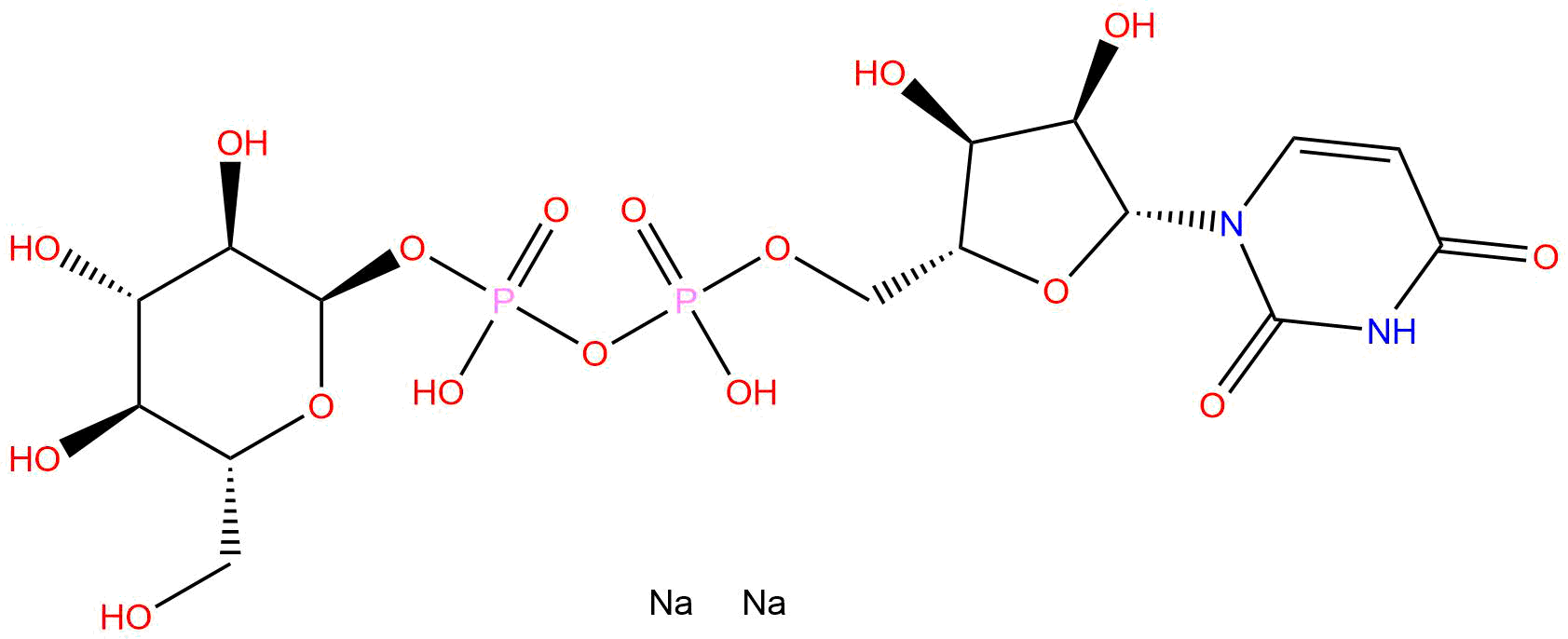
The chemical name of UDP glucose is uridine-5 '- glucose diphosphate disodium salt, CAS number 28053-08-9, molecular formula C15H22N2Na2O17P2, molecular weight 566.30. Its structure is composed of uridine nucleotides and glucose connected by a diphosphate bridge, belonging to nucleotide carbohydrate compounds. The structure contains multiple polar groups, including phosphate esters, hydroxyl groups, and amino groups, which endow it with high hydrophilicity.
In terms of physicochemical properties, the LogP value of UDP glucose is -2.82, indicating its extremely low hydrophobicity and high water solubility (115.55 mg/mL). It is highly soluble in water and difficult to diffuse freely through lipid membranes. Its topological polar surface area (TPSA) is as high as 296.99 Å ², further indicating its strong polarity and strong intermolecular hydrogen bonding ability. The low permeability of the blood-brain barrier suggests difficulty in entering the central nervous system. The negative result of hERG channel inhibition experiment indicates a low risk of cardiac toxicity. The Ames test score is 0.9, indicating a low risk of genotoxicity and good safety.
The structural characteristics of UDP glucose determine its metabolic stability and biological distribution in vivo, and its high polarity limits oral absorption, requiring appropriate administration strategies to improve bioavailability.
Plant sources and extraction methods
UDP glucose, as a widely present metabolic intermediate in cells, is widely present in various plant tissues, especially in rapidly growing tender leaves, root tips, and seeds with high levels. UDP glucose in plants is mainly synthesized by glucose-1-phosphate and uridine triphosphate (UTP) catalyzed by UDP glucose pyrophosphate (UGPase).
Traditional extraction methods often rely on the use of water solution extraction combined with ion exchange chromatography, affinity chromatography, and other techniques for purification after plant cell fragmentation. The specific steps include:
- Sample Pretreatment Select plant parts with abundant content, quickly freeze and grind to prevent enzymatic degradation.
- Water extraction Extract with cold water or buffer solution and maintain low temperature to prevent hydrolysis of UDP glucose.
- Ion exchange chromatography Remove impurities and enrich nucleotide sugars through anion exchange resin.
- Affinity chromatography purification Further purify UDP glucose using its specific binding properties.
- Concentration and drying: The pure product is obtained by freeze-drying or spray drying.
In recent years, biosynthesis and enzyme catalyzed synthesis have gradually become the mainstream technologies for preparing UDP glucose. The efficient synthesis of UDP glucose using recombinant enzyme systems has solved the problems of low plant extraction yield and difficult purity control, promoting its large-scale production and application.
Pharmacological activity research
UDP glucose, as a nucleotide sugar, exhibits various biological activities in pharmacological research, involving cellular metabolism regulation, immune regulation, tissue repair, and other fields.
1. Regulation of cellular metabolism
UDP glucose is an essential substrate for glycosyltransferases, involved in glycosylation modifications and regulating the functional states of proteins, lipids, and nucleic acids. Its key role in glucose metabolism affects cellular energy metabolism and signal transduction, indirectly regulating cell proliferation, differentiation, and apoptosis processes.
2. Immune regulatory effect
Research has shown that UDP glucose can act as an extracellular signaling molecule, mediating immune cell chemotaxis and activation through P2Y14 receptors, and regulating inflammatory responses. Its role in macrophages and dendritic cells helps regulate innate immune responses and has potential anti-inflammatory and immune regulatory functions.
3. Organizational repair and regeneration
UDP glucose participates in the synthesis of glycosaminoglycans and proteoglycans, promotes the formation of extracellular matrix, and has a positive effect on tissue repair and wound healing. Partial studies have shown that UDP glucose can promote the regeneration of liver cells and nerve cells, demonstrating potential tissue protection and repair capabilities.
4. Neuroprotective effect
Although UDP glucose has low blood-brain barrier permeability, it has a protective effect on neuronal function in the peripheral nervous system by regulating glycosylation status and energy metabolism. Partial in vitro and animal experiments support its potential application value in neurodegenerative diseases.
Mechanism of action and molecular targets
The biological function of UDP glucose mainly depends on its role as a sugar donor and its activity as an extracellular signaling molecule, involving multiple molecular targets and signaling pathways.
1. Glycosyltransferase substrate action
UDP glucose is a substrate for various glycosyltransferases, such as glucosyltransferases and glycosidases, and is involved in glycosylation modification processes. Glycosylation modification is an important form of post-translational modification of proteins, which affects the stability, activity, and cellular localization of proteins, regulates cell signaling and immune recognition.
2. P2Y14 receptor agonists
UDP glucose acts as an endogenous agonist of the P2Y14 receptor, regulating the chemotaxis and activation of immune cells. The P2Y14 receptor belongs to the G protein coupled receptor family, mediating extracellular nucleotide signaling and participating in inflammatory response and immune regulation. UDP glucose activates downstream MAPK and NF - κ B signaling pathways through this receptor, promoting cytokine secretion and immune cell function regulation.
3. Regulation of extracellular matrix synthesis
UDP glucose participates in the synthesis of glycosaminoglycans, regulates the composition and structure of extracellular matrix, and affects cell adhesion, migration, and tissue repair processes. The changes in glycosylation modification are closely related to various diseases such as fibrosis and tumor metastasis.
4. Metabolic signal regulation
UDP glucose, as a key intermediate in glucose metabolism, affects intracellular energy metabolism and metabolic signaling pathways, such as AMPK and mTOR signaling pathways, regulating cellular metabolic homeostasis and physiological functions.
Evaluation of drug properties and pharmacokinetics
The pharmacological characteristics of UDP glucose are influenced by its physicochemical properties and biological activity. The specific analysis is as follows:
1. Absorption and distribution
Due to the high polarity of UDP glucose molecules (TPSA 296.99 Å ²) and a LogP of -2.82, the oral absorption rate is low and it is difficult to passively diffuse through lipid membranes. It has good water solubility (115.55 mg/mL) and is suitable for the development of water-soluble formulations. The low permeability of the blood-brain barrier limits its direct action in the central nervous system.
2. Metabolism and excretion
UDP glucose is mainly metabolized in the body through enzymatic hydrolysis and glycosyltransfer reactions, producing uridine monophosphate and glucose derivatives. Its metabolites participate in multiple metabolic pathways, and excretion is mainly completed through the kidneys. Good metabolic stability, moderate half-life, suitable for clinical application.
3. Safety evaluation
The hERG channel inhibition experiment showed a negative result, indicating a low risk of cardiac toxicity. The Ames test score is 0.9, indicating a low risk of genotoxicity and good safety. Preclinical toxicology studies have shown good tolerance to UDP glucose, with no significant acute or chronic toxicity reactions.
4. Administration route and dosage form
Due to its polarity and absorption limitations, UDP glucose is suitable for intravenous injection, local administration, or enhanced bioavailability through nanocarrier systems. In the future, drug carrier technology can be used to improve its pharmacokinetic properties and expand its clinical applications.
Clinical application prospects and prospects
UDP glucose, as an endogenous nucleotide sugar, has multiple biological functions and good safety, demonstrating broad clinical application potential.
1. Inflammation and immune diseases
By regulating the P2Y14 receptor mediated immune cell function, UDP glucose is expected to be used to treat inflammatory diseases, autoimmune diseases and infectious diseases, playing the role of immune regulation and anti-inflammatory.
2. Organizational Repair and Regenerative Medicine
UDP glucose promotes extracellular matrix synthesis and tissue repair, suitable for wound healing, tissue engineering, and regenerative medicine fields. Especially in the repair of liver and nervous system injuries, it has potential application value.
3. Metabolic disorders
As a key intermediate of glucose metabolism, UDP glucose participates in regulating energy metabolism and may play an auxiliary role in the treatment of diabetes, obesity and metabolic syndrome.
4. Neurodegenerative diseases
Despite the limited permeability of the blood-brain barrier, UDP glucose has the potential to serve as a neuroprotective agent to assist in the treatment of neurodegenerative diseases by regulating the metabolism and glycosylation status of the peripheral nervous system.
5. Drug development and formulation innovation
In the future, by optimizing the structure modification, carrier system, and administration route, it is expected to overcome the absorption and distribution limitations of UDP glucose and improve its clinical efficacy. Combining modern drug delivery technology, UDP glucose and its derivatives are expected to become novel glycosyltransferase modulators and immunomodulators.
Conclusion
Uridine-5 '- diphosphoglucose disodium salt, as an important nucleotide carbohydrate natural product, has significant research value in the field of natural product pharmacology due to its unique chemical structure and diverse biological functions. Its key role in glycosylation modification, immune regulation, tissue repair, and metabolic regulation provides new ideas and targets for the treatment of related diseases.
Despite the limitations of absorption and distribution of UDP glucose, its good safety and multi-target mechanism of action have laid a solid foundation for drug development. In the future, combining modern biotechnology and drug delivery systems, UDP glucose is expected to have greater potential in clinical applications, promoting the development of natural product pharmacology and glycosylation related disease treatment.
Thorough pharmacological mechanism research, preclinical evaluation, and formulation optimization will be the key to promoting the conversion of UDP glucose into clinical drugs. Looking forward to more basic and applied research in the future, providing solid support for the drug development and clinical application of UDP glucose.