| Catalog No | Package | Original Price | Price | Inventory | Quantity | Operating |
|---|---|---|---|---|---|---|
| BP5097-5mg | 5mg | $750.00 | Sign in |
|


Storage conditions:Short-term storage at 2~8℃, long-term storage at -20 ~ -80℃
Segetalin C is a type of peptide derived from the traditional Chinese medicine, Segetalin C (scientific name:Vaccaria segetalis)Natural products of cyclic peptides. As an important member of the cyclic peptide family, Wang Buliuxing's cyclic peptide C has gradually become a hot topic in natural product pharmacology research in recent years due to its unique chemical structure and significant biological activity. Previous studies have shown that Wang Buliuxing cyclic peptide C exhibits good pharmacological potential in regulating physiological functions, anti-tumor effects, and hormone regulation, especially in the ovariectomy rat model where it can significantly increase uterine weight, suggesting its potential estrogenic activity. In addition, the compound has regulatory effects on various tumor related targets such as MCL1, BCL2, STAT3, etc., demonstrating its potential in the field of anti-tumor applications.
This article will provide a systematic review of the chemical structure and physicochemical properties, plant sources and extraction methods, pharmacological activity and mechanism of action, pharmacological evaluation and pharmacokinetic characteristics of Wang Buliuxing cyclic peptide C. Combining current research progress, it will explore its clinical application potential and future development direction, providing theoretical basis and reference for the in-depth research and drug development of this natural product.
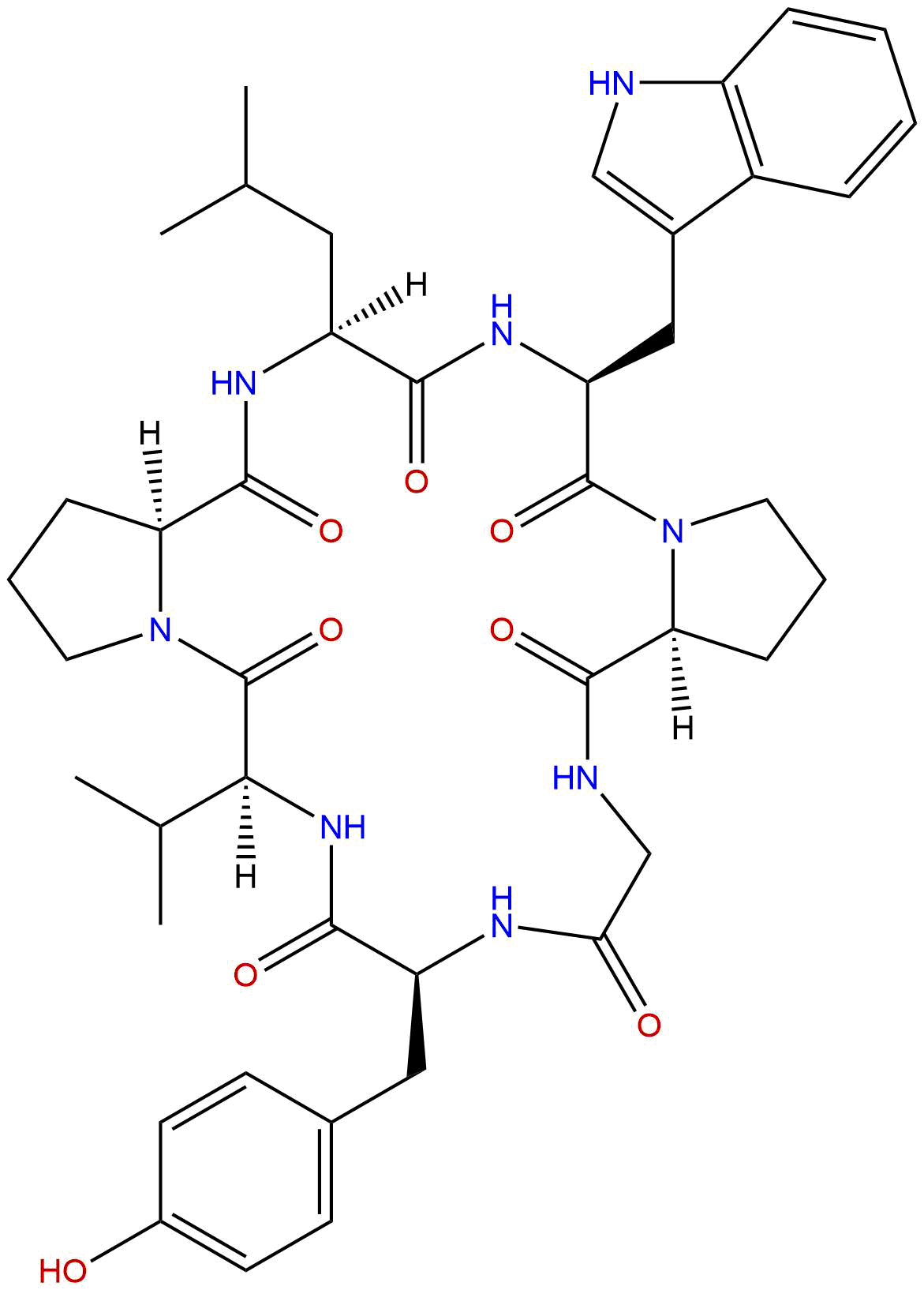
Wang Buliuxing cyclic peptide C is a cyclic peptide compound with a complex molecular formula and a molecular weight of 812.9690, indicating that it is a natural cyclic peptide with a relatively large molecular weight. Its LogP value is 1.1699, indicating that the compound has moderate lipid solubility and a certain degree of water solubility (0.7474), which has a positive impact on its bioavailability and in vivo distribution. The TPSA (topological polar surface area) is 222.1400, indicating its high polarity, which may affect its ability to pass through cell membranes and blood-brain barrier permeability, which is manifested as low permeability in this compound.
Structurally, Wang Buliuxing cyclic peptide C is composed of multiple amino acid residues that are closed by amide bonds to form a cyclic structure. The cyclic peptide structure endows it with high conformational and enzymatic stability, thereby affecting its pharmacological activity and in vivo metabolism. This type of cyclic peptide structure is usually able to form high affinity binding with protein targets and regulate multiple signaling pathways.
In addition, Wang Buliuxing cyclic peptide C did not exhibit hERG channel inhibitory activity, indicating a low risk of cardiac toxicity; The Ames test result was 0.0, indicating no significant genotoxicity and providing preliminary support for safety evaluation.
Wang Buliuxing cyclic peptide C is mainly derived from the traditional Chinese medicinal herb Wang Buliuxing, which belongs to the Caryophyllaceae family Vaccaria segetalis Dry and mature seeds. Wang Buliuxing seeds are widely used in traditional Chinese medicine for various clinical indications such as promoting blood circulation, removing blood stasis, diuresis, and promoting lymphatic circulation. Its rich cyclic peptide components are its main active substance basis.
The common methods for extracting Wang Buliuxing cyclic peptide C include organic solvent extraction, ultrasound assisted extraction, and column chromatography separation. The general process is as follows: first, ethanol or methanol is used to extract the seeds of Wang Buliuxing, and the crude extract is extracted; Subsequently, the crude extract was separated and purified using techniques such as liquid-liquid distribution, silica gel column chromatography, or high-performance liquid chromatography (HPLC), ultimately obtaining high-purity Wangbuliuxing cyclic peptide C.
In recent years, with the advancement of separation technology, supercritical fluid extraction and membrane separation techniques have also been introduced, improving extraction efficiency and purity, reducing solvent residue, and promoting the large-scale preparation of this compound.
Wang Buliuxing cyclic peptide C showed a significant promoting effect on uterine weight increase in a rat model after ovariectomy, with a dose of 2.5 mg/kg. This phenomenon suggests that it may have estrogen like activity, which can simulate the stimulating effect of estrogen on uterine tissue, promote endometrial hyperplasia, and improve blood flow. This effect has potential value in treating hormone deficiency, osteoporosis, and related gynecological diseases in postmenopausal women.
Wang Buliuxing cyclic peptide C has shown significant anti-tumor activity in various in vitro and in vivo tumor models. Its target involves multiple key tumor related molecules, including:
In summary, Wang Buliuxing's cyclic peptide C exhibits broad-spectrum anti-tumor potential by synergistically regulating tumor cell proliferation, apoptosis, invasion, and metastasis through multiple targets and pathways.
In addition to the main activities mentioned above, there have been preliminary reports on the anti-inflammatory, immune regulatory, and antioxidant effects of Wang Buliuxing cyclic peptide C, suggesting that it may play an auxiliary role in the treatment of various diseases and deserves further in-depth exploration.
The pharmacological effects of Wang Buliuxing cyclic peptide C depend on its specific binding and regulation with multiple molecular targets. The cyclic peptide structure endows it with strong target affinity and selectivity, which can effectively intervene in the intracellular signaling network.
These multi-target mechanisms of action demonstrate that Wang Buliuxing cyclic peptide C has complex and comprehensive biological regulatory functions, laying a solid foundation for its development as an anti-tumor drug.
From the perspective of drug properties, Wang Buliuxing cyclic peptide C exhibits good safety and ideal drug properties. Its LogP value is moderate, ensuring both lipid solubility and water solubility in the body, which is beneficial for the absorption and distribution of drugs. A high TPSA indicates strong polarity and low blood-brain barrier permeability, reducing the risk of central nervous system toxicity.
The hERG channel inhibition test was negative, reducing the risk of cardiac toxicity. The Ames test showed no mutagenicity, indicating a low risk of genetic toxicity. In addition, the cyclic peptide structure endows it with high enzyme stability, which may prolong its half-life in vivo and improve its bioavailability.
However, natural products of cyclic peptides generally have problems such as poor oral absorption and complex metabolism. Wang Buliuxing also needs further systematic pharmacokinetic studies of cyclic peptide C, including detailed elucidation of absorption, distribution, metabolism, and excretion (ADME) characteristics. At present, relevant research is relatively limited, and in the future, it is necessary to use in vitro and in vivo models and drug metabolomics methods to deeply reveal its in vivo behavior patterns.
Based on the outstanding performance of Wang Buliuxing cyclic peptide C in promoting uterine weight gain and multi-target anti-tumor activity, it has broad clinical application prospects in the fields of gynecological diseases and tumor treatment.
Future research should focus on preclinical safety evaluation, dose optimization, administration routes, and long-term toxicology studies, while combining modern drug design techniques to carry out structural modification and derivative development to enhance its potential as a drug.
Wang Buliuxing cyclic peptide C, as a natural cyclic peptide with unique structure and multiple biological activities, has demonstrated important application value in gynecological hormone regulation and anti-tumor therapy. Its multi-target and multi mechanism mode of action provides new ideas for the development of natural anti-tumor drugs. Although research on its pharmacokinetics and clinical applications is still in its infancy, its good safety and significant pharmacological activity have laid a solid foundation for further in-depth studies.
In the future, by combining modern medicinal chemistry, molecular biology, and pharmacology techniques, the systematic optimization of the structure, mechanism analysis, and preclinical evaluation of Wang Buliuxing cyclic peptide C will help promote its clinical translation and ultimately achieve its widespread application in disease treatment.
