Introduction/Overview
Natural products have long been an important source of innovative drug discovery, and their structural diversity and wide range of biological activities provide unique molecular frameworks for addressing various disease challenges. Among numerous natural active molecules, polyketide compounds have attracted much attention due to their complex chemical structures and significant pharmacological effects. Methyl eugenol (Eugenitin, CAS number: 480-12-6) is one example, which is a polyketide derivative isolated from specific fungi. Although its structure is relatively simple, preliminary studies have revealed its biological activity in the field of anti infection, especially in anti parasitic and potential antibacterial aspects, such as its inhibitory effect on Leishmania major. Meanwhile, its low cytotoxicity towards multiple human cancer cell lines suggests that it may have good selectivity. With the increasingly severe problem of drug resistance worldwide, especially the spread of bacterial and fungal resistance, it is particularly urgent to search for lead compounds with new mechanisms of action from natural products. The discovery of methyl eugenol provides a candidate molecule worth further exploration for the development of new anti infective drugs. This article aims to systematically review the chemical properties, sources, pharmacological activities, potential mechanisms of action, pharmacological properties, and future research and development prospects of methyl eugenol, in order to provide comprehensive scientific references for the subsequent research and development of this compound.
Chemical structure and physicochemical properties
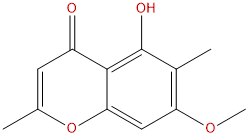
Methyl eugenol ketone, commonly known as 5-hydroxy-7-methoxy-2-methyl ketone, is a typical ketone like polyketide compound. Its molecular formula is C12H12O4 and its molecular weight is 220.2240 g/mol. Structurally, it consists of a benzopyranone (chromone) core with hydroxyl and methoxy substituents at positions 5 and 7, respectively, and a methyl group at position 2. This specific substitution pattern has a decisive impact on its physicochemical properties and biological activity.
Its physical and chemical properties conform to the characteristics of medium polarity small molecule compounds. The calculated lipid water partition coefficient (LogP) is 1.9952, indicating that the compound has moderate lipophilicity, which theoretically facilitates its penetration into cell membranes. The topologically polar surface area (TPSA) is 59.6700 Å ², which is relatively small and usually advantageous for the membrane permeability of the compound. The predicted value of water solubility is about 0.2256 mg/mL, which belongs to the range of slightly soluble to poorly soluble. This may pose challenges in formulation development and requires optimization through salt form, prodrug, or formulation technology. Preliminary drug risk assessment shows that its ability to cross the blood-brain barrier is relatively low, which to some extent limits its application in central nervous system infections, but may also reduce potential neurotoxic risks. In addition, its hERG channel inhibition risk is negative, indicating a low likelihood of causing prolonged QT interval in the heart. The Ames test result is 0.6 (usually expressed in terms of mutation rate, which needs to be judged based on specific experimental thresholds. This value suggests that the risk of mutagenicity may be low), providing preliminary positive signals for its genetic toxicity safety.
Plant sources and extraction methods
Strictly speaking, methyl eugenol is not directly derived from higher plants, but from endophytic fungi associated with medicinal plants in South America Mycoleptodiscus indicus Obtained through separation. This discovery highlights the importance of microorganisms, especially endophytic fungi, as a treasure trove of novel bioactive substances. Endophytic fungi live within healthy plant tissues, forming symbiotic relationships with their hosts and producing a series of structurally novel and uniquely active secondary metabolites to help hosts adapt to their environment or resist pathogens.
The extraction and isolation of methyl eugenol from fungal fermentation products usually follow the conventional process of natural product chemistry. Firstly, regarding Mycoleptodiscus indicus The strain undergoes large-scale liquid fermentation cultivation. After cultivation, the mycelium is separated from the fermentation broth by filtration or centrifugation. The active ingredient may exist in the mycelium or fermentation broth, or both, and therefore needs to be treated separately. Common extraction methods include:
1. Organic solvent extraction For fermentation broth, organic solvents such as ethyl acetate, dichloromethane, or n-butanol are commonly used for multiple extractions to enrich the concentrated polar target components. The mycelium is usually dried and crushed first, and then soaked in polar solvents such as methanol and acetone or extracted by ultrasound.
2. Coarse separation Combine the organic extracts and concentrate them under reduced pressure to obtain a paste. The extract can then be gradually separated and purified using a variety of chromatographic techniques, such as silica gel column chromatography (elution with different proportions of petroleum ether ethyl acetate or chloroform methanol gradient), Sephadex LH-20 column chromatography and high performance liquid chromatography (HPLC).
3. appraisal The final pure compound was structurally identified by spectroscopic techniques such as nuclear magnetic resonance (NMR, including 1H NMR and 13C NMR), mass spectrometry (MS), infrared spectroscopy (IR), and ultraviolet spectroscopy (UV), and compared with literature data or standard samples to confirm its identity as methyl eugenol.
Pharmacological activity research
The pharmacological activity research of methyl eugenol is currently in its early stages, but it has shown its potential in specific fields, mainly focused on anti infection and cytotoxicity evaluation.
-
Antiparasitic activity:
The most significant activity report is directed towards the protozoan parasite, the Omicron parasite(Leishmania major). Leishmaniasis is a neglected tropical disease caused by Leishmania parasites and transmitted by sandflies. Research has shown that methyl eugenol has an effect on this parasite Pre flagellar body The form exhibits inhibitory activity, with a median lethal dose (LD50) of 39.9 μ M. This level of activity makes it a promising lead compound for anti leishmaniasis, worthy of further structural optimization and in vivo pharmacological evaluation.
-
Antibacterial potential (based on target association):
Although direct antibacterial activity experimental data is limited in existing publicly available materials, based on its related molecular target information, it can be inferred that methyl eugenol may have broad-spectrum antibacterial (including antibacterial and antifungal) potential. These targets cover key enzyme systems for the survival of bacteria and fungi:
- Antibacterial targets Including DNA gyrase subunit A (GYRA, involved in DNA replication), cell division protein FtsZ (FTSZ, a key regulator of bacterial division), acyl carrier protein reductase (FABI, a key enzyme in bacterial fatty acid biosynthesis), dihydrofolate reductase (DHFR, a key enzyme in folate metabolism), etc. These targets are currently hot topics in the development of antibacterial drugs.
- Antifungal target Including lanosterol 14 α - demethylase (ERG11/CYP51A1, a key enzyme in ergosterol biosynthesis and a major target of azole antifungal drugs) and efflux pump proteins (such as CDR1). Methyl eugenol may exert antifungal effects by inhibiting ergosterol synthesis or overcoming efflux pump resistance mechanisms.
- In addition, penicillin binding protein (PENA) and methicillin-resistant protein (MECA) associated with β - lactam resistance have also been listed as relevant targets, suggesting that the compound may have an effect on drug-resistant strains.
-
Cytotoxicity assessment:
It is crucial to evaluate the toxicity of compounds to normal or non target cells in the early stages of drug discovery. Research shows that methyl eugenol has an effect on Several human cancer cell lines The cell toxicity is relatively low, with a half maximal inhibitory concentration (IC50) greater than 131 μ M. This value is much higher than its LD50 (39.9 μ M) against Leishmania parasites, suggesting that the compound may have certain Selective toxicity The killing effect on parasites is stronger than the damage to mammalian cells, which is a positive signal. Of course, validation still needs to be conducted on a wider range of normal human cell lines.
Mechanism of action and molecular targets
The exact mechanism of action of methyl eugenol has not been fully elucidated, but based on its rich target information, it can be speculated that it may exert anti infective effects through multi-target action, which may be a potential advantage in overcoming the susceptibility of single target drugs to drug resistance.
-
Possible mechanisms of resistance to Leishmania parasites There is limited research on the mechanism of action of Leishmania parasites. Given its polyketide structure, it may interfere with the metabolic pathways of parasites, such as mitochondrial function, oxidative stress response, or specific enzyme systems. Further biochemical and cellular biology research is needed to determine the specific targets within the protozoa.
-
Potential multi-target mechanism of antibacterial activity:
- Inhibition of nucleic acid synthesis By binding to DNA gyrase (GYRA), it interferes with the supercoiling of bacterial DNA, preventing DNA replication and transcription.
- Disrupting cell division By binding to the bacterial microtubule protein homolog FtsZ protein, it inhibits its polymerization to form a Z loop, thereby blocking the bacterial division process.
- Interference with metabolic pathways Inhibition of FABI can block the biosynthesis of bacterial fatty acids; Inhibiting DHFR interferes with folate metabolism and affects nucleotide synthesis.
- Targeting cell wall synthesis related targets The association with penicillin binding proteins such as PENA suggests that it may affect the synthesis of cell wall peptidoglycans.
-
Potential mechanisms of antifungal activity:
- Inhibition of ergosterol synthesis Like azole drugs, they may disrupt fungal cell membrane integrity by inhibiting CYP51A1 (ERG11) enzyme.
- Inhibit the discharge pump Targeting efflux pump proteins such as CDR1 may reverse fungal resistance to existing drugs or enhance the efficacy of other antifungal drugs.
It should be emphasized that the associations between these targets are mostly derived from computational predictions or preliminary molecular docking studies. To confirm the direct binding, inhibitory activity, and functional contribution of methyl eugenol to these target proteins, it is necessary to Surface Plasmon Resonance (SPR), Isothermal Titration Calorimetry (ITC), Enzyme Activity Inhibition Experiment, Gene Knockout/Overexpression Validation Further verification through experimental methods.
Evaluation of drug properties and pharmacokinetics
The drug efficacy evaluation (DMPK) based on computational and preliminary experimental data is a key step in determining whether a lead compound can advance towards the drug direction.
-
Absorption, distribution, metabolism, excretion (ADME) prediction:
- absorb Moderate LogP (~2) and smaller TPSA (~60 Å ²) are beneficial for its passive diffusion through biofilms, suggesting that oral absorption may be feasible, but the specific bioavailability needs to be confirmed through in vivo experiments.
- distribution Predict low blood-brain barrier permeability, mainly distributed in peripheral tissues. This may be sufficient for treating systemic or cutaneous leishmaniasis, but not beneficial for central nervous system infections.
- Metabolism The presence of hydroxyl and methoxy groups in the structure is a common site for phase I metabolism (such as oxidation and demethylation) and phase II metabolism (such as glucuronidation and sulfation). The metabolic stability and major metabolites need to be evaluated through liver microsomal or hepatocyte incubation experiments.
- excretion Metabolites may be mainly excreted through the kidneys or bile.
-
Preliminary Safety Assessment:
- cardiotoxicity HERG inhibition negativity is an important safety advantage.
- Genotoxicity The preliminary results of Ames test (0.6) suggest a low risk, but a complete genetic toxicity test combination (such as micronucleus test, chromosome aberration test) needs to be completed.
- cytotoxicity The low toxicity to cancer cells (IC50>131 μ M) is a positive signal, but its toxicity to normal liver cells, kidney cells, hematopoietic cells, etc. still needs to be evaluated.
-
Research gap in pharmacokinetics (PK)Currently, there is a lack of in vivo pharmacokinetic data on methyl eugenol, such as Plasma half-life, clearance rate, apparent volume of distribution, absolute bioavailability Wait. These data are crucial for determining the dosing regimen. Future research requires single and multiple dose PK studies in animal models such as mice and rats.
-
Pharmaceutical Challenge Its low water solubility is the primary issue that needs to be addressed in formulation development. It may be necessary to explore solubilization technologies such as nanocrystals, liposomes, cyclodextrin inclusion complexes, solid dispersions, or design prodrugs with better water solubility.
Clinical application prospects and prospects
Methyl eugenol, as a natural lead compound with a unique structure, its clinical application prospects mainly depend on the results of subsequent in-depth research and face a series of challenges and opportunities.
-
Potential application directions:
- Antileishmaniasis drugs This is currently the direction supported by the most experimental data. Given the existing drugs for leishmaniasis, such as antimony agents, amphotericin B, and amitriptyline, which suffer from high toxicity, long treatment duration, and increased drug resistance, there is an urgent need to develop new, safe, and effective drugs. Methyl eugenol can be optimized as a lead compound.
- New antibacterial/antifungal agents If its multi-target antibacterial mechanism is experimentally confirmed, it may become a candidate molecule for combating multidrug-resistant bacteria (such as MRSA, drug-resistant tuberculosis bacteria) and fungi (such as drug-resistant Candida, Aspergillus). Especially targeting non classical targets such as FtsZ and FABI, it may bring new mechanisms of action.
-
R&D Challenge:
- The activity intensity needs to be increased The LD50 of anti Leishmania parasite is 39.9 μ M, which is still far from being a highly effective drug. need to pass through Structure Activity Relationship (SAR) Study Perform chemical modifications, such as modifying hydroxyl, methoxy, methyl groups, or introducing other pharmacophores, to enhance their potency and selectivity.
- The mechanism of action needs to be confirmed It is necessary to clarify the authenticity of its primary target and multi-target synergistic effect through experiments.
- Pharmaceutical properties need to be optimized Water solubility and metabolic stability may be the main optimization directions. Comprehensive in vivo pharmacological, pharmacokinetic, and toxicological evaluations are essential for advancing preclinical research.
- Source and synthesis Dependence on fungal fermentation yield may be limited and requires development Fully synthetic or semi synthetic routes To ensure the supply of raw materials and facilitate structural modification.
-
Future Prospects:
- Structure based drug design If the eutectic structure of methyl eugenol with key targets such as FtsZ and CYP51 can be obtained, it will greatly promote rational drug design and quickly obtain optimized derivatives.
- Exploration of combination therapy Given its potential multi-target nature, explore its synergistic effect with existing anti infective drugs to reduce dosage and decrease the development of drug resistance.
- Expand biological activity screening In addition to anti infection, its activity in other fields such as anti-inflammatory and immune regulation can also be explored.
Conclusion
As a polyketide natural product discovered from endophytic fungi, methyl eugenicol has demonstrated its potential as a lead compound for anti infective drugs due to its activity against Leishmania parasites, potential effects on key targets of various pathogens, and relatively low toxicity to mammalian cells. It reveals the enormous value of microbial resources, especially endophytic fungi that symbiotically coexist with medicinal plants, in the discovery of new drug molecules. At present, research on this compound is still in its early stages, and its exact molecular mechanism of action, in vivo pharmacological and pharmacokinetic properties, as well as structural optimization space, need to be further explored. In the face of the increasingly severe global challenge of drug resistance, systematic research on molecules with novel structures and multi-target potential, such as methyl eugenol, not only helps to develop new therapeutic weapons, but may also provide new perspectives for understanding pathogen biology. Future research should focus on elucidating its target through chemical biology methods, optimizing its activity and drug properties through medicinal chemistry strategies, and verifying its therapeutic potential through preclinical studies, in order to promote this natural molecule towards candidate drugs.