
licoriceGlycyrrhiza uralensisFisch.It is a leguminous Glycyrrhiza plant, widely distributed in northwest, North China, northeast and other regions of China[1]At the same time, licorice is one of the original plants of licorice, which is widely used in medicine, food, cosmetics and other industries[2]The research on genetic diversity of Glycyrrhiza uralensis mainly focuses on2000—2012In, researchers carried out a comprehensive and systematic investigation of wild Glycyrrhiza resources across the country, studied Glycyrrhiza uralensis from different provenances, and found that there were significant differences in morphology, glycyrrhizin and glycyrrhizic acid content, genetic material and other aspects, and there was also a certain degree of variation within the same provenance. It can be seen that the rich genetic diversity of Glycyrrhiza uralensis is widely recognized. In recent years, the research on the chemical constituents of Glycyrrhiza uralensis has gradually deepened[3], more chemical components can be detected simultaneously[4-5]And the research gradually focused on the effect of exogenous substances on the yield and quality of Glycyrrhiza uralensis[6]And functional genes related to glycyrrhizin and glycyrrhizin biosynthesis[7]. However, the progress of Glycyrrhiza variety breeding has been slow, and the main reason is that Glycyrrhiza3Characteristics of plants that bloom more than years ago[8], as well as the uncontrollability of variation within the licorice population. In addition, the time for studying the same object is mostly limited to3. Most of the germplasm materials in this experiment came from our research groupstay2002The samples collected during the national survey in ensured that the same germplasm came from a group of individuals with similar wild forms, and simulated the farmland ecological environment for many years to minimize the impact of the original ecological environment on the germplasm morphology and chemical composition content. In this experiment, the samples with good growth and complete fruit sequence42Accessions were selected as the research object12Morphological traits and5In order to speed up the process of Glycyrrhiza uralensis breeding, the genetic diversity of four chemical components was studied and excellent germplasm was screened.
1 Materials and methods
1.1 material
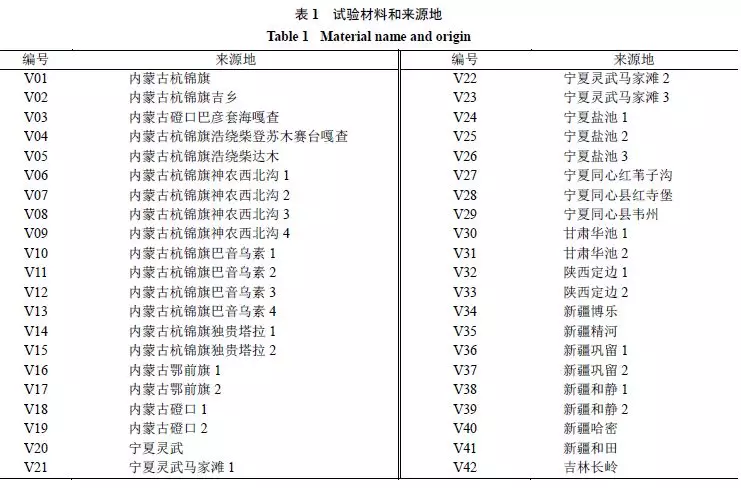
The test material is42Copies domesticlicoriceGlycyrrhiza uralensis Fisch. Germplasm, including Inner Mongolia19Copies, Ningxia10Copies, Xinjiang8Copies, Gansu and Shaanxi2Copies, Jilin1Copies, see table1。
1.2 method
1.2.1 experimental design 42Liquorice germplasm materials as the research group2001—2010. Before transplanting, the length of the transverse stem was trimmed to15~20 cm, and the transplanting depth was20 cm, line spacing30 cmThe underground stems of the same germplasm are planted in the same plot and set between different plots1.5 mAs a protective row, corn is planted in the protective row and cut every year to prevent the underground stems of different germplasm of Glycyrrhiza uralensis. /Stout) on the growth of morphological traits.
1.2.2 Character investigation and content determination For the measurement method of above ground morphological traits of Glycyrrhiza uralensis, refer to Weishengli et al[9], Yu Fulai, et al[10]According to the determination standard, the plant height, plant width, stem diameter, compound leaf length, upper limit of leaflet number, lower limit of leaflet number, leaflet length, leaflet width, inflorescence length, inflorescence width, inflorescence stalk length, and actual inflorescence length were selected12Morphological trait indexes were selected randomly for each Germplasm10Strains were used as samples for morphological data collection. Meanwhile, each germplasm collection3Parts of root material with uniform thickness is used as the experimental material for the detection of main chemical components, with reference to jinyanqing et al[11]Determination method ofglycyrrhizic acid、liquiritin 、Liquiritigenin、Isoliquiritigenin、IsoliquiritigeninThe relative content of.
1.2.3 Data standardization and statistical analysis applySPSS 19.0The software analyzed the coefficient of variation of each trait(coefficient of variation,CV), genetic diversity index(Shannon-Wienerindex,H′). According to the calculation results, each property of all materials is divided into10Grades, per1Relative frequency of stage(P)ForH′Calculations.
H′=−∑PilnPi
PiIndicates the number ofiFrequency of variant types
Principal component analysis and cluster analysis inSAS 8.2In the software, the average value of various groups isMicrosoft Excel 2010The software was completed, and the distance between accessions wasEuclideanDistance, and cluster analysis was performed using the sum of squared deviations method(Ward’ method)。
2 Results and analysis
2.1 Variation of main chemical components in Glycyrrhiza uralensis
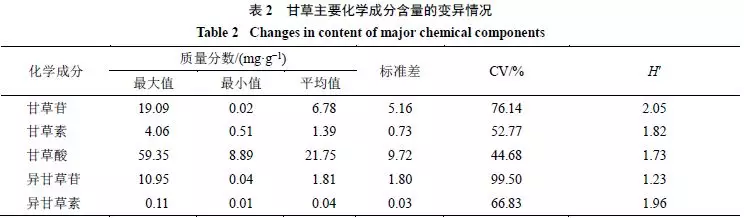
《Chinese Pharmacopoeia》2015Glycyrrhizic acid and glycyrrhizin are the indicators of the quality of Glycyrrhiza uralensis Fisch[2]Liquiritigenin, isoliquiritigenin and isoliquiritigenin are related substances in the biosynthetic pathway of liquiritin. From table2It can be seen that the content of liquiritin in each chemical component isH′Up to2.05, isoliquiritigenin contentH′Min1.23, the content of other chemical componentsH′The order of size was isoliquiritigenin > liquiritigenin > glycyrrhizic acid,5Chemical compositionH′The average of1.76. isoliquiritigenin contentCVMax99.50%, and the variation amplitude was0.04~10.95 mg/g; for other traitsCVAnd the range of variation was in the order of liquiritinCVby76.14%, and the variation amplitude was0.02~19.09 mg/g; isoliquiritigeninCVby66.83%, and the variation amplitude was0.01~0.11 mg/g; glycyrrhizinCVby52.77%, and the variation amplitude was0.51~4.06 mg/g; glycyrrhizic acidCVby44.68%, and the variation amplitude was8.89~59.35 mg/g; averageCVby67.98%,4Of flavonoidsCVWere higher than those of glycyrrhizic acidCV, flavonoid glycosidesCVMore than its aglycone, isoliquiritigenin, isoliquiritigenin represented chalcone compoundsCV(83.16%)> glycyrrhizin, liquiritigenin as the representative of dihydroflavonoid compoundsCV(64.46%)> of triterpenoids represented by glycyrrhizic acidCV(44.68%). It can be seen that there are differences in the variation degree of different classes of compounds among liquorice germplasm.
2.2 Correlation analysis of main chemical components
From table3It can be seen that the content of liquiritin and isoliquiritigenin is moderately positively correlated, and isoliquiritigenin is low positively correlated with liquiritigenin and liquiritigenin. Liquiritigenin, liquiritigenin, isoliquiritigenin and isoliquiritigenin belong to flavonoids, which are all shikimic acid pathway and acetic acid-The product of malonic acid pathway biosynthesis, with coumaroyl coenzymeAAnd malonyl coenzymeA(CHS)(CHR)Isoliquiritigenin is synthesized under the regulation of genes, and further interacts withβ-D-Isoliquiritigenin was synthesized from glucopyranose, and isoliquiritigenin inOtone isomerase(CHI)Glycyrrhizin is synthesized under the regulation of genes, and glycyrrhizin further interacts withβ-D-Glucopyranose binding to produce glycyrrhizin[12]。
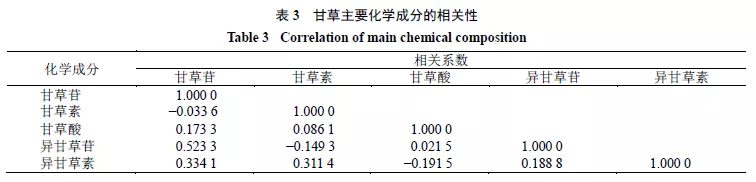
It can be seen that there is a clear direct and indirect relationship among liquiritigenin, liquiritigenin and isoliquiritigenin. Therefore, when breeding varieties, we should not only focus on liquiritigenin, but also the content of liquiritigenin, liquiritigenin and isoliquiritigenin. The aglycone of isoliquiritigenin is isoliquiritigenin, which is a related substance in the biosynthesis of liquiritigenin, and has a strong correlation with liquiritigenin. Therefore, the content of isoliquiritigenin should also be paid attention to in quality detection and variety breeding; Glycyrrhizic acid belongs to triterpenoids and is the product of mevalonate pathway. The experimental results showed that the content of glycyrrhizic acid was similar to that of other4There is no correlation in the content of flavonoids. It is presumed that the two kinds of compounds belong to different biosynthetic pathways. .
2.3 Variation of main morphological traits of Glycyrrhiza uralensis
When classifying and describing the measurement indicators, plant height, plant width and stem diameter are taken as the measurement indicators of plant type description, compound leaf length, leaflet number, leaflet length and leaflet width are taken as the measurement indicators of leaf type description, and inflorescence length, inflorescence width, actual inflorescence length and inflorescence stalk length are taken as the measurement indicators of fruit type description. From table4It can be seen that the plant height of some morphological traits in different regionsH′Up to2.08, upper limit of leaflet numberH′Min1.10, genetic diversity of the remaining traitsThe sex index was in the order of compound leaf length > stem length > actual fruit length > stem diameter > plant width.The results showed that the average sex index of the two species was 0.05%, 0.05%, 0.05%, 0.05%, 0.05%, 0.05%, 0.05%, 0.05%, 0.05%, 0/Inflorescence length > leaflet width > leaflet length > inflorescence width > lower limit of leaflet number. Comparison of plant type and fruit type indexesH′The mean values of1.94and1.85, blade typeH′The average of1.54It can be seen that the genetic diversity of plant type and fruit type of different germplasm of Glycyrrhiza uralensis is relatively greater than that of leaf type.
The results showed that there were large differences in some morphological traits among different local varieties, and the actual inflorescence was longCVMax37.09%, and the variation amplitude was1.20~13.90 cmAt the same time, the fruit sequence is wide(34.56%)Length of handle(34.54%)OfCVRelatively large, it can be seen that different liquorice accessions have large differences in the shape and size of inflorescenceVariants; For other traitsCVFollowed by stem diameter(29.75%)> plant width(27.56%)> long inflorescence(27.35%)> leaflet width(24.65%)>Plant height(23.00%)> leaflet length(22.26%)(21.89%)> lower limit of leaflet number(20.05%)> upper limit of leaflet number(14.34%). Fruit type, plant type, leaf typeCVThe mean values of33.39%、26.77%、20.24%, indicating that the variation of leaf type is less than that of fruit type and plant type. From the above results, we can see that there are abundant variations among different germplasm of Glycyrrhiza uralensis, and the variation is more concentrated on fruit type and plant type. Therefore, in the process of germplasm collection and variety breeding, we should pay more attention to the variation of fruit type and plant type.
2.4 cluster analysis
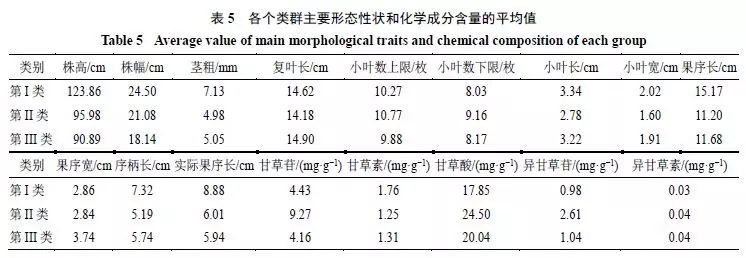
From Fig1According to the plant height, compound leaf length, fruit order length, etc12individualMorphological characters and glycyrrhizin, glycyrrhizic acid, etc5Chemical components were used as indicatorswardMethod, taking the Euclidean distance as the genetic distance, and taking the genetic distance as6.6When the42Accessions were divided into3Groups, of whichITaxa10Copies, pageIITaxa21Copies, pageIIITaxa11.By table5It can be seen that NoITaxa10Liquiritin of accessions(4.43 mg/g)And glycyrrhizic acid(17.85 mg/g)2015The annual standard (liquiritin >5.00 mg/g, glycyrrhizic acid >20.00 mg/g)3The content of liquiritigenin was the highest among the three groups. At the same time, compared with the other two groups, the above ground morphological traits of these groups include plant height, plant width, stem diameter, leaflet length and leaflet width of leaf type indicators, and the fruit type indicators of inflorescence length, actual inflorescence length, and inflorescence stalk length are the largest. It can be seen that the above ground morphological traits of these groups are mainly characterized by tall and stout plant type, large leaflets, long cylindrical inflorescence, and long inflorescence stalk. The yield and other agronomic traits of these groups can be investigated, and the above ground part can be emphatically developed; PageIITaxonomic21Liquiritin of accessions(9.27 mg/g)And glycyrrhizic acid(24.50 mg/g)The content reached Chinese Pharmacopoeia2015The content of isoliquiritigenin and isoliquiritigenin is3The content of liquiritigenin was the lowest among the four groups. The main morphological traits of its aboveground part are as follows: the upper and lower limits of the number of leaflets are the most, and the stem diameter, compound leaf length, leaflet length, leaflet width, infructescence length, infructescence width, infructescence stalk length are3The smallest of the groups. When the high content of glycyrrhizin and glycyrrhizic acid is taken as the breeding target of new varieties of Glycyrrhiza uralensis, such materials have great potential, and their external main morphological characteristics are small leaves and large number (about11The shape of inflorescence is short, cylindrical or spherical, and the inflorescence stalk is short, and the erect stem is not thick; PageIIITaxonomic11Liquiritin of accessions(4.16 mg/g)The content does not reach Chinese Pharmacopoeia2015The annual standard is3The lowest among the groups, but glycyrrhizic acid(20.04 mg/g)Content up to Chinese Pharmacopoeia2015Annual standard. Plant height, plant width, upper limit of leaflet number and actual fruit sequence length are3Among the four groups, it is the smallest, and the compound leaf length and fruit sequence width are the largest. The main characteristics are short plants and few leaflets (about9The shape of the inflorescence is nearly spherical, which can be used as a germplasm material for windbreak and sand fixation.
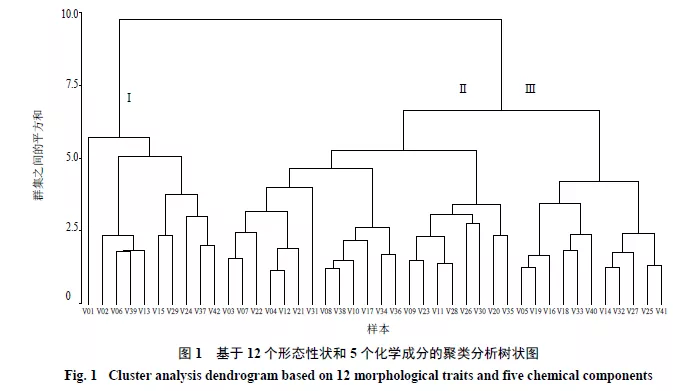
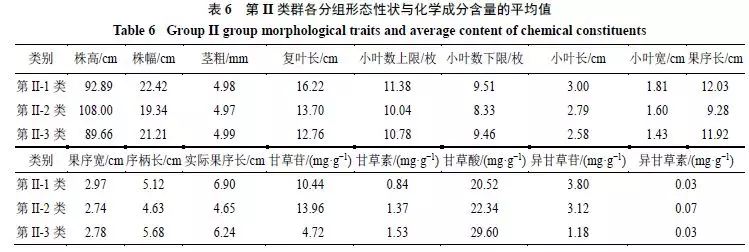
From the above results, we can see that theIIThe germplasm of taxa has great potential in the breeding of new varieties, and contains a large number of germplasm, so its potential should be further explored. At a genetic distance of4.6When the21Accessions were divided into3Subgroups, of which noII-1Taxa7Accessions, PII-2Taxa6Accessions, PII-3Taxa8Accessions. By table6It can be seen that NoII-1The content of glycyrrhizin and glycyrrhizic acid in the group were higher, which could meet the quality requirements, and the content of glycyrrhizin and glycyrrhizic acid in the secondIIOn the basis of the characteristics of the group, the plant type is relatively tall, and the shape of the infructescence is relatively short and cylindrical; PageII-2The chemical composition content of the groups showed a high advantage, which mainly showed that the plant type was larger and the plant width was smaller, and the fruit order shape was close to spherical; PageII-3The group showed outstanding advantages in glycyrrhizic acid content, but its glycyrrhizin content was relatively low, the plant type was shorter and the leaflet was smaller, which was similar toII-1、II-2The main difference between.II-1WithII-2The groups can be used as germplasm materials for the breeding of new liquorice varieties, andII-2The group has more advantages in the content of main chemical components, but its yield still needs further investigation;II-3The group has outstanding advantages in glycyrrhizic acid content. When ignoring glycyrrhizin content and only pursuing glycyrrhizic acid content, that is, when used to extract glycyrrhizic acid, this kind of germplasm will have better potential.
2.5 principal component analysis
right42Of accessions12Morphological traits and5Chemical components were analyzed by principal component analysis, and the extracted characteristic values were greater than1The principal component of the17Personality simplified to6Factors, with a cumulative contribution rate of72.96%, including17Most information of personality indicators. factor1As a comprehensive factor, it reflects the characteristics of the morphology and chemical composition of the whole plant2Is the leaf shape factor, factor3Is the fruit type factor, factor4Is plant type factor, factor5Aglycone factor as the main flavonoid component, factor6It is the glycoside factor of the main flavonoids and triterpenoids, reflecting the morphological characteristics and chemical composition characteristics of each part of the plant respectively.
From table7It can be seen that No1The eigenvalues of the principal components are3.46, with a contribution rate of20.37%In its eigenvector, the traits with higher load and positive value have small leaf width(0.40), leaflet length(0.37)Length of handle(0.35), plant height(0.33), stem diameter(0.32). Leaflet length, leaflet width, plant height and stem diameter4The increase of traits will increase the aboveground biomass, and has a great positive correlation with the yield[13], but at the same time, it will reduce glycyrrhizin(−0.28), isoliquiritigenin(−0.21)And glycyrrhizic acid(−0.17)The quality of licorice will be reduced. It can be seen that the increase of aboveground biomass will affect the accumulation of major secondary metabolites in the underground part, so the aboveground biomass should not be excessively pursued in the process of Glycyrrhiza variety breeding.
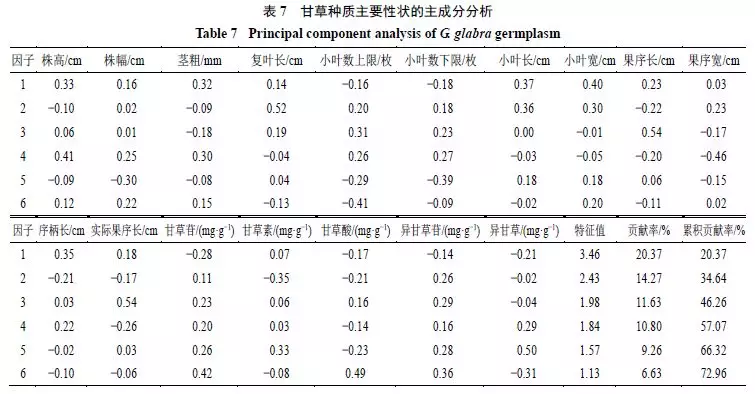
Page2The eigenvalues of the principal components are2.43, with a contribution rate of14.27%In its eigenvector, the trait with higher load and positive value is compound leaf length(0.52), leaflet length(0.36), leaflet width(0.30), this3Traits are indicators of leaf characteristics, compound leaf length and leaf size[14]The increase of glycyrrhizin would increase the efficiency of photosynthesis and then increase the yield, but at the same time reduce the glycyrrhizin(−0.35)And glycyrrhizic acid(−0.21)Liquiritigenin is the precursor of glycyrrhizin biosynthesis, so the reduction of liquiritigenin will lead to the reduction of liquiritigenin content to a certain extent. In order to obtain high-quality new varieties of Glycyrrhiza uralensis in breeding, the mother parent with relatively small leaves and short compound leaves should be selected.
Page3The eigenvalues of the principal components are1.98, with a contribution rate of11.63%In its eigenvector, the trait with higher load and positive value is inflorescence length(0.54)(0.54)(0.31), isoliquiritigenin(0.29)Due to the strong correlation between isoliquiritigenin content and liquiritigenin content, in order to improve the content of liquiritigenin, when formulating the morphological standard for screening excellent germplasm, we should appropriately reduce the length of its fruiting sequence and actual fruiting sequence, as well as reduce the number of leaflets.
Page4The eigenvalues of the principal components are1.84, with a contribution rate of10.80%(0.41), stem diameter(0.30), isoliquiritigenin(0.29), isoliquiritigeninIt is indirectly related to glycyrrhizin synthesis. Therefore, when selecting Germplasm with high glycyrrhizin content, the plant height of selected germplasm should not be too low and the stem diameter should not be too fine. (−0.45)The shape of the inflorescence showed a cylindrical change.
Page5The eigenvalues of the principal components are1.57, with a contribution rate of9.26%In its eigenvector, the trait with higher load and positive value is isoliquiritigenin(0.50), liquiritigenin(0.33)The lower limit of leaflet number is the character with low load and negative value(−0.39)(−0.30)(−0.29).
Page6The eigenvalues of the principal components are1.13, with a contribution rate of6.63%(0.49), liquiritin(0.42), isoliquiritigenin(0.36), the traits with low load and negative value are the upper limit of leaflet number(−0.41), isoliquiritigenin(−0.31). The increase of liquiritigenin and isoliquiritigenin content will inevitably lead to the decrease of isoliquiritigenin content, which is related to its biosynthetic pathway. When screening the Germplasm with high glycyrrhizic acid content, the Germplasm with abnormally large number of leaflets should not be selected11Pieces.
3 discuss
. Weishengli et al[9]Through the national36Investigation of wild liquorice populations revealed plant height, leaflet length, leaflet width, etc8Morphological traits, pod and seed morphology[15]And glycyrrhizic acid content[16]There are significant geographical variations, and some materials in this experiment are the germplasm preserved for this investigation. After growing in the same environment for many years, data collection is carried out, and the results show that42Of liquorice Germplasm12Morphological traits and5The content of chemical components still varied to varying degrees, indicating that there is rich genetic diversity in Glycyrrhiza uralensis in China, and the variation among different germplasm is stable and will not disappear due to environmental changes. At the same time,5Chemical componentsH′The average of1.76, averageCVby67.98%,4Of flavonoidsCVWere higher than those of glycyrrhizic acidCV, flavonoid glycosidesCVMore than its aglycone, isoliquiritigenin, isoliquiritigenin represented chalcone compoundsCV(83.16%)> glycyrrhizin, liquiritigenin as the representative of dihydroflavonoid compoundsCV(64.46%)> of triterpenoids represented by glycyrrhizic acidCV(44.68%)。5Chemical composition ofCV(67.98%)It is much larger than that of above ground morphological traitsCV(26.25), but bothH′Very close, respectively1.76and1.74The above shows that liquorice germplasm has great potential for improvement in both chemical composition and morphological traits.
Glycyrrhizic acid and liquiritin, etc4The results showed that there was no correlation between the content of glycyrrhizic acid and the content of liquiritin and its related substances in different germplasm, but4There was a certain correlation among the flavonoids. Yu Fulai et al[10]The study on two-year cultivated Glycyrrhiza uralensis showed that the contents of glycyrrhizic acid and liquiritin were affected by germplasm and environment; Weishengli et al[13]. On the12The morphological traits of aboveground parts of individuals were similar to5.
In this experiment, through the analysis of12Above ground morphological traits and5Cluster analysis of chemical components revealed that,3Of the groupsIITaxonomic21Four accessions performed better in glycyrrhizic acid and liquiritin content, and liquiritin(9.27 mg/g)And glycyrrhizic acid(24.50 mg/g)The content of isoliquiritigenin and isoliquiritigenin reached the standard of Chinese Pharmacopoeia3The highest among the four groups. The main morphological traits of its aboveground part were that the erect stem was not thick, and the leaflets were small and numerous (ca11The shape of inflorescence is short, cylindrical or spherical, and the inflorescence stalk is short; PageIThe content of glycyrrhizin and liquiritin in the group did not meet the standard of Chinese Pharmacopoeia. The above ground morphological traits of the group mainly showed that the plant type was tall and stout, the leaflets were larger, the fruit order was long cylindrical and the order handle was longer. PageIIIThe main characteristics of the group were short plants and few leaflets (CA9The shape of inflorescence was close to spherical, and the contents of liquiritin and glycyrrhizic acid were4.16、20.04 mg/gTherefore, if licorice medicinal materials that meet the Pharmacopoeia standards are needed, the above ground plant height and stem diameter of the selected germplasm should be moderately reduced, which is similar to Weishengli et al[13]The results of the study were similar. In addition, due to the transverse stem transplanting in this experiment, its yield cannot be measured. Here, the potential of its yield is evaluated in combination with the existing research results. Weishengli et al[5]The results of the study showed that plant height and stem diameter were significantly positively correlated with the main root length, reed head diameter, underground biomass and other yield indicators, and the leaflet length and width were significantly positively correlated with the main root length and reed head diameter, Yu Fulai et al[17]It was also found that there was a significant positive correlation between plant height and yield. Combined with the plant height, stem diameter, leaflet number, leaflet length and leaflet width of each group, the secondIThe high-yield potential of the group was greater, while theIIIThe potential of taxa is small. Apply the same principles toIITaxonomic21Accessions were evaluated, PII-2The group has great advantages in the content of glycyrrhizic acid and glycyrrhizin, and at the same time, it has a significant difference in the content of glycyrrhizic acid and glycyrrhizinIIOn the basis of the existing morphological characteristics of the group, the plant height, leaflet length and leaflet width were moderately increased, and the yield was increased on the basis of high quality. It can be seen that the GermplasmV08、V10、V17、V34、V36、V38It can be preferentially used as germplasm material for the breeding of new varieties of Glycyrrhiza uralensis.
The results of principal component analysis showed that there was a certain contradiction between the content of the main chemical components of Glycyrrhiza uralensis and the yield related indicators (plant height, stem diameter, leaflet length, leaflet width, etc.), and different trait indicators had little or more connection with each other, either inhibiting or promoting. In the breeding practice of Glycyrrhiza uralensis, Glycyrrhiza uralensis3The characteristic of flowering for more than years has brought many difficulties and inconvenience to the breeding work, so directional breeding from wild or cultivated populations has become one of the effective ways to solve the problem of Glycyrrhiza breeding. As a medicinal plant, licorice is different from other crops. It not only pursues the yield, but also guarantees the quality of its medicinal materials. . China's liquorice resources are widely distributed and rich in germplasm resources. A reasonable analysis of the genetic diversity of different germplasm will speed up the process of variety breeding, and is of great significance to the rational development and utilization of liquorice resources in China.
References (omitted)
Come ; Lin, Yan Binbin, houjunling, Yu Fulai, Cui Jie, wangwenquan Genetic diversity analysis of main morphological traits and chemical components of Glycyrrhiza uralensis germplasm [j]. Chinese herbal medicine, 2019, 50 (2): 517-526