
Gardenia jasminoides belongs to the genus Gardenia of RubiaceaeGardenia jasminoidesEllisThe dried fruit of the tree was first recorded in Shennong materia medica classic, treatise on febrile diseases, Mindong Materia Medica, Puji Fang, and Shengji Zonglu. Gardenia is bitter and cold in nature. It has the effects of purging fire and removing vexation, clearing heat and dampness, cooling blood and detoxifying. It is mainly used for the treatment of fever, jaundice due to damp heat, astringent pain due to drenching syndrome, vomiting due to blood heat, swelling and pain of eyes, sores and sores due to fire poison, and trauma, writhing and contusion[1]Gardenia in China is mainly produced in Pingyang and Wenling of Zhejiang, Xiangtan and Liuyang of Hunan, Yongfeng and Pingxiang of Jiangxi, and Shandong, Henan, Jiangsu and Anhui[2]Gardenia jasminoides Ellis is the first batch of dual-use Chinese medicinal materials for medicine and food issued by the Ministry of health of China. In recent years, Gardenia jasminoides Ellis has been more and more widely used in medicine and health food. Therefore,Gardenia.
Traditional Chinese medicine belongs to a complex composition system. The quality of traditional Chinese medicine is closely related to germplasm, origin, harvesting, processing, etc., which requires the full industrial chainWhole process and traceability control,Monitor the whole industrial process with indicator components and single standards,It has been far from meeting the needs of the current rapid development of the industry. In this paper, the research progress of chemical constituents and pharmacological effects of Gardenia jasminoides Ellis in recent years was briefly reviewed, combined with the idea of quality marker, in order to provide reference for the comprehensive and accurate evaluation of the quality of Gardenia jasminoides Ellis.
1 chemical composition
.
1.1 Iridoids
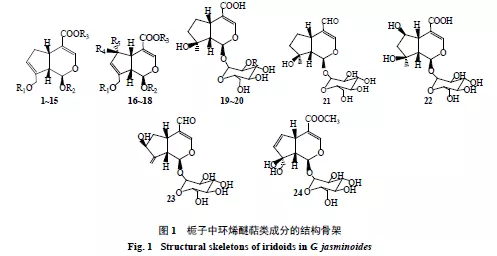
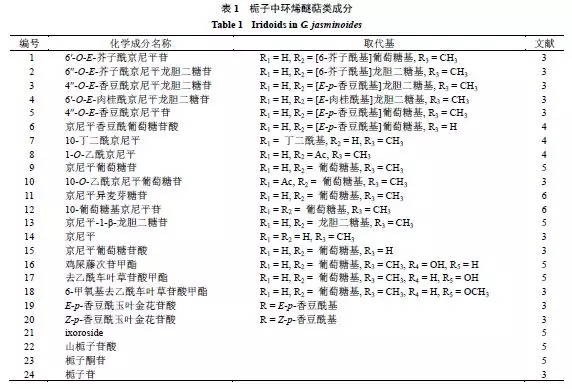
Iridoids are a class of monoterpene derivatives with cyclopentane, which mainly exist in Gardenia fruit in the form of glycosides.IridoidClass compounds mainly include4Types: iridoid alkanes, iridoid glycosides, iridoid diacetal esters, and schizoiridoid glycosides. The structural skeleton of iridoid components in Gardenia jasminoides is shown in Fig1See table for compound names and substituents1。
1.2 Monoterpene glycosides
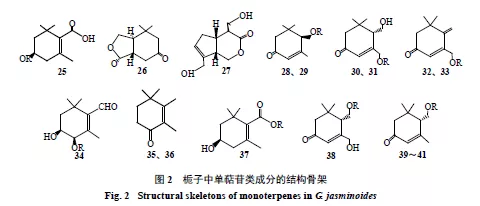
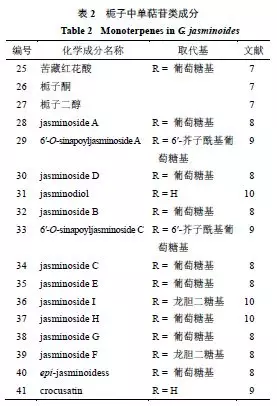
Gardenia containsMonoterpene glycosideMost of the compounds are monocyclic monoterpene glycosides, and the research on such components started from20century90In the s, it has been found in Gardenia10The chemical structure skeleton of more than monoterpene glycosides is shown in Fig2See table for compound names and substituents2。
1.3 Diterpenes
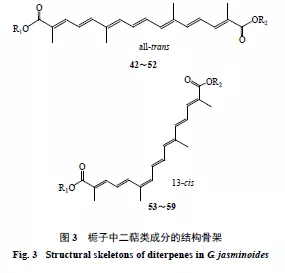
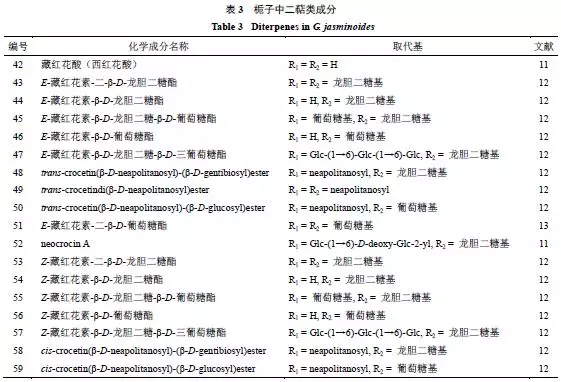
In the past ten years, many scholars have studied the effects of Gardenia jasminoides EllisDiterpenesAfter in-depth study of the constituents, it was found that the diterpenes in them were mainly pigments, including crocin (crocin) and its derivatives. See Fig3See table for compound names and substituents3。
1.4 Triterpenoids
Most of the triterpenoids in Gardenia are found in the stem bark and flowers of plants, and the triterpenoids in gardenia fruits have been reported to beTriterpenoidsThere are more than ten compounds, fuxiaomei et al[14]The triterpenoids of Gardenia jasminoides Ellis were isolated and purified by column chromatography and gel column chromatography, and their structures were identified according to the physicochemical properties and spectral data7Compounds were ursolic acid19α-hydroxyl-3-Acetylursolic acid, ironAspartic acidisotaraxeral、barbinervic acid、clethricacidandmyrianthic acid. zhangzhongli et al[15]Using various column chromatography methods to separate and purify gardenia, it was also found that4Three new compounds were Gardenia acetic acid3-acetyl-Gardenia formic acid3α-hydroxyl-Ursolic acid and ivy saponin.
1.5 Organic esters
Gardenia jasminoides Ellis is rich in organic ester compounds, of which chlorogenic acid is the most.Heetc.[16]adoptHPLC-DAD-MSMethods gardenia fruit was extracted and identified5(3-Caffeoylquinic acid), cryptochlorogenic acid(4-Caffeoylquinic acid), neochlorogenic acid(5-Caffeoyl quinineNiacin), isochlorogenic acid(4,5-Dicaffeoylquinic acid), quercetin-3-Rutinoside.
1.6 Other classes
In recent years, there have been few studies on flavonoids, polysaccharides and volatile oils in Gardenia jasminoides Ellis, Huang Xiao et al[17]adoptPlackett-burmanThe key factors affecting the extraction of total flavonoids from Gardenia jasminoides were designed and screened, and the content of total flavonoids was measured as3.23%Domestic scholars' research on Gardenia polysaccharide mostly stays on the extraction process, and the literature shows that the extraction amount of Gardenia polysaccharide is less than3%. Jili et al[18]utilizeGC-MSThe chemical components of volatile oil in Gardenia fruit were quantitatively analyzed, and the principal component was reverse,back-2,4Decadienoic acid, followed by linoleic acid and palmitic acid. Gardenia also contains various trace elements, such asCr、Mn、Fe、Ni、Zn、Cu、Ca、Pb、Sb、Sn、Bi、Ba、BeEt al.
2 pharmacological action
Modern pharmacological studies have shown that Gardenia jasminoides Ellis has certain activities in protecting the liver and gallbladder, reducing blood glucose, promoting pancreatic secretion, protecting gastric function, reducing blood pressure, regulating lipid, neuroprotection, anti-inflammatory, antioxidant, anti fatigue, antithrombotic and other aspects.
2.1 Hepatoprotective and choleretic effects
Chen Ming et al[19]The cholagogic effect of Gardenia extract and its effect onD-Galactosamine(D-GLaN)It was found that gardenia extract may inhibit the biosynthesis of uridine phosphate in animals by promoting the liver protection effect of induced acute liver injury model miceD-GLaN. Sunxuqun et al[20]Administration to ratsigGeniposide6 h, it was found that geniposide could increase the content of isothiocyanate in normal rats as well as-1-The amount of bile secretion in rats with naphthalene induced liver injury indicates that it has choleretic effect.Kangetc.[21]It was found that gardenia extract and geniposide could reduce the content ofP4503AImmune related protein density. Liyuanming[22]Gardenia extract was used to intervene the alcoholic liver injury model rats, and it was found that gardenia extract could make the serum cholesterol of model rats(TC), triacylglycerol(TG), alanine aminotransferase(ALT), aspartate aminotransferase(AST)Levels and malondialdehyde(MDA)Reduced content, glutathione peroxidase(GSH-Px)-α(TNF-α), interleukin-6(IL-6)TNF-αandIL-6It can promote fat metabolism and scavenge free radicals in liver tissue, so as to play a role in protecting liver.
According to relevant studies, the possible mechanisms of Gardenia's hepatoprotective and choleretic effects are ① reducing free radical generation and enhancing the ability to scavenge free radicals; ② α(PPARα)Expression; ③ It can prevent and treat hepatitis through its anti-inflammatory effect; ④ Promote the secretion and excretion of bile.
2.2 Hypoglycemic effect
Yaodongdong et al[23]utilizeC57BL/67Mice were treated with a single injection90 mg/kgStreptozotocin(STZ)Postbinding4The diabetic mouse model was established by feeding high-fat diet every week,Geniposidetreat30 dAfter treatment, the blood glucose level of mice in the treatment group decreased, while the plasma insulin level increased, and the oral glucose tolerance(OGTT)Improved, and promoted isletβCell proliferation, speculate its mechanism and promote isletβCell proliferation, activation of insulin receptor downstreamAktPathway related. Lihongzhuan et al[24]Objective to investigate the effect of long-term intake of Gardenia on blood glucose level, islet function and structure of normal rats. The results showed that the blood glucose and glycated hemoglobin of Gardenia group(HbA1C), insulin(INS)、CPeptides(C-P)The proliferation and hypertrophy of pancreatic islet tissue and the infiltration of inflammatory cells in Gardenia group suggested that gardenia could reduce the blood glucose level of rats, but long-term medication could damage the structure of pancreatic islets.
2.3 Promoting pancreatic secretion
Gardenia jasminoides Ellis and its extract have the effect of reducing pancreatic enzyme activity. Geniposide significantly reduced pancreatic amylase, while genipin, its enzymatic hydrolysate, had the strongest effect on increasing pancreatic and biliary flow for a short time[25]. wangyanlei et al[26]Effect of Gardenia jasminoides Ellis on pancreatic cell structure and function in severe acute pancreatitis and its relationship with nitric oxide(NO), endotoxin, oxygen free radical(OFR)It was found that after Gardenia treatment, amylaseNO, endotoxin, lipid peroxide(LPO)With lysosomesACP(SDH)P450Levels were significantly negatively correlated, indicating that gardenia can alleviateNO, endotoxinOFRDestruction of pancreatic cell structure and function. It is suggested that Gardenia jasminoides Ellis can prevent lipid peroxidation and protect the structure and function of pancreatic subcellular organelles by scavenging oxygen free radicals in pancreatic subcellular organelles during severe acute pancreatitis[27]。
2.4 Effect on gastric function and diarrhea
Ju Jing[28]Total Gardenia glycosides were studied(TGZ)The effect on gastric ulcer in pylorus ligation model rats and the mechanism of its anti ulcer effect were preliminarily discussedig TGZ 70or140mg/kg 5 dIt can significantly inhibit the occurrence of gastric ulcer in rats with pylorus ligation, inhibit the amount of gastric juice, reduce the free acidity and total acidity in gastric juice, and effectively reduce the pepsin activity in gastric juice. Ma Yan et al[29]Studied theTGZThe protective effect of low-dose aspirin on gastric mucosal injury in rats was foundTGZAfter administration, the gastric mucosal injury index of rats was significantly lower than that of the model group, and the local blood flow of gastric mucosa was increased. At the same time, it could reduce the infiltration of inflammatory cells in gastric tissue, and significantly improve the histopathological changes of gastric mucosa, indicating thatTGZIt has obvious protective effect on gastric mucosal injury. Lifeiyan et al[30]The purgative effect of Gardenia jasminoides Ellis and its effect on gastrointestinal motility in mice were studied. The results showed that the time for mice in each group to excrete loose stools for the first time was significantly reduced when the dose of Gardenia jasminoides Ellis was greater than the clinical equivalent dose,6 hCompared with the blank group, the gastric emptying rate and intestinal propulsion rate of Gardenia were significantly reduced, gardenia had a significant diarrhea effect, and taking for a long time had an inhibitory effect on gastrointestinal motility.
2.5 step-down、Lipid regulating effect
Gardenia Decoction and alcohol extract have antihypertensive effect. Intravenous administration of Gardenia extract can reduce blood pressure rapidly and maintain it for a short time. The current research results show that the antihypertensive effect of Gardenia jasminoides Ellis is located in the center, which is mainly caused by strengthening the excitability of the parasympathetic center of the medulla oblongata[31]。
Xiezhixin et al[32]The effect of Gardenia Formula Granule on blood lipid and liver toxicity in normal Kunming mice was studied. The results showed that compared with the blank group, the effect of each dose group of Gardenia Formula Granule on blood lipid and liver toxicity was significantly differentTGWere significantly reduced,16 g/kgThe body length of mice in Gardenia group was significantly increased,Lee’sThe liver index andASTThe content of Gardenia jasminoides Ellis was significantly increased, the liver cells were obviously swollen and necrotic, and the inflammatory cells were infiltrated, indicating that Gardenia jasminoides Ellis has a significant reduction in serumTGEffect, but onTCThe effect is not significant. Long term low-dose administration of Gardenia has no effect on the liver, but long-term high-dose administration is prone to cause liver toxicity. Shenyi et al[33]It was also found that gardenia decoction could significantly reduce the body weight and serum of hyperlipidemic miceTC、TGAnd low-density lipoprotein cholesterol(LDL-C)Content, significantly increased HDL cholesterol(HDL-C)Content, which proves that gardenia water decoction has the effect of regulating blood lipid metabolism.
2.6 Neuroprotection
Geniposide can significantly increase the injectionβAmyloid protein(Aβ)QuasiADThe rat model inYLearning and memory ability in maze, further inAPPV717i ADIn the transgenic mouse model, geniposide was again verified to increaseAPP/PSImiceAC1Area dendritic spine density, indicating that geniposide has a significant effect onAPP/PSIThe pathological changes of dendritic spine loss in transgenic mice are ameliorative[34]。
Haowenyu et al[35](NeuN)Elevated positive expression5-Bromodeoxyuridine(BrdU)The area number density of positive cells also increased significantly, suggesting that the crude extract of Gardenia jasminoides Ellis can significantly improve the behavior of depression model mice, and can significantly promote neurogenesis in the hippocampus.Aminetc.[36]Studies have shown that crocin in Gardenia jasminoides Ellis at higher doses(40 mg/kg)It showed good antidepressant effect.
2.7 anti-inflammatory effect
Fuetc.[37]Using lipopolysaccharide in vitro(LPS)Stimulated mouse macrophage model and in vivoLPSThe anti-inflammatory effect of Geniposide was studied in a lung injury model, and the results showed that geniposide could significantly inhibit the in vivo and in vitroLPSinduceTNF-α、IL-6andIL-1βCan also block the production ofLPSStimulating mouse macrophage nuclear factor-κBinhibitory factorα(IκBα)、p65、p38、ERKandJNKPhosphorylation of; In the in vivo experiment in mice, geniposide could attenuate the pathological changes in the lungs, and the results showed that geniposide could up regulateTollLike receptor4(TLR4)It is very effective in inhibiting acute lung injury and may become an effective drug for the treatment of acute lung injury.Oliveiraetc.[38]The effect of crocin in Gardenia jasminoides Ellis on cancer cells was studied. The results showed that crocin could inhibit the proliferation of malignant tumor cells, and the mechanism and downregulationIL-1andTNF-αIs related to the expression of.
2.8 Antioxidant effect
Chenetc.[39]It is proved that in the fruit of Gardenia jasminoides EllisSaffronAnd geniposide can scavenge free radicalsDPPH, which has antioxidant effects. Suwenzhao et al[40]Comparative study of GardeniagardecinCompared with the antioxidant activity of crocin with different structures, in4,gardecinHalf inhibitory concentration of(IC50),gardecinIt has stronger antioxidant activity than crocin, and the sugar group in the structure of crocin is conducive to the exertion of antioxidant activity.
2.9 Anti fatigue effect
Maoting et al[41]The results showed that gardenia yellow pigment could prolong the anti hypoxia time of mice under atmospheric pressure, and had significant difference compared with the model group; .
2.10 Antithrombotic effect
Zhangetc.[42]The antithrombotic effect of Gardenia water extract was studied by using rat and mouse models. The results showed that gardenia water extract and aspirin could shorten the length of tail thrombus in rats and mice in a concentration dependent manner, and could also improve the thrombus caused by arterial and venous ligation. Zhang Haiyan[43]Studies have found that geniposide can reduce the dry and wet mass of thrombus in arteriovenous thrombosis model, inhibitFeCl3Induced carotid thrombosis in rats; At the same time, it can reduce the whole blood viscosity, inhibit the release of endothelin, reduce the content of thromboxane, and increase prostaglandinFlα(ADP)Induced platelet aggregation, indicating that geniposide may play its antithrombotic role by inhibiting platelet aggregation.
Wang Xin et al[44]The antithrombotic effect of Gardenia water extract was evaluated by several classical animal models at the same time. The results showed that each dose group of Gardenia water extract could prolong the bleeding time, coagulation time and plasma recalcification time of mice; ; Gardenia extract in each dose group can prolong the thrombin time, and can significantly reduce the incidence of arterial venous bypass thrombosis model andFeCl3Cause thrombus quality of carotid artery model and reduceADPThe maximum aggregation rate of induced platelet aggregation and the inhibition of platelet aggregation suggest that the antithrombotic mechanism of Gardenia jasminoides Ellis is related to the endogenous coagulation system and the coagulation process3Stage is related to platelet function.
3 Gardenia quality marker(Q-marker)Prediction analysis of
Q-markerIt is a new concept of quality control of traditional Chinese medicine proposed by academician liuchangxiao, which refers to the chemical substances that are inherent in traditional Chinese medicine and traditional Chinese medicine products (traditional Chinese medicine decoction pieces, traditional Chinese medicine decoction, traditional Chinese medicine extract, traditional Chinese medicine preparations, etc.) or formed in the process of processing and preparation, and are closely related to the functional attributes of traditional Chinese medicine. It is used as a marker to reflect the safety and effectiveness of traditional Chinese medicine for quality control[45-46]Objective and scientific evaluation of Gardenia quality and prediction of Gardenia quality marker are conducive to the establishment of scientific quality control methods of Gardenia.
3.1 Based on the evidence of plant phylogeny and chemical composition specificityQ-markerPredictive analysis
Gardenia plants around the world250. Gardenia plants in China have5species1variety[47]Gardenia contains a variety of chemical components, among which iridoid compounds are considered to be the main effective components of Gardenia plants and important chemical markers of Gardenia plants. 30Species, and the iridoid constituents with systematic taxonomic value include geniposide, hydroxyisogeniposide, and genipin- 1-β-Gentiobioside et al. Geniposide is a representative iridoid compound of Gardenia plants. Fuxiaomei et al[48]right22Batch of Gardenia herbs10The content of the main active ingredients was determined, of which10The main active ingredients are7Three are iridoid compounds with different structural types. The distribution of iridoid compounds with different structural types in various groups can reflect the genetic relationship and evolution status among these populations, so they can be used as medicinal plants of GardeniaQ-markerImportant references for screening.
3.2 Traditional efficacy basedQ-markerPredictive analysis
Gardenia was first recorded in Shennong materia medica classic, which has the effects of purging fire, clearing heat and dampness, cooling blood and detoxifying[1]Modern pharmacological research shows that gardenia iridoid components such as geniposide have cholagogic and hepatoprotective effects, anti-inflammatory, hypoglycemic, antioxidant, anti fatigue, antithrombotic, hypotensive, lipid-lowering and other effects; Gardenia diterpenes such as crocin and crocetin have neuroprotective, pancreatic secretion promoting, antioxidant, anti fatigue, antithrombotic and other effects. These chemical components correspond to the traditional efficacy of gardenia, which is the main material basis of the traditional efficacy of gardenia, and can be used as an important basis for the quality marker screening of Gardenia.
3.3 Based on new pharmacodynamic usesQ-markerPredictive analysis
In modern clinical application, gardenia is often used to treat depression. For example, zhizichi decoction has significant curative effect on depression. Its antidepressant effect may be through increasing adenosine cyclophosphate effector element binding protein and brain-derived neurotrophic factor in the hippocampus(BDNF)And vascular growth factor levels to produce antidepressant effects.Vahdatietc.[49]It was confirmed that crocetin, a diterpenoid in Gardenia jasminoides, can increase the expression of adenosine cyclophosphate effector element binding proteinBDNFAnd vascular growth factor levels to produce antidepressant effects. Studies have shown that diterpenes in Gardenia are related to the treatment of depression with gardenia, and diterpenes should be regarded as GardeniaQ-markerImportant references for.
3.4 Testability Based on chemical compositionQ-markerPredictive analysis
The measurability of chemical composition is alsoQ-markerImportant basis for determination. At present, the chemical components of traditional Chinese medicine are mainly analyzed and determined by chromatographyQ-markerIt must be able to carry out qualitative identification and quantitative determination on chromatography, so as to facilitate the establishment of quality evaluation methods and the formulation of scientific and feasible quality standards.
According to the above analysis, iridoids, monoterpene glycosides, diterpenes, triterpenes and organic esters are Gardenia jasminoidesQ-markerImportant choice. -The effect relationship is fuzzy, and at present, there is a lack of exclusive content determination method, so it is relatively difficult to study. . Many scholars have studied some chemical constituents of Gardenia jasminoides, such as geniposide and genipin, which are iridoids-1-β-D-Geniposide, geniposide, etc; Crocetin of diterpenesE- andZ-Saffron- β-D-Gentian disaccharide-β-D-Glucose esterE- andZ-Saffron-β- D-Gentian disaccharide ester, etc; 19α-hydroxyl-3-Acetylursolic acid, iron aspartic acid, etc; Chlorogenic acid and cryptochlorogenic acid of organic esters. .
3.5 Based on traditional medicineQ-markerPredictive analysis
The nature, taste and meridian tropism of traditional Chinese medicine is the basic attribute of traditional Chinese medicine, and it is also an important basis for clinical treatment and prescription...The main content of this paper is as follows:the main content of this paper is as follows:the main content of this paper is as follows:the main content of this paper is to analyze the characteristics. Gardenia has bitter taste and cold nature. It can return to the heart, lungs and triple energizer meridians. According to the theory of traditional Chinese medicine properties, the material basis of "bitter taste" should first have bitter taste characteristics; At the same time, it should also have the functional attribute of "bitter taste". Yanyongqing et al[50]research460According to the chemical constituents of commonly used bitter traditional Chinese medicines, it was found that alkaloids in bitter traditional Chinese medicines accounted for the majority, followed by terpenoids and glycosides. According to the above analysis, iridoids, monoterpenes, diterpenes and triterpenes in Gardenia jasminoides should be the main material basis of its "bitter taste" and should be taken as Gardenia jasminoidesQ-markerImportant references for selection.
3.6 Based on the chemical composition of bloodQ-markerPredictive analysis
Although the chemical composition of traditional Chinese medicine is very complex, the chemical components must be absorbed into the blood and reach a certain blood concentration in the body before they can exert pharmacological effects directly or indirectly. Through the analysis of the prototype components and their metabolites, based on the compound-Target-Pathway to analyze its effective way, and the tissue distribution of blood components combined with the disease site and drug intervention method, as a screening method of Gardenia jasminoides EllisQ-markerImportant criteria.
Longzhimin[51]The in vivo and in vitro samples of zhizichi Decoction were analyzed, and it was found that after oral administration of zhizichi decoction, the24The structures of the blood components were deduced. Among them, geniposide, gardeniac acid, saikoside methyl ester and hydroxyisogeniposide belong to15Prototype ingredients, which can be used to screen GardeniaQ-markerImportant references for.
3.7 Based on the change of chemical composition content in different storage timeQ-markerPredictive analysis
The clinical efficacy of traditional Chinese medicine is closely related to its quality. Traditional Chinese medicine often needs to be stored from harvest and processing to clinical application. Therefore, it is also very important to monitor the dynamic changes of components during storage. Zhaochengcheng[52]It was found that the content of Geniposide gradually decreased with the extension of storage time, indicating that the storage time had a certain impact on the quality of Gardenia. Geniposide should be used to screen Gardenia jasminoides based on different storage timeQ-markerImportant references for.
4 epilogue
China's traditional Chinese medicine is broad and profound, and the formulation of quality standards of traditional Chinese medicine is also a process of continuous revision and improvement. With the development of modern science and technology, traditional Chinese MedicineQ-markerThe research path and referential modes and methods are becoming more and more perfect. It is of great significance for the healthy development of Gardenia industry to comprehensively and accurately evaluate the quality of Gardenia and guide the rational utilization of Gardenia resources.
Based on the review of its chemical constituents and pharmacological effects, combined withQ-markerAccording to the chemical composition of Gardenia jasminoides Ellis, the relevance of new clinical uses, measurable components, traditional medicinal efficacy, blood components and storage timeQ-markerThe systematic literature analysis and argumentation were carried out to screen and determine. Later, this research group will base on GardeniaQ-markerThe quality of Gardenia jasminoides Ellis was further studied by the prediction analysis ofQ-markerIn order to establish the quality control and quality traceability system of Gardenia jasminoides Ellis, a feasible quality analysis and evaluation method was established.
References (omitted)
Come Source: Shi Yongping, Kong Haotian, lihaonan, Lixiaobin, Zhang Yun, hanliwen, tianqingping, liukechun Research Progress on chemical constituents and pharmacological effects of Gardenia jasminoides Ellis and quality marker prediction analysis [j]. Chinese herbal medicine, 2019, 50 (2): 281-289